 TD
TD
Key Takeaways
- A scanner checks whether a term is present; a human checks whether you were any good at it. Only one of those is scored.
- The signature of the problem is bullets full of correct keywords and empty of outcomes.
- Four weak patterns account for most of it: duty statements, tool lists, vague scale, and process descriptions with no result.
- Fixing this rarely changes your score and frequently changes your callback rate.
- The diagnostic question for every bullet is "so what?"
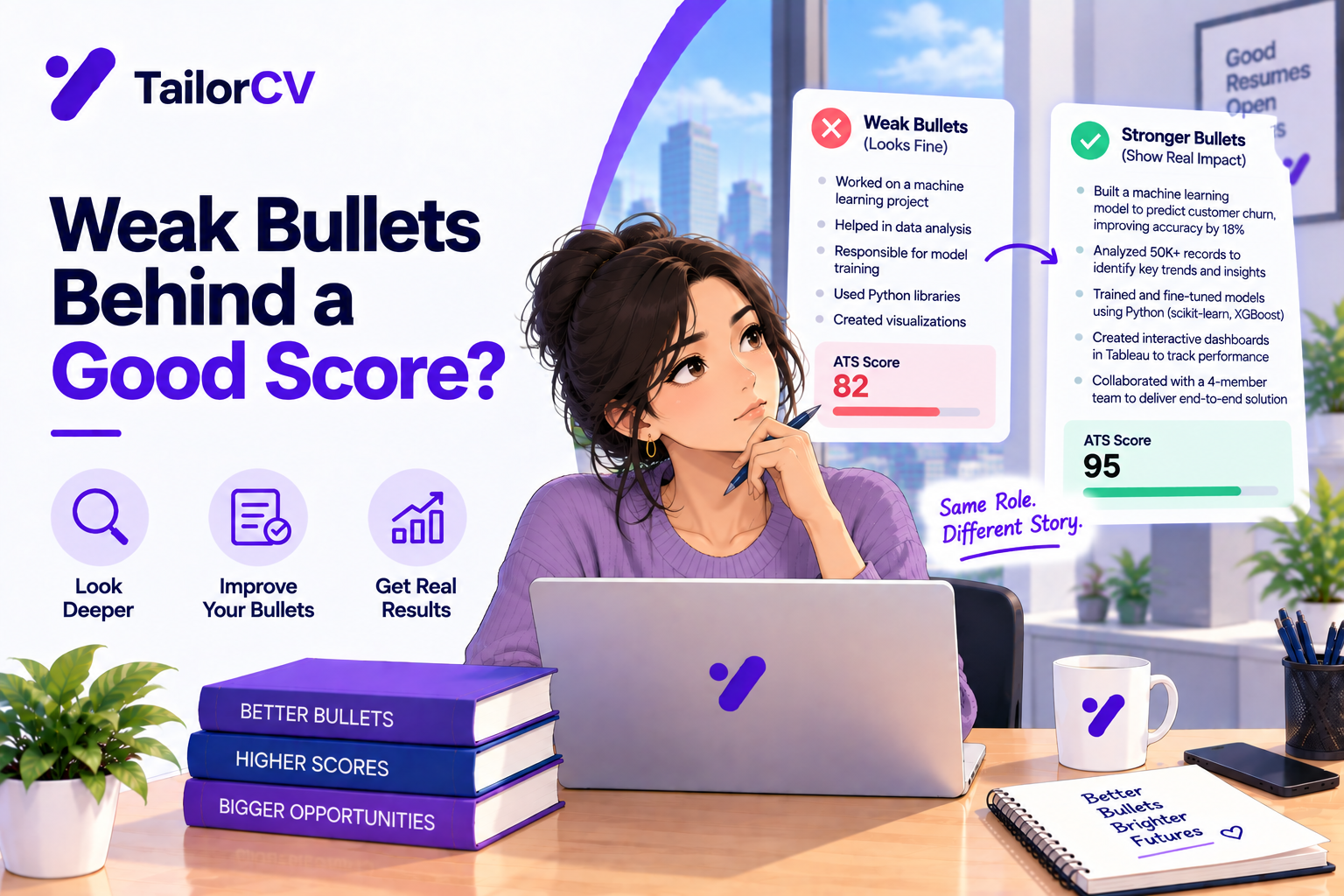
You can build a resume that scores in the mid-eighties and tells a hiring manager almost nothing.
That is not a flaw in scanners so much as a limit on what they measure. Keyword coverage is a proxy for relevance. It is not a proxy for competence, and the reader who decides your application is looking for the second thing.
What the Scanner Cannot Assess
A scanner can confirm that "stakeholder management" appears in your resume. It cannot assess whether you managed two stakeholders or twenty, whether the outcome was good, whether you led the work or attended the meetings, or whether the sentence would impress anyone who does that job.
Those are exactly the judgments a hiring manager makes in the seven seconds after the scan is irrelevant.
So a high score with weak bullets means: legible, relevant, unconvincing. That combination produces the specific pattern of never being rejected outright and never being called.
The Four Weak Patterns
1. The duty statement
Describes the job rather than your performance in it.
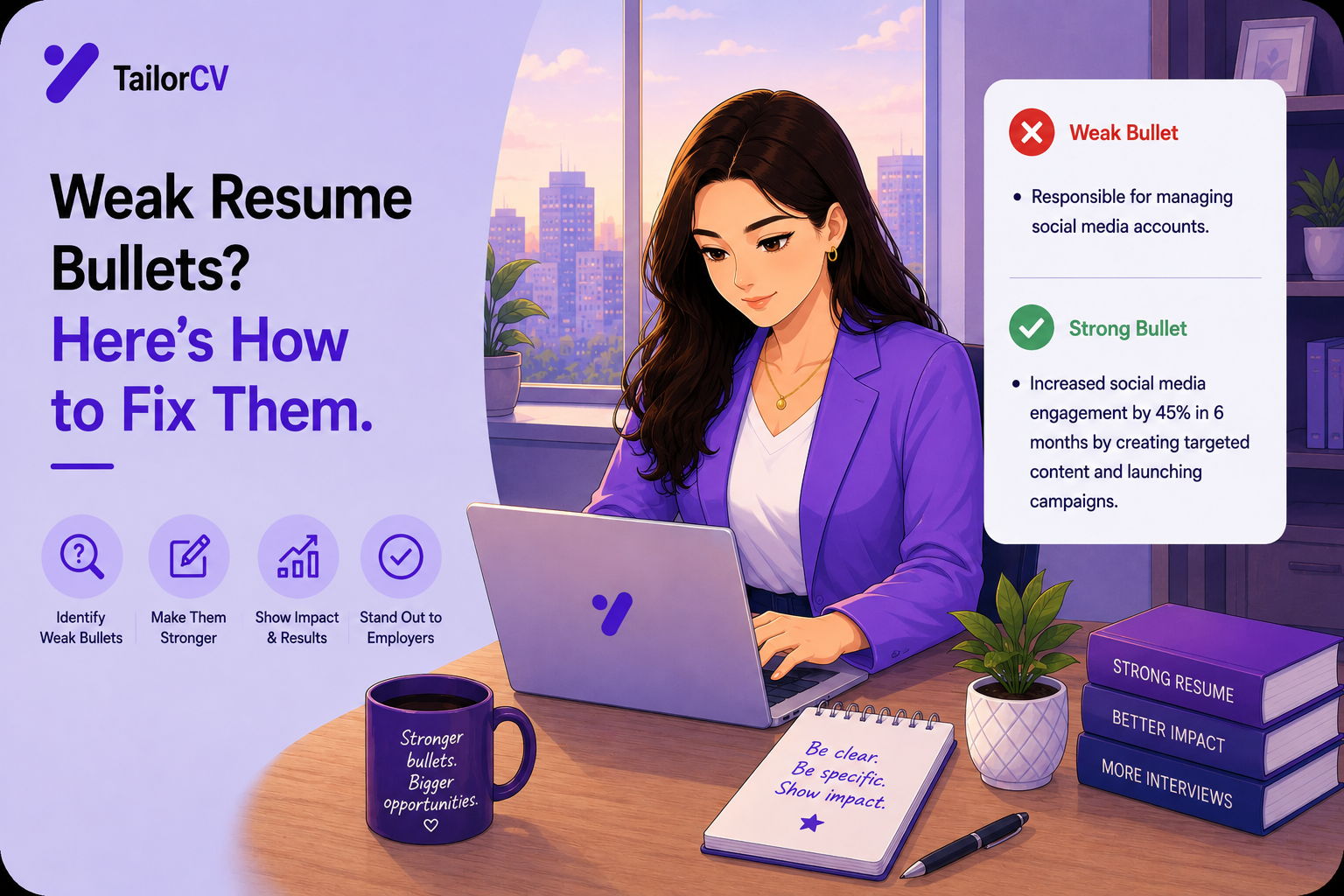
Weak: Responsible for managing the weekly sales reporting process and communicating results to stakeholders.
Strong: Rebuilt weekly sales reporting from four manual spreadsheets into one automated dashboard, cutting turnaround from two days to 40 minutes and removing a recurring source of month-end errors.
Both contain the keywords. The first describes the role's job description; the second describes what changed because you were there.
2. The tool list disguised as a bullet
Names technologies without saying what you did with them.
Weak: Utilised Python, SQL, Airflow, dbt and Snowflake in a fast-paced data environment.
Strong: Built the nightly ingestion pipeline in Python and Airflow, loading 40 source tables into Snowflake and cutting data-freshness lag from 12 hours to 45 minutes.
The first scores marginally better - more terms in less space. The second is the only one that tells a reader you can actually build something.
3. Vague scale
Uses words that sound quantitative and commit to nothing.
Weak: Managed multiple large-scale projects for various key clients, significantly improving efficiency.
Strong: Managed six concurrent implementation projects for three enterprise clients, reducing average delivery time from 14 weeks to nine.
"Multiple," "various," "significant," "large-scale" and "key" are all placeholders where a number should be. Readers discount them automatically, because anyone can write them.
4. Process with no outcome
Describes activity accurately and stops before the point.
Weak: Conducted user interviews, synthesised findings, and presented recommendations to the product team.
Strong: Ran 18 user interviews that identified onboarding drop-off as the main churn driver; the resulting flow change lifted week-one retention from 41% to 58%.
The first is a description of a research process. The second is a description of a result. Only one of them makes the case that hiring you was worth it.
The Test
For every bullet on your resume, read it and ask: so what?
If the bullet does not answer that - if there is no outcome, no number, no change, no consequence - it is a duty, and it is doing very little work for you regardless of its keyword content.
Apply this to your top five bullets first. Those are the ones that get read.
Why This Is Hard
Two real obstacles, worth naming because "just add metrics" is unhelpful advice when you cannot.
You may not have the numbers. Plenty of work is never measured. The fix is not invention - it is stating the change qualitatively and precisely. "Removed a recurring source of month-end errors" is a real outcome without a metric.
The work may have been collective. Most work is. Claim your part accurately: "led," "owned," "contributed to," "supported" all mean different things, and using the right one is more credible than inflating.
Both constraints leave plenty of room for bullets that answer "so what?"
Where the Effort Belongs
Once your score is in a reasonable range, additional keyword work has close to zero return. Bullet quality has a high one, because it affects the decision that actually determines your outcome.
A practical split: get the score to a workable level with one tailoring pass, then spend the remaining time on the top five bullets. That allocation produces better results than another hour of keyword optimisation ever will.
Adding numbers is the fastest way to strengthen these bullets; estimating impact honestly covers how when you do not have exact data.
Frequently Asked Questions
Will rewriting bullets lower my score? Sometimes slightly, because stronger bullets are often longer and the relevant proportion shifts. It is a trade worth making.
How many bullets need to be strong? Your first two or three under your most recent role, plus your single best achievement wherever it sits. Those get read; later bullets are skimmed.
What if none of my work had measurable outcomes? Describe the change rather than the metric. "Cut the approval step from three signatures to one" is concrete without a percentage.
Is it enough to add numbers to my existing bullets? Usually not on its own. A duty statement with a number attached is still a duty statement - the structure needs to move from activity to result.
How long should a strong bullet be? One to two lines. Long enough for action, scale and outcome; short enough to be read in the first pass.
Fix the Part That Decides It
The scanner stage is solvable with one pass. The persuasion stage takes actual rewriting, and it is where the callbacks come from.
If you want to check the first is genuinely handled before you move on, scan your resume against a posting — then close the report and spend your time on whether each of your top bullets answers "so what?"
Related: turning duties into achievements and high score but no interviews.
What is your resume scoring right now?
Scan it against a job description and get your ATS match score in about a minute.
Drop your resume here or choose a file
PDF only. Max 2 MB.
We never share your data or use it to train AI models.

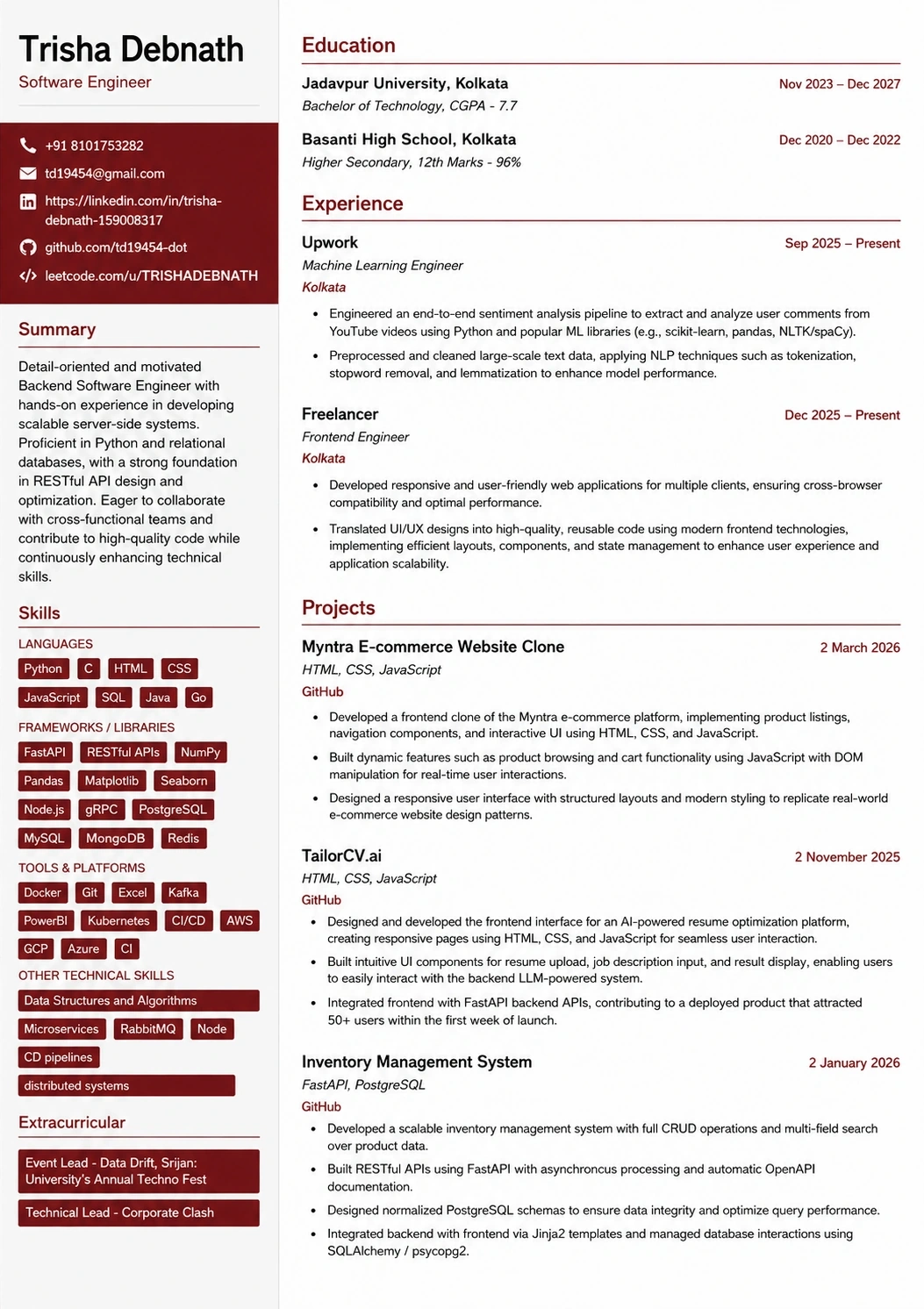
Templates that keep this structure intact
This template is ATS-tested — start from it and the formatting rules in this guide are already handled.
Was this guide useful?
Be the first to rate it.