 TD
TD

Key Takeaways
- A term inside a described achievement is worth more than the same term in a list - to scanners that weight context, and to every human reader.
- The placement hierarchy runs: job title line, experience bullets, skills section, summary, then everything else.
- The top third of page one carries disproportionate weight because that is what a recruiter reads first.
- A skill that appears only in your skills section and nowhere in your history reads as unevidenced.
- Never place terms in headers, footers, text boxes or graphics - they frequently do not arrive at all.
Most advice about keywords stops at "include them." Where you put them changes how much they are worth, and the difference is large enough to matter on a competitive posting.
The Placement Hierarchy
Six tiers, strongest first. The gap between the top and the bottom is larger than most people assume - it is the difference between a term that decides your ranking and one that never arrives.
The top two tiers: title and bullets
1. The job title line. The strongest position on the resume. A title matching or closely resembling the posting's title is the single highest-weight signal, for scanners and humans alike.
You cannot invent a title you did not hold. You can accurately clarify one - more on that below.
2. Inside experience bullets. The most valuable placement you fully control. A term here comes with proof attached: what you did with it, at what scale, to what effect.
These two tiers are where a competitive application is won. If the posting's central requirements do not appear here, they are not really covered however many times they appear elsewhere.
The middle tiers: skills and summary
3. The skills section. Useful and expected, but weaker. It asserts without evidencing. Its real job is coverage for terms already demonstrated elsewhere, and what to list and what to cut is mostly a question of what you can defend.
4. The summary. High visibility because it sits at the top, moderate weight because it is self-description. Best used for the two or three terms the posting repeats most.
The bottom tiers: supporting sections and dead zones
5. Education, certifications, projects. Genuine placements for genuinely relevant terms, lower weight for most roles - though projects carry real weight for career changers and early-career applicants.
6. Headers, footers, text boxes, graphics. Effectively zero. Often literally zero, because the text never arrives.
The hierarchy in one table
| Placement | Scanner weight | Human weight | Best used for |
|---|---|---|---|
| Job title line | Highest | Highest | Role match, clarified internal titles |
| First two bullets, current role | High | Highest | The posting's top two requirements |
| Later bullets, current role | High | Medium | Secondary requirements with evidence |
| First bullet, previous role | High | Medium | Evidence your current role lacks |
| Skills section | Medium | Low-medium | Coverage for demonstrated terms |
| Summary | Medium | Medium | Two or three central terms, framed |
| Projects | Medium | High for juniors | Tools with no professional history |
| Certifications | Medium | High when required | Named credentials the posting demands |
| Education | Low | Low after 3 years | Degree requirements, relevant modules |
| Older roles, page two | Low | Very low | Context only |
| Headers and footers | Near zero | Zero | Nothing - move it into the body |
| Text boxes and graphics | Zero | Zero | Nothing - retype as body text |
The two columns rarely disagree, which is the useful part: optimising placement for the scanner generally improves the document for the human too.
Why Evidenced Placement Wins
Consider the same skill placed two ways.
Skills-only: Skills: Python, SQL, dbt, Airflow, Snowflake
Evidenced: Built the nightly ingestion pipeline in Python and Airflow, loading 40 source tables into Snowflake and cutting the data-freshness lag from 12 hours to 45 minutes.
The first asserts five things. The second proves three of them and tells the reader the scale you worked at.
Both can coexist - the skills line for coverage, the bullet for proof. What does not work is the first without the second. A skills section listing fifteen technologies that appear nowhere in the work history is the most common pattern recruiters read as padding.
What "context weighting" actually means
Systems that weight context are not doing anything mysterious. They look at whether a term sits inside a sentence describing work, near a verb and an outcome, or whether it sits alone in a delimited list.
The first pattern is evidence of use. The second is evidence of a claim. Sensible weighting treats them differently, which is the mechanical reason coverage beats stuffing even before a human sees the page.
The Top-Third Rule
Independently of section, position on the page matters because of how the first read works. A recruiter's initial pass covers roughly the top third of page one: your name, title, summary, and the first bullets of your most recent role.
Whatever the posting cares about most should appear in that space.
This is a reordering job, not a writing job. If your most relevant achievement is the fifth bullet of your current role, move it to first. If it belongs to an older role, name the capability in your summary so it appears early even though the detail sits lower.
The fifteen-second reordering pass
Before rewriting anything, do this:
1. Identify the posting's top two requirements from the title and opening paragraph.
2. Find your strongest evidence for each, anywhere in your history.
3. Move it up. Within its role if it is buried; into the summary as a named capability if it sits in an older job.
That is the highest-return edit available per application, and it changes no words at all. Choosing which bullets to rewrite starts with exactly this check, because a large share of tailoring problems are ordering problems.
The Job Title Problem
Your title carries the most weight and is the one thing you cannot change. But internal titles are often unrecognisable outside the company, and that costs you real matches.
The honest fix is clarification, not substitution:
Internal title only: Business Partner II
Clarified: Business Partner II (HR Business Partner)
Also acceptable: HR Business Partner (internal title: Business Partner II)
You have not claimed a job you did not hold. You have translated an internal label into the market's language, which is what the reader needs. Inventing a more senior title is a different thing and will surface in reference checks.
When the title still undersells you
Sometimes the accurate market title understates the job because your scope was broader than the label. Add a scope line rather than inflating the title:
Operations Coordinator — 3 workflows, £180k budget, 2 direct reports
The title stays verifiable and the scope does the persuading, which is more convincing anyway because it is specific. The full treatment is in fixing a non-standard job title.
A Before and After
The same experience, placed badly and placed well. The posting asks for stakeholder management, process improvement and data analysis.
Before: Summary: Hard-working professional seeking a challenging role. Skills: stakeholder management, process improvement, data analysis, Excel, communication Experience - Operations Coordinator: Responsible for various reporting duties and supporting the team.
Every term is present. Nothing is evidenced, and the summary wastes the most valuable lines on the page.
After: Summary: Operations coordinator with four years in process improvement and stakeholder management across finance and supply chain. Skills: Data analysis (SQL, Excel), process mapping, stakeholder management, KPI reporting Experience - Operations Coordinator: Led process improvement across three finance workflows, cutting month-end close from nine days to five. Managed stakeholders across four departments through the rollout.
Same person, same job, same truth. Every central term now appears in a high-weight position with proof attached.
A Second Example: The Engineer With Buried Evidence
The operations case is a rewriting problem. This one is purely placement - nothing is badly written, everything is in the wrong place.
A backend engineer applying for a platform role. The posting's opening paragraph names Kubernetes, CI/CD and reliability.
Current role, as written: - Maintained REST APIs for the customer-facing product - Participated in on-call rotation - Wrote unit and integration tests for new features - Migrated the deployment pipeline to Kubernetes, cutting deploy time from 40 minutes to four and enabling same-day rollbacks - Attended architecture review meetings
The fourth bullet is the entire application and it is in fourth position, below "participated in on-call rotation." On a first pass it is never read.
Reordered: - Migrated the deployment pipeline to Kubernetes, cutting deploy time from 40 minutes to four and enabling same-day rollbacks - Owned reliability for the customer-facing API tier, including on-call response and incident follow-up - Maintained REST APIs and their test coverage across unit and integration suites
One bullet moved, two merged and reframed, one dropped. No new facts. The posting's three central terms now appear in the top third of page one attached to outcomes - and the total edit took under three minutes.
Placement Mistakes to Avoid
Contact details in the page header. The most common way to lose a phone number. Put them in the body.
A keyword block at the bottom. A list of terms appended under "Additional Keywords" fools nobody and looks like what it is.
Terms only in a graphic or skills chart. Text inside an image does not exist as far as a parser is concerned.
Stuffing the summary. The top of the page is your highest-value space. Spending it on a list rather than a claim about what you do is a waste.
The placements that silently vanish
Several of these are not weak placements but absent ones - the text never reaches the reader at all.
Headers, footers, text boxes, sidebars built as separate frames, and anything inside an image can all be dropped entirely during extraction. You cannot see this from the page, which is why the copy-paste test is worth thirty seconds before any keyword work.
If a whole section can disappear, so can an entire job, and no amount of placement strategy survives that.
Edge Cases
You have a skills-first resume
Putting skills above experience is legitimate for career changers and early-career applicants, because it puts relevant capability in the top third before a less-relevant history. Section order is one of the few structural choices worth varying by situation.
It does not change the hierarchy. The terms still need evidence below, or the section reads as a list of aspirations - and an unevidenced skills list is the pattern recruiters read fastest.
Your dates or title line did not parse
Placement assumes the structure survives extraction. If your dates detach from their roles, the system computes your experience wrongly and no placement decision compensates.
Employment dates parsing wrong is worth ruling out before optimising anything above it, because it changes what the reader sees about your seniority rather than your keywords.
Your most relevant work was a side project
Projects carry real weight for juniors and changers, and near-zero for senior candidates with a long professional history.
If it is your strongest evidence, give it a proper entry with scale and outcome rather than a line in a list. Side projects earn their place when they are described like work.
The posting's central term genuinely belongs in your education
Relevant modules, a dissertation topic, or a named methodology from a degree are fair placements early in a career. State them concretely rather than listing course titles.
After about three years of experience this placement stops carrying weight.
You are applying to a company with no scanner
Small employers frequently read every application. Placement still matters, because the top-third rule is about human attention rather than parsing.
The hierarchy barely changes; only the mechanism does.
Two pages, and the relevant work is on page two
On a first pass, page two effectively does not exist. Either surface the capability in your summary, or reconsider whether the resume should be two pages at all for this application.
What This Looks Like at Each Level
Fresher. Skills and projects sit high, because the experience section cannot carry the terms yet. Every skill needs a project, module or placement behind it.
Two to five years. Experience bullets take over as the primary placement. The skills section shifts to a coverage role for terms already demonstrated.
Senior. The title line and the scope of described systems do most of the work. A senior resume leading with a technology list reads as someone describing proximity rather than ownership, which is a common reason strong candidates get no response despite good coverage.
Career changer. Summary and projects carry disproportionate weight, because they are where the translation happens. The history below supplies evidence in the destination field's vocabulary, and bridging two fields is largely a placement exercise.
Frequently Asked Questions
Is the skills section pointless then?
No - it provides fast coverage and recruiters do scan it. It is just weaker than evidenced placement, so it should support your bullets rather than substitute for them.
Should every skill in my skills section appear in a bullet too?
The important ones should. Peripheral tools can sit in the list alone, but anything central to the role needs evidence somewhere.
Does a keyword in my summary count as much as in a bullet?
It gets high visibility and lower credibility, because a summary is self-description. Use it for the two or three terms that matter most.
Can I put a skills section above my experience?
Yes, and for career changers and early-career applicants that often helps - it puts relevant capability in the top third before a less-relevant job history.
What about a keywords line in white text?
Never. It is detected, it reads as deception when found, and it gets applications discarded outright.
Does bolding a keyword make it count for more?
Not to a scanner - formatting is stripped during extraction. It can help the human eye land on it during a skim, so use it sparingly on genuinely central terms.
Where should certifications go?
Their own section with issuer and date. A certification buried in a skills list loses the credibility that the issuer and date provide.
Should the same term appear in both skills and a bullet?
For central requirements, yes - once in each. That is coverage plus evidence. Beyond two placements the repetition starts to read oddly.
Does placement matter on LinkedIn too?
Yes, and differently: LinkedIn's headline and skills section feed recruiter search directly, so they carry more weight there than the equivalent resume sections do.
My resume is one page and everything is in the top third. Does this still apply?
The hierarchy does - title line and evidenced bullets still outrank the skills list. The top-third rule matters less, which is one of the quiet advantages of a well-edited single page.
See Where Your Terms Landed
Placement is easier to judge from outside the document. The useful check is whether the posting's central terms appear in high-weight positions, or only in your skills list.
Scan your resume against a posting and look at what was found - then check where those terms actually live on your page, and move the important ones up. Most of the gain here comes from reordering rather than rewriting, so it is quick.
If you want the reordering and rewriting drafted against the posting directly, the tailoring tool works from the same comparison.
Related: how many keywords a resume needs and which three bullets to rewrite.
See which keywords you are missing
Scan your resume against the posting and get the exact terms it did not find.
Drop your resume here or choose a file
PDF only. Max 2 MB.
We never share your data or use it to train AI models.

Where those keywords actually go
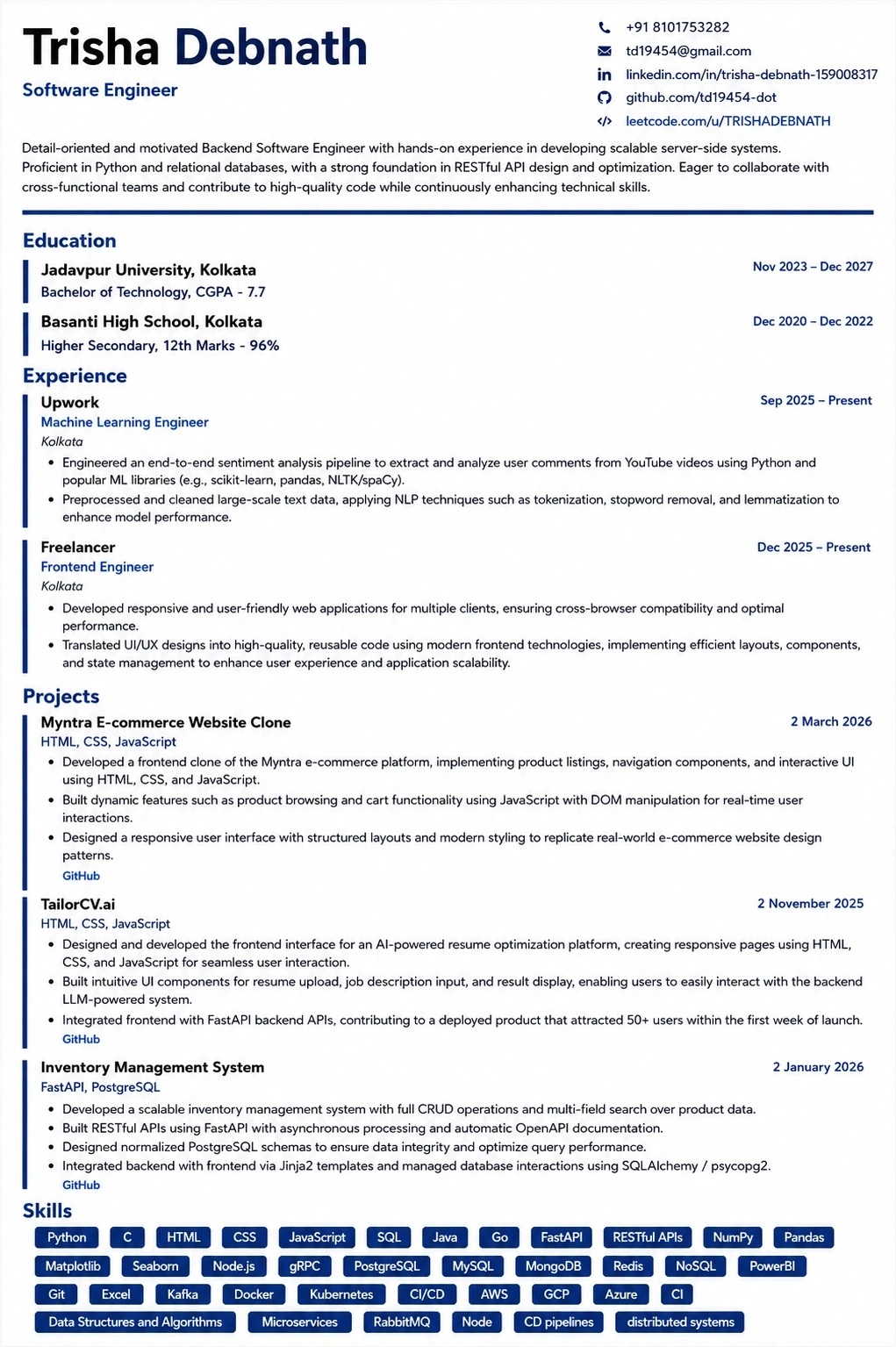
A layout with a real skills section gives the parser somewhere clean to find every term you just added.
Was this guide useful?
Be the first to rate it.