 SS
SS

Key Takeaways
- There is no industry-standard passing score - the number comes from whichever tool you used, not from the employer's system.
- Treat the score as a relevance signal for one specific posting, not as a grade for your resume.
- Most of the available gain arrives in the first round of edits; the last stretch of chasing a higher number usually damages readability.
- A moderate score on a well-matched job beats a high score achieved by stuffing.
- If your score is low and you cannot raise it honestly, that is information about fit rather than a formatting failure.
The question "what is a good ATS score?" has no fixed answer, and the confident numbers you find online — 75%, 80% — are not standards. They are thresholds chosen by individual tools.
That does not make the number useless. It makes it a different kind of useful than most people assume.
What the Number Actually Measures
A score is a comparison between two documents: your resume and one job posting. It broadly reflects how much of the posting's language and requirements are evidenced in your resume.
Three consequences follow, and they matter more than the number itself.
It is posting-specific
The same resume scored against two jobs produces two different numbers. A drop is not your resume getting worse; it is a different comparison. This is why the same resume scores differently on two jobs without anything changing.
It is tool-specific
Different scanners weight sections, synonyms and repetition differently. Comparing a score from one tool to a threshold quoted for another is meaningless — a point covered in depth in why two ATS checkers disagree.
It is not the employer's number
Unless you are scanning inside the employer's own system, you are seeing an approximation. A useful one, but an approximation. The employer's configuration, weighting and knockout questions are invisible to you.
So the honest framing: the score tells you roughly how legible your relevance is for this posting. It does not tell you whether you will get an interview.
A Working Range
With that caveat stated, people still need something actionable. Based on how these tools generally behave:
| Score range | What it usually means | What to do |
|---|---|---|
| Below 50% | Structural problem or genuine mismatch | Check parsing before touching words |
| 50–65% | Real match, under-expressed | Tailoring pays off most here |
| 65–80% | Good working range for a job you fit | One pass, then apply |
| 80–90% | Strong match, or over-fitted to the posting | Check it still reads naturally |
| Above 90% | Rarely reached honestly | Usually mirroring the posting |
The useful target is the middle-upper band, reached honestly — not the highest number the tool will give you.
Why below 50% means "check parsing first"
A very low score is more often a readability failure than a relevance one. If a whole section did not parse, every term in it is missing and the score collapses.
Run the copy-paste test before you rewrite anything. Fixing a layout problem frequently moves a score twenty points in one edit, because content becomes visible for the first time.
Where the Returns Stop
The first round of edits usually produces most of the improvement. You fix a parsing problem, rename two or three things in the posting's vocabulary, move key evidence up the page.
After that, each additional point costs more effort and buys less. Worse, the edits available at that stage tend to be the damaging kind: adding marginal terms, repeating keywords, padding the skills list with things you have touched once.
What deterioration looks like
Honest and well-matched: Built and maintained ETL pipelines in Python and Airflow, cutting daily reporting lag from 6 hours to 40 minutes.
Optimized past the point of usefulness: Built and maintained ETL pipelines (ETL, data pipelines, pipeline development) using Python, Airflow, SQL, data engineering and workflow orchestration tools.
The second scores higher. It is also visibly worse to any human who reads it, and it invites interview questions about tools you barely know.
The stopping rule
When your next available edit would make the line worse to read, stop. The scanner is not the last reader, and recruiters spot generic resumes faster than most candidates expect.
The Effort Curve
| Edit | Typical score movement | Time | Worth it? |
|---|---|---|---|
| Fix a parsing failure | +10 to +25 | 10 min | Always |
| Rename 3 terms to match posting | +5 to +12 | 5 min | Always |
| Move key evidence to top third | +0 to +3 | 2 min | Yes, for humans |
| Add 5 more skills you have | +2 to +5 | 5 min | Usually |
| Add marginal terms you barely know | +2 to +4 | 10 min | No |
| Repeat keywords across sections | +1 to +3 | 10 min | No |
| Third optimization pass | +0 to +2 | 20 min | No |
The top three rows are the whole game. Everything below the line trades credibility for a rounding error.
When a Low Score Is the Right Answer
Sometimes the score is low because the match is genuinely poor. You are missing the central requirement, or three years short on a hard threshold, or the role is adjacent to but not actually your field.
No amount of rewording fixes that, and trying is how people end up with resumes claiming more than they can defend.
A low score on a badly matched posting is the system working. It tells you to spend limited time elsewhere — more valuable advice than a higher number would have been. If the missing item is one you could honestly frame differently, there are legitimate options; if not, move on.
What to Do With Your Score
1. If it is very low, check readability first
Copy-paste your PDF into a plain text editor. Missing sections explain low scores faster than any wording change.
2. If it is mid-range, tailor once, properly
Align vocabulary on the two or three things the posting repeats most, and move that evidence into the top third of the page. The per-application checklist covers the full routine.
3. Re-scan once
See whether the change moved the number meaningfully.
4. Then stop and apply
A second and third optimization pass on the same posting almost never changes the outcome, and the time is better spent on the next application.
A Worked Example of Knowing When to Stop
A backend developer applying for a platform engineering role. First scan: 61%.
Pass one (8 minutes). The copy-paste test was clean, so parsing was not the issue. Comparing vocabulary, the posting repeatedly said "infrastructure as code," "observability" and "incident response." His resume said "wrote Terraform," "set up monitoring" and "on-call rotation" — the same work in different words.
He rewrote three bullets to use the posting's terms while keeping the specifics:
Before: Set up monitoring dashboards and was part of the on-call rotation.
After: Owned observability for four services — Grafana dashboards and alerting — and ran incident response as part of a six-person on-call rotation.
Score after pass one: 78%. Seventeen points for eight minutes, and the bullet is genuinely better written.
Pass two (22 minutes). He added Kubernetes, Istio, Prometheus, Datadog and ArgoCD to his skills list. He had touched three of the five briefly and used two properly.
Score after pass two: 84%. Six points for twenty-two minutes — and a skills section where two of five entries could not survive a follow-up question.
He reverted pass two. The interview he eventually got asked him to talk through an incident he had handled, which came straight from the pass-one bullet. Nobody asked about Istio, and if they had, the honest answer would have been embarrassing.
The pattern holds generally: the first pass buys most of the score and improves the document. The second buys a few points and introduces risk.
What a Good Score Looks Like at Different Stages
A "good" score is not one number. What counts as strong depends on how much evidence you have to match with.
Freshers and first-job applicants
Expect lower scores, and do not treat that as failure. A posting describing two years of experience will never match a resume that has none, no matter how it is worded.
Workable range: 50–65%. Above that usually means either an entry-level posting or genuine project work that lines up well. Chasing 80% at this stage produces padded skills lists, which is the most visible form of inexperience. The ATS score for freshers guide covers realistic benchmarks.
Mid-career applicants
This is where the published ranges apply most directly. You have enough evidence that a poor score usually means a real problem — parsing, vocabulary, or targeting.
Workable range: 65–80%. If you are consistently below 60% on well-matched postings, check parsing before anything else.
Senior and executive applicants
Scores often read lower, and the number matters less. Senior postings are written in outcomes and scope rather than tool lists, so there is less literal vocabulary to match.
Workable range: 55–75%, with far more weight on whether your scope language matches the level. ATS mistakes experienced professionals make covers why optimising a senior resume like a junior one backfires.
Career changers
The hardest case to read from a score alone. A low number can mean vocabulary mismatch — fixable in ten minutes — or a genuine domain gap that no wording addresses.
Diagnose by looking at which terms are missing rather than the percentage. If they are things you have done under other names, the gap is lexical. If they are the domain itself, the score is telling you something true.
How the Score Behaves Across a Batch of Applications
One score tells you about one posting. Ten scores tell you about your resume.
| Pattern across 10+ applications | What it means | What to do |
|---|---|---|
| Consistently 70%+ | Base resume is sound | Focus on bullet quality |
| Consistently 40–55% | Structural or targeting problem | Check parsing, then role band |
| Wildly variable (40–85%) | Applying across too many role types | Build 2–3 base versions |
| High scores, no responses | Scanner stage solved | Move to evidence quality |
The third row is the most commonly missed. A resume optimised for one role type will score erratically across several, and the fix is splitting into separate versions rather than one document that half-fits everything.
Common Mistakes
Comparing scores across different tools. They share a percentage sign and nothing else.
Treating the score as a resume grade. It measures fit to one posting. A resume is not "an 82% resume."
Optimising before checking parsing. The most common wasted hour in a job search.
Chasing 100%. A resume that scores perfectly against a posting is usually mirroring it rather than describing you.
Ignoring bullet quality once the score is good. The scanner cannot see whether your achievements are impressive, which is what weak bullets behind a good score addresses.
Re-scanning after every small edit. It encourages optimising for the tool rather than the reader, and it turns a ten-minute tailoring job into an hour of diminishing adjustments.
Using the score to decide whether to apply. It measures wording overlap, not your candidacy. Plenty of people are hired from applications that scored in the sixties, and plenty of ninety-percent resumes are never called because the bullets underneath said nothing.
The same stopping logic applies beyond the score - how much tailoring is too much covers when extra edits make the resume read worse to a human.
Frequently Asked Questions
Is 70% good enough to apply?
For a job you genuinely fit, yes. The score is one signal among several, and a well-matched application at 70% is stronger than a stuffed one at 90%.
Why did my score drop when I added more keywords?
Some tools penalise unnatural repetition, and adding low-relevance terms dilutes the proportion of your resume that is clearly relevant. More words is not more signal — see why your score dropped after editing.
Should I aim for 100%?
No. A resume that scores 100% against a posting is usually mirroring it rather than describing you, which reads badly to the human and is hard to defend in an interview.
Do employers see the same score I do?
No. Your score comes from the tool you used. The employer's system, if they use one, has its own weighting you cannot see.
My score is high but I get no interviews. What now?
That points away from keyword coverage and toward substance, targeting, or applicant volume. The score has done its job and the problem is elsewhere.
Does a longer resume score better?
Not reliably. More content can mean more matched terms, but it also dilutes relevance density. The resume length guide covers the trade-off.
What if my scores are consistently low across many postings?
A pattern across ten or more well-matched postings is different information from one low score. It usually means either a structural problem carried in your base resume, or that you are applying outside the band your experience supports. Check parsing once; if it is clean, the issue is targeting rather than wording.
How often should I re-scan while editing?
Once before tailoring and once after. Scanning after every sentence turns a ten-minute job into an hour and encourages optimising for the tool.
Does the score predict anything about salary or level?
No. It measures textual overlap with one posting and nothing else. A perfect match on a junior role alongside a weak match on a senior one tells you about how the two postings were written, not about what you are worth or what you are ready for next.
Should I stop applying if the score is low and I cannot raise it?
Not necessarily — but weight your time. One application to a poorly matched role is fine; ten is an afternoon spent on odds you already know are bad. Better-matched postings convert at a much higher rate for the same effort.
Is there a score at which I should stop tailoring entirely?
Once you are in the workable band for your stage and the missing terms are all things you genuinely lack, further tailoring has nothing honest left to do. That is the point to send it and move on.
Is a free checker good enough?
For confirming parsing and seeing which terms are missing, yes. Paid tools often present more detail and nicer reporting, but the underlying score is still that vendor's own formula rather than an industry measurement. The free ATS score checker comparison covers what genuinely differs between the tiers.
What to Do Next
Use the score as an entry condition, not a goal. Get it into a workable range with one deliberate pass — parsing, then vocabulary, then placement — and then stop measuring and start applying.
The part worth more of your attention is what happens after the scan: whether your bullets state outcomes, and whether your strongest evidence sits where a recruiter will actually see it.
Run a free scan against a posting you are actually applying to and read the breakdown rather than the headline figure. The found and missing lists tell you what to edit; the percentage mostly tells you when to stop.
If the layout turned out to be your bottleneck rather than the wording, the resume templates are built single-column so parsing is not the variable.
Related: reading your ATS report properly and the ATS score improvement checklist.
What is your resume scoring right now?
Scan it against a job description and get your ATS match score in about a minute.
Drop your resume here or choose a file
PDF only. Max 2 MB.
We never share your data or use it to train AI models.

Templates that keep this structure intact
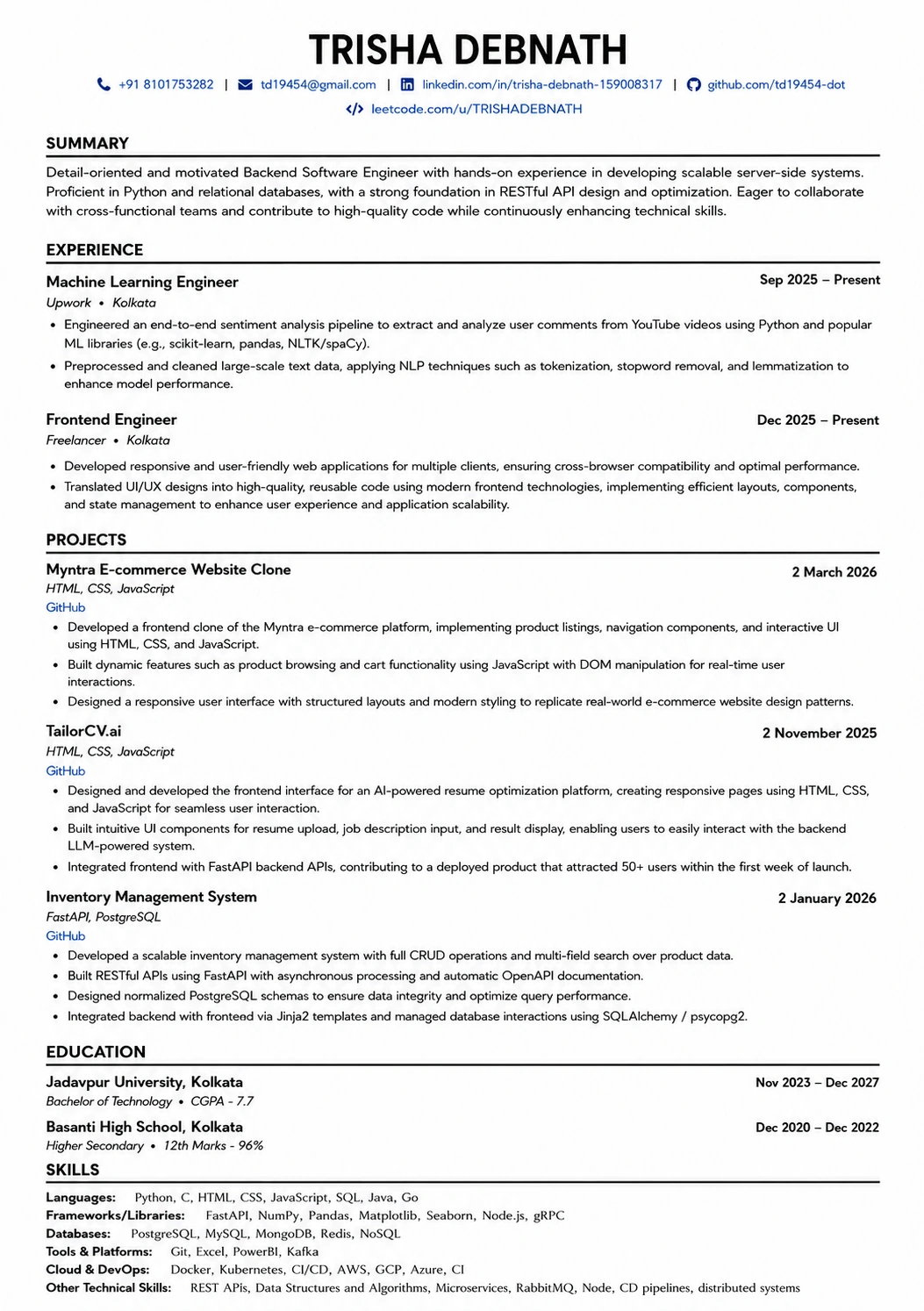
This template is ATS-tested — start from it and the formatting rules in this guide are already handled.
Was this guide useful?
Be the first to rate it.