
 SS

Key Takeaways
- A recruiter reads the first two bullets under your most recent role and skims the rest. Bullet order decides what gets read.
- Reordering takes sixty seconds, changes no content, and carries no risk of overclaiming — unlike rewriting.
- The rule: most relevant to this posting first, strongest evidence second, everything else in its original order.
- Reordering fails when your most relevant work sits under an older role, or when no bullet addresses the requirement at all.
- Do this before you rewrite anything. Most applications need reordering and two renames, not new bullets.
You have six bullets under your current role. The posting wants data modelling. Your data modelling bullet is fourth, below two bullets about process documentation that have nothing to do with this job.
The short answer: move it to first. That single change does more for the application than rewriting any of the six, and it takes under a minute. Nothing about your experience is altered — you are deciding what gets read in the thirty seconds you actually get.
Why Order Decides What Gets Read
Recruiter reading behaviour is well documented and consistent: an initial pass of six to eight seconds, then a longer read of two to four minutes for anything that survives. In both passes, attention concentrates at the top of each section.
Under your most recent role, the first two bullets get read properly. The third gets skimmed. The fourth through sixth are frequently not read at all on the first pass.
That is not carelessness. It is a rational strategy when someone has ninety resumes and a shortlist of eight to produce. They assume — reasonably — that you put your most important work first.
The implication is uncomfortable: if your most relevant bullet sits fourth, you have effectively hidden it, and the reader concludes you have not done that work.
| Position | Read on first pass | Read on second pass |
|---|---|---|
| Bullet 1 | Almost always | Always |
| Bullet 2 | Usually | Always |
| Bullet 3 | Sometimes | Usually |
| Bullet 4 | Rarely | Sometimes |
| Bullet 5+ | Almost never | Sometimes |
The Ordering Rule
Three slots decide most of the outcome.
First: the bullet that addresses their top requirement. Whichever of your existing bullets most directly speaks to the thing the posting repeats. Not your proudest achievement — their priority.
Second: your strongest evidence. The bullet with the clearest outcome, the best number, or the largest scope. This is where you prove capability generally, having proved relevance specifically in slot one.
Third onward: original order. Do not agonise. The returns have already collapsed by here.
The first two slots are doing almost all the work, which is why this takes sixty seconds rather than ten minutes.
Finding your top-requirement bullet
You need to know what their top requirement actually is, which means reading the posting for structure rather than content — the three requirements that decide the shortlist are identifiable in about four minutes.
Then match against your existing bullets. In most cases one of them is an obvious fit and the decision takes seconds.
A Worked Example
A candidate applying to a data analyst role. The posting repeats SQL, dashboarding, and stakeholder reporting.
Original order under her current job:
- Documented the team's reporting processes and maintained the internal wiki.
- Supported the monthly close process with variance analysis.
- Built and maintained 12 Power BI dashboards used across three departments.
- Wrote SQL queries against the warehouse to answer ad-hoc business questions.
- Coordinated the quarterly planning cycle with department heads.
- Trained two new analysts on internal tooling.
Three of her six bullets are directly relevant. All three sit below two that are not.
Reordered — the dashboards bullet moves from third to first, SQL from fourth to second, and the planning-cycle bullet from fifth to third. The wiki, close-process and training bullets drop to slots four through six in their existing order.
Not one word changed. The first two bullets now address two of the posting's three repeated requirements, and the third covers stakeholder reporting.
Sixty seconds of work. Compare that with rewriting six bullets, which would take twenty minutes and introduce the risk of overclaiming in every one.
Why the discarded ones still belong on the page
A reasonable objection: if three bullets are irrelevant to this posting, why keep them at all?
Because relevance is per-posting and the base resume is not. The wiki bullet is dead weight for a data analyst role and genuinely useful for an operations or knowledge-management one. Cutting it from the base to optimise one application costs you on the next.
There is also a completeness argument. A role with three bullets reads as thinner than a role with six, even when the three are stronger. The lower slots are doing quiet work — establishing that the job had scope — without competing for the attention that the top two need.
Cut from the base only when the page genuinely runs long. Demote freely; delete rarely.
Why This Beats Rewriting
| Property | Reordering | Rewriting |
|---|---|---|
| Time per application | ~60 seconds | 15–25 minutes |
| Risk of overclaiming | None | Real |
| Changes what you claim | No | Yes |
| Effect on first-pass reading | Large | Moderate |
| Needs the base to be good | Yes | Yes |
| Reversible | Instantly | Not really |
Rewriting has its place — when a bullet genuinely understates what you did, or uses vocabulary so different from the posting that a reader cannot translate. But that is a smaller category than people assume, and which three bullets to rewrite is a question worth answering deliberately rather than by default.
The sequence that works: reorder first, then rename two or three things, then rewrite only what remains genuinely unclear.
When Reordering Is Not Enough
Your relevant work is under an older role
Reordering within a role cannot fix relevance that sits two jobs back. Three options, in order of preference:
Name the capability in your summary, so it appears in the first three lines regardless of where the evidence sits. Move the relevant bullet up within its own role, so it leads that section. Or, for a substantial career pivot, consider a skills-first structure — though that is a bigger change than tailoring and belongs in career-change matching.
No bullet addresses the requirement
If nothing in your history speaks to their top requirement, reordering has nothing to work with. That is a content problem, and the honest moves for a missing skill apply instead.
All your bullets are duties rather than outcomes
Reordering duties produces a better-ordered list of duties. If your bullets say what you were responsible for rather than what happened, the base resume needs work — rewriting bullets properly is a one-time fix that improves every future application.
The role is too old to matter
Reordering bullets under a job from eight years ago changes very little. Attention concentrates on the most recent one or two roles.
Ordering the Sections, Not Just the Bullets
The same logic applies one level up, and it is worth thirty extra seconds on applications where the fit is not obvious.
Skills before experience, or after? For most candidates, after — experience is the evidence and skills are the index. The exception is a career change or a heavily technical role where the stack is the first screen; there, a compact skills block above the fold saves the reader hunting.
Projects before experience? For graduates and career changers, frequently yes. If your projects demonstrate the target capability and your employment does not, the conventional order actively works against you.
Education position. Top for current students and recent graduates, bottom for everyone else. The common mistake is keeping it at the top three years into a career, where it displaces the experience that should be leading.
Certifications. Near skills if they are central to the role, at the bottom otherwise. A cloud certification matters for an infrastructure role and is noise for a marketing one.
One caution: section order is a base-resume decision, not a per-application one. Changing it for every posting creates version drift and eats the time the bullet reordering just saved. Decide the structure once for a role family, then reorder bullets within it per application.
What This Looks Like at Different Levels
| Level | Where reordering matters most | Typical gain |
|---|---|---|
| Graduate | Projects section, not experience | Large — projects carry the relevance |
| Early career | Current role, all bullets | Large — limited material, so order is everything |
| Mid-level | Current and previous role | Large — usually too much material, so selection matters |
| Senior | Current role only | Moderate — summary does more work |
| Career changer | Across roles, by capability | Limited — structure is the real problem |
The mid-level case is the most common and the highest-return. By five to ten years in, most people have more relevant material than fits on the page, and the failure mode is burying the right bullet under chronological habit.
Common Mistakes
Ordering by chronology within a role
Bullets under a single job have no inherent chronological order, yet people write them in the order things happened. The reader does not know or care about that sequence.
Ordering by pride rather than relevance
Your proudest achievement and their top requirement are frequently different things. Slot one belongs to them; slot two can be yours.
Reordering and then forgetting to check the summary
If you have moved a bullet to first position because it is the most relevant thing you have done, your summary should probably mention that capability too. The two should agree.
Making it a rewrite
You open a bullet to move it, notice a weak verb, and twenty minutes later you have rewritten the role. Move first, and note anything that needs rewriting for a separate pass.
Leaving an irrelevant bullet in slot one out of habit
The most common single failure. The bullet that has always been first stays first through fifteen applications, because moving it never occurs to anyone.
A Second Example: When the Obvious Choice Is Wrong
Reordering is usually straightforward. The case that trips people up is when the most impressive bullet and the most relevant bullet are different, and the impressive one is genuinely impressive.
A project manager applying to a role whose repeated requirements are budget ownership and vendor management. Two candidate bullets:
A: Delivered the company's ERP migration across 11 sites and 400 users, six weeks ahead of schedule.
B: Owned a £1.4m project budget across nine vendor contracts, renegotiating two mid-delivery to absorb a 12% scope increase without additional spend.
Bullet A is the better achievement by most measures — bigger, more visible, better outcome. Bullet B addresses both of the posting's repeated requirements directly.
B goes first. A goes second.
The reasoning is not that A matters less, but that slots one and two do different jobs. Slot one answers "can this person do the thing we need?" Slot two answers "are they any good?" Putting A first answers the second question before the reader has asked the first, and a recruiter scanning for budget ownership may not reach B at all.
This is also why the rule specifies relevance for slot one and strength for slot two rather than ranking bullets on a single scale. They are not competing on the same axis.
The failure mode to avoid is the reverse: leading with the impressive-but-irrelevant bullet across every application because it is the one you are proudest of. That bullet has earned its place on the resume. It has not earned slot one for every posting.
If reordering bullets is not enough because your most relevant job sits further down the page, reordering your work history shows the safe layouts that keep dates in order.
Frequently Asked Questions
Should I reorder for every application?
Yes — it is the cheapest change available and the highest return per second. It is the one step worth doing even when you have five minutes total.
Does bullet order affect an ATS score?
Barely. Most parsers extract all bullets regardless of order, so the score is largely unchanged. The gain is entirely at the human stage, which is where most rejections actually happen.
How many bullets should a role have?
Four to six for your current role, three to four for previous ones, one or two for anything more than about eight years back. Beyond six, the tail is not read.
Should I cut irrelevant bullets instead of demoting them?
Demote first. A bullet that is irrelevant to this posting may be relevant to the next one, and cutting from the base costs you across applications. Cut only when the resume runs long.
Does this work for a resume with one job?
Yes, and it matters more — with a single role, bullet order is the only structural lever you have.
What about bullets under projects?
Same rule. For graduates especially, project bullets often carry more relevance than employment, so order them against the posting too.
Is there a risk the reader notices the reordering?
No — they have nothing to compare against. Ordering by relevance is what a well-constructed resume looks like.
Should the first bullet always have a number in it?
Preferably, but relevance outranks quantification. A relevant bullet without a number beats an irrelevant one with a great number. If neither of your top two has a figure, there are ways to quantify without metrics.
What if two bullets are equally relevant?
Lead with the one that has better evidence — a clearer outcome, a larger scope, or a number.
Does reordering count as tailoring for a scan?
It contributes little to a keyword score and a lot to how a person reads the document. That gap is the whole reason a strong score can sit behind weak bullets.
My bullets are too long to scan quickly. Does order still help?
Less than it should. A two-line bullet in slot one competes with itself — bullets that run long lose the reader before the relevant clause arrives. Shorten the top two, then order them.
What if my most relevant experience used a different tool than the posting names?
Order it first anyway, and let the description do the translating. Adjacent skills are best surfaced in a top-slot bullet where there is room to show the work.
Should the first bullet use the posting's exact wording?
Where the wording is genuinely accurate for what you did, yes. That is a rename rather than a rewrite, and it is the natural companion to reordering — what to change and what to leave covers the boundary.
Does a two-column layout change any of this?
It can make it moot. If your bullets are in a column that parses out of order or not at all, ordering them is irrelevant — check whether the layout survives parsing first.
Do This Before Anything Else
Reordering is the highest-value minute in the entire tailoring process, and it is the step people skip because it feels too small to matter.
Open your resume, read the posting's top requirement, and move the bullet that addresses it into first position under your most recent role. Then look at what sits in slot two.
Scan the posting to identify which requirements are real, then tailor the order and the two or three renames that follow.
Related: which three bullets to rewrite, tailoring in ten minutes, and how much tailoring is too much.
What is your resume scoring right now?
Scan it against a job description and get your ATS match score in about a minute.
Drop your resume here or choose a file
PDF only. Max 2 MB.
We never share your data or use it to train AI models.
Templates that keep this structure intact
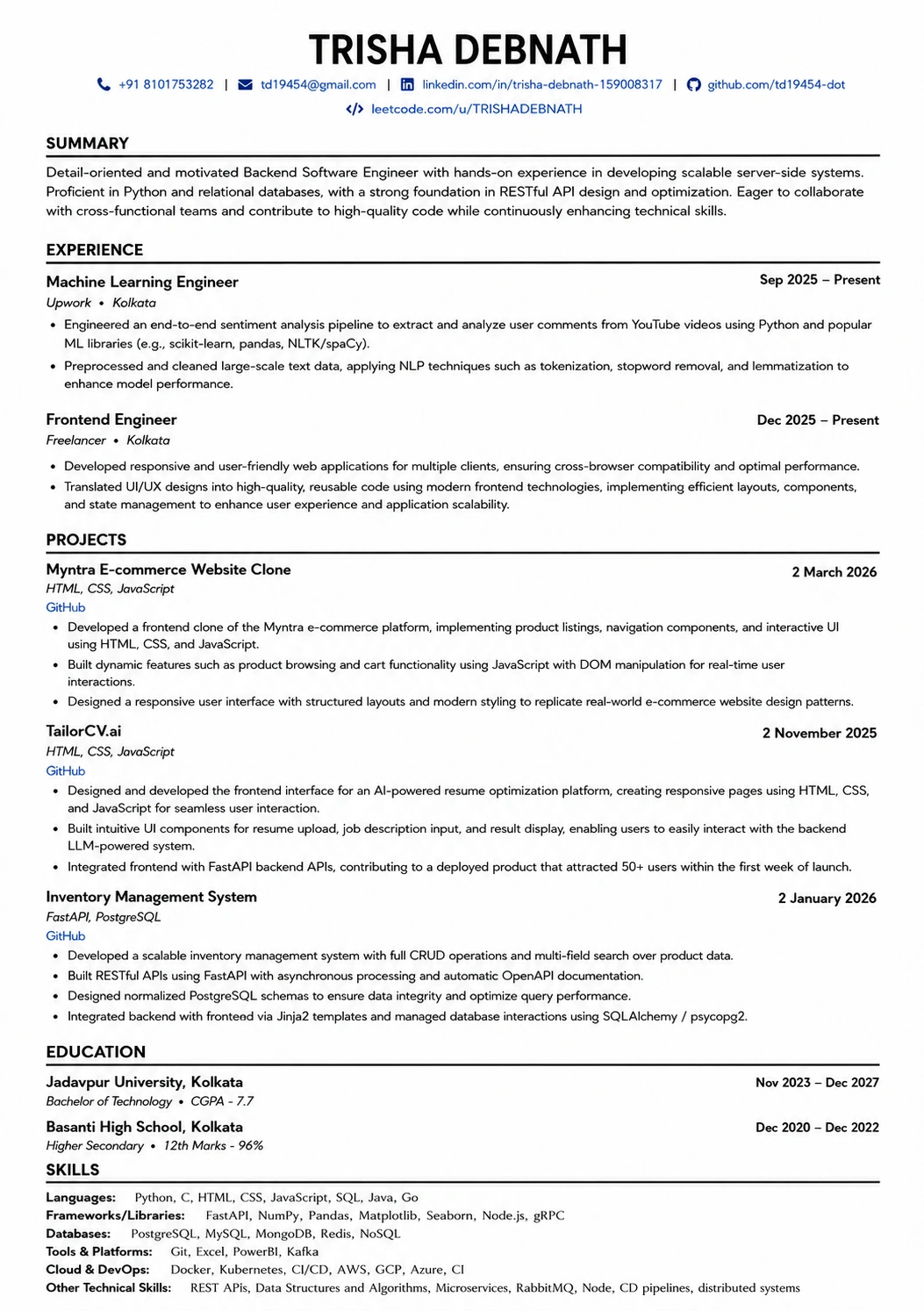
This template is ATS-tested — start from it and the formatting rules in this guide are already handled.
Was this guide useful?
Be the first to rate it.