 SS
SS

Key Takeaways
- The title line is the highest-weight text on your resume for both scanners and recruiters.
- Changing a title to something you did not hold is a verifiable false claim - reference and background checks surface it.
- Clarifying an unclear internal title in brackets is legitimate and solves most of the problem.
- Where your title genuinely differs from the market term, the bracket format covers both.
- Seniority words are the line you should not cross: "Senior" is a level claim, not a translation.
Your job title does more work than any other line on your resume. It is the first thing a recruiter reads after your name, and it carries the most weight in matching.
Which creates a real temptation when your title does not match the posting, and a real distinction between two things that look similar.
Why the Title Matters So Much
Recruiters and systems both use it as shorthand for "has this person done this job before." A title match answers that question instantly. A title mismatch means the reader has to work through your bullets to find out - and on a competitive posting, many will not.
That is why an accurate but unrecognisable title costs you interviews you should have had. The problem is genuine. The question is what to do about it.
The two places it is read
Recruiter search. Titles are the primary search field. A recruiter typing "customer success manager" builds a list, and an unrecognisable title never enters it.
Ranking and first-pass reading. Once you are in the pile, the title sets the reader's frame for everything below it. This is why the title sits at the top of the placement hierarchy and why fixing it returns more than any other single edit.
The Distinction That Matters
Clarifying is adding the market-standard name for the job you actually did.
Substituting is replacing your title with a different one.
The first is translation for a reader who does not know your company's internal vocabulary. The second is a false statement about a verifiable fact - which HR confirms in reference checks, and which background-check providers verify against payroll records.
Why verifiability changes everything
Most resume claims are assessed rather than checked. Titles, dates and degrees are checked, routinely, by most mid-size and large employers.
That moves title inflation out of the category of "overselling" and into the category of things that end processes late - after you have invested weeks, and usually at the offer stage. The general boundary is covered in tailoring without lying; titles are its sharpest case.
Clarifying, Properly
The bracket format is the standard solution and it is widely accepted:
Internal title only: Member of Technical Staff III
Clarified: Member of Technical Staff III (Senior Software Engineer)
Both pieces of information are present. Nothing is hidden, nothing is invented, and a recruiter scanning for "software engineer" now finds you.
It works in either order:
Senior Software Engineer (internal title: Member of Technical Staff III)
Use whichever puts the market term where it will be read. If your internal title is completely opaque, lead with the market term.
Choosing the order
| Your situation | Recommended form | Why |
|---|---|---|
| Title is unusual but guessable | Real title (market term) | Real title still communicates |
| Title is meaningless externally | Market term (internal: real) | Market term must be read first |
| Numbered grade (Analyst II) | Real title (market term) | Grade signals level internally |
| Invented title (Growth Ninja) | Market term (internal: real) | Nobody searches the invented one |
| Translated from another language | Market term (internal: real) | Literal translations mislead |
| Title narrower than the job | Real title (market term) | Bracket carries the wider scope |
| Title is already standard | Real title alone | No clarification needed |
| Contractor or agency placement | Real title, client named | Context matters more than the label |
| Founder or self-employed | Market-equivalent function | "Founder" hides what you did |
| Promoted mid-role | Both titles, with dates | Progression is the signal |
| Title changed in a reorg | Current title (formerly X) | Explains a mid-role shift |
| No formal titles at company | Market-standard function | Describe accurately if asked |
The rule underneath the table: whichever term the reader needs to recognise you goes first, and the other goes in brackets.
Titles Worth Clarifying
Some categories reliably cause problems:
Numbered or graded titles. Analyst II, Engineer IV, Grade 7. Meaningless outside the organisation.
Company-invented titles. Customer Happiness Advocate, Growth Ninja, Brand Storyteller. Charming internally, unsearchable externally.
Titles that mean something different elsewhere. "Consultant" means one thing at a consulting firm and another inside a corporate team. "Associate" ranges from junior to senior depending on industry.
Localised or translated titles. A direct translation often lands on a phrase nobody uses in the target market.
Titles narrower than the job. "Reporting Analyst" when the role was genuinely analytics engineering.
Finding your market term
Work from the job rather than from ambition. Find five postings describing what you actually do, ignore their titles at first, and read the responsibilities.
Then look at what those postings are called. If four of five say "Analytics Engineer," that is your market title. The full method, including the level check, is in fixing a non-standard job title.
Where the Line Is
Some changes are not clarification.
Seniority inflation. Adding "Senior" or "Lead" to a title you did not hold is a level claim, and level is exactly what reference checks confirm.
Function substitution. Calling a coordinator role a manager role because you want manager roles. Different job, different accountability.
Scope invention. "Head of Analytics" when you were one of four analysts with no reports.
The test: would your former employer's HR confirm the title on your resume? If they would confirm "Business Partner II" and your resume says "Senior HR Manager," that discrepancy is discoverable and it ends processes late, after you have invested weeks.
Clarification passes this test because the real title is right there.
The asymmetry worth noticing
Inflation buys you a better first impression on applications you may not convert anyway. It costs you the offer on the one you do convert.
Because the benefit lands early and the cost lands late, the trade feels better than it is - the same distortion that makes hidden keyword tricks tempting.
When You Genuinely Held the Better Title
Sometimes your title was fine and the posting simply uses a different word - "Product Owner" versus "Product Manager," "Data Engineer" versus "Analytics Engineer." These are industry variations rather than levels.
Here the bracket format still helps, and the deciding factor is accuracy: if the two titles describe the same work at the same level, showing both is fair. If the posting's title implies broader scope than you had, do not adopt it.
A Second Example: The Contractor
The bracket format assumes one employer and one title. Contract and agency work breaks that assumption, and the usual fixes make things worse.
A developer who spent two years through an agency, placed with three clients.
Confusing: Consultant, Acme Recruitment Ltd, 2023-2025
Accurate and useless. It names the agency, which nobody is hiring for, and "Consultant" says nothing about the work.
Clear: Backend Developer (contract via Acme Recruitment) — three placements, 2023-2025 - Fintech client, 9 months: Built the payments reconciliation service in Python and Postgres, processing 40k transactions daily - Retail client, 8 months: Migrated the order API off a legacy monolith, cutting p95 latency from 800ms to 210ms
The function leads, the contracting arrangement is stated plainly, and each placement gets its own evidence. Nothing is hidden and the reader can finally see what was done.
The same structure works for freelancers: lead with the function you performed, name the arrangement, and let the client work supply the evidence. Tailoring for contract and freelance roles covers the surrounding decisions.
What to Do When Clarification Is Not Enough
If your title is genuinely two levels below the posting, no formatting fixes that. What helps is making the scope visible immediately, so the reader does not rely on the title alone.
Operations Coordinator (internal title) — scope: 3 workflows, £180k budget, 2 direct reports
- Planned and delivered a 120-person office relocation across four months...
The title is accurate. The scope line tells the reader what the title does not, in the place they are already looking. That is more persuasive than an inflated title and it cannot be contradicted.
Why scope beats seniority words
"Senior" is a claim anyone can type. "Three workflows, £180k, two reports" is a claim with edges, and edges are what make a statement credible.
Readers assessing level are looking for scope anyway - the title is only a shortcut to it. Supplying the real thing skips the shortcut, and it is the same reason specific bullets outperform strong adjectives.
Edge Cases
Your title changed mid-role
Show both with their dates. A promotion inside one employer is a positive signal and hiding it flattens your trajectory.
Acme Corp, March 2019 – Present Senior Data Analyst, June 2022 – Present Data Analyst, March 2019 – June 2022
Keep the structure simple, because nested date ranges are one of the layouts parsers handle least reliably. A company line with each role indented beneath it, each carrying its own dates in plain text, survives extraction; the same information inside a table frequently does not - and detached dates mean your computed experience comes out wrong.
You were a founder or freelancer
"Founder" tells a reader about your circumstances rather than your work. Lead with the function - "Founder & Lead Developer" or "Freelance Marketing Consultant" - so the capability is visible.
The underlying problem is that founders do several jobs and the title names none of them. A reader hiring a backend engineer cannot tell from "Founder" whether you wrote code or raised money. Naming the function you are applying for, where it is genuinely what you did, converts an ambiguous line into a relevant one - and the evidence underneath then has to carry the specifics.
The posting's title is inflated relative to the work
Some postings advertise a "Head of" role that is an individual contributor position. Match what the work is, not what the posting calls it, and let your scope line do the positioning.
Applying internally at your own company
Use the internal title alone. The bracket clarification exists for outside readers who lack context, and inside the company it reads oddly.
Internal applications invert most of this article's advice: the reader already knows what Analyst II means and what your team does. What they do not know is your scope and your outcomes, so the effort that would go into title translation should go into bullets that state results instead.
Your LinkedIn says something different
Fix one of them. A mismatch between your resume and your profile is noticed and raises exactly the question you do not want raised - and LinkedIn titles drive recruiter search harder than resume titles do.
What This Looks Like at Each Level
Fresher. Internship and placement titles are often vague ("Intern"). Add the function: "Marketing Intern (content and analytics)". Where the internship title genuinely was the whole story, let projects carry the specifics instead of stretching the title.
Two to five years. The bracket format's core use case. Internal grades and invented titles are most common here and cost the most.
Senior. Scope lines matter more than the title itself, because readers assess seniority by budget, headcount and ambiguity rather than by the word "Senior."
Career changer. Your title is the thing working hardest against you. Clarify it toward the target field's vocabulary where genuinely accurate, and let transferable evidence do the rest.
Common Mistakes
Mistakes that cross the line
Adding a seniority word. The most common inflation and the most easily verified.
Replacing rather than bracketing. Substitution removes the verifiable fact; clarification keeps it.
Adopting the posting's title wholesale. Writing their exact title as your own on every application produces a resume history that changes shape by employer.
Mistakes that leave value on the table
Leaving an opaque title unexplained. The most common underclaim, and a one-line fix.
Burying scope in the fourth bullet. If your title undersells you, the scope belongs on the title line or in the first bullet, not further down.
Inconsistency across applications. Pick one accurate formulation and use it everywhere, including across resume versions.
Treating the title as the only lever. A clarified title gets you read; it does not get you hired. Once the line is accurate and findable, the return moves to what to change when tailoring everything below it.
Frequently Asked Questions
Will an ATS reject me if my title does not match?
Not outright in most cases - it lowers your ranking. The bigger cost is the recruiter skimming past a title that does not obviously fit.
Is the bracket format ever seen as gaming?
No. Recruiters encounter internal titles constantly and generally find the clarification helpful. Showing both is the opposite of concealment.
What about on LinkedIn?
Same approach, and worth doing because LinkedIn titles drive recruiter search. Keep it consistent with your resume - a mismatch between the two invites questions.
Can I use the posting's exact title if my work was identical?
Show both. Your real title plus the market equivalent covers the search and stays accurate.
What if my company had no formal titles?
Use the market-standard title for the work you did, and say so plainly if asked. Describing an untitled role accurately is not inflation.
Does the bracket hurt my chances with a strict string matcher?
No. Both strings are present in the text, so whichever the system searches for, it finds. That is the whole point of the format.
Should I clarify titles for older roles too?
Only where they are genuinely confusing and genuinely relevant. Roles from ten years ago are context and rarely need the treatment.
What if my title was more senior than the work?
Keep the real title - it is verifiable - and let the bullets describe the actual scope. Overstated titles are the employer's doing, not yours.
How does this interact with a career change?
Clarify toward the target field only where the equivalence is genuine. A teacher writing "Instructional Designer" for classroom work is substituting, not clarifying.
Will a background check flag a bracketed title?
No, because your real title is stated. Checks flag discrepancies, and the bracket format is designed to prevent one existing. Providers verify the title held on record against what you declared, so the format that shows both is the one least likely to generate a query - and a query at offer stage costs you time even when it resolves in your favour.
Check What Your Title Line Is Doing
Because the title carries the most weight, it is worth knowing whether yours is registering against the roles you want.
Scan your resume against a posting and check whether the posting's title or its close variants come back as found - if not, your title line is likely the reason, and the bracket fix is a one-line change with disproportionate effect.
If you would rather see the whole document adjusted against the posting at once, the tailoring tool works from the same comparison.
Related: when your internal title does not match the market and where to place keywords so they count.
What is your resume scoring right now?
Scan it against a job description and get your ATS match score in about a minute.
Drop your resume here or choose a file
PDF only. Max 2 MB.
We never share your data or use it to train AI models.

Templates that keep this structure intact
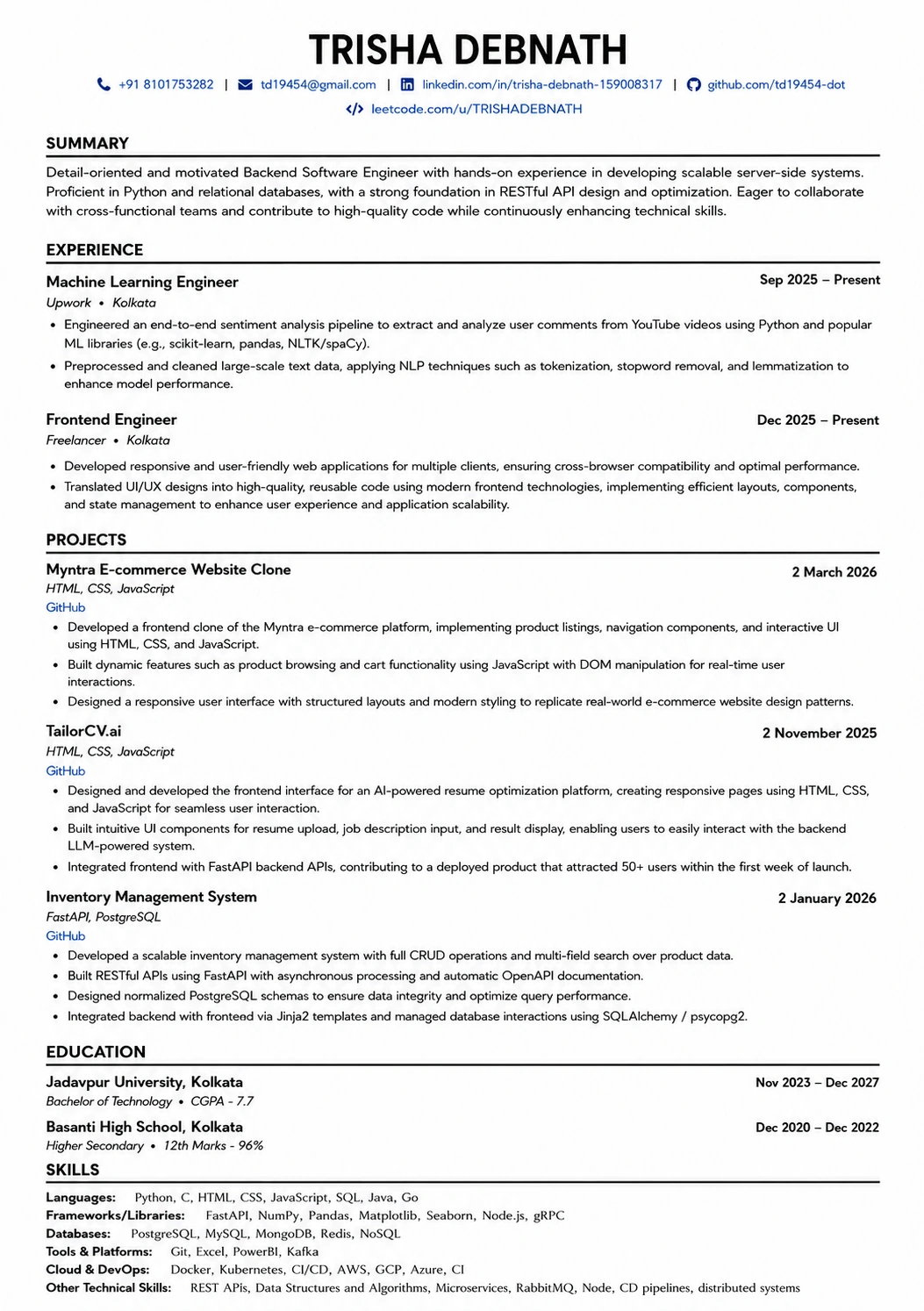
This template is ATS-tested — start from it and the formatting rules in this guide are already handled.
Was this guide useful?
Be the first to rate it.