 SS
SS
Key Takeaways
- First work out whether the missing item is genuinely central or one line among twenty - that answer changes everything you do next.
- Four honest moves exist: show the adjacent skill, show transfer evidence, show it in progress, or address it directly in the cover letter.
- Adding the term to your skills list is the most common dishonest move and the easiest to expose, because interviewers pick probe topics from exactly that section.
- Employers rarely expect every listed item, but they do expect you to discuss anything you claim.
- If the missing item is in the job title and repeated throughout, the right move is a different application.
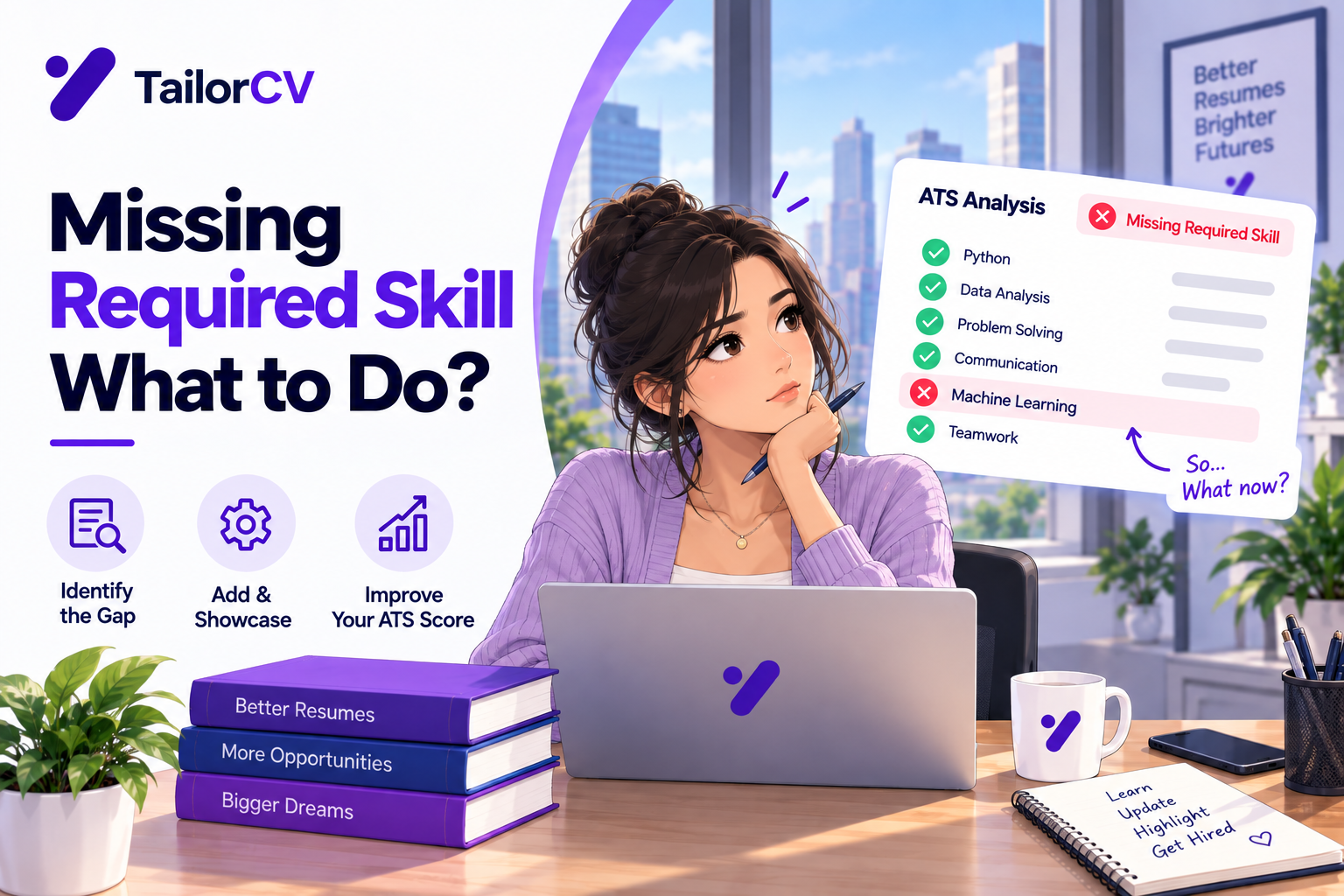
A posting names a tool, a certification or a domain you have never touched.
The question is not whether to lie about it. It is what the honest version of a competitive application actually looks like — and whether this application is worth making at all.
Both answers take about two minutes to reach.
First: Work Out What You Are Missing
Before deciding what to write, establish how much the gap matters. Three signals, in order of reliability.
Position in the posting
Is it in the title and opening paragraph, or the fourteenth bullet in a long list?
The title and first paragraph are usually written by the hiring manager themselves, which is why matching your resume to the job description should start there. The long bullet list is often inherited from a previous requisition and extended by several contributors — which is why reading a job description properly changes what you conclude from it.
Repetition across sections
Does it appear in the title, the summary and the bullets? Three mentions means three different people thought it mattered.
A skill appearing exactly once, near the bottom, is usually a preference that migrated into the requirements list.
Framing
Is it under "required" and "must have", or under "nice to have", "bonus", "or similar"?
Employers are inconsistent about this, but when a posting bothers to separate the two, believe it.
Putting it together
| Signal pattern | What it means | Should you apply? |
|---|---|---|
| In the title, repeated, marked required | This is the job | Usually no |
| In the opening paragraph, mentioned twice | Central | Only with a strong adjacent skill |
| Mid-list, specific, marked required | Real but not decisive | Yes, address it |
| Bottom of list, mentioned once | Preference | Yes, ignore it |
| Listed with alternatives | One of these suffices | Yes, if you have any of them |
If it is genuinely the job, no wording saves the application. Knowing that in thirty seconds rather than after an hour of editing is the point of this step.
The Four Honest Moves
1. Name the adjacent skill you do have
Most tools belong to a family. Someone who knows one member learns another quickly, and hiring managers know this.
Posting asks for: Looker
You have: three years of Tableau
Write: Built and maintained 20+ production dashboards in Tableau, including row-level security and scheduled distribution to 200 users.
You have not claimed Looker. You have demonstrated the underlying capability at a level that makes the specific tool a detail.
This works for tool families, adjacent languages and comparable frameworks. It does not work across genuinely distinct disciplines — adjacent skills and where the boundary sits covers which transfers are credible.
2. Show the transfer explicitly
If you have learned a comparable thing before, that is evidence you can do it again. Make the pattern visible rather than leaving it implied.
Picked up dbt in the first month of the migration project with no prior exposure, and owned the model layer by the end of the quarter.
This tells a hiring manager something useful about your ramp speed. It is also the honest version of "fast learner" — a claim nobody believes as an adjective and most people accept as an example.
3. Show it in progress, accurately
If you are genuinely learning the thing, say so with enough specificity to be checkable.
Vague and unconvincing: Familiar with Kubernetes.
Specific and credible: Currently working through the CKA curriculum; have deployed and managed a three-node cluster for a personal project.
The first invites a follow-up you cannot answer. The second sets an accurate expectation, and the follow-up is one you can handle.
Be careful with "familiar with". It is the most over-used hedge on resumes and experienced readers translate it as "has heard of".
4. Address it in the cover letter
The resume is a poor place for nuance. A letter can say directly what a bullet cannot:
I should be straightforward that I have not worked with Looker. I have spent three years in Tableau building the same kind of governed, self-serve reporting your posting describes, and I would expect the transition to take weeks rather than months.
This does three things at once: it is honest, it demonstrates the judgment to raise the issue first, and it reframes the gap as a timeline rather than a disqualification.
The Three Moves That Get Found Out
Adding it to the skills list
It satisfies a scanner and creates an interview landmine. Interviewers select probe topics from exactly that section, because it is your own claim about yourself.
The cost is not usually being caught in a lie. It is visibly not knowing something you listed, which damages everything else on the page.
"Exposure to" and "familiarity with"
Transparent hedging. Everyone in hiring recognises the construction, and it signals that you knew the gap mattered and chose to obscure it rather than address it.
Placing it in a bullet where it did not happen
A straightforward false statement about verifiable work. Reference checks and technical questions both surface it, and the line between framing and fabrication is exactly here.
| Move | Scanner effect | Interview risk | Verdict |
|---|---|---|---|
| Adjacent skill, named specifically | Partial match | None | Best option |
| Transfer evidence | Small | None | Strong |
| In-progress, specific | Small | None if accurate | Good |
| Cover letter disclosure | None | None | Good for central gaps |
| Adding to skills list | Full match | High | Avoid |
| "Familiar with X" | Partial | Moderate | Avoid |
| False bullet | Full match | Severe | Never |
Should You Apply At All?
Apply when
- The missing item is one of several preferences
- It is adjacent to something you have done well
- It appears once, near the bottom of the list
- It is listed alongside alternatives you do have
- You match the title and opening paragraph strongly
Think harder when
- It is named in the job title
- It is a hard credential the role legally requires — a licence, a clearance, a registration
- You are missing several central items rather than one
- It is the domain itself rather than a tool within your domain
The common advice to "apply anyway, they never expect everything" is half right. Postings are written aspirationally, and shortlists routinely include people missing several listed items.
But applying to everything dilutes the time available for applications you could genuinely win. Ten well-matched applications beat forty scattered ones, and quality versus volume is the trade worth being deliberate about.
What This Looks Like at Different Career Stages
Freshers and first-job applicants
Almost every posting will name things you lack. That is the nature of entry-level hiring, where postings describe an ideal rather than a realistic first hire.
Lead with coursework, projects and any tool you used properly — technical skills for freshers covers what counts as evidence when you have no job history. What matters most is evidence you can learn quickly, which is why the transfer move works well here even when the transfer is from academic to professional work.
Mid-career applicants
The adjacent-skill move is strongest at this stage, because you have enough depth in one tool that comparable experience reads as credible.
The risk is over-listing, and which skills to add is worth a look before you expand the section. You have touched many things across several roles, and the temptation to claim all of them is highest exactly when your skills section is being read most carefully.
Senior and executive applicants
Individual tools matter least. A posting for a Head of Data naming Tableau is describing an environment, not testing whether you build dashboards.
What matters is scope, budget and headcount. If those match, a missing tool is rarely decisive — the inversion covered in executive resume tailoring.
Career changers
The hardest case, because you will be missing genuine domain knowledge rather than a tool.
Be honest with yourself about which it is. A missing tool is bridgeable; missing domain expertise usually is not, and pretending otherwise wastes months.
Where the Gap Shows Up Later
Handling the gap on the resume is only the first stage. Knowing what happens afterwards changes how you frame it now.
At the screening call
Recruiters often work from a checklist supplied by the hiring manager. If the missing item is on it, you will be asked directly in the first ten minutes.
Have a two-sentence answer ready — what you have instead, and how long you would need. Rehearsing it matters more than people expect, and the STAR method gives it a structure that does not sound defensive.
In the technical round
If you claimed it, you will be tested on it. If you disclosed it honestly, the conversation is usually about the adjacent skill instead — a much better conversation to be having.
At reference check
Credentials and titles are verified routinely. Skills claims occasionally surface here too, when a former manager is asked what you actually worked on.
After you start
The worst outcome of overclaiming is getting the job. A role built on a skill you do not have becomes obvious within weeks, and recovering from that is harder than not having been hired.
A Worked Example
A marketing analyst applying for a growth role. The posting requires SQL, and she has used it only through a BI tool's query builder.
Wrong response — added to skills list:
Skills: SQL, Python, Tableau, Google Analytics, A/B testing
She would be asked to write a join in the second interview.
Right response — accurate, with the adjacent capability foregrounded:
- Built 30+ reports in Looker using its modelling layer, including cohort and funnel analyses across four product lines
- Working through a SQL fundamentals course; comfortable reading and modifying queries, currently building toward writing them independently
Same gap, stated honestly, using the employer's own vocabulary where it was accurate — the approach in best resume keywords. The first line proves she can do the analytical thinking the role needs, stated as an outcome rather than a duty — see quantifying achievements. The second sets an expectation she can meet rather than one that collapses under a follow-up.
She was interviewed and asked about exactly that second line — and had a real answer.
Common Mistakes
Deciding before reading the posting properly. Half the "required" skills people panic about are preferences at the bottom of an inherited list.
Treating every gap as equal. A missing tool and a missing licence are different problems with different answers.
Padding around the gap. Adding five adjacent tools to compensate for one missing item makes the skills section less credible, not more — and recruiters read resumes closely enough to notice.
Applying to everything because "you never know". You partly do know, and the time is finite.
Ignoring the rest of the resume. A missing skill matters less when everything around it is strong — the fundamentals in the resume optimization guide do more for your odds than the gap costs you.
Never applying unless you match 100%. The opposite failure, and more common among candidates who would actually be competitive. Most shortlisted candidates do not match every line.
Hiding the gap and hoping. If it is central, it surfaces in the first technical conversation. Better to frame it yourself.
Frequently Asked Questions
Will the ATS reject me for one missing skill?
Usually it lowers your ranking rather than rejecting you outright. The exception is knockout questions on the application form, which can filter automatically on a specific answer regardless of your resume.
Is "familiar with" ever acceptable?
Only when you can hold a real conversation about the thing. If it is standing in for "I read the documentation once", it will not survive a follow-up question.
Does a career gap make a missing skill worse?
Not directly, though both are things a reader is weighing at once. Handle them separately — explaining an employment gap is a different conversation from a missing tool.
Should I learn the tool before applying?
For a strongly-matched role worth pursuing, a weekend of genuine hands-on use converts "never used it" into a defensible in-progress claim. For a marginal role, that time is better spent on better-matched applications.
What if I have the skill but no professional experience with it?
Say where you used it. Personal projects, coursework and volunteer work are all legitimate evidence when labelled accurately — misrepresenting the context is the only problem.
How many missing requirements is too many?
If you are missing most of the core list, the application is unlikely to be competitive. One or two adjacent gaps is normal and expected.
Does mentioning the gap in a cover letter hurt me?
Not when framed as a timeline rather than an apology. It usually reads as confidence, and it pre-empts the objection the reader was already forming.
Should I still apply if I lack a required certification?
Depends whether it is legally required or preferred. A licence a role cannot legally operate without is a hard stop. A preferred certification is worth applying around, especially if you are working toward it.
What if the posting lists three tools and I know one?
That is almost always sufficient — clustered alternatives usually mean "one of these". Listing all three because a scan flagged them is the padding pattern covered in missing keywords you should ignore.
Can I say I am "willing to learn"?
It adds nothing on its own. Everyone is willing, and ATS keywords will not rescue a claim with no evidence behind it. Evidence that you have learned something comparable quickly is the version that means something.
Will they check whether I actually know it?
For technical roles, frequently — through a task, a live question, or a specific follow-up. For credentials, almost always through verification. Assume anything on your resume can be tested.
What to Do Next
Start by classifying the gap using position, repetition and framing. That single step tells you whether to apply at all, and most people skip it and spend an hour editing an application they should not have sent.
If you are applying, pick one of the four honest moves — usually the adjacent skill, since it is the strongest and requires no disclaimer. Write the bullet so the underlying capability is evident, then stop. Do not compensate elsewhere.
Most flagged gaps turn out to be vocabulary rather than substance: you did the work and called it something else.
Scan your resume against the posting and sort the flagged terms into "did this under another name" and "genuinely don't have". The first group is quick to fix; the second tells you whether the application is worth making.
If the letter is where you want to address it, the cover letter generator builds from the posting so the framing stays specific to what they actually asked for.
What is your resume scoring right now?
Scan it against a job description and get your ATS match score in about a minute.
Drop your resume here or choose a file
PDF only. Max 2 MB.
We never share your data or use it to train AI models.

Templates that keep this structure intact
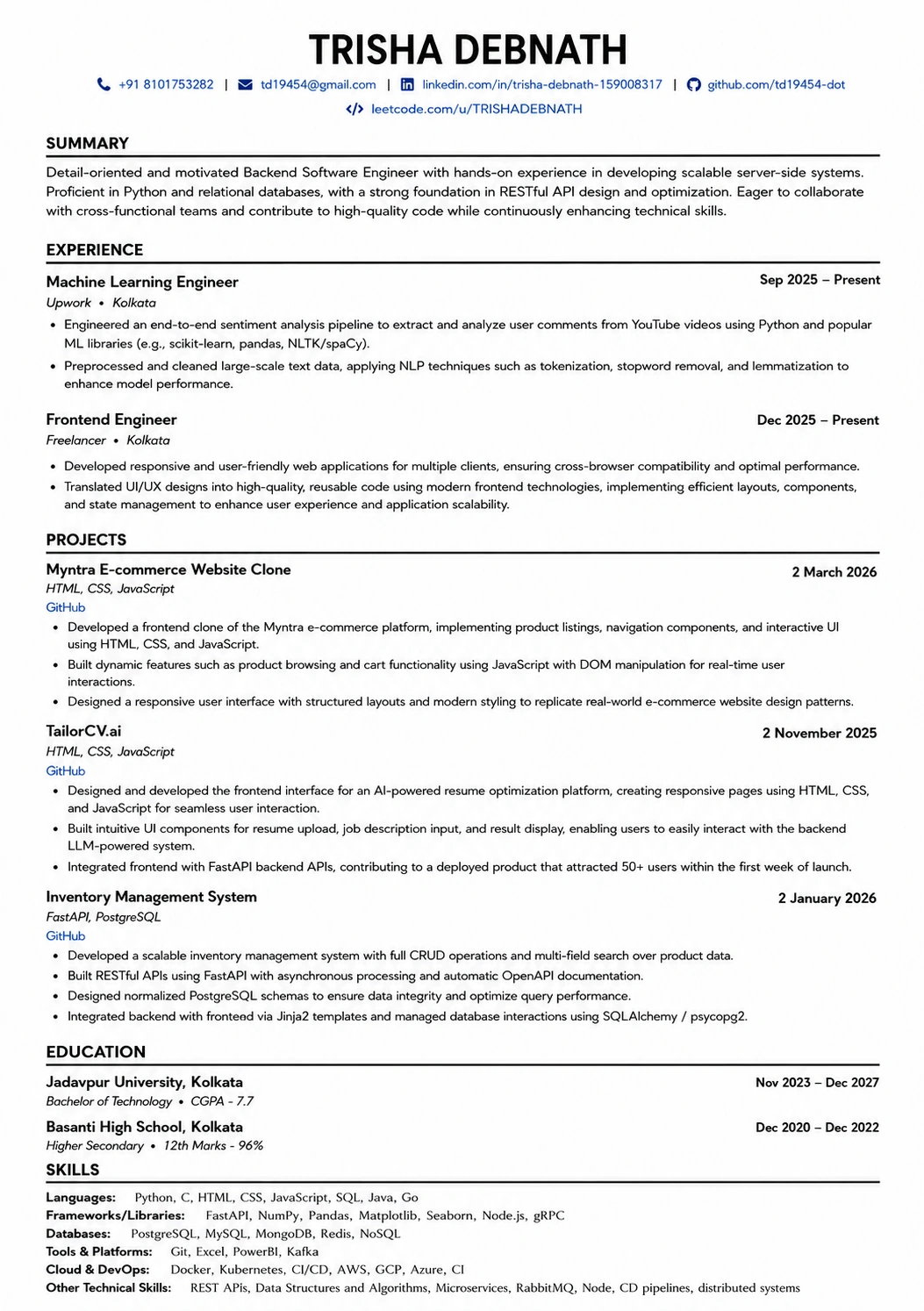
This template is ATS-tested — start from it and the formatting rules in this guide are already handled.
Was this guide useful?
Be the first to rate it.