SS
SS

Key Takeaways
- A missing-terms list is a list of differences between two documents, not a list of your failures - most items on it need no action at all.
- Sort every flagged term into one of four buckets: you have it under another name, you have it and left it out, you genuinely lack it, or it is noise.
- On a typical report, roughly a third is noise and another third is unfixable, leaving a handful of items that actually deserve your time.
- Terms you cannot honestly claim are information about fit, not gaps to paper over.
- The rewording bucket produces most of the score movement and takes about five minutes.
The report says 64% and lists nineteen missing keywords. Your instinct is to work down the list until it is empty.
That instinct produces padded, unconvincing resumes and burns an hour per application. A missing-terms list is a comparison of two documents, and most of the differences between them do not matter.
Here is how to tell which ones do.
What the Report Is Actually Telling You
Before sorting anything, it helps to know what produced the list.
The tool extracts terms from the job posting, extracts terms from your resume, and reports what appears in the first but not the second. It has no model of your career. It cannot tell that "led the migration" and "migration experience" are the same thing unless its matching is generous, and it cannot tell that you would pick up a new tool in a fortnight.
That is why the report needs a human pass. You supply the judgment the tool does not have: which differences are real, and which are vocabulary.
One thing worth ruling out first: if a whole section of your resume failed to parse, every term in it will show as missing and the report will look far worse than reality. The copy-paste test takes thirty seconds and tells you whether you are reading a vocabulary problem or a parsing problem.
Why the score and the list say different things
The score is a single number summarising overall overlap. The list is specific and actionable. Almost always, the list is the more useful output — a point covered further in why two ATS checkers disagree, since the number varies by tool while the missing terms largely do not.
If you want to know what range is worth reaching before you stop editing, what counts as a good ATS score covers where the returns flatten out.
The Four Buckets
Read the list once and put every item into one of four buckets. This takes about three minutes and replaces an hour of aimless editing.
| Bucket | What it means | Action | Typical share |
|---|---|---|---|
| 1. Called it something else | You did this work, under different wording | Reword 2–3 lines | 25–35% |
| 2. Have it, left it out | Genuinely yours, absent from this version | Add where evidenced | 10–15% |
| 3. Genuinely lack it | Never done it | None | 25–35% |
| 4. Noise | Culture text, benefits, company names | None | 25–35% |
Buckets 3 and 4 together are usually more than half the list. That is the single most useful thing to understand about these reports.
Bucket 1: You Have It, You Called It Something Else
This is where the score moves, and it moves without you claiming anything untrue.
The posting asks for: cross-functional collaboration, requirements gathering, process documentation
Your resume currently says: Worked with sales and ops teams to understand what they needed and wrote up how the new system should work.
Rewritten: Led cross-functional collaboration with sales and operations, running requirements gathering sessions and owning process documentation for the new system.
Identical work. Identical truth. The second version is legible to a scanner matching against that posting, and it reads more professionally to a human too — which is the test that actually matters.
The caution
Do this only where the term genuinely describes what you did. If "requirements gathering" is a grander name than the two hallway conversations you had, do not use it. You will be asked about it, and the line between framing and fabrication is where interviews are lost.
Common translations worth knowing
| You probably wrote | The posting may call it |
|---|---|
| Client relationships | Stakeholder management |
| Reporting | Business intelligence, analytics |
| Supplier contracts | Vendor management, procurement |
| Training new staff | Onboarding, enablement |
| Fixing broken processes | Process improvement |
| Working with other teams | Cross-functional collaboration |
| Checking data quality | Data governance, validation |
More of these by industry are in best resume keywords to beat ATS.
Bucket 2: You Have It, You Left It Out
Straightforward. If you have used the tool or done the work and it is simply absent from this version, add it where it belongs.
One rule: add it to the place where it is evidenced, not only to the skills list. A term that appears in your skills section and nowhere else in your history is weak evidence to a human reader, even when it satisfies a scanner. Where you place keywords changes how much they are worth.
Bucket 3: You Genuinely Lack It
This is the part people find hardest, because the report flags it in a colour that implies you should fix it.
You cannot fix it, and every option available to you is bad:
- Adding the term to your skills list — defensible to a scanner, indefensible in an interview.
- Writing "familiar with X" for something you read about once — transparent to anyone who asks a follow-up.
- Burying it in a bullet where it did not happen — a straightforward false claim about verifiable work.
The honest read
This posting wants something you do not have. If it is one item among many, apply anyway — postings are written aspirationally and shortlists routinely include people missing several listed items.
If it is the central requirement, repeated throughout, that is a signal to spend your time on a better-matched role. What to write when you lack a required skill covers the four honest moves available.
Either way, the correct action on Bucket 3 is none.
Bucket 4: Noise
Scanners tokenise the whole posting, including text that was never a requirement. Recognising these takes seconds once you know the categories.
- Culture language: fast-paced, dynamic, self-starter, team player, detail-oriented
- Company nouns: the employer's name, product names, office locations
- Benefits and admin: health insurance, PTO, hybrid, equity, equal opportunity employer
- Generic verbs: manage, collaborate, deliver, drive, execute
- Seniority framing: senior, junior, proven track record
None of these is a checkable skill. Adding "self-starter" to your resume satisfies nothing and costs you a line. Missing keywords you should ignore goes through each category in detail.
The Test That Sorts Everything
For any flagged term, ask: could a specific person evidence this, and could they be asked about it in an interview?
- "Kubernetes" — yes. Real skill, real follow-up question.
- "Fast-paced environment" — no. Nobody has been asked to describe their fast-paced-environment experience.
- "Stakeholder management" — yes. Real practice, real follow-up.
- "401(k)" — no.
The question filters almost everything correctly, at about a second per term.
A Full Worked Sort
A posting for a mid-level data analyst produced nineteen flagged terms:
SQL, Python, Tableau, Power BI, Looker, dbt, Snowflake, stakeholder management, A/B testing, fast-paced, self-starter, cross-functional, Acme Analytics, hybrid working, equity, detail-oriented, communication, Agile, bachelor's degree
Applying the buckets:
| Terms | Bucket | Why |
|---|---|---|
| fast-paced, self-starter, detail-oriented, communication, cross-functional | 4 — noise | Culture language, not skills |
| Acme Analytics, hybrid working, equity | 4 — noise | Company name and benefits |
| Tableau / Power BI / Looker | 1 — one suffices | Clustered alternatives |
| bachelor's degree | 3 — have or not | Credential, not actionable |
| Agile | 4 — likely noise | Process, secondary to the role |
| SQL, Python, dbt, Snowflake, stakeholder management, A/B testing | 1 or 2 | The real worklist |
Nineteen became six, and of those six the analyst already had four — they were simply described differently. The actual editing job was three sentences.
The Three-Minute Routine
- Skim and delete the noise. Company names, culture phrases, benefits language. Gone.
- Mark what you can honestly claim. Buckets 1 and 2 — your real worklist.
- Rewrite two or three lines to use the posting's term for work you already did.
- Add Bucket 2 items to the place they are evidenced.
- Ignore the rest and apply.
If your worklist comes out empty and the score is still low, you have learned something useful: the gap is real, not cosmetic.
Reading the Report When You Are Short on Time
The full sort takes three minutes. Sometimes you have thirty seconds, applying to your fifth role of the evening. Here is the compressed version.
The 30-second version
Read only the terms that appear in the job title or first paragraph of the posting. Check those against your resume. Ignore everything else on the report entirely.
That single filter captures most of the value, because position in the posting is the strongest signal of what actually matters.
The 3-minute version
The full four-bucket sort described above. Worth doing for any role you genuinely want.
The 10-minute version
The full sort plus rewriting the two or three Bucket 1 lines properly, with outcomes rather than just renamed duties. This is the version that also improves your base resume permanently — the renamed lines usually stay in place for future applications.
| Time available | What to do | What you get |
|---|---|---|
| 30 seconds | Check title-paragraph terms only | Catches the deal-breakers |
| 3 minutes | Full four-bucket sort | Knows what is worth fixing |
| 10 minutes | Sort plus proper rewrites | Permanent base-resume gain |
| 30+ minutes | Diminishing returns | Usually padding territory |
What the Report Cannot Tell You
Worth stating plainly, because people over-trust these tools in both directions.
It cannot judge whether your work was impressive
A bullet reading "responsible for reporting" and one reading "rebuilt reporting, cutting turnaround from two days to 40 minutes" can score identically. The scanner sees the same keywords; a hiring manager sees two different candidates. That gap is covered in weak bullets behind a good score.
It cannot tell you the employer's threshold
You do not know what score, if any, the employer's system applies — or whether they use ranking rather than filtering. The difference between ATS score and recruiter judgment is the gap between passing a filter and being chosen.
It cannot see knockout questions
Application forms often filter on answers to direct questions — work authorisation, notice period, salary expectation, willingness to relocate. Those decisions happen outside your resume text entirely, and a perfect report will not save an answer that disqualifies you.
It cannot account for internal candidates
Some postings are open because policy requires it while an internal candidate is already favoured. No report models that, and it explains a share of unexplained rejections.
Common Mistakes
Treating the list as a to-do list. It is a diff between two documents, and diffs contain plenty of irrelevant differences.
Clearing the list completely. A cleared list usually means a resume that has absorbed the posting's language wholesale, which reads badly and is hard to defend.
Adding everything to the skills section. It is the weakest placement and the one interviewers pick questions from. It also tips quickly into keyword stuffing, which recruiters recognise on sight.
Re-scanning after every edit. It encourages optimising for the tool rather than the reader, and it is how a ten-minute job becomes an hour — see tailoring in ten minutes for a timed routine that avoids it.
Ignoring the report entirely. The opposite failure. Bucket 1 is genuinely valuable and takes five minutes.
Acting on the score instead of the list. The number varies by tool; the missing terms mostly do not.
Once the report is sorted, turning a scan result into three concrete edits shows exactly which changes to make first.
Frequently Asked Questions
Should I try to clear the entire missing-keywords list?
No. A cleared list usually means a resume that mirrors the posting rather than describing you, which reads badly to humans and is hard to defend in interview.
Why does the report flag words like "team player"?
Because it tokenises the whole posting, including culture and benefits text. Those tokens are not requirements and can be ignored entirely.
Is it dishonest to use the posting's exact wording?
Not when it describes work you genuinely did. Using the employer's vocabulary for your real experience is translation. Using it for work you did not do is the line.
What if every missing keyword is something I do not have?
Then the scan has told you the match is weak, which is useful information. Apply if you want, but weight your time toward better-fitting postings.
How many terms should I actually act on?
Usually two or three. If your worklist is longer than five, you are probably including Bucket 3 items you cannot honestly claim.
Does adding a keyword to my skills section count?
It counts for the scanner and very little for the human. A skill named inside described work is far stronger evidence than the same word in a list.
Should I scan against every job I apply to?
For roles you genuinely want, yes — it takes a minute and the Bucket 1 items differ per posting. For low-priority applications, tailoring the summary alone is often enough.
My score went up but I still got rejected. Was the report wrong?
No — the report only measures keyword relevance for one posting. Rejection can come from bullet quality, competition, or internal candidates. High score, no interviews covers what to look at next.
Should I trust a report that gives me a very high score?
Be slightly suspicious of it. A score above ninety usually means your resume has absorbed the posting's language closely enough that it reads as generic to a human. Check that your bullets still sound like you describing your own work, not the posting reflected back.
Does re-scanning after edits cost anything?
Only time. Scan once before tailoring and once after — that gives you a clean before-and-after. Scanning after every sentence is how a ten-minute job becomes an hour, and it pulls your attention toward the tool rather than the reader who decides.
Do the clustered tools really mean "pick one"?
Usually. Several similar tools listed adjacently without separate requirements almost always signals flexibility. If the posting says "must have Tableau specifically," that is different.
What to Do Next
The sorting method works on any report from any tool, and it is worth doing by hand once so the four buckets become automatic. After that it takes three minutes rather than an hour.
The output you want is a worklist of two or three terms you can honestly claim, rewritten into lines that already describe real work. Everything else on the report gets ignored deliberately rather than anxiously.
Scan a resume against a posting you are applying to and try the sort on what comes back. The flagged list becomes far more useful once you stop treating it as a checklist.
If your layout is what is suppressing matches rather than your wording, the resume templates are built single-column so parsing stops being the variable.
See which keywords you are missing
Scan your resume against the posting and get the exact terms it did not find.
Drop your resume here or choose a file
PDF only. Max 2 MB.
We never share your data or use it to train AI models.

Where those keywords actually go
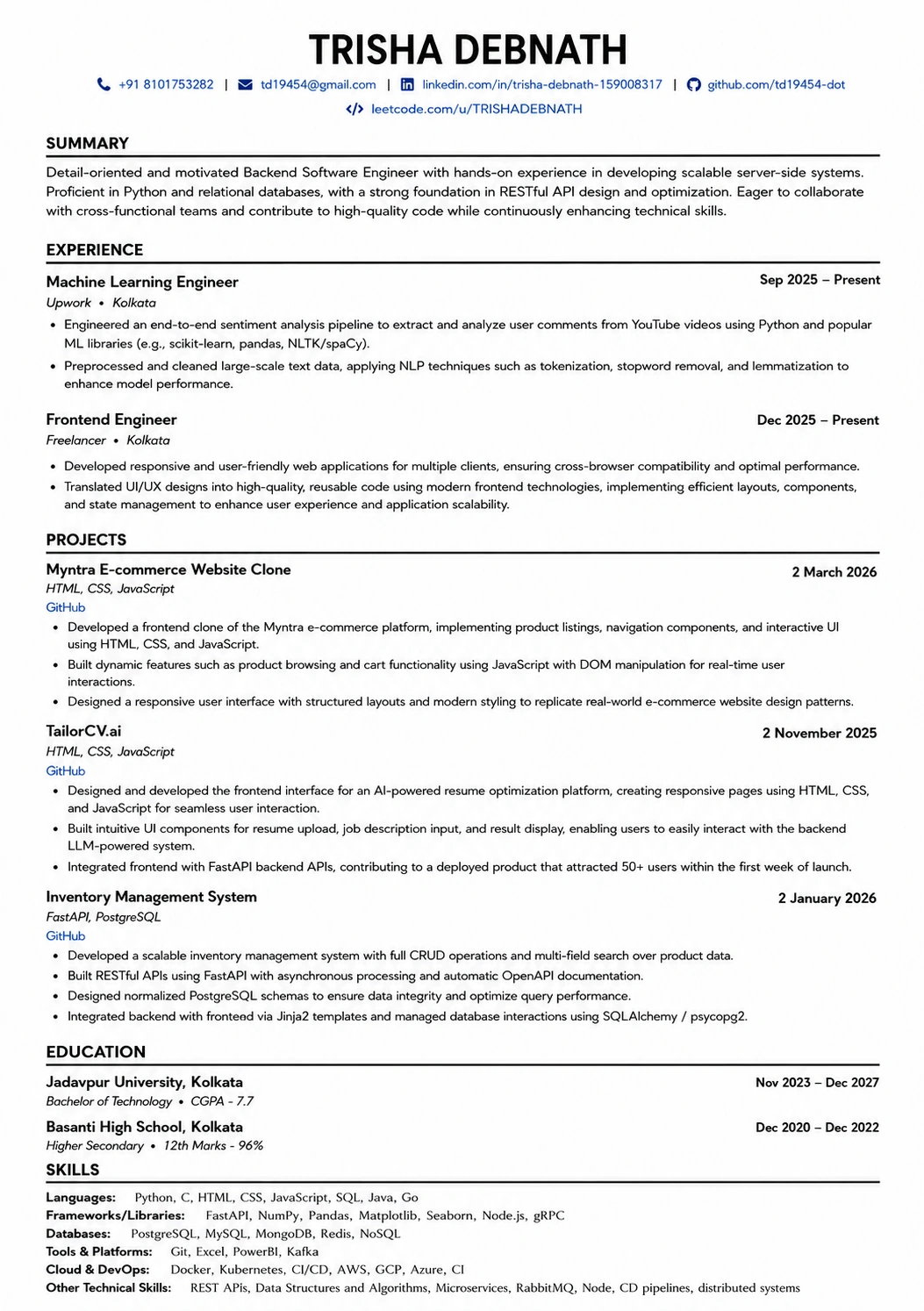
A layout with a real skills section gives the parser somewhere clean to find every term you just added.
Was this guide useful?
Be the first to rate it.