SS
SS
Key Takeaways
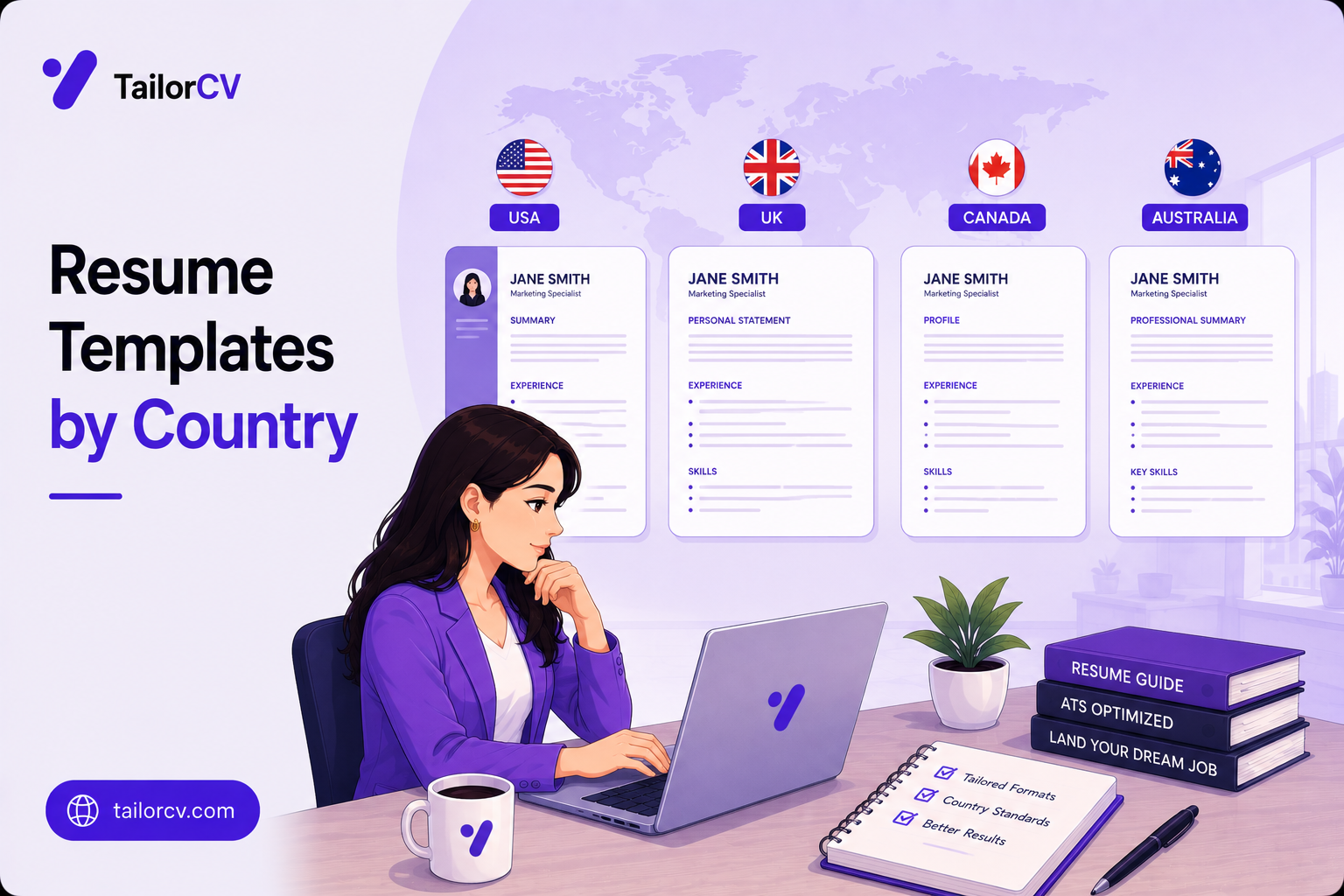
- There is no universal resume template. Photo, length, personal details and section order all vary by market, and getting them wrong signals unfamiliarity.
- Photo markets: Germany, Switzerland, much of the Gulf, South Korea, and traditionally France. No-photo markets: UK, Ireland, US, Canada, Australia, New Zealand.
- Length: one page in France and the US, two in most of Europe and the Gulf, two to three in New Zealand.
- Whatever the market, the template must parse. Single column, standard headings, selectable text.
- TailorCV offers 22 templates across 4 style variants, so you can hold one base resume and render it appropriately per market.
The four things that vary
Almost every national difference reduces to one of four decisions.
Photo or no photo. In the UK, Ireland, US, Canada, Australia and New Zealand, including one is at best neutral and at worst a signal you did not check. In Germany, Switzerland, South Korea and much of the Gulf, omitting one is conspicuous. In France and the Netherlands it is optional and trending toward omission at large employers.
Personal details. Date of birth, nationality, marital status and visa status appear routinely in Germany, Switzerland, the Gulf and Korea, and are deliberately excluded in the UK, US, Canada, Australia and New Zealand for anti-discrimination reasons.
Length. One page in France and the US. Two in Germany, the Netherlands, Ireland, the UK, Switzerland and the Gulf. Two to three in New Zealand. Longer academic CVs are a separate category everywhere.
Order. Education before experience for graduates in France, Germany and much of continental Europe; experience first almost everywhere else once you have any.
By market
| Market | Photo | Length | Personal details |
|---|---|---|---|
| United Kingdom | No | 2 pages | Minimal |
| Ireland | No | 2 pages | Minimal |
| United States | No | 1 page | Minimal |
| Canada | No | 1–2 pages | Minimal |
| Germany | Usually | 2 pages | Extensive |
| Switzerland | Yes | 2 pages | Extensive, incl. permit status |
| France | Optional | 1 page | Some |
| Netherlands | Optional, trending no | 2 pages | Some |
| Nordics | No | 2 pages | Minimal |
| Australia / NZ | No | 2–3 pages | Minimal |
| UAE / Gulf | Yes | 2 pages | Extensive, incl. visa status |
| South Korea | Yes | Structured form | Extensive |
| Hong Kong / Singapore | Optional | 2 pages | Some, incl. work rights |
The one universal: state your work authorisation clearly in markets where it is a live question. It is the reader's first practical concern and the most common thing left ambiguous.
The thing that matters more than the template
Parsing. It is invisible, it is decisive, and template choice is where people usually break it.
Single column. Two-column layouts look organised to a human and interleave into nonsense in a parser. This is the single most common self-inflicted resume failure.
Standard section headings. Experience, Education, Skills. A parser looks for recognisable headings and a creatively named section may not register as a section.
Text, not images. Anything rendered as a graphic — contact details, skill bars, an icon-based header — is invisible to automated screening.
Selectable text in the export. If you cannot select it in the PDF, no system can read it.
Simple bullets and standard fonts. Decorative glyphs sometimes extract as junk.
A template that fails these fails everywhere, regardless of how well it matches national convention. Run any new template through an ATS check once before you use it for real.
Holding one base and rendering many
The practical way to work across markets without maintaining several documents.
Keep one complete base resume. Everything you have done, described properly, in a plain format.
Render it per market. TailorCV holds 22 templates across 4 style variants, which means the same underlying content can be output as a two-page UK document or a photo-bearing German one without you rewriting anything.
Adjust the four variables, not the content. Photo, length, personal details, order. The substance is the same person either way.
Do not maintain five separate files. They drift, and one of them is always the stale one you send by accident.
And pick one template per market and stay with it. Consistency matters if anyone at a company sees two of your applications.
Choosing between templates within a market
Once the national conventions are settled, a few things still distinguish a good choice from a bad one.
Match density to your content. A candidate with ten years of experience needs a compact template; a graduate with one internship needs one with generous spacing, or the page looks empty. Using a dense template with thin content is the most common mismatch.
Prefer conservative for conservative sectors. Law, finance, government and healthcare reward a plain document. Design and technology tolerate more character.
Check how it handles long entries. Some templates break badly when a job title runs to two lines or a company name is long. Test with your actual content, not the sample text.
Check the page break. A template that splits a role across two pages awkwardly, or leaves a single orphaned line on page two, looks careless in a way nobody will tell you about.
Look at it printed, or at least at full page size. Screen-reading at 60% zoom hides spacing problems that are obvious on paper, and some employers still print.
Then commit. Template shopping is a very effective way to avoid improving the content, which is what actually determines outcomes.
Updating across markets efficiently
A workflow that stays maintainable.
One base document is the source of truth. Every fact lives there, complete and current.
Update the base, never the renders. The moment you edit a rendered version directly, you have two sources of truth and one of them is wrong.
Re-render when the base changes. It takes seconds and it means every market's version is current.
Keep a note of which template you use per market, so you are consistent if a company sees two applications from you.
Review the base quarterly. New projects, new tools, new responsibilities. Fifteen minutes every three months keeps everything downstream accurate.
And re-run the parsing check after any template change. A new template is a new risk, and the check takes ninety seconds.
Section order and what it signals
Beyond the four big variables, order carries meaning.
Education first is correct for graduates in France, Germany, Switzerland and much of continental Europe, and for anyone with under a year of experience almost anywhere. It answers the reader's first question rather than making them look for it.
Experience first is correct everywhere once you have relevant work. Education moves down and shrinks to a few lines.
A skills block near the top works well for technical roles and for automated screening, and looks odd on a senior commercial CV.
A summary paragraph is genuinely read in the Netherlands, France and the Gulf, and often skimmed in the UK and US. Where it is read, make it specific; where it is skimmed, keep it short or omit it.
Certifications and licences deserve their own section in Australia, the Gulf and healthcare everywhere, and can be a line elsewhere.
Referees are expected in New Zealand and Switzerland, and "available on request" is unnecessary filler in the UK and US.
Interests are conventional in France, unusual in the US, and harmless in most places if kept specific.
A practical sequence
If you are building this from scratch, do it in this order.
1. Write the base document. Complete, plain, everything included, no design.
2. Fix the content. Outcomes not duties, numbers where they are real, specific tools named. This is the step that determines outcomes and it is the one people rush.
3. Choose the market. Then apply the four variables — photo, length, personal details, order.
4. Pick a template that matches density and sector. Test it with your real content.
5. Run the parsing check. Export, copy the text out, read it.
6. Run an ATS check against a real posting to confirm both parsing and matching.
7. Only then start applying — and tailor per posting from the base rather than editing the render.
Most people do steps four and seven and wonder why it is not working.
Mini checklist
- unchecked: Target market's photo convention checked
- unchecked: Length matched to the market
- unchecked: Personal details included or excluded appropriately
- unchecked: Section order correct for a graduate in that market
- unchecked: Work authorisation stated where it is a live question
- unchecked: Single-column layout confirmed
- unchecked: Standard section headings used
- unchecked: Text selectable in the exported PDF
- unchecked: Template run through an ATS check once
Scenarios
Scenario 1: You are applying to Germany and Ireland in the same week
Same base resume, two renders. The German one gets a photo, personal details and education first; the Irish one gets none of those and leads with experience. The content underneath is identical.
Scenario 2: You found a template you love with two columns
Test it before committing. Copy the text out of the exported PDF and read it. If the sentences interleave, it will fail at every large employer regardless of how good it looks.
Scenario 3: You do not know which market you are targeting yet
Use the two-page, no-photo, single-column convention. It is the least wrong default globally, and it adapts to a photo market with one change.
Tip: Before you commit to any template, export it and copy the text into a plain editor. What you see is what every automated system sees, and a template that fails that test fails in every country on the list.
Do's and Don'ts
Do
- Match photo convention to the market
- Match length to the market
- State work authorisation where it matters
- Keep one base and render per market
- Use single-column layouts
- Test any new template for parsing
Don't
- Use one document everywhere
- Include a photo in the UK, Ireland, US, Canada or Australia
- Omit one in Germany, Switzerland or the Gulf
- Use two-column or icon-heavy designs
- Maintain five separate resume files
- Assume a good-looking template parses well
Common Mistakes
- One document for every market. The four variables are noticed and they signal unfamiliarity.
- Two-column layouts. The most common self-inflicted parsing failure there is.
- Text inside images. Invisible to every automated system.
- Maintaining several files. They drift, and you will send the stale one.
- Ignoring work authorisation. It is the reader's first practical question.
- Never testing the export. Ninety seconds catches what nothing else will.
Related Guides
Keep building on this with the related guides in this series:
- Free ATS Checkers Versus Paid Tools
- Cover Letters That Match the Country
- Portfolio Websites for International Students
- The Swiss Application Dossier
- Resume Format for Dubai and the UAE
You can also check your resume's ATS score for free, generate a tailored cover letter, or build a portfolio website in minutes.
Frequently Asked Questions
Should I include a photo on my resume?
It depends entirely on the market. Yes in Germany, Switzerland, the Gulf and South Korea; no in the UK, Ireland, US, Canada, Australia and New Zealand; optional and declining in France and the Netherlands.
How long should my resume be?
One page in France and the US, two in most of Europe and the Gulf, two to three in New Zealand. Academic CVs are a separate category.
Does the template affect my ATS score?
Substantially. Two-column layouts, text inside images and non-standard headings all break parsing, and a document that parses badly fails before any matching happens.
Should I keep separate resumes for each country?
Keep one complete base and render it per market. Separate files drift apart and you will eventually send the stale one.
What is the safest default if I am unsure?
Two pages, no photo, single column, standard headings, experience first. It is the least wrong option globally and adapts easily.
How do I test a template?
Export it as PDF, copy the text into a plain editor, and read what comes out. If it is scrambled or missing, no automated system will read it either.
How do I choose between templates within one market?
Match density to how much content you have, prefer conservative templates in conservative sectors, test with your real content rather than sample text, and check where the page breaks fall.
How do I keep versions for several markets in sync?
Keep one base document as the source of truth, update only the base, and re-render per market. Editing a rendered version directly creates a second source of truth that will drift.
What order should my sections go in?
Education first for graduates in continental Europe and for anyone with under a year of experience; experience first everywhere else once you have relevant work.
What is the right sequence for building a resume?
Write the complete base, fix the content, choose the market, pick a template matching your density and sector, run the parsing check, run an ATS check against a real posting, then apply.
Does your formatting survive the parser?
Upload your resume and see what an ATS actually reads back.
Drop your resume here or choose a file
PDF only. Max 2 MB.
We never share your data or use it to train AI models.

Was this guide useful?
Be the first to rate it.