TD
TD
Key Takeaways
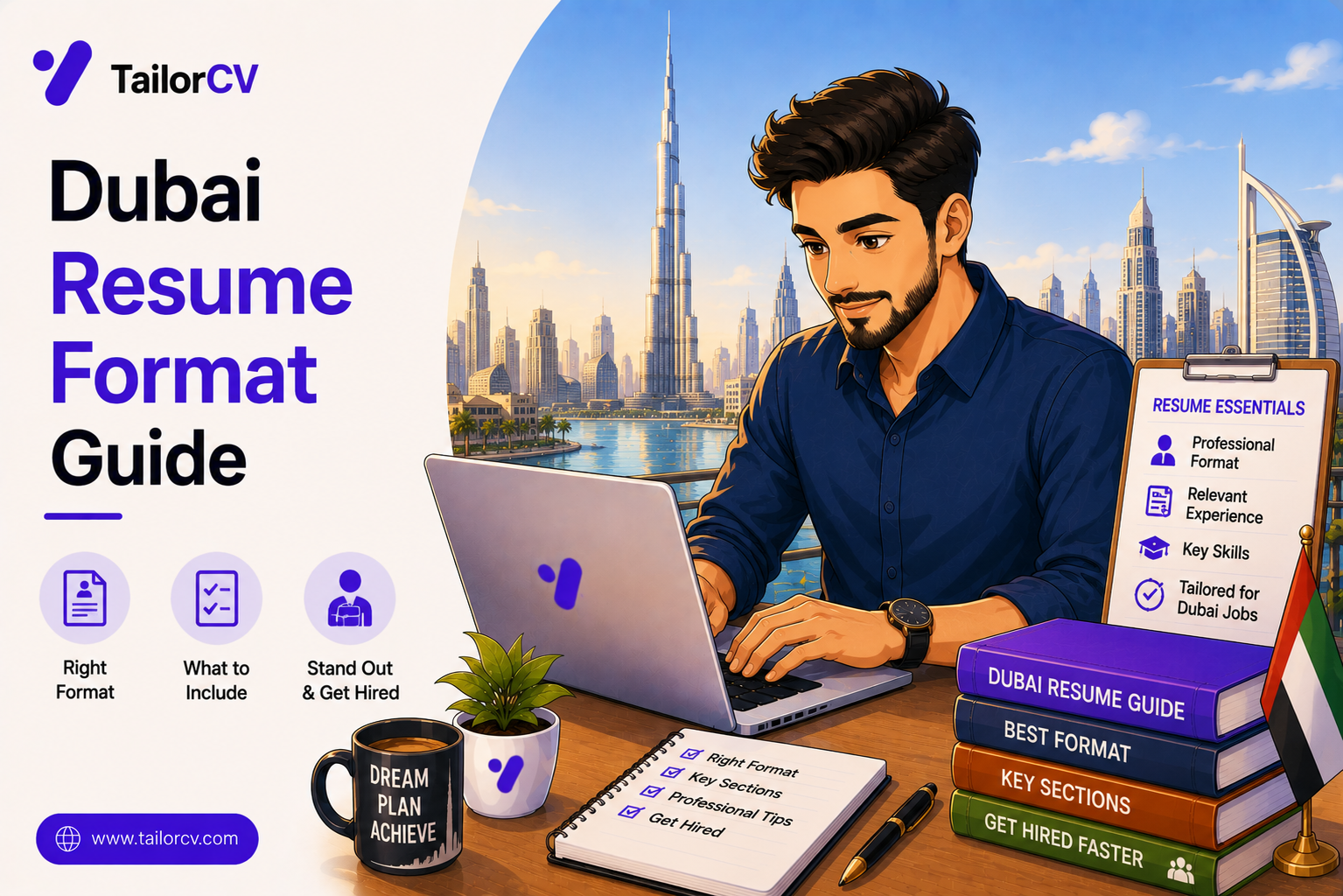
- UAE CVs are two pages, and include details that would be omitted in the UK or US — photo, nationality, and visa status.
- State your visa status explicitly. Employment visa, visit visa, spouse-sponsored, Golden Visa — recruiters screen on it immediately.
- Nationality is conventional here and is genuinely used in screening, which is a difference from Western markets that candidates should simply know about.
- Quantify everything. The market is competitive and volume-driven, and concrete numbers separate applications quickly.
- Include notice period and availability — Gulf recruiters ask early because start dates matter for visa processing.
The shape of a UAE CV
Two pages, clean, reverse chronological, and more informationally complete than a Western CV.
Contact details: name, UAE phone number if you have one, email, LinkedIn, and current location. A local number matters — it signals you are here or seriously committed to being.
A photo is conventional. A plain professional headshot, top corner. This is standard practice across the Gulf and its absence is noticed.
Personal details that would be unusual elsewhere: nationality, and often date of birth and marital status. Nationality in particular is used in screening — for visa cost, for language coverage, and for market familiarity.
Visa status is the most important line on the document. More on this below.
Professional summary of three or four lines, specific and quantified.
Work experience with employer, location, dates, and results with numbers.
Education, with the institution's country stated clearly. Degrees from a wide range of countries appear in this market and recruiters need the context.
Skills, languages (Arabic is a genuine advantage in some roles, and other languages matter for regionally-facing positions), and certifications.
Driving licence if you hold a UAE one — for many roles it is a practical requirement and worth stating.
The visa status line
This is the single highest-value sentence you can write on a UAE CV.
Why it matters. Sponsoring an employment visa costs the employer money and time. A candidate who already holds transferable status, or who needs no sponsorship at all, is materially cheaper to hire.
Write your actual position plainly:
- "UAE Employment Visa (transferable), currently with [sector] employer"
- "UAE residence visa sponsored by spouse — no employer sponsorship required"
- "Golden Visa holder — self-sponsored, available immediately"
- "Visit visa, in Dubai until [date], available for interview"
- "Applying from abroad, sponsorship required"
Even the last one is better than silence. Ambiguity makes a recruiter assume the most expensive case, and a large number of otherwise strong applications die on exactly this uncertainty.
A spouse-sponsored or Golden Visa position is a genuine competitive advantage — say it in the summary, not buried at the bottom.
Writing bullets that survive volume screening
Dubai recruiters see very high application volumes, and skimmable specificity wins.
Lead with the outcome, not the duty. "Reduced monthly reporting cycle from five days to two by rebuilding the consolidation process" beats "responsible for monthly reporting".
Numbers do the work. Team size, budget, transaction volume, percentage change, timeframe. They do not need to be large — they need to be real.
Name the region. GCC, MENA, Levant, South Asia — regional experience is a genuine asset in this market and worth making explicit.
Name systems and standards precisely. SAP, Oracle, IFRS, specific engineering codes. Screening is literal, and the exact term is what matches.
Keep bullets to two lines. Anything longer stops being scanned.
Notice period and availability
A small section that resolves a real question.
Gulf employers plan around visa processing and handover, so your availability is a practical scheduling input rather than small talk. State it: "Available immediately" or "30 days' notice". Putting it on the CV saves a round of emails and signals that you understand how the market works.
Structuring for a high-volume market
Dubai recruiters handle unusual application volumes, and structure is what survives that.
Front-load the first third of page one. Name, contact, visa status, and a summary that states your discipline, your years of experience and one quantified achievement. If a reader stops there, they should still know whether to continue.
Use a skills block. A short, scannable list of tools, systems and standards. It reads quickly and it matches literally against automated screening.
Keep formatting conservative. Single column, standard headings, no text inside graphics. Designed CVs parse into nonsense and in a volume market a parsing failure is simply a rejection.
Reverse chronological, always. Functional CVs raise suspicion here as they do in most markets.
Name the file properly. "Ahmed_Khan_CV_Financial_Analyst.pdf" is findable in a folder of three hundred; "Resume_updated.pdf" is not.
Tailoring for the Gulf specifically
Three adjustments that a Western CV rarely makes.
Name the market you have worked in. Experience in GCC, MENA, the Levant or South Asia is genuinely valued, and generic geography wastes it. "Managed a supplier base across the GCC" says something a bare list of duties does not.
Translate your qualifications into recognisable terms. Degrees in this market come from dozens of education systems. State the country, and where a qualification is professionally significant — ACCA, CFA, PMP, CIPS, specific engineering chartership — put it prominently, because these carry weight here.
Reflect the advert's exact wording. If a posting names IFRS, or a specific ERP module, or a particular safety standard, use that exact term where it is true of you. One ATS check confirms the document parses and matches before you send it anywhere.
Include a cover note even when optional. A short, specific message that names the company and connects your experience to the role separates you from the majority who attach a CV and nothing else. A tailored cover letter built against the actual posting is a fast way to do this properly.
What to leave off
Some conventions travel badly in the other direction, and a Western candidate over-correcting is its own problem.
Do not include your passport number, Emirates ID number or visa number. Status yes, document numbers no — those belong on forms, not on a document you email to strangers.
Do not attach scanned certificates to the CV itself. Send them when asked. A twelve-megabyte attachment with a CV buried in it is a bad first impression.
Do not list salary history unprompted. If a portal asks, answer. Volunteering it on the CV weakens your position before any conversation starts.
Do not use a religious or personal statement. The UAE workplace is extremely mixed and professional documents stay professional.
Skip the objective statement. "Seeking a challenging role in a dynamic organisation" is filler, it appears on a large share of CVs in this market, and it makes yours look like all of them. Replace it with a summary that states what you do and one thing you have measurably done.
Do not exaggerate your Arabic. As with any language claim, it can be tested in the room, and in a market where Arabic is genuinely useful the temptation is stronger than usual.
Following up in the Gulf
Etiquette differs from the Swiss or Dutch convention and it is worth knowing.
Persistence is more acceptable here. A polite follow-up after a week, and another later, is normal rather than pushy. Processes genuinely stall for reasons unrelated to you, and a well-timed message brings an application back to the top of a pile.
Use LinkedIn to reach the hiring manager, not only the recruiter. A short, specific message referring to the role and to something concrete about the company works far better than a connection request with no note.
Ask for a referral before you apply, not after. Referrals matter more than almost anything else in this market, and an internal referral submitted alongside your application is a different object from a cold submission.
Be ready to interview quickly. Availability is a genuine advantage — employers here move fast when they decide, and a candidate who can meet this week has an edge over one who cannot.
Sector-specific adjustments
The base format holds; the emphasis shifts by field.
Finance and accounting. Lead with your professional qualification — ACCA, CPA, CFA, CMA — in the summary, not the certifications section. Name the standards you have worked under, and quantify by transaction value, portfolio size or reporting scope.
Engineering and construction. State the codes and standards you have worked to, your project values, and any UAE or GCC authority approvals you have dealt with. Local regulatory familiarity is a genuine differentiator on a Gulf project.
Technology. Name the stack precisely and link to something deployed. A portfolio site with working projects does more here than an extra paragraph of description.
Sales and business development. Quantify relentlessly — targets, achievement against target, territory, deal sizes, and named market coverage.
Healthcare. Licensing dominates. DHA, HAAD/DoH, MOH — state which licence you hold or which eligibility you have obtained, because without it the rest of the CV is academic.
Hospitality and aviation. Property or fleet scale, brand names, and language coverage carry disproportionate weight in a market where these are major employers.
Mini checklist
- unchecked: Two pages, reverse chronological
- unchecked: Professional photo included
- unchecked: Nationality stated
- unchecked: Visa status stated explicitly and prominently
- unchecked: UAE phone number if you have one
- unchecked: Notice period and availability included
- unchecked: Every bullet quantified
- unchecked: Regional experience named explicitly
- unchecked: Education country stated
- unchecked: Exported as PDF and checked with an ATS scan
Scenarios
Scenario 1: You hold a spouse-sponsored residence visa
Put it in your professional summary, not at the bottom. It means an employer hires you with no sponsorship cost at all, which is one of the strongest things you can say in this market.
Scenario 2: You are applying from abroad with no UAE presence
Say so plainly and pair it with a reason to bother — a specific skill, regional experience, or a qualification that is scarce here. Vagueness about status plus vagueness about value is fatal.
Scenario 3: You are in Dubai on a visit visa for interviews
State it with the dates. It tells a recruiter you can attend an in-person interview this week, which is a genuine practical advantage over a candidate in another time zone.
Tip: Put your visa status in the top third of the first page, not at the end. Recruiters screening a hundred CVs are looking for it, and the ones who cannot find it quickly assume the expensive answer.
Do's and Don'ts
Do
- Include a professional photo
- State visa status prominently
- Give a UAE phone number if you have one
- Quantify every bullet
- Name your regional experience
- Include notice period
Don't
- Omit visa status and hope
- Use a UK or US CV unchanged
- Write duty-based bullets
- Exceed two pages
- Leave your education's country ambiguous
- Use a heavily designed layout that parses badly
Common Mistakes
- Leaving visa status out. Recruiters assume the most expensive case when it is missing.
- Reusing a Western CV unchanged. No photo, no nationality and no visa line reads as unfamiliar with the market.
- Duty-based bullets. In a high-volume market only quantified outcomes get read.
- Burying an advantage. Spouse-sponsored or Golden Visa status belongs in the summary.
- No local phone number. It signals distance and reduces callbacks.
- Omitting availability. Start dates matter here because of visa processing.
Related Guides
Keep building on this with the related guides in this series:
- Graduate Jobs in the UAE
- The UAE Golden Visa Explained
- Tax-Free Salaries in the UAE
- The Swiss Application Dossier
- How to Write a Dutch CV That Gets Read
- Veteran to Civilian Resume Guide 2026
You can also check your resume's ATS score for free, generate a tailored cover letter, or build a portfolio website in minutes.
Frequently Asked Questions
Should I put a photo on a Dubai CV?
Yes. A plain professional headshot is conventional across the Gulf, and its absence is noticed.
Do I need to state my nationality?
It is conventional in the UAE and it is used in screening. This differs from Western practice, and following the local convention is the practical choice.
Where should visa status go?
In the top third of the first page, ideally in the professional summary. Recruiters screen on it, and missing information is read as the most expensive scenario.
How long should a UAE CV be?
Two pages. Longer is not read; shorter usually means you have not quantified enough.
Is Arabic required?
Rarely for professional private-sector roles, which run in English. It is a genuine advantage for government-facing, legal and some client-facing positions.
Should I include my notice period?
Yes. Gulf employers plan around visa processing and handover, so availability is a practical input rather than a detail.
How conservative should my Dubai CV formatting be?
Very. Single column, standard headings, no text in graphics. Volume screening is automated and literal, and a designed document that parses badly is simply rejected.
Do professional qualifications matter in the UAE?
Considerably. ACCA, CFA, PMP, CIPS and engineering chartership carry real weight in this market and belong prominently on the document rather than in a footnote.
Should I include my passport or Emirates ID number on my CV?
No. State your visa status, but keep document numbers off a file you email to strangers — those belong on official forms.
Is following up acceptable in the UAE?
More so than in most markets. A polite follow-up after a week, and another later, is normal, and processes genuinely stall for reasons unrelated to your application.
Does your formatting survive the parser?
Upload your resume and see what an ATS actually reads back.
Drop your resume here or choose a file
PDF only. Max 2 MB.
We never share your data or use it to train AI models.

Was this guide useful?
Be the first to rate it.