SS
SS

Key Takeaways
- Estimating is legitimate when you can explain how you got the number in one or two sentences. If you cannot, it is a guess - leave it out.
- Build estimates from things you directly observed: time per task, volumes you handled, before-and-after counts, team size, frequency.
- Use honest wording - "about", "roughly", "~", or a range - and round down rather than up.
- Prefer small, certain numbers over big, uncertain ones. "Cut report prep from 2 days to half a day" beats "saved the company lakhs".
- Scope metrics (volume, frequency, size) are almost always knowable and often just as persuasive as outcome metrics.
- Keep a one-line note of how you calculated each estimate. Interviewers ask, and "I worked it out like this" is a strong answer.
The posting wants measurable impact, and you were never shown the dashboard. You do not need exact data to write a credible number - you need a number you can explain. Build it from what you directly saw (hours saved, volumes handled, before-and-after counts), phrase it as an approximation, and round down.
This guide covers five estimation methods, the wording that keeps estimates honest, and how to defend them when an interviewer asks "how did you measure that?"
Why Estimates Are Fair Game - Within Limits
Most people's real work was never measured precisely. Interns, junior staff and people in support roles rarely see revenue figures. Recruiters know this.
What reviewers actually want from a number
A metric on a resume does two jobs: it shows scale, and it shows you think in outcomes. An honest estimate does both. It also gives recruiters searching for evidence something concrete to stop on, instead of a line of duties. The post on how to quantify resume achievements covers why numbers catch the eye; this guide is about producing them when nobody handed you one.
The line between estimate and fabrication
| Estimate (fine) | Fabrication (not fine) |
|---|---|
| Built from things you observed | Pulled from nowhere or from what sounds impressive |
| You can explain the calculation | You would struggle if asked |
| Rounded down, stated as approximate | Presented as precise, rounded up |
| Your manager would recognise it as fair | Your manager would be surprised |
The general honesty tests - verifiability, defensibility, proportion - are in tailoring without lying. Estimates live or die on the second one.
What You Can Almost Always Measure
Before estimating outcomes, check the numbers you already know. These scope metrics are nearly always available and are persuasive on their own.
| Type | Examples | Where to find it |
|---|---|---|
| Volume | Tickets handled, invoices processed, calls made | Your memory of a typical day or week |
| Frequency | Daily report, weekly release, monthly close | Your calendar or routine |
| Size | Team members, users, stores, SKUs, rows of data | Org charts, system screens, project docs |
| Duration | Project length, turnaround time, cycle time | Emails, tickets, commit history |
| Money handled | Budget managed, cash reconciled, spend approved | Approval limits, budget emails |
| Reach | Students taught, attendees, subscribers | Registrations, class lists |
Weak: "Handled customer support tickets."
Strong: "Resolved about 40 support tickets a day across email and chat for a 12,000-customer SaaS product."
Nothing here is estimated beyond a typical daily count. The post on quantifying achievements without numbers has more scope-metric examples; the rest of this guide covers outcome estimates.
Five Methods for Estimating Outcomes
Method 1: Time saved, multiplied out
The most reliable estimate. You know how long something took before and after your change, and how often it happens.
Calculation: time saved per occurrence x occurrences per week or month.
"The weekly report took me about 6 hours to build by hand. After I automated the data pull in Python, it took about 1 hour. That is 5 hours a week, or roughly 20 hours a month."
Bullet: "Automated the weekly sales report in Python, cutting preparation time from about 6 hours to 1 - roughly 20 hours a month freed for analysis."
Method 2: Before-and-after counts
You saw a count before and after your change - errors, complaints, returns, late deliveries - even if nobody reported the percentage.
Calculation: (before - after) / before.
"We used to get around 25 billing complaints a month. After I rewrote the invoice template, it dropped to around 10."
Bullet: "Redesigned the invoice template after tracking recurring confusion; billing complaints fell from about 25 to 10 a month."
Notice the bullet gives counts rather than a "60% reduction". Counts are more honest when your sample is small, and they are easier to defend. The action-then-result shape it uses is the standard one from how to write resume bullet points.
Method 3: Share of a known total
You know the total and roughly what share your work touched.
"The team processed about 3,000 applications a quarter. I handled the screening for the engineering roles, which were about a third."
Bullet: "Screened roughly 1,000 engineering applications a quarter, about a third of the team's total volume."
Method 4: Unit value x volume
You know the approximate value of one unit and how many units your work affected.
"Each recovered failed payment was worth about ₹800 on average. My retry flow recovered around 150 a month."
Bullet: "Built a failed-payment retry flow that recovered around 150 payments a month - roughly ₹1.2 lakh in monthly revenue."
Use this only when you genuinely know the unit value. If you are guessing both numbers, drop the revenue claim and keep the count.
Method 5: Ranges and conservative bounds
When you know the value falls in a range, state the range or the lower bound.
Bullet: "Cut onboarding time for new hires from two weeks to four or five days by writing the team's first setup guide."
A range signals honesty. The lower bound signals confidence. Both are better than a suspiciously precise single figure.
Choosing the Method for Your Situation
| What you know | Best method | Example output |
|---|---|---|
| How long a task took before and after | Time saved x frequency | "~20 hours/month saved" |
| A rough count before and after | Before/after counts | "Complaints fell from ~25 to ~10 a month" |
| The team total and your share | Share of total | "~1,000 of the team's 3,000 cases" |
| The value of one unit | Unit value x volume | "~₹1.2 lakh recovered monthly" |
| Only a rough range | Range / lower bound | "from two weeks to 4-5 days" |
| Nothing numeric at all | Scope metrics only | "for a 12-store region" |
Wording That Keeps Estimates Honest
The same number reads differently depending on how you frame it.
Approximation markers
"About", "roughly", "around", "~", "nearly" and "over" all signal an estimate. Use them once per bullet, not three times. "Cut preparation from about 6 hours to 1" is enough; "roughly cut about 5 hours, approximately" is not.
Round down, not up
If your calculation gives 23 hours, write "about 20" or "over 20", not "25". Rounding down protects you if the interviewer's own sense of the number is lower.
Attribute team outcomes carefully
If the outcome came from a team, say what your part was. "Contributed to a 30% cut in delivery time by building the route-planning sheet" is honest; "Cut delivery time 30%" alone may not be. Tailoring when your work was a team effort covers this in depth.
Avoid false precision
"Improved efficiency by 37.4%" invites the question "how did you measure 0.4%?" Unless you have the exact data, precise decimals look invented.
Worked Example 1: An Intern With No Access to Metrics
Situation: Zoya did a three-month marketing internship. She wrote social posts and helped with a newsletter. Nobody shared performance data with her.
What she observed: She posted on Instagram three times a week. The account had about 8,000 followers when she started and about 9,500 when she left. She also cleaned the newsletter mailing list of about 4,000 addresses, removing roughly 600 that had bounced.
Before: "Created social media content and supported newsletter operations."
After: "Wrote and scheduled three Instagram posts a week during a period when followers grew from about 8,000 to 9,500. Cleaned a 4,000-address newsletter list, removing about 600 bounced contacts."
She does not claim she caused the follower growth - she states what she did and what happened during that period. That is honest and still informative. For more intern-level examples, see fresher resume projects that get interviews.
Worked Example 2: A Mid-Career Operations Lead
Situation: Karthik manages warehouse operations. He introduced a new picking sequence but never received a formal before-and-after report.
What he knew: Pickers used to complete about 90 orders per shift; after the change, about 110. There were two shifts a day with eight pickers each.
Calculation: (110 - 90) / 90 = about 22% more orders per shift.
Bullet: "Redesigned the warehouse picking sequence, raising output from about 90 to 110 orders per picker per shift across a 16-person team."
He could have written "boosted productivity 22%", but the counts are more concrete and easier to explain. His note for interviews: "Pickers logged orders per shift on the handheld; I compared a month before and a month after."
Worked Example 3: A Developer Estimating Performance Impact
Situation: Aditi optimised a slow database query. She knows the page load time dropped but has no business metrics.
What she observed: The dashboard took around 8 seconds to load; after her index and query rewrite, about 2 seconds. About 300 internal users opened it daily.
Weak: "Optimised database queries to improve performance."
Strong: "Rewrote the main dashboard query and added two indexes, cutting load time from about 8 seconds to 2 for roughly 300 daily internal users."
She resisted adding "saving 30 hours of employee time per day" - that multiplication assumes every user waited the full time every visit, which she could not defend. Engineers are especially prone to this kind of inflated derived metric; ATS mistakes tech professionals make covers the other common ones.
Worked Example 4: A Customer Support Agent With Only Anecdotes
Situation: Rukhsar has two years in customer support at an e-commerce company and wants a team lead role. She has no reports, just her memory of the work.
What she can reconstruct:
- She handled about 50 chats a day on a typical shift.
- She wrote 14 saved-reply templates that the team adopted; she remembers colleagues saying replies got faster.
- The team's weekly CSAT report showed her scores near the top most weeks.
What she writes:
Before: "Provided excellent customer service and helped the team improve response times."
After: - "Handled about 50 customer chats a day across order, refund and delivery issues." - "Wrote 14 saved-reply templates adopted by a 12-person support team for common order issues." - "Consistently ranked in the top three of 12 agents on weekly CSAT."
She does not claim a percentage improvement in team response time, because she never saw one. The template count and adoption are facts she can verify; "top three of 12 on weekly CSAT" is specific and checkable with her former manager. Each line passes the "would my manager nod?" test. For moving into a lead role, see two years in and applying for a mid-level role.
At Each Career Stage
| Stage | Numbers you usually have | Numbers you usually lack | Best method |
|---|---|---|---|
| Fresher / intern | Volumes, counts, dataset sizes | Business outcomes | Scope metrics, before/after counts |
| Early career | Time saved, tickets, tasks, users | Revenue impact | Time saved x frequency |
| Mid-career | Team outcomes, budgets, KPIs | Your isolated contribution | Share of total, attributed carefully |
| Senior | Business results, budgets, headcount | Clean attribution | Ranges and conservative bounds |
Freshers: scope beats outcome
A student project rarely has a business outcome, but it almost always has scale: rows of data, users, requests, participants. Scope metrics are honest and persuasive at this stage.
Senior candidates: attribution is the risk
Senior people usually have big numbers available - the risk is claiming more of them than they drove. Use "led the team that..." and ranges rather than precise attributions you cannot defend.
Edge Cases and Exceptions
Your employer's numbers are confidential
Use relative figures - percentages, multiples, ranges - instead of absolute ones. Confidential work on your resume covers anonymising numbers.
The result came after you left
If you started something and the result arrived after you moved on, say so honestly: "Designed the onboarding flow launched after my departure; the team later reported activation up about 10%."
The outcome was negative, but you limited the damage
Damage limitation is impact too: "Rebuilt the rollback process after a failed release, cutting recovery time from 6 hours to 40 minutes."
Two sources give different numbers
Use the lower, more conservative figure, or give a range. Never pick the higher number because it looks better.
Common Mistakes
Multiplying assumptions together
Every assumption you multiply adds uncertainty. "5 hours saved x 20 staff x ₹500 an hour x 52 weeks" produces an impressive number built on four guesses. Stop at the first number you actually know.
Claiming outcomes you could not have caused
Revenue went up in the year you joined - that does not make it your result. Tie outcomes to your specific action, or describe the context separately. Unexplained big claims are one of the resume red flags recruiters notice most quickly.
Estimating what you could state exactly
If you can check the real number - in a ticket system, a report, an old email - check it. Estimates are for when data is truly unavailable.
Using an estimate you would not repeat to your manager
The simplest honesty test: would your former manager nod if they read the line? If not, revise it down.
Converting everything to money
Money is impressive but often the least certain number. Time, counts and scope are usually more defensible and still persuasive.
Defending Your Numbers in an Interview
Interviewers pick the most impressive number on your resume and ask about it. Prepare.
Keep a calculation note for every estimate
For each estimated number, keep one line explaining how you got it. You will not show this to anyone, but you will say it out loud.
| Bullet number | Calculation note |
|---|---|
| "~20 hours a month saved" | Report took ~6h weekly by hand, ~1h after automation; 5h x 4 weeks |
| "Complaints fell from ~25 to ~10" | Counted billing tickets in the helpdesk for 2 months before and after |
| "~₹1.2 lakh recovered monthly" | ~150 recoveries x average order value of ~₹800 from the finance dashboard |
Say the method, not just the number
"About 20 hours a month - the report took roughly six hours by hand every week, and after I automated it, it took one" is a strong answer. It shows the number is real and that you think carefully about measurement. The interview story bank method is a good place to keep these explanations, and the mock interview tool will ask you about your own resume's numbers.
How This Fits Into Tailoring
When a posting emphasises "data-driven", "measurable impact" or specific KPIs, the bullets under your most relevant role need numbers most. Start there.
Quick sequence
- Find the posting's top requirement that implies metrics.
- Pick the two or three bullets closest to it.
- For each, list what you directly observed - time, counts, volumes, scope.
- Apply the matching method from the table above.
- Phrase with one approximation marker; round down.
- Write a calculation note for each.
For choosing which bullets to rewrite, see which bullets to rewrite. If a scan says your bullets lack quantified results, weak bullets behind a good score explains why that matters even when your keyword match is high.
TailorCV's AI resume optimizer is built not to invent numbers: it rewords around the metrics already in your resume, so estimates should come from you. Add yours first, then run the free ATS scan to see how the updated bullets read against the posting.
Quick Checklist
- Is every estimate built from something you directly observed?
- Can you explain each calculation in one or two sentences?
- Did you round down rather than up?
- Does each estimated number use one approximation word ("about", "roughly", "~")?
- Are team outcomes attributed with your specific part?
- Would your former manager recognise each number as fair?
- Have you written a one-line calculation note for every estimate?
Frequently Asked Questions
Is it OK to estimate numbers on a resume?
Yes, as long as you can explain how you got the number and it is based on what you directly observed. Use approximation words like "about" or "roughly", and round down.
What if I don't have access to any metrics?
Use scope metrics you always know: volumes handled, frequency, team size, number of users or customers. Then estimate outcomes only where you saw a clear before and after.
Should I use percentages or raw numbers?
Raw numbers are often more honest when your sample is small and easier to defend. Percentages work when the base is large and clearly measured. "From 25 to 10 complaints a month" is usually better than "60% fewer complaints" for a small team.
What if an interviewer asks how I measured something?
Explain your method in one or two sentences - what you observed and how you calculated it. A clear method is a strong answer, even when the number is approximate.
Can I claim a team result on my resume?
Only with your contribution made clear. State what you specifically did and how it contributed. See tailoring when your work was a team effort.
How precise should resume numbers be?
Only as precise as your data. Estimates should be rounded and marked as approximate; exact figures are fine when you have the real data.
Is it lying to round a number up?
Rounding up a real number slightly is common, but rounding down is safer and more defensible. Inflating a number beyond what you can explain crosses into misrepresentation.
What if my work had no measurable impact?
Most work has at least a scope metric - how much, how often, for whom. If an outcome truly cannot be estimated, describe the result qualitatively and specifically ("adopted by all three regional teams") rather than inventing a figure.
Is "about" or "~" better on a resume?
Both are fine. "About" reads more naturally in sentences; "~" saves space in tables or dense bullets. Use one consistently and only once per bullet.
Should I leave a bullet without a number rather than estimate?
If you cannot build an estimate you can explain, yes. A specific, qualitative result ("adopted by all three regional teams") is better than an invented figure.
What to Do Now
Pick the three bullets most relevant to the posting you are applying for. For each one, write down what you directly observed: how long, how many, how often, before and after. Choose a method from the table, write the estimate with one approximation word, and keep a one-line calculation note.
Then read confidential work on your resume if some of your numbers are sensitive, and team vs individual credit if your results came from a group effort.
What is your resume scoring right now?
Scan it against a job description and get your ATS match score in about a minute.
Drop your resume here or choose a file
PDF only. Max 2 MB.
We never share your data or use it to train AI models.

Templates that keep this structure intact
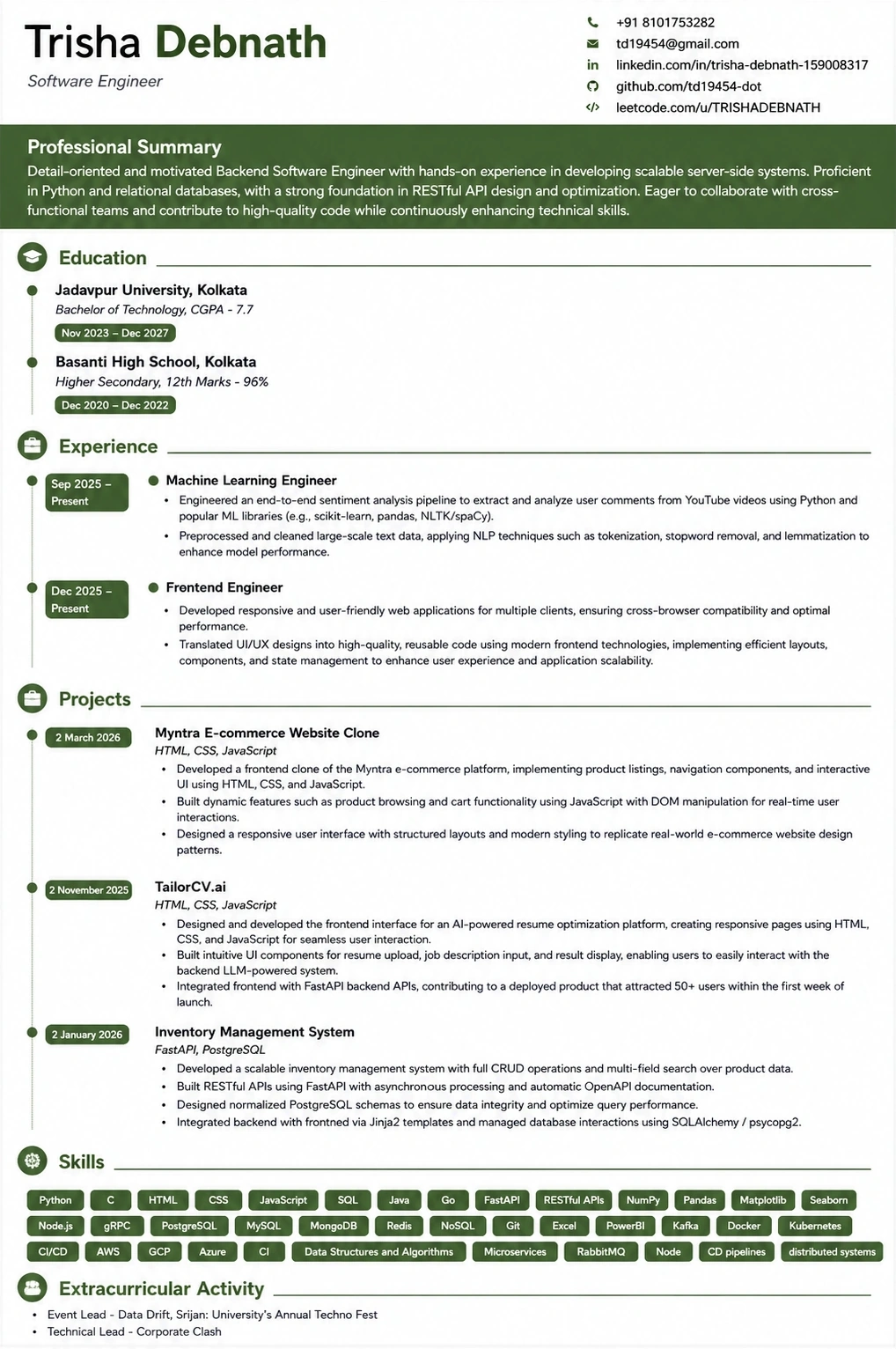
This template is ATS-tested — start from it and the formatting rules in this guide are already handled.
Was this guide useful?
Be the first to rate it.