 SS
SS
Key Takeaways
- Cover letters are not equally important everywhere. In the US and UK they are frequently skimmed; in France, Germany, the Netherlands and Switzerland they are genuinely read.
- Where they are read, a generic letter is worse than no letter — it demonstrates that you did not bother.
- The structure differs by market: the French vous, moi, nous, the German formality, the Dutch directness, the American brevity.
- Closing formulas are fixed in French and German and getting them wrong is conspicuous.
- A generated draft solves the blank page and the structure; the specifics and the voice should be yours.
Where it actually matters
The first question is whether to spend effort at all, and the answer is country-specific.
| Market | How much it matters |
|---|---|
| France | Very — the lettre de motivation is a real part of the assessment |
| Germany | Very — the Anschreiben is expected and read |
| Switzerland | Very — part of the required application dossier |
| Netherlands | Considerably — the motivatiebrief is standard |
| Denmark / Sweden | Considerably — the ansøgning and personligt brev are read |
| Ireland | Moderately — expected, read variably |
| United Kingdom | Variably — often skimmed, sometimes decisive |
| United States | Often skimmed, and many applications do not ask |
| Australia / New Zealand | Moderately — a short covering note is normal |
| UAE / Hong Kong / Singapore | Less formalised, but a short specific note stands out |
The practical rule: where the market reads them, write a real one. Where it does not, write a short specific note rather than nothing — because in a market where most people skip it, three good sentences are cheap and occasionally decisive.
The structural differences
Not just tone — the actual architecture differs.
France — vous, moi, nous. Open with the company and why it interests you; continue with what you bring and the evidence; close with what you would do together. The order matters, and the closing formula is fixed and formal.
Germany — the Anschreiben. Formal, structured, and precise. It states the position, connects your qualifications to the requirements specifically, mentions availability and often salary expectations if the advert asked, and closes with a standard formula.
Switzerland follows the German pattern and sits inside a complete dossier alongside work certificates and diplomas.
Netherlands — direct, specific, one page. Overstatement is penalised and hedged language reads as evasive. Say what you did.
United States — short, achievement-focused, and confident in a register that would read as boastful in the Netherlands or Sweden.
United Kingdom — a middle position: professional, evidence-based, less formal than Germany and less assertive than the US.
Nordics — understated and specific, because self-promotion is culturally uncomfortable and specificity is how you convey competence instead.
What every good letter does
Underneath the local variation, the same three things.
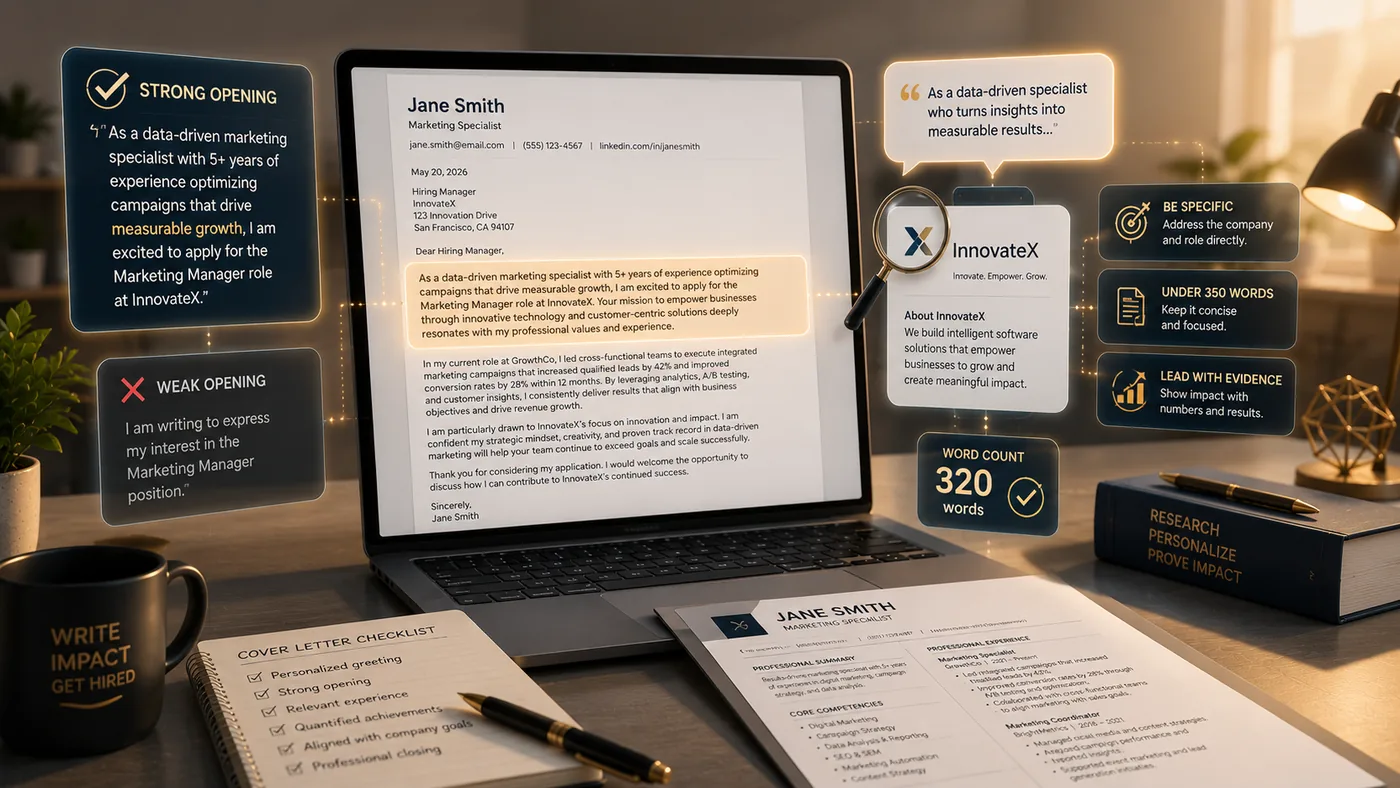
It is about them, not you. The opening should name something specific about the company — a product, a decision, a market they are in. "I am writing to apply for the position advertised" is a wasted first sentence in every country on earth.
It connects specific experience to specific requirements. Not a summary of your CV, which they have. One or two concrete things you have done that map onto what this role needs.
It answers the question the CV cannot. Why this company, why this role, why now. That is the letter's actual job.
And it is short. One page everywhere, three or four paragraphs, and shorter is usually better than longer.
Using a generated draft well
The blank page is the real obstacle, and it is worth solving.
A tailored cover letter generated against the actual posting gives you a structured first draft built from your own resume and the job description, which means it starts from your real material rather than from a template.
Then do three things to it.
Replace the opening with something specific to the company. This is the sentence that most distinguishes a real letter from a generated one, and it takes ninety seconds of reading their site.
Check the register against the market. A confident American draft needs toning down for the Netherlands; a measured one needs strengthening for the US.
Fix the closing formula. In France and Germany these are fixed phrases and an improvised one is immediately conspicuous.
On tier-one applications, rewrite the middle paragraph entirely in your own words. On volume applications, the draft with a specific opening is genuinely fine.
Common openings and why they fail
The first sentence carries more weight than the rest of the letter and most are wasted.
"I am writing to apply for the position of X advertised on Y." The reader knows. You applied through a form that recorded it.
"I was excited to see this opportunity." Every applicant says this and none of it is checkable.
"I am a recent graduate with a passion for..." Passion is unfalsifiable and the phrase appears on a large share of graduate applications.
"With over three years of experience in..." Better, but it is a CV summary rather than a reason to read on.
What works instead: something specific to them that you could only write after looking. "Your decision to move the platform onto an event-driven architecture is the kind of problem I spent last year on" is a sentence no other applicant sends.
Or something specific to you that is genuinely unusual. A concrete, slightly surprising fact about your work beats any adjective.
The test: could another applicant send your first sentence unchanged? If yes, rewrite it.
Formatting and delivery
Small things that affect whether it gets read at all.
Match the file to the market. PDF everywhere unless the advert asks otherwise, named with your own name and the role.
Address a named person where you can find one, with the correct local form. Where you cannot, use the market's standard neutral address.
Keep it on one page with normal margins and a readable size. A letter squeezed to nine-point to fit is a letter that was too long.
Paste it into the body of the email too when applying by email, rather than only attaching it. Attachments go unopened; body text gets read.
Mirror the advert's key terms where they are true — some employers screen the letter as well as the CV.
Proofread in the target language. If it is not your first language, have someone read it. The letter is the document where errors are least forgiven, because its entire premise is that you wrote it for them.
Adapting one letter across markets
You do not need to write from scratch each time, and you should not use the same one either.
Keep a master structure, not a master letter. Three or four paragraph slots — the company hook, your relevant evidence, the connection, the close.
The company hook is always new. It is the only paragraph that genuinely cannot be reused, and it is the one that matters most.
The evidence paragraph is reusable within a role type. If you are applying for data analyst roles, the concrete achievements you cite are largely stable.
The register changes by market. Same facts, different confidence level — stronger for the US, more measured for the Netherlands and the Nordics, more formal for Germany, Switzerland and France.
The close is fixed by language. Learn the standard formula for each language you apply in and use it exactly.
Which means the real work per application is one paragraph, not four. That is the difference between writing a real letter every time and giving up on them.
When to skip it entirely
Not every application deserves one, and pretending otherwise leads to skipping them everywhere.
When the form does not ask and the market does not read them. A US application form with no cover letter field is telling you something.
When there is a strong referral. An internal referral does more than any letter, and the letter becomes a formality.
When the role is tier three volume applying. Spend the effort on the applications you actually want.
But never skip it in France, Germany, Switzerland or the Netherlands. In those markets its absence is noticed, and the letter is part of how the application is assessed rather than an optional extra.
And never skip it when the advert explicitly asks for one. Ignoring a stated instruction is the cheapest possible way to be rejected.
Mini checklist
- unchecked: Market's expectations checked before deciding effort level
- unchecked: One page, three or four paragraphs
- unchecked: Opening specific to the company, not to the vacancy
- unchecked: One or two concrete achievements mapped to requirements
- unchecked: Register matched to the local norm
- unchecked: Correct closing formula for the language
- unchecked: Written in the language of the advert
- unchecked: Proofread by a native speaker if not your first language
- unchecked: Does not restate the CV
Scenarios
Scenario 1: You are applying in France or Germany
Write a real one, in the local language if the advert is in it, with the correct fixed closing formula. In these markets the letter is genuinely assessed and a generic one damages an otherwise strong application.
Scenario 2: You are applying in the US and the form makes it optional
Write three specific sentences. Most applicants skip it entirely, which makes a short, genuinely specific note disproportionately noticeable for almost no effort.
Scenario 3: Your language is not strong enough for a formal letter
Apply in English to employers whose advert is in English. A poor letter in the local language does more damage than a strong one in English, because it undermines the language level you claimed elsewhere.
Tip: Spend your ninety seconds on the opening sentence. Naming something specific about the company — a product decision, a market they entered, something you actually used — is what separates a real letter from a generated one, and it is the only part a reader is guaranteed to reach.
Do's and Don'ts
Do
- Check what the market expects before deciding effort
- Open with something specific about the company
- Map concrete achievements to stated requirements
- Match the local register
- Use the correct fixed closing formula
- Write in the advert's language
Don't
- Send a generic letter in a market that reads them
- Restate your CV
- Exceed one page
- Improvise a closing in French or German
- Write in a language beyond your actual level
- Skip it entirely where it is expected
Common Mistakes
- Generic letters where they are read. Worse than sending nothing at all.
- Restating the CV. They already have it; the letter answers what it cannot.
- Wrong register. American confidence reads badly in the Nordics and Netherlands.
- Improvised closings. French and German formulas are fixed and errors are conspicuous.
- Wrong language. Answering a German advert in English signals you did not read it.
- A wasted opening sentence. "I am writing to apply for" tells the reader nothing.
Related Guides
Keep building on this with the related guides in this series:
- Which Resume Template to Choose
- Portfolio Websites for International Students
- Free ATS Checkers Versus Paid Tools
- The French CV and Lettre de Motivation
- The Swiss Application Dossier
You can also check your resume's ATS score for free, generate a tailored cover letter, or build a portfolio website in minutes.
Frequently Asked Questions
Do cover letters actually get read?
It depends entirely on the market. In France, Germany, Switzerland and the Netherlands, genuinely yes. In the US and UK they are frequently skimmed or not requested.
Is a generic cover letter better than none?
In markets that read them, no — it demonstrates you did not bother. In markets that skim them, three specific sentences beat both.
How long should it be?
One page everywhere, three or four paragraphs. Shorter is usually better than longer.
Do closing formulas really matter?
In French and German, yes. They are fixed conventional phrases and an improvised closing is immediately noticeable.
Should I use a generated draft?
As a first draft, yes — it solves the blank page from your own material. Then replace the opening with something specific about the company and fix the register.
What language should I write in?
The language of the advert. A poor letter in the local language undermines the language level you claimed on your CV.
What makes a bad opening sentence?
Anything another applicant could send unchanged — restating the vacancy, expressing excitement, or claiming passion. If your first line passes that test, rewrite it.
Should I paste the letter into the email as well as attaching it?
Yes, when applying by email. Attachments frequently go unopened; text in the body gets read.
Do I have to write a new letter every time?
No — keep a master structure rather than a master letter. Only the company hook is genuinely new each time; the evidence paragraph is reusable within a role type and the close is fixed by language.
When can I skip the cover letter?
Where the form does not ask and the market does not read them, or when you have a strong internal referral. Never in France, Germany, Switzerland or the Netherlands, and never when the advert asks for one.
Was this guide useful?
Be the first to rate it.