TD
TD
Key Takeaways
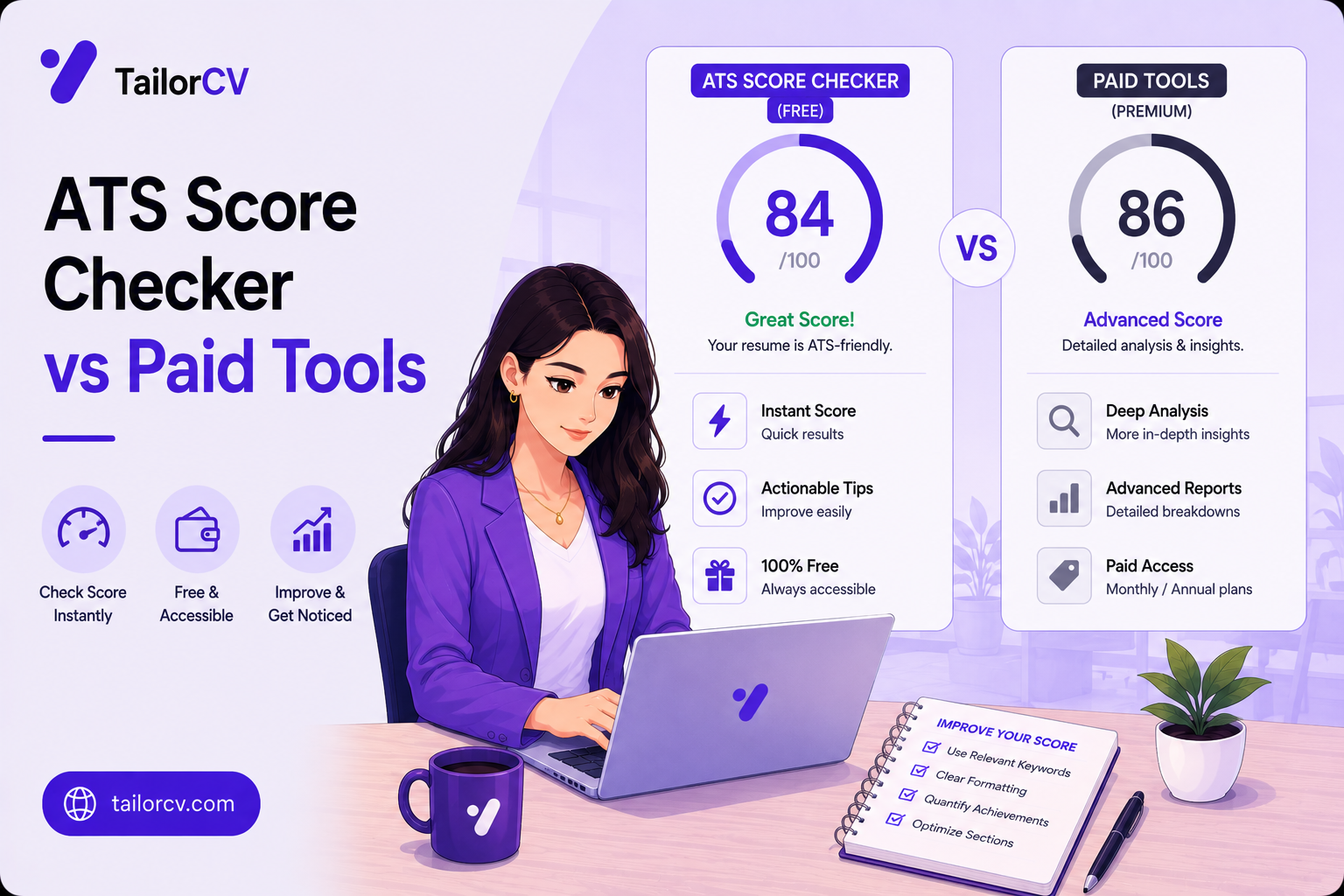
- Most of what paid resume scanners charge for — a match score and a keyword list — is available free, including on TailorCV's ATS analysis.
- The parsing check is the genuinely valuable part and the part users most often skip: whether a machine can read your document at all.
- A high score guarantees nothing. It measures document-to-posting correspondence, not whether you get an interview.
- What is worth paying for is doing something with the result — a rewritten, tailored document — not the diagnosis itself.
- Beware tools that raise your score by inventing skills. That is a problem you have to defend in an interview.
What an ATS checker actually measures
Strip away the presentation and every scanner does two things.
It parses your document. It extracts the text and tries to identify sections — contact details, work experience, education, skills. This is the step that silently kills applications, because a document that parses badly fails before any matching happens.
It matches text against a job description. Usually literal term matching, sometimes with light normalisation. It reports which terms from the posting appear in your document and which do not.
That is essentially the whole product. A score is a summary of the second step, presented as a number because a number feels more actionable than a list.
What none of them do is evaluate whether you can do the job, whether your experience level fits, or whether the vacancy is real. Those determine outcomes far more than a match percentage does.
Free versus paid, honestly
| Typically free | Typically paid | |
|---|---|---|
| Match score | Yes | Yes |
| Missing keyword list | Yes | Yes |
| Parsing / formatting check | Often | Yes |
| Section detection feedback | Sometimes | Yes |
| Rewriting the document for you | Rarely | Yes |
| Per-job tailoring at volume | Rarely | Yes |
| Unlimited scans | Varies | Usually |
The diagnosis is commodity. Scoring a resume against a job description is not technically difficult, which is why it is widely available free.
The action is where the work is. Rewriting a resume so it genuinely emphasises the right experience, in the posting's vocabulary, without inventing anything and without losing content — that is the part that takes real engineering, and it is the part worth paying for if you value your time.
On TailorCV specifically: the ATS analysis is free and unlimited for logged-in users, and guests get one free scan. The paid tier is about volume of tailored documents, not about seeing your score.
The parsing check nobody uses
If you take one practical thing from this, take this.
Open your resume PDF and try to select the text. If you cannot select it, it is an image, and every automated system in the world sees a blank page.
Copy all the text and paste it into a plain text editor. Read what comes out. This is approximately what a parser sees.
If it is scrambled, you have a two-column layout interleaving lines, and sentences that mean nothing to a matcher.
If your contact details are missing, they are inside an image or a header the parser did not read.
If sections run together, your headings are not recognisable as headings.
This test takes ninety seconds and it catches the single most damaging and most invisible resume problem there is. Almost nobody does it.
What no scanner can tell you
Worth being clear about, because scores become goals.
Whether the job is real. Reposted listings, pipeline-building adverts and roles already earmarked internally all score exactly the same as live vacancies.
Whether your level fits. A perfectly matched document for a role wanting eight years when you have one is still a rejection.
Whether the recruiter will like you. Human review is the next gate and it uses entirely different criteria.
Whether you should want the job. The most expensive applications are the well-optimised ones to jobs the candidate would have hated.
And whether the score is even the bottleneck. If you are getting interviews but no offers, your resume is working and improving the score changes nothing.
Reading a keyword gap honestly
The missing-terms list is the most actionable output of any scanner, and the most misused.
Sort every missing term into three buckets.
Have done it, did not write it. This is the largest bucket for most graduates and it is pure upside. You used Docker; your resume says "containerised the deployment". Name the tool. Legitimate, instant, and it improves every future application at once.
Have touched it. A university module, a small project, a few weeks alongside someone senior. Write it accurately — "used X in a university project to do Y" — rather than either omitting it or implying years of it.
Never used it. Not a resume edit. If it appears in most postings in your target market, it is a learning priority. If it appears in one, ignore it.
The failure mode is treating all three as bucket one. A resume padded with terms you cannot discuss produces interviews that go badly and a reputation you do not want.
And notice the pattern across postings, not within one. A term missing from one job description is noise; a term missing from eight is a signal about your market.
Choosing where to spend money
If you are going to pay for something in a job search, an honest ranking.
Worth paying for: anything that saves you significant repeated time — tailoring documents at volume, generating drafts you would otherwise write from scratch. Time is the scarce resource in a search and it converts directly into more and better applications.
Sometimes worth paying for: professional review by a human who knows your specific target market, if you can find a genuinely good one.
Rarely worth paying for: a score you can get free, a generic template you could recreate in an hour, a course teaching what a free guide covers.
Never worth paying for: anything promising to guarantee interviews, anything that raises your score by adding skills you lack, or any service that applies to jobs on your behalf without you reading the applications.
And free, but expensive in time: doing everything manually. That is a legitimate choice, and it is worth being honest that it costs you applications you did not make.
Diagnosing which gate you are failing
A score is only useful if it is the right problem. Here is how to tell.
No responses at all, ever. Likely a parsing or screening failure. Do the text-selection test, check your section headings, and confirm the document is not silently unreadable.
Occasional responses, mostly silence. Screening is passing sometimes. The issue is match quality and targeting — are you applying to roles your resume genuinely evidences?
Responses but no first interviews. The document passed the machine and failed the human. That is a content problem: duties instead of outcomes, no numbers, or a summary that says nothing.
First interviews but no second ones. The resume is working. Stop editing it. This is interview performance and it needs practice out loud rather than another scan.
Final rounds but no offers. Preparation and positioning at the late stage, or genuine competition. Ask for feedback; some employers give it.
Offers you do not want. Your targeting is off, not your documents. Narrow rather than broaden.
Most people optimise the wrong gate, usually the resume, because it is the part they control most directly. Working out which gate is actually failing is worth more than any tool.
When the score is misleading
Three situations where a scanner tells you something false.
Career changers. Your resume genuinely does not match the target role's vocabulary yet, and the score reflects that accurately while being useless as guidance. What you need is a rewritten narrative, not more keywords.
Highly specialised roles. A niche posting with unusual terminology can score low against an excellent resume simply because the vocabulary is idiosyncratic.
Very short job descriptions. A four-line posting gives a matcher almost nothing to work with, and the resulting score is close to noise.
In all three, read the posting yourself and make a human judgement. A scanner is a model of one gate, not a career adviser.
Myths worth retiring
Four claims that circulate constantly and are wrong or badly overstated.
"ATS rejects 75% of resumes automatically." The figure is repeated everywhere without a credible source. Most systems rank and surface candidates for a human rather than auto-rejecting them, though hard knock-out questions on work authorisation or location genuinely do reject.
"You need white keyword text hidden on the page." This is old advice and it is actively harmful. It is detectable, and a recruiter who finds it treats it as an attempt to deceive.
"Never use a PDF." Modern systems parse PDFs fine. The problem is not the format; it is a PDF containing an image or a two-column layout. If the advert asks for Word, send Word.
"A specific score gets you through." There is no universal threshold. Configuration varies enormously by employer and by role, and a number that clears one requisition means nothing for another.
What is true underneath all of it: documents must be machine-readable, terms must match literally, and knock-out questions matter. Those three facts explain most real outcomes without any of the folklore.
Mini checklist
- unchecked: Text-selectable check done on your PDF
- unchecked: Paste-into-plain-text test done and read
- unchecked: Contact details confirmed extractable
- unchecked: Section headings confirmed standard
- unchecked: Free ATS analysis run against a real posting
- unchecked: Missing terms reviewed for honesty, not just added
- unchecked: Score treated as relative, not as a target
- unchecked: Bottleneck identified — screening, human review, or interview
Scenarios
Scenario 1: You are being told to buy a resume scanner
Run a free one first, including the ninety-second parsing test. If the free result tells you what you needed, you have your answer about the paid one.
Scenario 2: Your score is low and you do not know why
Do the parsing test before anything else. A large share of low scores are parsing failures rather than content problems, and no amount of keyword editing fixes a document the machine cannot read.
Scenario 3: You get interviews but no offers
Stop optimising the resume. It is doing its job. The bottleneck has moved to the interview, and time spent on scores is time not spent on interview preparation.
Tip: Copy all the text out of your resume PDF and paste it into a plain text editor. What you see is roughly what every automated system sees. Ninety seconds, no tool required, and it catches the most damaging invisible problem there is.
Do's and Don'ts
Do
- Run the parsing test yourself
- Use a free checker before paying for one
- Add missing terms only where they are true
- Treat the score as relative
- Identify which gate you are actually failing
- Pay for action, not for diagnosis
Don't
- Chase a score as a goal in itself
- Add skills you do not have
- Assume a high score means an interview
- Ignore parsing in favour of keywords
- Keep optimising a resume that is already getting interviews
- Pay for a number you can get free
Common Mistakes
- Skipping the parsing test. It is free, fast, and catches the most damaging problem.
- Treating the score as a target. It measures correspondence, not outcomes.
- Adding untrue keywords. It creates an interview you cannot survive.
- Paying for diagnosis. The scoring is commodity; the rewriting is not.
- Optimising the wrong gate. Interviews without offers is not a resume problem.
- Assuming a low score means a bad fit. It often means your resume understates you.
Related Guides
Keep building on this with the related guides in this series:
- Getting an ATS Score on Any Job Posting
- Which Resume Template to Choose
- Cover Letters That Match the Country
- Portfolio Websites for International Students
- Tailoring Your Resume on LinkedIn
You can also check your resume's ATS score for free, generate a tailored cover letter, or build a portfolio website in minutes.
Frequently Asked Questions
Are free ATS checkers good enough?
For the diagnosis, generally yes. Scoring and keyword listing are commodity capabilities. What costs money is acting on the result at volume.
What is the single most useful check?
The parsing test. Copy the text out of your PDF and read it in a plain editor — if it is scrambled or missing, no keyword work will help.
Does a high ATS score mean I will get an interview?
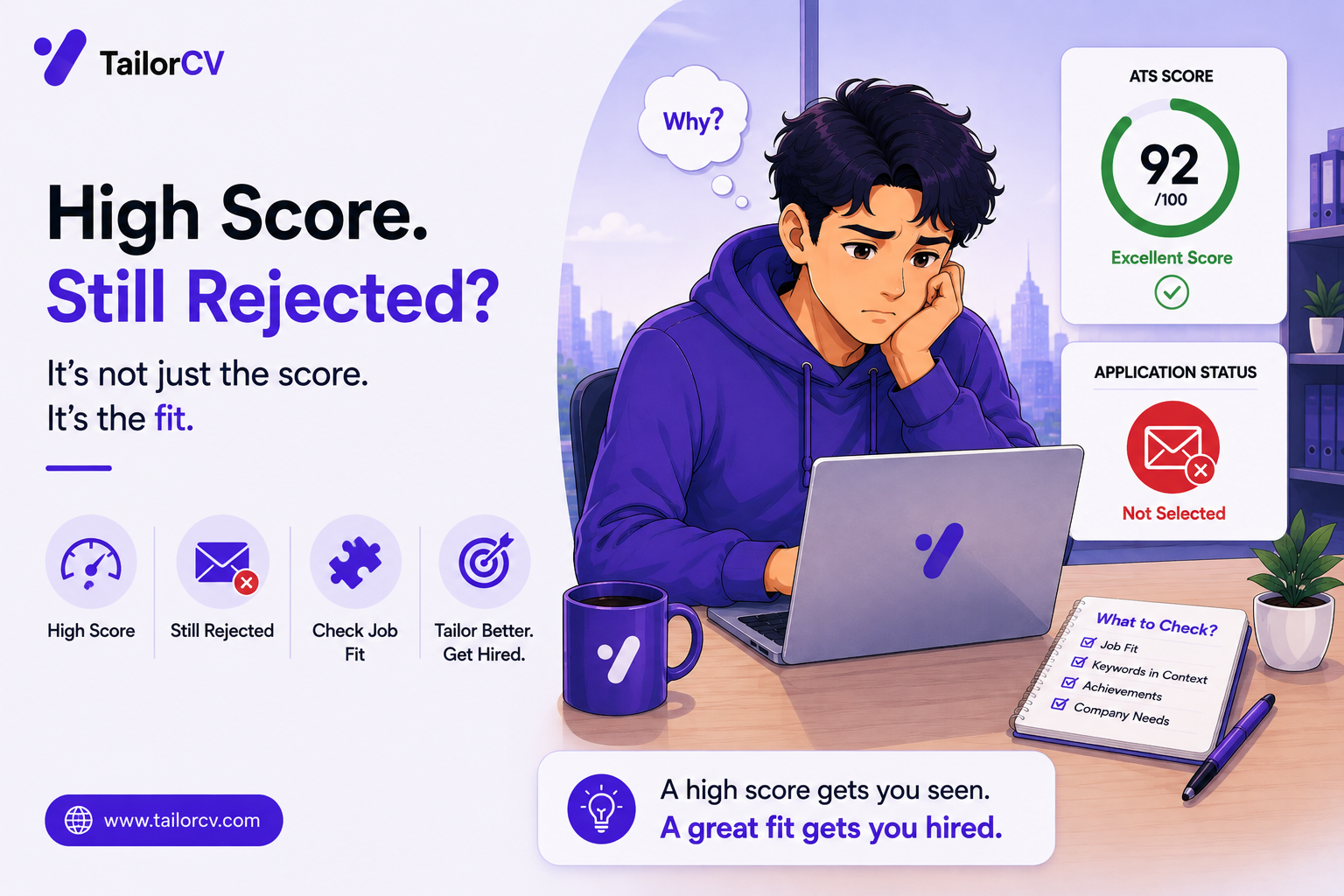
No. It measures how well your document corresponds to the posting. Timing, competition, level fit and whether the vacancy is real all sit outside it.
Should I add every missing keyword?
Only the ones that are genuinely true of you. The rest are a learning list, not a resume edit.
Is TailorCV's ATS analysis free?
It is free and unlimited for logged-in users, and guests get one free scan. The paid tier covers volume of tailored documents.
When should I stop optimising my resume?
When you are getting interviews. At that point the document is working and the bottleneck has moved.
What should I do with a missing-keyword list?
Sort each term into have-done-it, have-touched-it and never-used-it. Add the first group, phrase the second accurately, and treat the third as a learning list rather than a resume edit.
What is worth paying for in a job search?
Anything that saves significant repeated time. Not a score you can get free, and never anything that guarantees interviews or applies to jobs without you reading the applications.
What is your resume scoring right now?
Scan it against a job description and get your ATS match score in about a minute.
Drop your resume here or choose a file
PDF only. Max 2 MB.
We never share your data or use it to train AI models.

Was this guide useful?
Be the first to rate it.