SS
SS

Key Takeaways
- A pharmacist resume in 2026 should highlight clinical competence, licensure, and medication safety records relevant to the specific pharmacy setting.
- Use an ATS-friendly format that includes a header with licensure, a summary, skills, work experience, and education within one to two pages.
- Strong bullet points should quantify achievements and demonstrate clinical or operational impact, using action verbs and specific outcomes.
- Incorporate relevant ATS keywords such as "medication therapy management," "patient counseling," and "controlled substances" to enhance visibility to employers.
- Tailor your resume summary to reflect your experience level, emphasizing key skills and certifications that align with the desired pharmacy role.
A pharmacist resume in 2026 must show clinical competence, licensure, medication safety record, and the specific pharmacy setting you specialize in - retail, hospital, clinical, or industry. Pharmacy hiring is credential-driven, so your license and certifications must be immediately visible, and your clinical responsibilities must be specific.
Before applying, run your resume through the ATS score checker. Use ATS-friendly resume templates. For other healthcare roles, read the nursing resume guide.
Best Pharmacist Resume Format
- Header with licensure
- Summary
- Licensure and certifications
- Clinical and technical skills
- Work experience
- education
Your resume after optimization
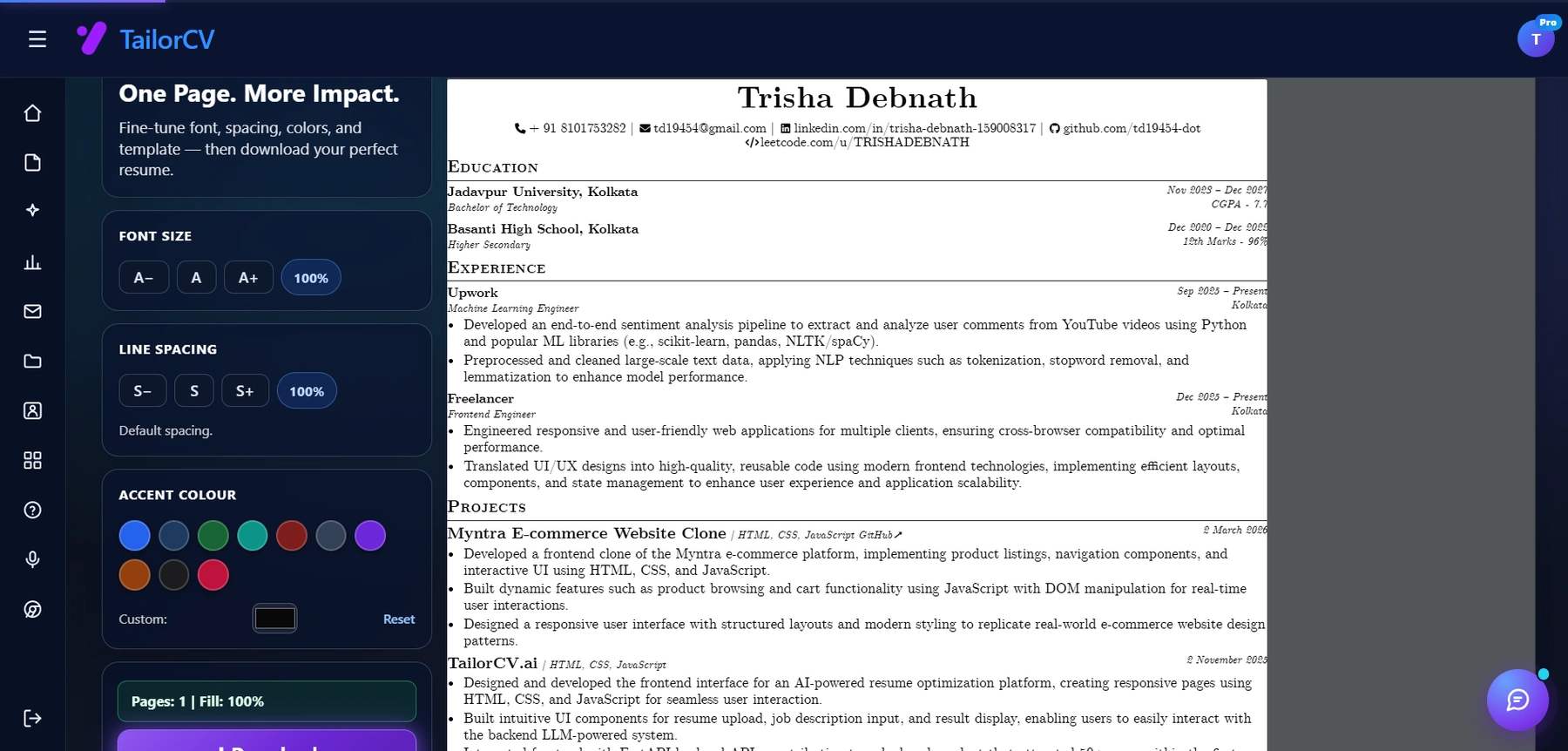
Font size, spacing, accent colour and template are all adjustable, with a live page counter.
One to two pages.
Pharmacist Resume Summary
Formula:
Licensed Pharmacist with X years of experience in [retail / hospital / clinical] pharmacy. Skilled in [medication therapy management, dispensing, clinical review]. Maintained [dispensing accuracy or safety record].
Example for Experienced Pharmacist
Licensed Clinical Pharmacist (PharmD) with 6 years of hospital pharmacy experience. Skilled in medication therapy management, antimicrobial stewardship, IV admixture, and clinical consultation. Maintained 99.98% dispensing accuracy across 250+ daily orders. Board Certified Pharmacotherapy Specialist (BCPS).
Example for Entry-Level Pharmacist
Licensed Pharmacist (PharmD) with strong clinical knowledge and 1 year of retail pharmacy experience. Skilled in prescription dispensing, patient counseling, immunization administration, and insurance processing. Immunization-certified and seeking a community or hospital pharmacy role.
Pharmacist Skills
Clinical: Medication therapy management (MTM), drug interaction review, dosing calculations, therapeutic drug monitoring, antimicrobial stewardship, anticoagulation management Dispensing: Prescription verification, compounding, IV admixture, sterile preparation (USP 797/800), inventory management Patient Care: Patient counseling, immunization administration, medication reconciliation, adherence counseling Systems: Epic Willow, Cerner, pharmacy management systems, e-prescribing, automated dispensing cabinets (Pyxis, Omnicell) Compliance: DEA regulations, controlled substance handling, HIPAA, state board compliance, formulary management Specialized: Oncology, critical care, ambulatory care, geriatrics, pediatrics (as applicable)
Best ATS Keywords for Pharmacist Resume
- Licensed pharmacist / PharmD
- Medication therapy management (MTM)
- Prescription dispensing
- Patient counseling
- Drug interaction review
- Immunization
- Controlled substances / DEA
- Compounding
- IV admixture / sterile compounding
- Antimicrobial stewardship
- Medication reconciliation
- Formulary management
- Epic / Cerner / Pyxis
- HIPAA compliance
- Clinical consultation
- Inventory management
- Therapeutic drug monitoring
- BCPS / board certification
- Insurance processing
- Patient safety
How to Write Pharmacist Resume Bullet Points
Formula:
Dispensed / Managed / Counseled / Reduced + [clinical or operational activity] + [volume or setting] + [accuracy, safety, or outcome result]
Strong Bullet Points
- Verified and dispensed 250+ prescriptions daily with 99.98% accuracy in a high-volume community pharmacy serving 1,200+ weekly patients.
- Led antimicrobial stewardship initiative reviewing 60+ weekly antibiotic orders, contributing to a 22% reduction in inappropriate broad-spectrum antibiotic use over 12 months.
- Provided medication therapy management consultations for 40+ chronic disease patients monthly, improving medication adherence rates by 18% measured through refill data.
- Administered 800+ immunizations in one flu season, expanding the pharmacy's vaccination service revenue by $32K.
- Performed medication reconciliation for 30+ daily hospital admissions, identifying and resolving an average of 4 discrepancies per day to prevent adverse drug events.
Pharmacist Resume Example
Clinical Pharmacist Tertiary Care Hospital | Mar 2021 - Present
- Provide clinical pharmacy services for a 40-bed medical-surgical unit, reviewing 200+ medication orders daily for appropriateness, dosing, and interactions.
- Led the hospital's anticoagulation management program, monitoring 80+ patients on warfarin and DOACs, reducing bleeding-related adverse events by 26%.
- Prepared sterile IV admixtures and chemotherapy following USP 797 and 800 standards with zero compounding errors over 3 years.
- Counseled 15+ patients daily on discharge medications, contributing to a 14% reduction in 30-day medication-related readmissions.
- Precepted 6 pharmacy students and 2 residents, providing clinical rotation training in inpatient pharmacy practice.
Common Pharmacist Resume Mistakes
Mistake 1: License not prominent
Pharmacy is credential-gated. Your license status and number must be clearly visible near the top.
Mistake 2: No accuracy or safety metrics
Dispensing accuracy, error rates, intervention counts, and adherence improvements are powerful and expected.
Mistake 3: No pharmacy systems listed
Epic Willow, Cerner, Pyxis, Omnicell - list the systems you have used. These are screening filters.
Mistake 4: Generic duties
"Dispensed medications and counseled patients" - add volume, setting, accuracy, and specific clinical programs.
Related Guides
- Nursing Resume
- Physiotherapist Resume
- Accountant Resume
- Android Developer Resume
- Backend Developer Resume
- Business Analyst Resume
- Chemical Engineer Resume
- Civil Engineer Resume
- Cloud Engineer Resume
- Consultant Resume
- Content Writer Resume
- Customer Service Resume
- Cybersecurity Engineer Resume 2026 - Complete Guide with Examples
- How to List Education on a Resume in 2026 - Complete Guide with Examples
Make This Practical
Once you draft this resume, test it against a real job post with the free ATS score checker. Then improve fit using Resume Matching With Job Description, polish the layout with ATS-friendly resume templates, and make the bullets stronger with How to Write Resume Bullet Points.
A complete application needs more than one document. Pair the resume with a targeted letter from the AI cover letter generator, practice role-specific questions with the AI mock interview tool, and publish proof of work with the portfolio website builder when your role benefits from projects or case studies.
Conclusion
A strong pharmacist resume in 2026 shows licensure, clinical competence, pharmacy systems proficiency, and measurable safety and patient care outcomes. Make your credentials visible and your responsibilities specific.
Run your resume through the TailorCV ATS score checker. Then prepare for interviews with the interview preparation guide.
Frequently Asked Questions
What should I include in my pharmacist resume header?
Your pharmacist resume header should prominently display your name, contact information, and most importantly, your licensure details. Clearly stating your licensure as a pharmacist (e.g., "Licensed Pharmacist (PharmD)") at the top ensures that hiring managers can quickly verify your credentials. This is crucial in the pharmacy field, where credential verification is a key aspect of the hiring process.
How do I tailor my pharmacist resume for ATS?
To optimize your pharmacist resume for Applicant Tracking Systems (ATS), include relevant keywords from the job description, particularly those pertaining to clinical skills and pharmacy operations. You can use the free ATS score checker to evaluate your resume's compatibility with ATS software, ensuring that your qualifications are highlighted effectively.
What are the key sections to include in a pharmacist resume?
A well-structured pharmacist resume should include the following key sections: a header with your licensure, a summary of your experience, a list of certifications, clinical and technical skills, work experience, and education. Each section should be tailored to showcase your specific skills and accomplishments in the pharmacy field, directly aligning with the job you are applying for.
How can I demonstrate my clinical skills on my pharmacist resume?
To effectively demonstrate your clinical skills on your pharmacist resume, use specific examples in your work experience section that highlight your contributions to patient safety and pharmacy operations. For instance, mention any medication therapy management programs you led or your success in maintaining high dispensing accuracy. Including metrics can provide tangible evidence of your impact in a clinical setting.
Are there examples of pharmacist resumes I can refer to?
Yes, this blog post provides examples of both experienced and entry-level pharmacist resumes. These examples illustrate how to format your resume, highlight your clinical competencies, and include relevant skills and achievements. For further insights, you may also want to explore the physiotherapist resume guide for additional formatting and content ideas. Additionally, consider checking out the job description analysis checklist to better align your resume with the specific requirements of the positions you are targeting.
What is your resume scoring right now?
Scan it against a job description and get your ATS match score in about a minute.
Drop your resume here or choose a file
PDF only. Max 2 MB.
We never share your data or use it to train AI models.

Templates that keep this structure intact
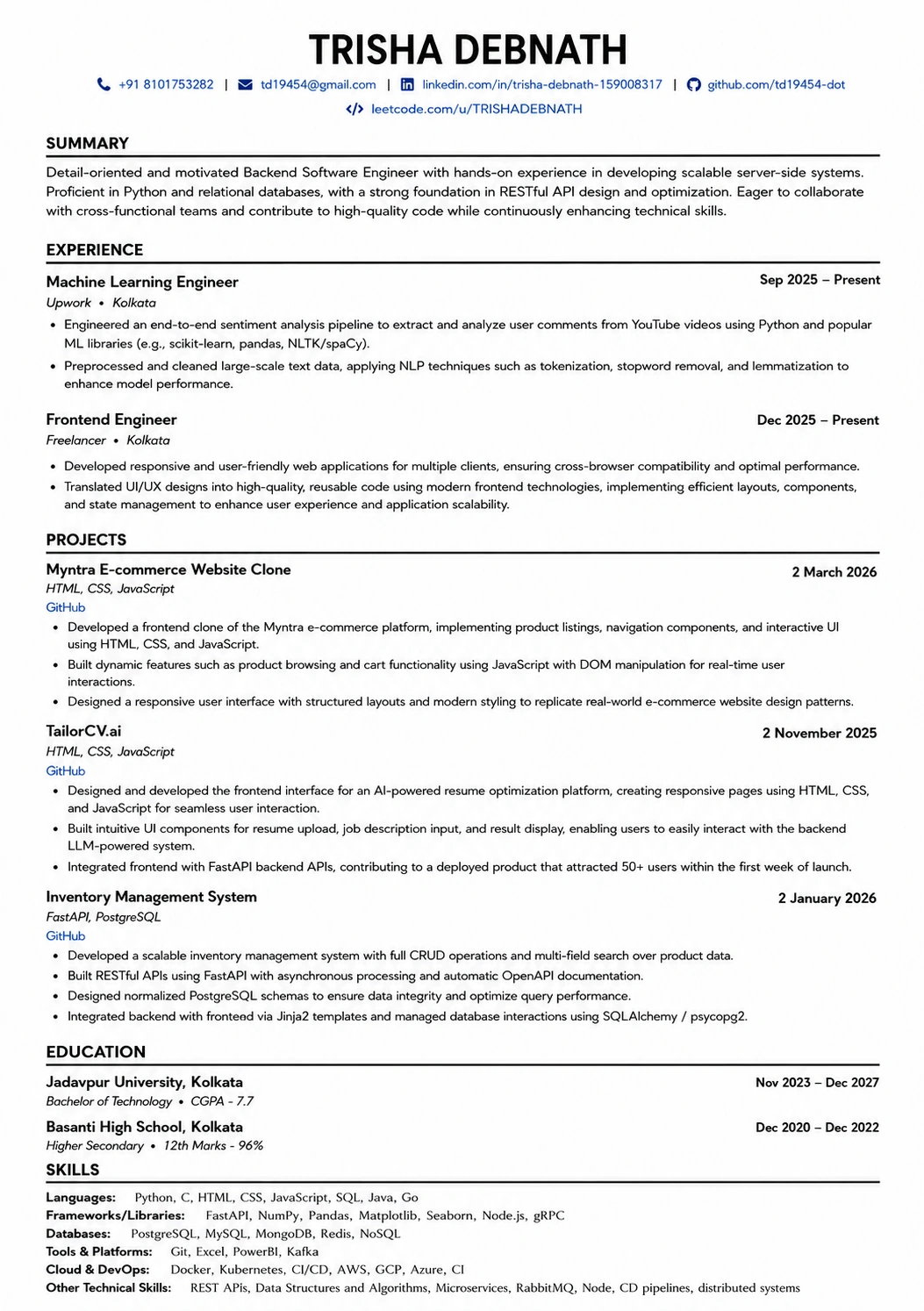
This template is ATS-tested — start from it and the formatting rules in this guide are already handled.
Was this guide useful?
Be the first to rate it.