 TD
TD

Key Takeaways
- A DevOps engineer resume in 2026 should highlight outcomes achieved through tools, such as improved uptime and reduced costs, rather than just listing technologies.
- Use an ATS-friendly format that includes a header, summary, technical skills, work experience, projects or certifications, and education, ideally keeping it to one page for less experienced candidates.
- The resume summary should follow a formula that includes years of experience, technical strengths, and quantifiable achievements related to cloud infrastructure.
- Key technical skills for DevOps engineers include cloud platforms, infrastructure as code, container orchestration, CI/CD tools, monitoring, and security practices.
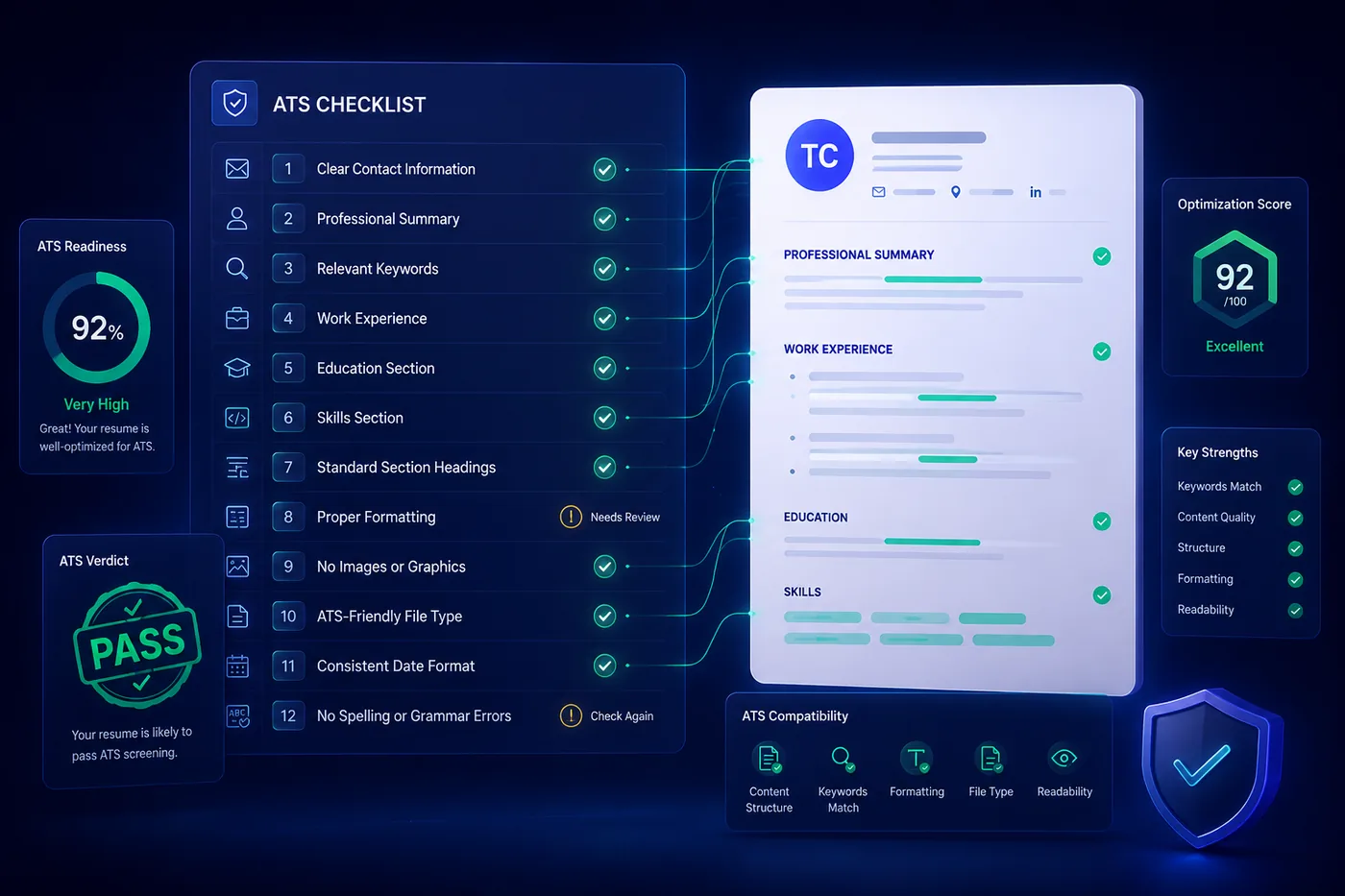
- Incorporate relevant ATS keywords in the resume to enhance visibility and match job descriptions effectively.
A DevOps engineer resume in 2026 needs to prove that you can design reliable infrastructure, automate deployments, manage cloud costs, and help engineering teams ship faster and safer. The role has expanded significantly - modern DevOps includes platform engineering, SRE practices, security automation, and developer experience.
If your resume only lists tools without showing outcomes - uptime improved, deployment frequency increased, costs reduced - it will not stand out. Recruiters for DevOps roles read dozens of resumes that all mention AWS, Docker, and Kubernetes. What they cannot find easily is a candidate who can quantify what those tools achieved.
Check your resume against your target job description using the ATS score checker. Use ATS-friendly resume templates and read the technical skills resume guide for help organizing your skills section. If you are targeting SRE roles specifically, the site reliability engineer resume guide is also worth reading.
Best DevOps Engineer Resume Format
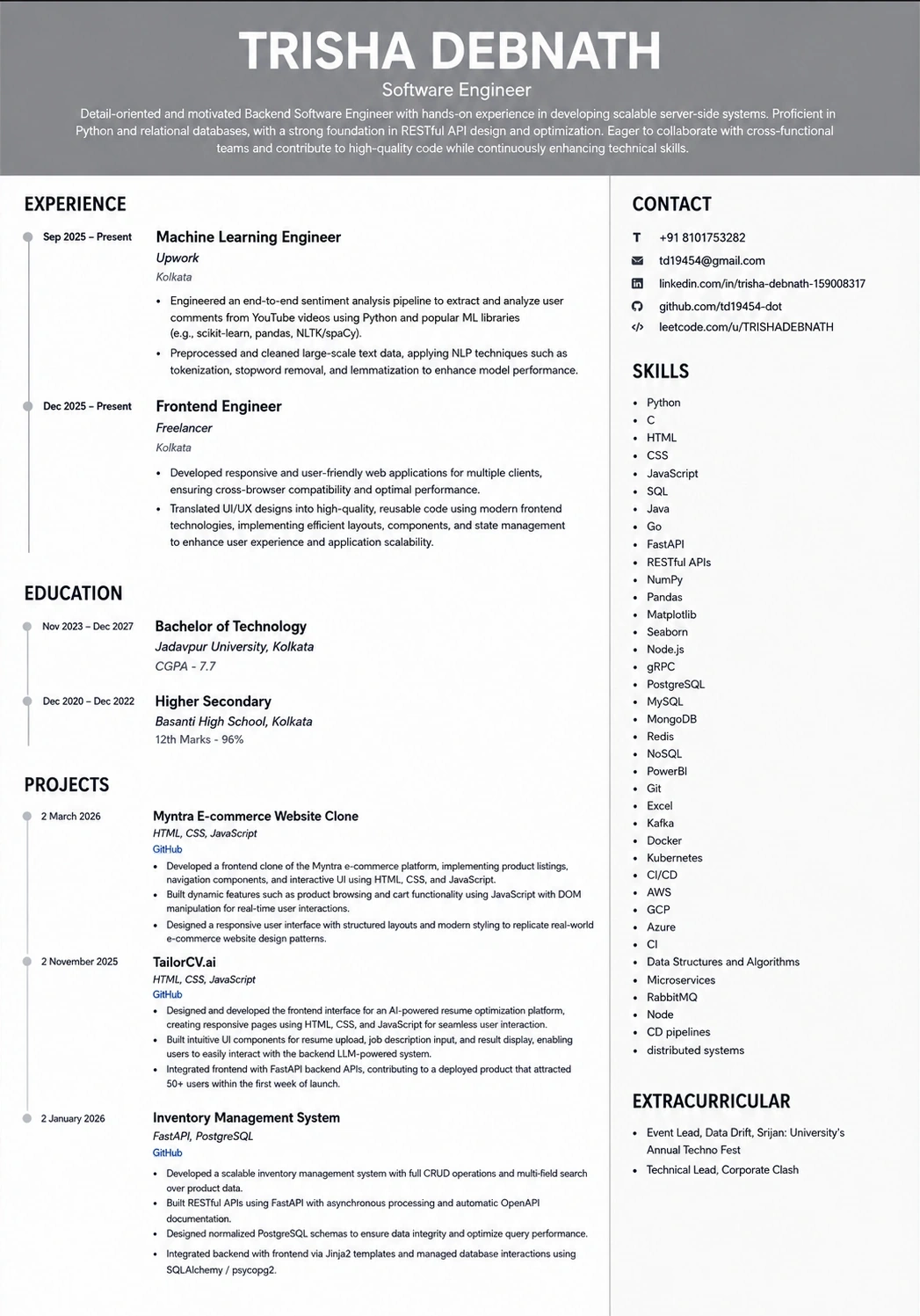
Your resume after optimization
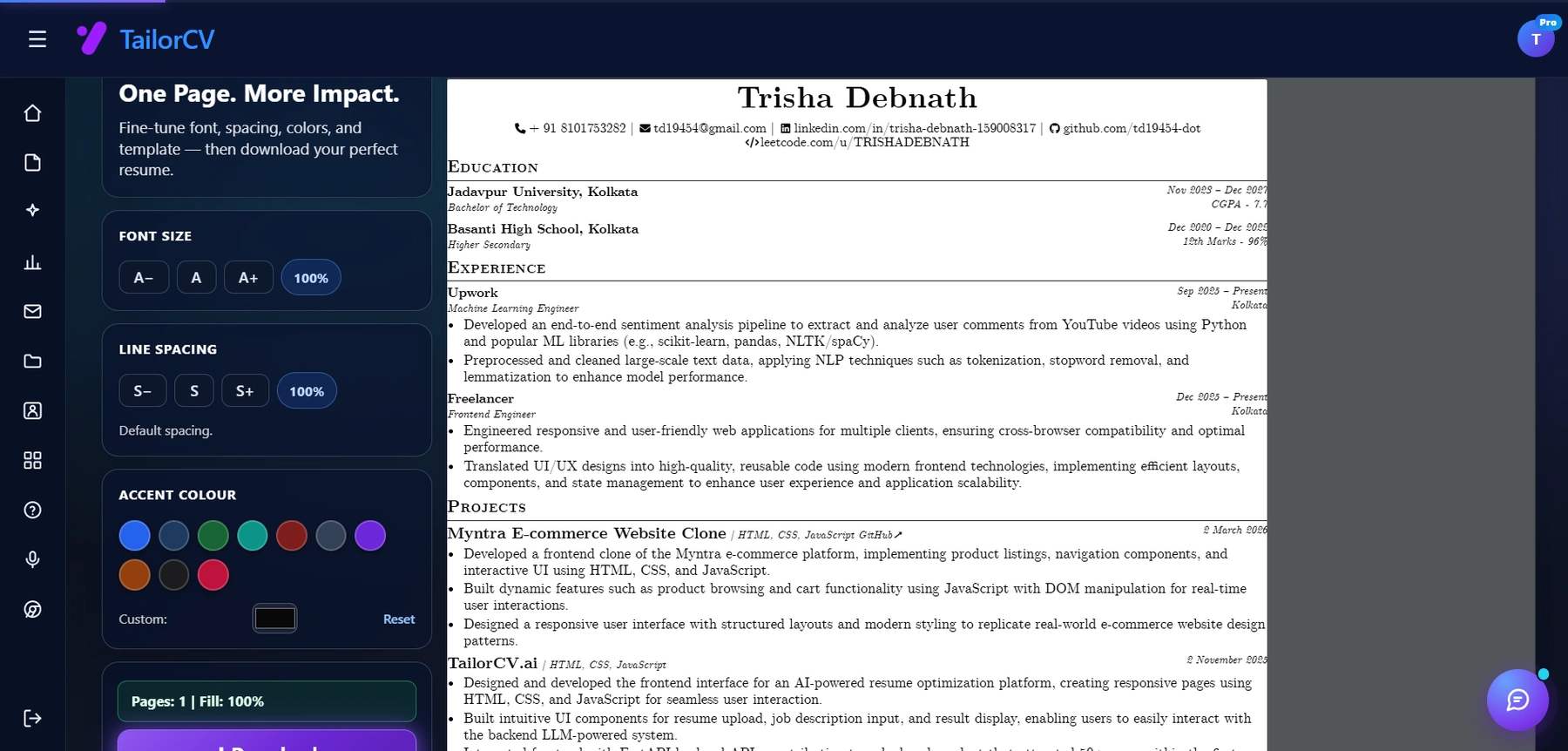
This is the resume after tailoring - the content is already matched, and these controls are how you fit it onto one page.
One page for engineers with under 8 years of experience. Two pages are fine for senior or staff-level engineers with deep cloud architecture or platform leadership.
DevOps Engineer Resume Summary
Formula:
DevOps Engineer with X years of experience managing [cloud or infrastructure context]. Strong in [CI/CD, Kubernetes, Terraform, observability]. Improved [uptime, deployment frequency, cost, security posture].
Example for Experienced DevOps Engineer
DevOps Engineer with 5 years of experience designing and maintaining AWS cloud infrastructure for SaaS platforms serving 2M+ users. Expert in Terraform, Kubernetes, Helm, GitHub Actions, and Datadog. Reduced deployment time from 45 minutes to 8 minutes and improved system availability from 99.6% to 99.96%.
Example for Entry-Level DevOps Engineer
DevOps Engineer with hands-on experience in Docker, Kubernetes, Terraform, GitHub Actions, and AWS. Automated CI/CD pipelines for 3 personal and team projects, reducing deployment effort from manual steps to one-click releases. Seeking a junior DevOps or cloud infrastructure role.
DevOps Engineer Technical Skills
Cloud Platforms: AWS (EC2, EKS, RDS, S3, IAM, CloudWatch), GCP (GKE, Cloud Run, Cloud SQL), Azure Infrastructure as Code: Terraform, Pulumi, AWS CloudFormation, Ansible Containers and Orchestration: Docker, Kubernetes, Helm, ArgoCD, Kustomize CI/CD: GitHub Actions, GitLab CI, Jenkins, CircleCI, Tekton Monitoring and Observability: Datadog, Prometheus, Grafana, PagerDuty, ELK Stack Security: Vault, AWS IAM, Trivy, SAST/DAST tools, SOC 2 compliance Scripting: Bash, Python, Go networking: VPC, Load Balancers, DNS, CDN, API Gateway
Best ATS Keywords for DevOps Engineer Resume
- CI/CD pipeline
- Kubernetes
- Docker
- Terraform
- Infrastructure as code
- AWS / GCP / Azure
- GitHub Actions
- Helm
- ArgoCD
- GitOps
- Monitoring and alerting
- Prometheus / Grafana
- Datadog
- Incident management
- Deployment automation
- Container orchestration
- SLO / SLA / SLI
- Cost optimization
- Security hardening
- Auto-scaling
How to Write DevOps Resume Bullet Points
Formula:
Automated / Designed / Reduced / Improved + [infrastructure system or process] + [context] + [quantified outcome]
Weak Bullet Points
- Set up CI/CD pipelines
- Used Kubernetes for container management
- Managed AWS infrastructure
- Wrote Terraform code
Strong Bullet Points
- Designed and implemented GitHub Actions CI/CD pipelines for 14 microservices, reducing average deployment time from 42 minutes to 9 minutes and enabling 8 deploys per day versus 2 per week previously.
- Migrated 18 EC2-hosted services to EKS with Helm and ArgoCD, improving cluster resource utilization from 34% to 71% and reducing monthly AWS costs by $14K.
- Wrote Terraform modules for VPC, IAM, RDS, and EKS infrastructure across 3 environments (dev, staging, production), reducing environment provisioning from 2 days to 40 minutes.
- Built a Prometheus and Grafana observability stack with 60+ dashboards and 120 alert rules, reducing mean time to detect incidents from 28 minutes to 4 minutes.
- Automated SSL certificate rotation and secret management using HashiCorp Vault and AWS Secrets Manager, eliminating all manual secret rotation tickets from the security backlog.
DevOps Engineer Resume Example
Senior DevOps Engineer B2B SaaS Platform | Feb 2022 - Present
- Owned cloud infrastructure across AWS, supporting 3.2M monthly active users across 6 production regions with 99.97% measured availability.
- Led Kubernetes platform migration from ECS, reducing infrastructure overhead by 40% and enabling self-service deployments for 7 engineering teams.
- Designed multi-environment Terraform infrastructure with remote state, module registry, and automated plan review in CI, reducing manual provisioning errors to zero over 18 months.
- Established incident management process with runbooks, on-call rotations, and blameless postmortems, reducing MTTR from 4.2 hours to 52 minutes over 6 months.
- Reduced AWS monthly spend by $22K through reserved instance planning, EBS volume cleanup, and autoscaling policy tuning.
Projects for Entry-Level DevOps Engineer
Strong project ideas:
- Kubernetes cluster setup with Helm and monitoring
- CI/CD pipeline from scratch with GitHub Actions
- Terraform-managed AWS multi-environment infrastructure
- Docker Compose multi-service local development setup
- Automated backup and restore pipeline
Strong Project Example
Multi-Environment AWS Infrastructure | Terraform, AWS, GitHub Actions, Docker
- Provisioned VPC, EC2, RDS, and S3 across dev, staging, and production environments using modular Terraform.
- Built a GitHub Actions CI/CD pipeline that ran tests, built Docker images, pushed to ECR, and deployed to EC2 with zero-downtime rolling updates.
- Added CloudWatch dashboards and SNS alerting for CPU, memory, and error rate thresholds.
- Documented all infrastructure decisions in an architecture decision record (ADR) format.
Common DevOps Engineer Resume Mistakes
Mistake 1: Tool list with no outcomes
"Experienced with AWS, Docker, Kubernetes, Terraform, Ansible, Jenkins, Datadog, Prometheus, Grafana" - this says nothing. Show what you achieved with each tool.
Mistake 2: No reliability or cost metrics
The most valuable DevOps outcomes are uptime improvement, deployment frequency increase, incident time reduction, and cost savings. quantify at least one of these.
Mistake 3: Ignoring security
In 2026, DevSecOps is expected. Add at least one line about IAM hardening, secret management, vulnerability scanning, or compliance.
Mistake 4: One-environment experience
If you only ever worked in a single development environment, practice building real infrastructure in multiple environments before applying to senior DevOps roles.
Related Guides
- Cloud Engineer Resume
- Site Reliability Engineer (SRE) Resume
- Civil Engineer Resume
- Chemical Engineer Resume
- Cybersecurity Engineer Resume
- Data Engineer Resume
- Electrical Engineer Resume
- Embedded Systems Engineer Resume
- Game Developer Resume
- Machine Learning Engineer Resume
- Mechanical Engineer Resume
- QA Engineer Resume
- Software Engineer Resume for FAANG in 2026
- How to List Education on a Resume in 2026 - Complete Guide with Examples
- Resume Tips for Working Students
Make This Practical
Once you draft this resume, test it against a real job post with the free ATS score checker. Then improve fit using Resume Matching With Job Description, polish the layout with ATS-friendly resume templates, and make the bullets stronger with How to Write Resume Bullet Points.
A complete application needs more than one document. Pair the resume with a targeted letter from the AI cover letter generator, practice role-specific questions with the AI mock interview tool, and publish proof of work with the portfolio website builder when your role benefits from projects or case studies.
Conclusion
A strong DevOps engineer resume in 2026 shows automated pipelines, cloud infrastructure ownership, reliability improvements, and cost outcomes. Do not list tools - show what changed because you automated it.
Use the TailorCV ATS score checker to compare your resume with the target job description and optimize your keyword matching. Then use the interview preparation guide to prepare for system design, infrastructure architecture, and incident response questions.
Frequently Asked Questions
What are the key elements of a DevOps Engineer resume in 2026?
A strong DevOps Engineer resume in 2026 should include a clear header, a compelling summary, a well-organized technical skills section, and detailed work experience. It’s also beneficial to showcase relevant projects or certifications and education. Tailoring these elements to highlight your impact on infrastructure and automation will make your resume stand out.
How can I quantify my achievements on a DevOps resume?
To effectively quantify your achievements, focus on metrics that reflect your impact, such as uptime improvements, deployment frequency increases, or cost reductions. Use specific examples and figures in your bullet points to demonstrate your contributions. For more insights on quantifying achievements, check out our guide on how to quantify resume achievements.
What should I include in the technical skills section of my DevOps resume?
In the technical skills section, list relevant tools, technologies, and methodologies that align with the job description. Focus on cloud skills, CI/CD practices, and any specific programming languages you are proficient in. For a deeper dive into organizing your skills, refer to our technical skills resume guide.
How do I ensure my resume passes ATS screening?
To ensure your resume passes ATS screening, use an ATS-friendly resume template and incorporate keywords from the job description. Regularly check your resume against your target job description using the free ATS score checker to optimize its chances of getting noticed by recruiters.
What should I do if I'm also interested in SRE roles?
If you're targeting SRE roles in addition to DevOps positions, consider highlighting your skills in site reliability practices and security automation. You can also reference our site reliability engineer resume guide for specific tips on tailoring your resume for these positions.
What is your resume scoring right now?
Scan it against a job description and get your ATS match score in about a minute.
Drop your resume here or choose a file
PDF only. Max 2 MB.
We never share your data or use it to train AI models.

Templates that keep this structure intact
This template is ATS-tested — start from it and the formatting rules in this guide are already handled.
Was this guide useful?
Be the first to rate it.