 SS
SS
Key Takeaways
- A summary is three lines that tell a recruiter who you are and why you fit, fast.
- Use the formula: identity + strongest proof + what you want to do next.
- Tailor it to the target role; a generic summary is worse than none.
- Lead with a number or a specific credential, not adjectives.
The Formula Behind Every Good Summary
[Who you are] + [strongest proof, ideally quantified] + [the value you bring to this role].
Skip "hardworking team player." Every line should be something only you could truthfully write. Below are examples you can adapt — but always swap in your real numbers and the target job's language.
Software Engineer
Backend engineer with 5 years building Python and Go services at scale, including a payments API handling 2M requests a day. Focused on reliability and clean design, now looking to lead backend architecture on a high-growth product team.
Marketing Specialist
Digital marketer who grew organic traffic 140% in 18 months across two SaaS brands through SEO and content strategy. Data-driven and hands-on, seeking a growth role where content and analytics meet.
Project / Product Manager
Product manager with a track record of shipping features that move retention — most recently redesigning onboarding to cut first-week churn from 38% to 12%. Comfortable owning the roadmap from discovery to launch.
Career Changer
Former secondary teacher moving into UX design, with a completed Google UX certification and three shipped case studies. Bringing five years of understanding how real people learn and get stuck — the core skill of good design.
New Graduate
Computer science graduate with three shipped side projects in React and Node, including an app used by 200+ classmates. Eager to learn fast on a team that ships and to grow into a full-stack role.
How to Adapt These
- Match the job title in the posting.
- Swap in your real metric — the summary lives or dies on a specific, true number.
- Mirror the posting's keywords so it reads relevant to both the recruiter and the ATS.
More Examples by Role and Stage
The formula flexes across every field. Here are more you can adapt — always swapping in your real numbers and the target posting's language.
Data analyst who turns messy operational data into decisions, most recently building a churn model that helped cut monthly churn from 6% to 4%. Fluent in SQL, Python, and Tableau, and happiest translating analysis into plain-language recommendations for non-technical teams.
UX / Product Designer
Product designer with 4 years shipping consumer mobile features, including a checkout redesign that lifted conversion 11%. I pair fast prototyping with real user research, and I care as much about the edge cases as the happy path.
Sales Representative
Account executive who has beaten quota in five of the last six quarters, closing $1.4M in new business last year. Consultative by default, relentless about follow-through, and energized by long, complex deal cycles.
Operations Manager
Operations leader who redesigned a vendor onboarding process from 10 days to 3, saving 15 staff hours a week. I find the bottleneck, fix it with a repeatable system, and leave the team better than I found it.
Nurse / Healthcare
Registered nurse with 6 years in high-acuity settings, known for calm under pressure and a 98% patient-satisfaction score across two units. Committed to safe, compassionate care and to mentoring newer staff on the floor.
Customer Success
Customer success manager who grew net revenue retention from 96% to 112% across a 40-account book by getting ahead of churn signals. I turn support tickets into product insight and anxious renewals into expansions.
Recent Graduate (Engineering)
Computer science graduate with three shipped side projects in React and Node, including an app used by 200+ classmates. I learn fastest by building, and I am eager to grow into a full-stack role on a team that ships often.
Career Changer (into Marketing)
Former journalist moving into content marketing, bringing five years of turning complex topics into stories people actually read. Completed a content-strategy certification and grew a personal newsletter to 3,000 subscribers in six months.
How to Write Your Own, Step by Step
- State your identity. Your role or target role, in the posting's words. "Backend engineer," not "coding professional."
- Add your strongest proof. One quantified achievement that maps to this job. This is the line that makes the summary believable.
- Name your focus or value. What you are especially good at, or what you care about, tied to what the role needs.
- Point it at the target. A short phrase on what you want next, aligned with the posting.
- Cut every filler word. Delete "hardworking," "detail-oriented," "team player," and any sentence that could appear on anyone's resume.
Your resume after optimization
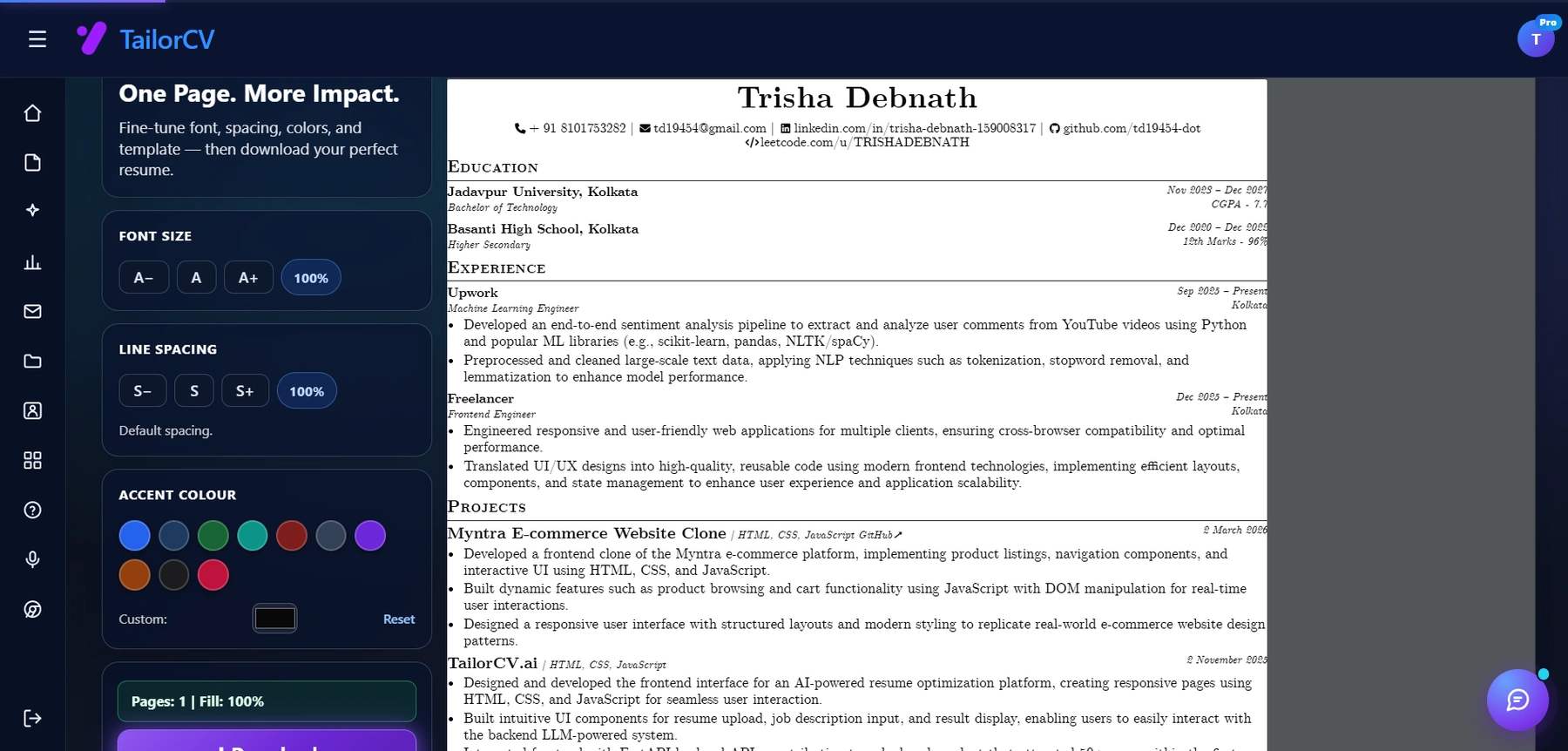
Font size, spacing, accent colour and template are all adjustable, with a live page counter.
Read it back and ask: could someone else truthfully have written this exact summary? If yes, it is too generic — add the specific number or detail that only you can claim.
What Makes a Summary Weak
- Adjective soup. "Motivated, hardworking, results-driven professional" says nothing and wastes your best real estate.
- No numbers. A summary without a single metric is a claim without evidence.
- Copy-paste generic. A summary that fits any job fits none. Tailor it.
- Too long. Five lines is a paragraph, not a summary. Two to three lines, tops.
- All about your wants. "Seeking a role where I can grow" centers you. Center your value to the employer instead.
- Buzzword stuffing. "Synergistic, dynamic, passionate" reads as filler to both humans and the ATS.
Where the Summary Goes and How Long It Should Be
Place the summary at the very top, directly under your contact details, so it is the first thing read. Keep it to two or three lines — long enough to land your identity, proof, and focus; short enough that a recruiter actually reads it before scanning your experience. On a tight one-page resume for an early-career candidate, a strong summary is a nice-to-have; for experienced professionals and career changers, it is the frame that makes everything below it make sense.
Tailor the Summary to Every Job
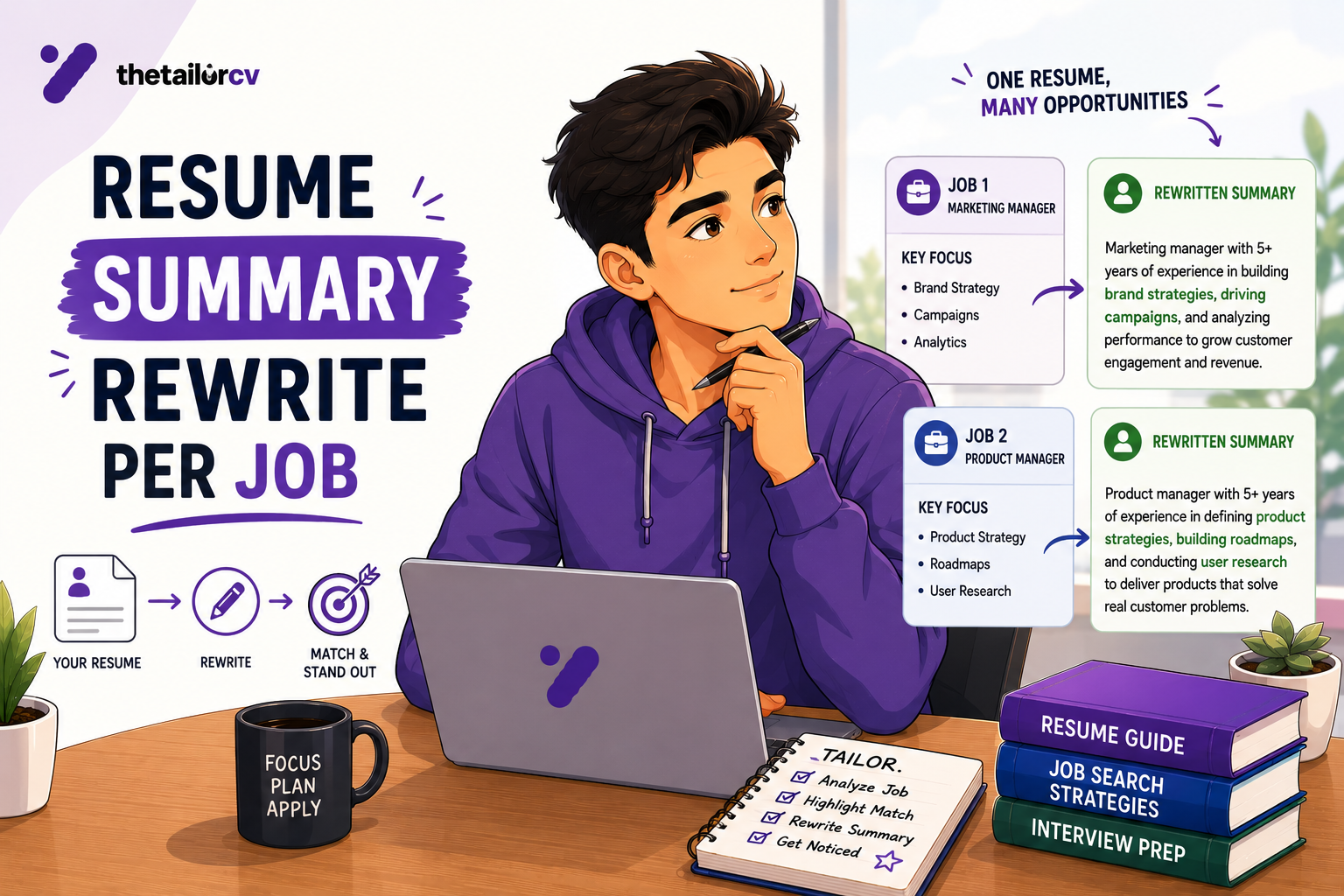
The single biggest upgrade to a resume summary is not better wording — it is a fresh version for each application. A summary that name-drops the exact role title and mirrors the posting's language reads as written for this job, because it was. That is also what an ATS score rewards: the closer your summary's terms match the posting, the higher your relevance.
You do not have to rewrite it from scratch each time. Keep one strong base summary, then adjust the role title, swap the lead metric to the most relevant one, and mirror two or three keywords from the posting. If you use the TailorCV resume optimizer, it reads the job description and rewrites your summary and bullets to match the exact role — turning a generic profile into a targeted one in a couple of minutes. And if you are starting from scratch, the resume builder gives you a clean, ATS-friendly structure to drop your summary into.
Before and After: Weak Summary to Strong
Before (weak):
Hardworking and motivated professional with experience in marketing looking for a challenging role to grow my skills and contribute to a dynamic team.
After (strong):
Content marketer who grew organic traffic 140% across two SaaS brands in 18 months through SEO and long-form content. Data-driven, hands-on, and looking to own the content strategy behind a growing product.
The "before" could belong to anyone and says nothing measurable. The "after" names the role, leads with a real number, and points clearly at the target. That is the entire difference between a summary a recruiter skips and one that earns the next thirty seconds.
Frequently Asked Questions
Do I even need a summary?
It helps most for experienced candidates and career changers who need to frame their story. For a straightforward early-career resume, a strong one is a bonus, not a requirement.
How long should a resume summary be?
Two to three lines. Longer and it stops being a summary; shorter and it says nothing.
Summary or objective?
Summary. Objectives ("seeking a role where I can grow") center your wants; summaries center your value to the employer.
Where do I get the metric if my role isn't obviously measurable?
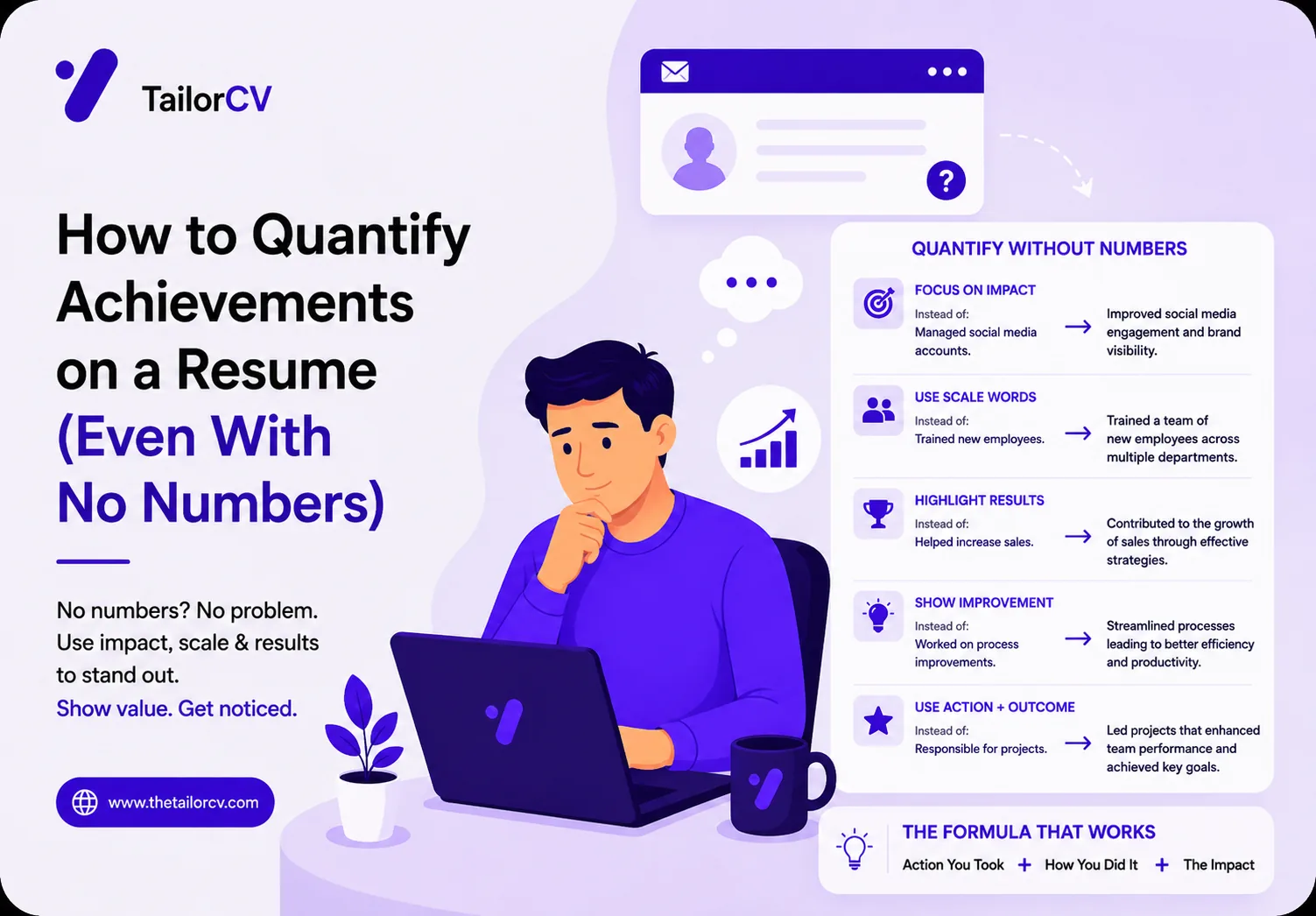
Almost every role hides a number — scale, time saved, volume handled, or a percentage change. Walk your experience through those lenses and you will find one. Our guide on quantifying achievements has a full worksheet.
Should the summary use "I" or third person?
Neither, ideally — write it in implied first person without the pronoun: "Content marketer who grew traffic 140%," not "I am a content marketer" or "He is a content marketer." It reads cleaner and saves space.
Can I reuse the same summary on LinkedIn?
Adapt it, do not copy it. Your resume summary is tight and role-targeted; your LinkedIn About section is longer, first-person, and warmer. Same facts, different voice.
Should the summary change for every job I apply to?
Ideally yes, at least lightly. Swap the role title to match the posting, lead with the most relevant metric, and mirror two or three of the job's keywords. A summary tuned to the specific role reads as written for it — because it was — and scores better with the ATS.
What tense should I write it in?
Present tense, implied first person, no pronouns: "Backend engineer who builds reliable payment systems," not "I build" or "Built." It reads cleanly, saves space, and keeps the focus on your current, ongoing value.
When to Skip the Summary Entirely
A summary is not mandatory, and a weak one is worse than none. If you cannot write a summary that says something specific and true — a real metric, a genuine specialty, a clear direction — leave it off and let a strong experience section lead instead. This is often the right call for a straightforward early-career resume where the projects and skills speak for themselves, or for a candidate whose most recent role obviously matches the target. The summary earns its space only when it frames something the reader might otherwise miss: a career change, a mix of experiences that needs a through-line, or a senior story that benefits from a headline. If your resume is already clear and targeted without it, three lines of generic self-description at the top only push your real evidence further down the page.
Common Words to Cut From Your Summary
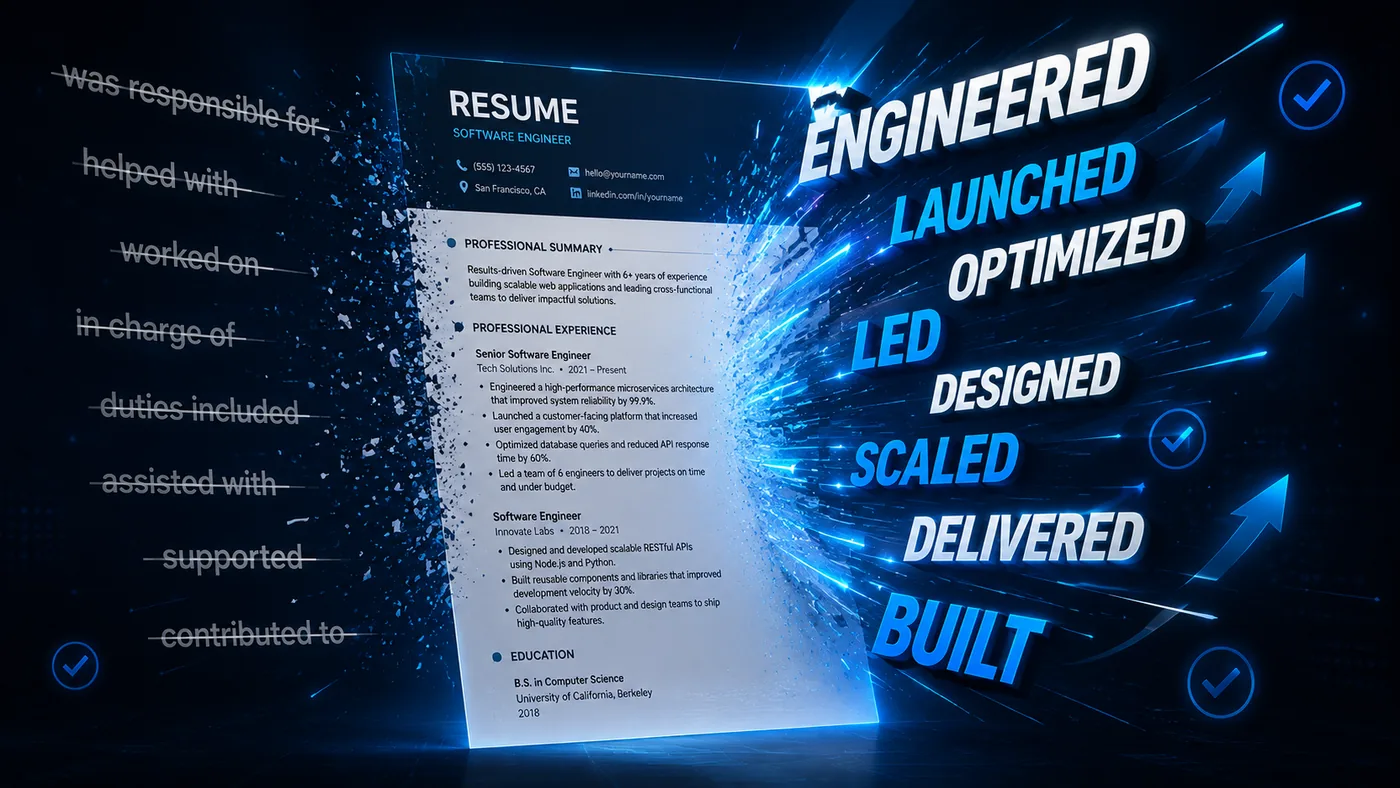
The fastest way to strengthen a summary is to delete the words that appear on everyone else's. Cut "hardworking," "motivated," "detail-oriented," "results-driven," "passionate," "team player," "go-getter," "self-starter," and "dynamic." None of them are provable, all of them are claimed by thousands of other candidates, and each one you delete makes room for something real — a number, a named skill, a specific outcome. Read your summary and highlight every adjective; for each one, ask whether it is a testable fact or an empty claim. Replace the empty claims with evidence. "Results-driven marketer" becomes "marketer who grew organic traffic 140%." "Detail-oriented analyst" becomes "analyst whose reporting overhaul cut monthly close errors to near zero." The specific version is always shorter on adjectives and longer on proof — which is exactly the trade that makes a recruiter believe you.
Putting It All Together
A resume summary is three lines of prime real estate at the top of your resume, and most people waste them on adjectives. Use the formula — identity, quantified proof, focus — mirror the target posting's language, and lead with a real number. Tailor it to every job, whether by hand or with a resume optimizer that matches it to the description automatically. Get those three lines right and you earn the one thing a summary exists to win: the recruiter's attention for the rest of the page.
What is your resume scoring right now?
Scan it against a job description and get your ATS match score in about a minute.
Drop your resume here or choose a file
PDF only. Max 2 MB.
We never share your data or use it to train AI models.

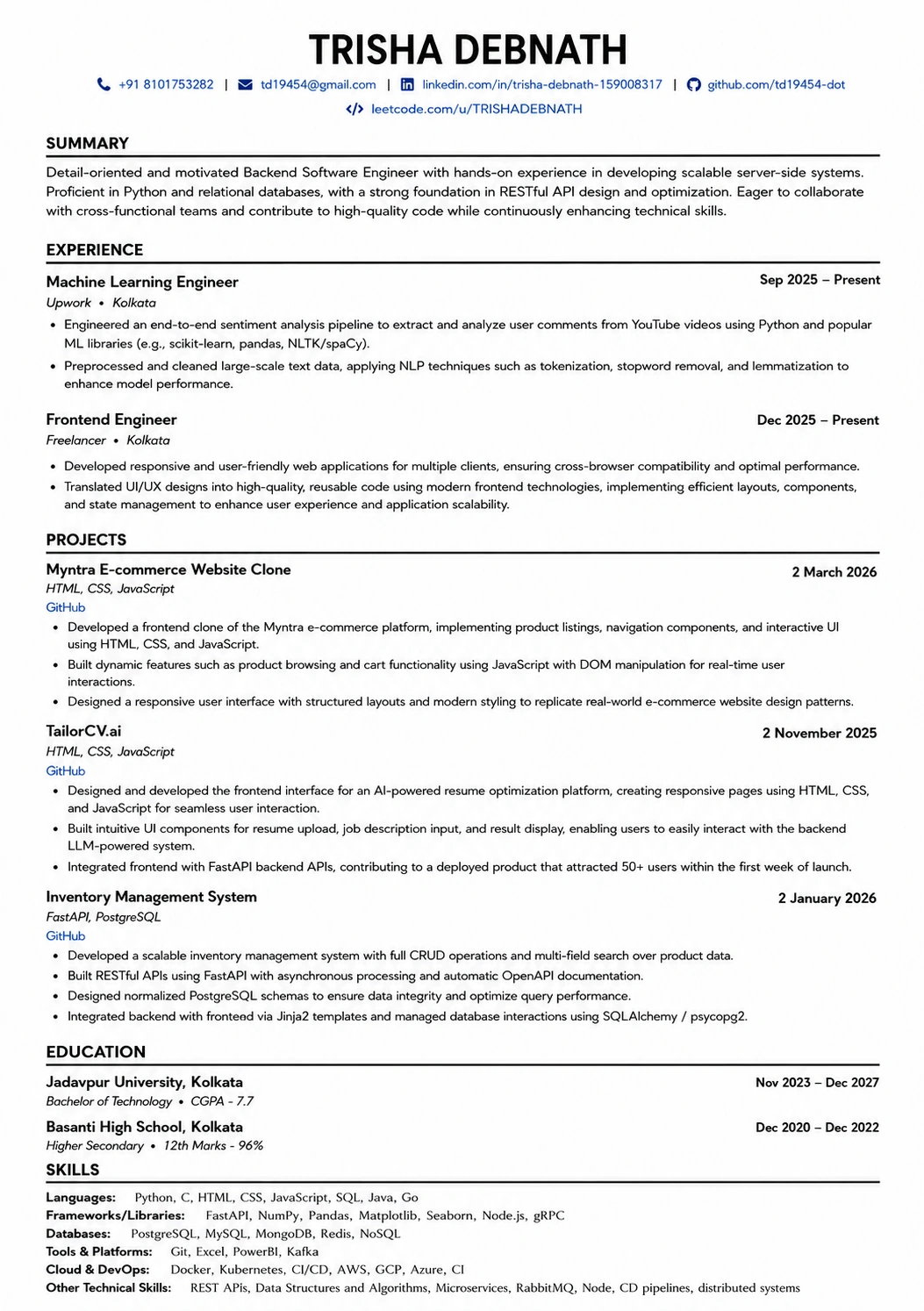
Templates that keep this structure intact
This template is ATS-tested — start from it and the formatting rules in this guide are already handled.
Was this guide useful?
Be the first to rate it.