 SS
SS
Key Takeaways
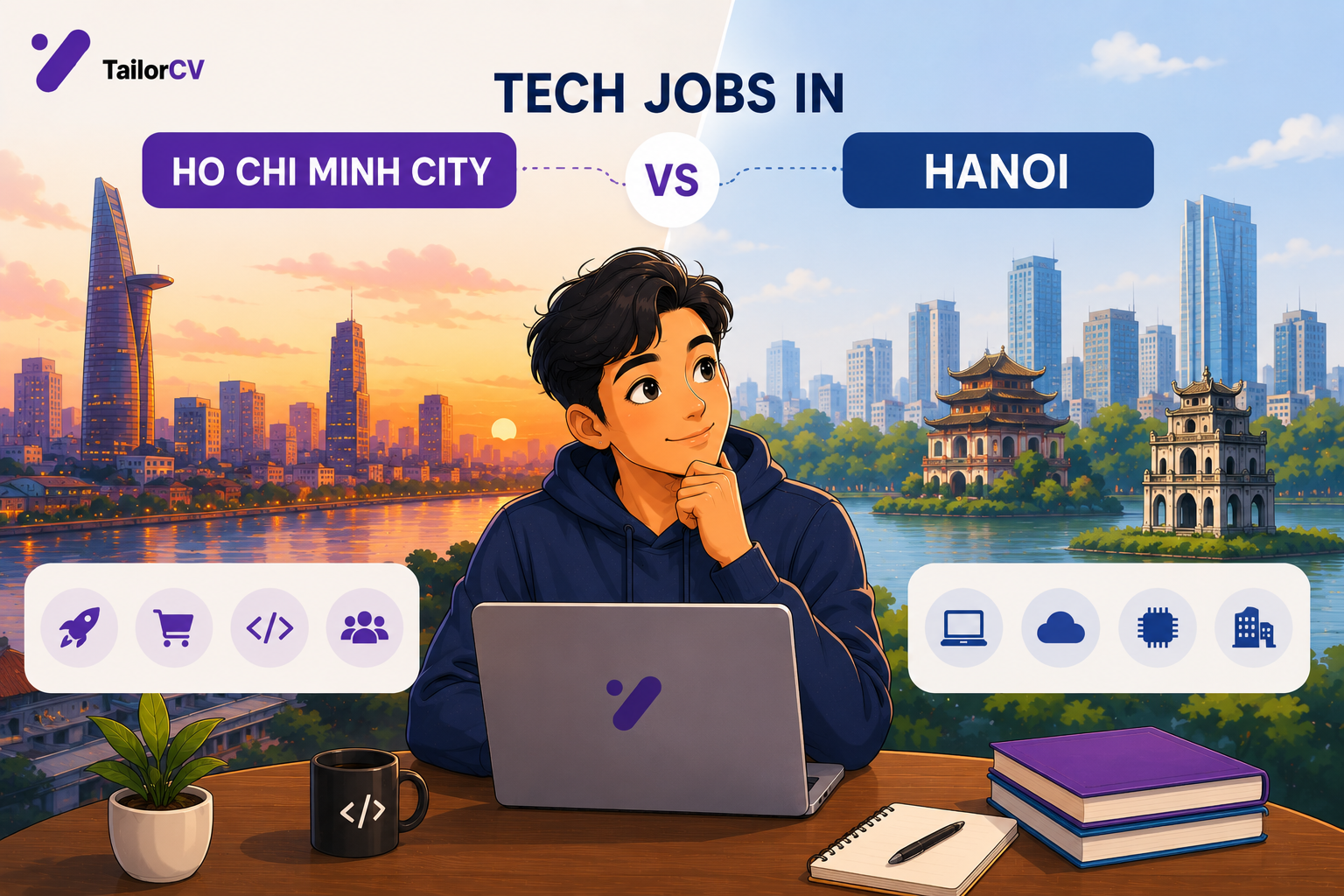
- Ho Chi Minh City is the commercial centre with the largest startup and product scene; Hanoi has a strong engineering base and government-adjacent technology.
- Software outsourcing is the largest employer — FPT, TMA, NashTech and a substantial tier of firms serving international clients.
- A domestic product sector exists around VNG, MoMo, Tiki, VNPay and a growing startup ecosystem.
- The local engineering talent pool is strong and inexpensive, which sets a high bar for foreign hires.
- Da Nang has emerged as a third centre with lower costs and a growing technology presence.
The outsourcing industry
Vietnam's largest technology employer and the foundation of the sector.
FPT Software is the largest, with tens of thousands of engineers serving clients across Japan, the US and Europe.
TMA Solutions, NashTech, KMS Technology, Axon Active and a substantial tier of firms operate similar models.
Japanese clients are a particular specialism. Vietnam has built deep relationships with Japanese firms, and Japanese language capability is genuinely valuable in this market — considerably more so than in most outsourcing destinations.
The work is real engineering — application development, maintenance, testing, embedded systems and increasingly data and cloud work.
It trains a great many people, and a large share of Vietnam's senior engineers came up through it.
For a foreigner, these firms hire mainly for client-facing, delivery management and specific technical leadership roles rather than for general engineering, since the local pool covers that.
The product and startup scene
Smaller but growing and increasingly where the interesting work is.
VNG is Vietnam's best-known technology company, spanning gaming, messaging and payments.
MoMo and VNPay dominate digital payments in a market that moved quickly to mobile money.
Tiki and the e-commerce sector, competing with regional players.
A growing startup ecosystem, concentrated in Ho Chi Minh City, with increasing venture funding.
Regional companies with Vietnamese engineering — several Southeast Asian technology firms run substantial development teams there.
And international companies establishing engineering centres, drawn by the talent pool and costs.
The pattern: Vietnam is transitioning from purely outsourced work toward product ownership, and the product side is where the more interesting engineering increasingly sits.
The two cities and Da Nang
| City | Character |
|---|---|
| Ho Chi Minh City | Commercial capital, largest startup and product scene, biggest international community, faster pace |
| Hanoi | Political capital, strong engineering universities, government-adjacent technology, more traditional |
| Da Nang | Growing third centre, coastal, much lower costs, increasingly popular with remote workers |
Ho Chi Minh City is where most foreign professionals are and where the commercial technology sector concentrates.
Hanoi has excellent technical universities and a deep engineering pool, with a somewhat more formal business culture.
Da Nang has grown deliberately as a technology and lifestyle destination, with lower costs and a coastal setting that has attracted both companies and remote workers.
Compensation and costs
The financial picture for technology work.
Local engineering salaries are low by international standards and have risen steadily as demand grew.
Senior and lead roles at product companies and international employers pay considerably more.
Foreign-linked packages at international companies are a different category and are what make Vietnam financially attractive for expatriate professionals.
Outsourcing firms pay less than product companies for equivalent seniority, which is the usual pattern.
Personal income tax is progressive for residents on worldwide income, with residency determined by days present and other factors.
Costs are genuinely low. Rent, food, transport and daily life all cost a fraction of Western equivalents, and even a modest salary supports a comfortable standard of living.
Ho Chi Minh City is the most expensive of the three cities, with Da Nang considerably cheaper.
And the savings rate can be high for someone on a foreign-linked salary, which is a large part of why people come.
Getting hired
Practical mechanics.
ITviec is the technology-specific platform and is well used by the local market.
VietnamWorks covers professional roles broadly.
LinkedIn works for international employers and senior roles.
Company career pages for FPT, VNG and the larger employers.
Technology meetups and communities exist in both cities and are genuinely accessible.
Recruiters are active, particularly for senior and specialist positions.
And be specific about your value. In a market with strong local talent, an application that does not clearly state what you bring beyond general engineering competence will not progress. Lead with the specialism, the language, the leadership experience or the client-facing capability that makes hiring you make sense.
The broader technology landscape
Beyond software, where technical work sits.
Embedded systems and hardware, tied to the electronics manufacturing base and genuinely substantial.
Fintech, driven by rapid mobile payment adoption — MoMo, VNPay, ZaloPay and the banking sector's digital efforts.
E-commerce and logistics technology, serving a market that moved online quickly.
Gaming, with VNG a significant regional player and a broader studio presence.
AI and data, growing from a low base with government interest and university programmes.
EdTech and HealthTech, both expanding.
And IT infrastructure and cloud, as Vietnamese enterprises modernise.
The pattern: Vietnam's technology sector has breadth beyond outsourcing, and the domestic product side has grown quickly enough that it is now a genuine career option rather than a smaller alternative.
Career progression
Where a Vietnamese technology career leads.
Within outsourcing, from engineer to lead to delivery management, with client-facing roles being the differentiator.
Into product companies, which increasingly recruit from the outsourcing pool.
Regionally, since Southeast Asian technology companies operate across borders and Vietnamese experience is recognised.
Into international companies' Vietnamese operations, which pay more and offer global exposure.
And out, since Vietnamese engineering experience is increasingly recognised internationally, particularly for people who worked on international client projects.
For a foreigner specifically, the path is usually leadership or specialist rather than individual contribution, and progression tends toward regional responsibility rather than deeper local roles.
Remote work and the alternative route
An increasingly common arrangement worth treating properly.
Vietnam is an attractive base for remote workers on cost grounds, and Da Nang in particular has built around this.
The visa position needs care. Vietnam does not currently have a dedicated digital nomad visa comparable to Thailand's or Portugal's, and working remotely on a tourist visa is not a lawful arrangement.
Some people use business visas or other categories, and the position should be verified properly rather than assumed from forum advice.
Tax residency is a separate question from immigration status, and spending significant time in Vietnam can create obligations regardless of your visa type.
The infrastructure is good. Internet is reliable and fast in the major cities, coworking spaces are plentiful and inexpensive, and the practical experience of remote working there is straightforward.
And the community exists. Ho Chi Minh City and Da Nang both have substantial remote-working populations, which makes arriving socially easier than in many places.
The honest advice: the lifestyle case is strong and the legal position requires proper attention rather than the casual approach many people take.
Practical steps for a technology search
Concrete actions.
Create profiles on ITviec and VietnamWorks, both of which are searched directly by recruiters.
Build a target list across outsourcing firms, domestic product companies and international employers with Vietnamese operations.
State your differentiator in the first line — the specialism, the language, the leadership experience. In a market with strong local talent, a generic profile does not progress.
Attend the meetups. Both cities have active technology communities and they are genuinely accessible to foreigners.
Join the bilateral chamber relevant to your nationality, which provides networking and job listings.
Understand the permit position before applying so you can answer it clearly when asked.
And consider the remote alternative honestly. For many foreign engineers, working remotely for a foreign employer while living in Vietnam is a better arrangement than seeking local employment — provided the visa position is handled properly.
Vietnam versus the region for technology
How it compares as a technology destination.
Against India. India's market is vastly larger with a deeper product ecosystem. Vietnam is smaller, growing faster from a lower base, and considerably cheaper.
Against the Philippines. The Philippines has the English-language advantage and a larger services sector; Vietnam has stronger engineering depth and a manufacturing-linked hardware base.
Against Thailand. Thailand's technology sector is smaller relative to its economy; Vietnam's engineering output is stronger.
Against Indonesia. Indonesia has the larger domestic market and consumer technology scene; Vietnam has the stronger outsourcing and engineering base.
Against Singapore and Malaysia. Both are considerably more developed with higher salaries and more established foreign employment; Vietnam is earlier-stage and cheaper.
The summary: Vietnam is a strong engineering market with rising quality, a manufacturing-linked hardware advantage, and a domestic product scene growing quickly — and it is a difficult market to enter as a general foreign engineer precisely because the local talent is good.
Mini checklist
- unchecked: Realistic assessment of what you offer beyond the local pool
- unchecked: Outsourcing versus product sector decided
- unchecked: Japanese language noted if you have it — genuinely valuable here
- unchecked: City chosen — HCMC, Hanoi or Da Nang
- unchecked: Work permit route understood
- unchecked: ITviec and VietnamWorks profiles created
- unchecked: Chambers of commerce networks explored
- unchecked: Salary compared against very low local costs
- unchecked: Remote work for a foreign employer considered as an alternative
Scenarios
Scenario 1: You are a general software engineer
Be realistic about the value proposition. Vietnam has strong, inexpensive local engineers, so a foreign hire needs delivery leadership, client-facing capability, a niche specialism or a language the market needs.
Scenario 2: You speak Japanese
This is a genuine and unusual advantage in Vietnam specifically. The outsourcing industry's Japanese client relationships are deep, and Japanese-capable technical people are actively sought.
Scenario 3: You work remotely for a foreign employer
Vietnam is an excellent base on cost grounds, and Da Nang in particular has built around this. Understand the visa position properly rather than assuming a tourist visa covers it.
Tip: If you speak Japanese, say so prominently. Vietnam's outsourcing industry has unusually deep Japanese client relationships, and Japanese-capable technical people are genuinely sought in a way that is specific to this market.
Do's and Don'ts
Do
- Be honest about what you add beyond local talent
- Highlight Japanese language ability if you have it
- Consider the product sector, not just outsourcing
- Look at Da Nang for cost and lifestyle
- Use ITviec for technology roles
- Network through the bilateral chambers
Don't
- Assume general engineering skills justify a foreign hire
- Overlook the outsourcing firms as employers
- Ignore Hanoi's engineering base
- Work remotely on a tourist visa
- Underestimate how strong the local pool is
- Expect Western salaries
Common Mistakes
- Underestimating local talent. Vietnamese engineers are strong and inexpensive, which sets the bar for foreign hiring.
- Ignoring the Japanese angle. A genuine and unusual differentiator in this specific market.
- Only considering outsourcing. The product and startup sector is where interesting work increasingly sits.
- Overlooking Da Nang. Lower costs and a growing technology presence.
- Visa carelessness. Working remotely on a tourist visa is not a legal position.
- Expecting Western pay. Local salaries are low; foreign-linked packages are the exception.
Related Guides
Keep building on this with the related guides in this series:
- Working in Vietnam as a Foreign Professional
- Vietnam Work Permits Explained
- Manufacturing Careers in Vietnam
- English Teaching Jobs in Vietnam
- Southeast Asian Job Markets Compared
- Edinburgh Tech Jobs Guide 2026 - Fintech, Data, and Asset Management
- Tech Jobs in Canada: How to Write a Resume That Gets Interviews
- Vancouver Tech Jobs Guide 2026 - Market, Pay, and the Housing Problem
You can also check your resume's ATS score for free, generate a tailored cover letter, or build a portfolio website in minutes.
Frequently Asked Questions
Is Vietnam good for software engineers?
For local engineers, yes and increasingly so. For foreign hires the bar is high, since the domestic pool is strong and inexpensive — you need delivery leadership, a niche specialism or a needed language.
What are the main technology employers?
FPT Software and the outsourcing tier — TMA, NashTech, KMS — plus domestic product companies including VNG, MoMo, VNPay and Tiki, and a growing startup ecosystem.
Why does Japanese matter in Vietnam?
The outsourcing industry has unusually deep Japanese client relationships, which makes Japanese-capable technical people genuinely sought in a way specific to this market.
Ho Chi Minh City or Hanoi?
Ho Chi Minh City for commercial technology, startups and the largest international community; Hanoi for a strong engineering university base and government-adjacent work.
What about Da Nang?
A deliberately grown third centre with much lower costs, a coastal setting, a growing technology presence and popularity with remote workers.
Can I work remotely from Vietnam?
Only with an appropriate visa position. Working remotely on a tourist visa is not a legal arrangement, and enforcement has tightened.
What do technology jobs pay in Vietnam?
Local salaries are low by international standards and rising, with product companies paying above outsourcing firms. Foreign-linked packages at international employers are a separate and much higher category.
How do I get hired in Vietnamese tech?
ITviec for technology roles, VietnamWorks for professional positions, LinkedIn for international employers, plus meetups and recruiters — and lead clearly with what you bring beyond general engineering skill.
What technology sectors exist in Vietnam beyond outsourcing?
Embedded systems tied to electronics manufacturing, fintech driven by rapid mobile payment adoption, e-commerce and logistics technology, gaming, and growing AI, edtech and healthtech sectors.
Can I work remotely from Vietnam legally?
Vietnam does not currently have a dedicated digital nomad visa, and working remotely on a tourist visa is not a lawful arrangement. Verify your specific position properly rather than relying on forum advice.
What is your resume scoring right now?
Scan it against a job description and get your ATS match score in about a minute.
Drop your resume here or choose a file
PDF only. Max 2 MB.
We never share your data or use it to train AI models.

Was this guide useful?
Be the first to rate it.