 SS
SS
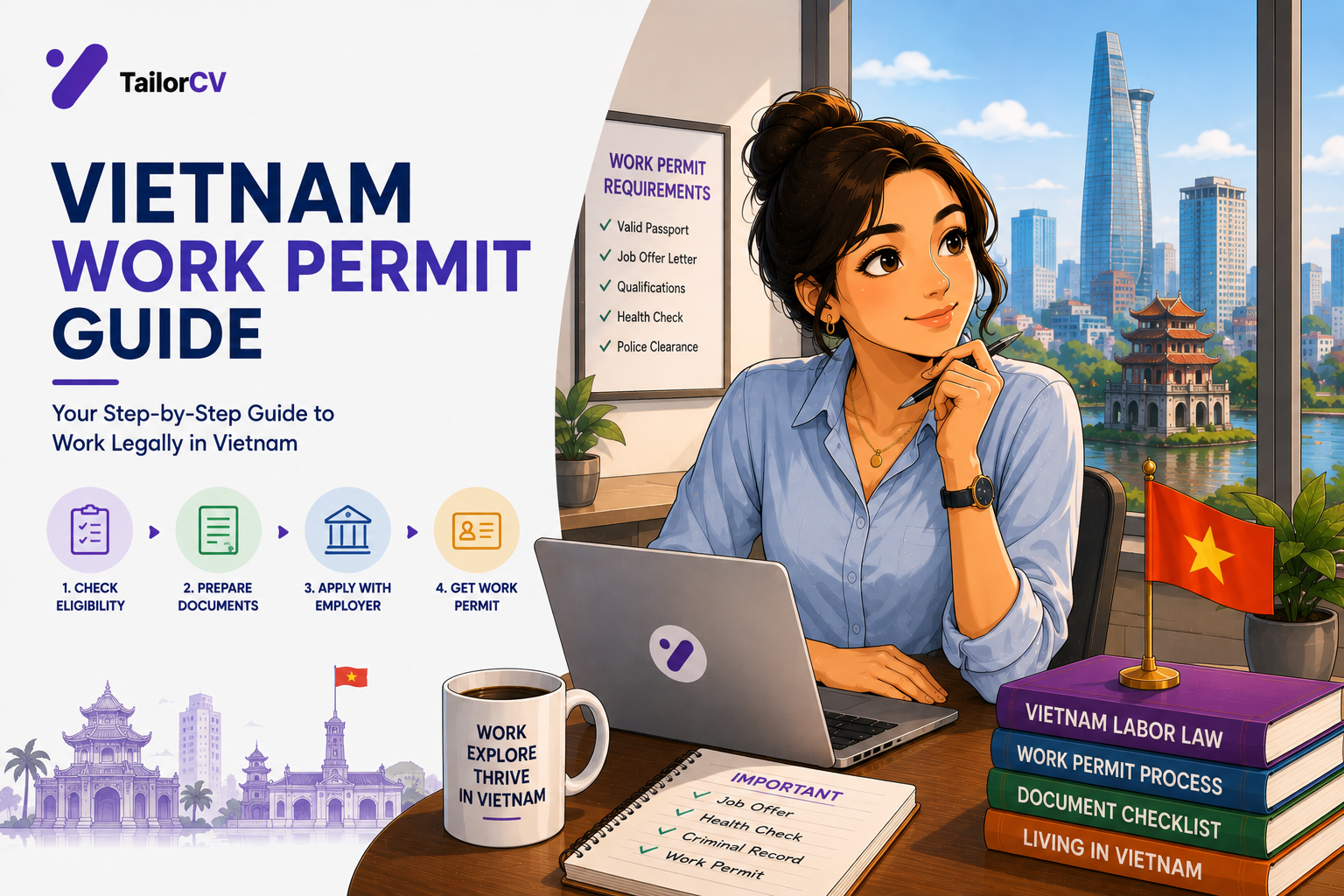
Key Takeaways
- Work permits in Vietnam are employer-sponsored and tied to a specific position and employer.
- The employer must generally show the role requires a manager, executive, expert or technical worker and that it cannot readily be filled locally.
- Document legalisation is the longest step — degrees, criminal record certificates and experience letters all need authentication.
- Exemptions exist for certain categories, including some short assignments, intra-company transfers in defined circumstances and specific roles.
- A temporary residence card typically follows the permit and governs how long you can stay.
What the permit requires
The conditions, in plain terms.
Employer sponsorship. You cannot obtain a Vietnamese work permit independently; a legal entity in Vietnam applies on your behalf.
A qualifying category. The role must fall into a recognised classification — typically manager, executive, expert or technical worker — each with its own evidence requirements around qualifications and experience.
Demonstrated need. Employers are generally required to justify recruiting a foreign worker, including publicly advertising the position, on the basis that a suitable Vietnamese candidate is not available.
Qualifications and experience evidence. A degree relevant to the role plus documented years of experience in the same field is the usual expert-category requirement.
Health clearance from an approved medical facility.
Criminal record certificate covering your recent residence.
And all foreign documents must be legalised — notarised, authenticated in the issuing country and consularised — then translated into Vietnamese by a recognised translator.
That legalisation chain is the timeline. Everything else moves faster than it does, and starting it before you have an offer is the single most useful thing you can do.
Exemptions and special cases
Worth checking, because they save considerable time where they apply.
Short assignments below a defined duration may be exempt, subject to conditions and to a confirmation procedure rather than a full permit.
Intra-company transfers within a commercial presence in Vietnam can qualify for exemption in defined circumstances.
Certain roles — including some legal, educational and specialist categories — have their own provisions.
Spouses of Vietnamese citizens and certain other family relationships carry provisions.
Investors and capital contributors above defined thresholds have separate arrangements.
Even where exempt, a confirmation of exemption is generally required rather than nothing at all, so it is a different process rather than an absence of process.
Verify with current Vietnamese labour regulations, which have been amended, rather than relying on secondhand accounts.
The residence card and staying legally
The step after the permit.
A temporary residence card is typically issued on the basis of a valid work permit, allowing you to remain for a period aligned to it without repeatedly renewing a visa.
Visa runs are not a substitute. Working on a tourist or business visa without a permit is unlawful and enforcement has tightened.
Renewals follow the permit's validity, and applying before expiry is essential.
Changing employer requires a new permit rather than a transfer, which is a meaningful practical constraint.
Dependants can generally accompany you with their own residence arrangements, and their right to work is a separate question.
And keep your documents. Vietnamese administration requires originals and certified copies repeatedly, and replacing legalised documents from abroad while in Vietnam is slow and expensive.
Timelines and practical planning
What to expect.
Document legalisation: weeks to a couple of months, depending on your home country's processes.
The permit application itself: faster once the file is complete, since the assessment is largely documentary.
The residence card: follows the permit.
Total: several months from decision to legally working, most of it front-loaded in paperwork.
Do not resign until the permit is issued.
The employer's competence matters enormously. A large foreign-invested company with an experienced HR function handles this routinely; a small local employer may never have done it and will need you to drive the process.
Ask directly whether they have sponsored foreign staff before, and how recently.
Budget for costs including legalisation fees, translation, the health check and the permit fee itself, and clarify who pays — practice varies.
And build in buffer. Vietnamese administrative timelines are not always predictable, and planning to the minimum estimate is how people end up between jobs and countries.
Common reasons applications fail
Five, most of them preventable.
Incomplete legalisation. A document notarised but not consularised will not be accepted.
Qualification mismatch. The degree must relate to the role for the expert category.
Insufficient documented experience. Claimed years need employment letters that specify the work, and ex-employers become slow correspondents once you have left.
Employer not eligible or unprepared. Not every Vietnamese entity is set up to sponsor.
Expired documents. Criminal record certificates and health checks have validity periods and can lapse mid-process.
And translation problems, where documents are translated by someone not recognised for the purpose.
Family and dependants
The questions after the permit.
Dependants can generally accompany a work permit holder, with their own temporary residence arrangements tied to yours.
A spouse's right to work is separate. Accompanying family status does not automatically confer permission to work, and a spouse wanting employment generally needs their own permit through their own employer.
Schooling is a substantial consideration. International schools in Ho Chi Minh City and Hanoi are good and expensive, and this is frequently the largest single cost in a family relocation.
Healthcare should be covered by international insurance, since the practical option for expatriate families is private and international facilities.
And the residence card duration for dependants follows yours, which means a change in your status affects the whole family.
Verify current provisions directly, since Vietnamese immigration rules have been amended and family arrangements are the part that changes most often.
Questions to ask your employer
The ones that determine whether this actually happens.
"Have you sponsored a foreign worker before, and how recently?" Experience matters enormously here.
"Which category are we applying under?" Manager, executive, expert or technical worker each carry different evidence requirements.
"Who handles the legalisation and who pays for it?" Practice varies and clarifying early avoids friction.
"What is a realistic start date?" Get a considered answer rather than an optimistic one.
"Will you sponsor a temporary residence card as well?" It makes life considerably easier than repeated visa renewals.
"What happens if the application is refused?" An uncomfortable question and worth asking before you resign anything.
And confirm the arrangement in writing rather than relying on conversation, since a Vietnamese employment relationship without documentation is a weak position.
After the permit is issued
The ongoing obligations.
Collect the permit and check the details. Errors in your name, position or employer create problems later and are easier to correct immediately.
Apply for the temporary residence card if your employer sponsors one, which removes the need for repeated visa renewals.
Register your residence with local authorities, which is a requirement and is usually handled by your landlord or employer.
Keep certified copies of everything, since you will be asked repeatedly.
Renew before expiry. Permits and residence cards both have hard end dates and lapsing creates a genuinely difficult position.
Report changes — a change of address, passport or position generally needs recording.
And understand what happens if you leave the job. Your permit is tied to that employer, so resignation has immigration consequences within a defined period.
Comparing Vietnam to its neighbours
If you are weighing Southeast Asian options on permit terms.
Against Thailand. Both are employer-sponsored and document-heavy. Thailand has more established expatriate infrastructure and a specific long-term resident visa; Vietnam's process is comparably demanding.
Against Indonesia. Indonesia's KITAS system is similarly employer-driven with its own sponsorship requirements. Both restrict certain positions to nationals.
Against the Philippines. English-language advantage there is substantial, and the permit process is comparable.
Against Singapore and Malaysia. Both are considerably more developed for skilled foreign employment, with clearer criteria and stronger infrastructure, and correspondingly higher salary expectations.
The general pattern across the region: work authorisation is employer-sponsored, expertise-based, document-heavy, and premised on the role not being fillable locally. Vietnam is neither notably easier nor notably harder than its neighbours.
Costs to budget for
The expenses involved, since practice on who pays varies.
Document legalisation in your home country — notarisation, authentication and consular fees, which vary by country and can be substantial.
Certified translation into Vietnamese.
The health check at an approved facility.
The permit application fee itself.
Temporary residence card fee, where applicable.
Courier costs for moving original documents internationally, which adds up given how many round trips are frequently needed.
And clarify who pays. Many employers cover the process; some expect you to. Establishing this at offer stage avoids an unwelcome surprise, and it is a completely normal question.
Mini checklist
- unchecked: Employer confirmed as able and willing to sponsor
- unchecked: Qualifying category identified for your role
- unchecked: Degree and experience evidence gathered
- unchecked: Criminal record certificate obtained and legalised
- unchecked: Documents notarised, authenticated and consularised
- unchecked: Vietnamese translations arranged
- unchecked: Health check requirements understood
- unchecked: Exemption possibility checked
- unchecked: Temporary residence card process understood
Scenarios
Scenario 1: You have a Vietnamese job offer
Start the document legalisation immediately, before anything else. Degrees and criminal record certificates need a full authentication chain in your home country, and this determines your start date more than any other factor.
Scenario 2: You are being transferred within your company
Check the intra-company transfer exemption. Where it applies the process is considerably lighter, and employers unfamiliar with it sometimes default to the full permit route unnecessarily.
Scenario 3: You are already in Vietnam on a tourist visa
Do not work on it. Enforcement has tightened and the consequences are serious. Find an employer willing to sponsor a proper permit and do it in the correct order.
Tip: Begin legalising your degree and criminal record certificate before you have an offer. The notarisation, authentication and consularisation chain runs through your home country's authorities and it is the single longest step in a Vietnamese work permit application.
Do's and Don'ts
Do
- Start document legalisation early
- Confirm your qualifying category
- Check exemption possibilities
- Keep originals and certified copies
- Understand the residence card process
- Verify current regulations directly
Don't
- Work on a tourist or business visa
- Assume a permit transfers between employers
- Leave legalisation until after an offer
- Rely on secondhand accounts of the rules
- Assume exemption means no process at all
- Let your permit or card lapse
Common Mistakes
- Late document legalisation. The longest step and entirely within your control to start early.
- Working without a permit. Unlawful, and enforcement has tightened.
- Assuming permits transfer. Changing employer requires a new permit.
- Ignoring exemptions. Where they apply the process is much lighter.
- Not keeping copies. Replacing legalised documents from abroad is slow and expensive.
- Using outdated information. Vietnamese labour regulations have been amended.
Related Guides
Keep building on this with the related guides in this series:
- Working in Vietnam as a Foreign Professional
- Technology Jobs in Ho Chi Minh City and Hanoi
- Manufacturing Careers in Vietnam
- English Teaching Jobs in Vietnam
- Thailand Work Permits and Visas
You can also check your resume's ATS score for free, generate a tailored cover letter, or build a portfolio website in minutes.
Frequently Asked Questions
Can I get a Vietnamese work permit on my own?
No. Permits are employer-sponsored and tied to a specific position and employer, and a legal entity in Vietnam must apply on your behalf.
What documents do I need?
A relevant degree, evidence of experience, a criminal record certificate and a health check — with all foreign documents notarised, authenticated, consularised and translated into Vietnamese.
What takes the longest?
Document legalisation, without question. The notarisation and authentication chain runs through your home country and should be started before you even have an offer.
Are there exemptions?
Yes, for certain short assignments, intra-company transfers in defined circumstances and specific categories — though a confirmation of exemption is generally still required.
Can I change employers on my permit?
Not directly. A new permit is required rather than a transfer, which is a real constraint on job mobility in Vietnam.
Can I work on a tourist visa?
No. It is unlawful, enforcement has tightened, and the consequences are serious. Obtain a proper permit through a sponsoring employer.
How long does a Vietnamese work permit take?
Several months from decision to legally working, with most of that in document legalisation rather than in the application assessment itself. Build in buffer and do not resign before it is issued.
Why do Vietnamese work permit applications fail?
Incomplete legalisation, a degree that does not relate to the role, insufficient documented experience, an employer not set up to sponsor, expired certificates, or translations by an unrecognised translator.
Can my family come with me to Vietnam?
Dependants can generally accompany a permit holder with residence tied to yours. A spouse's right to work is separate and generally requires their own permit through their own employer.
What happens if I leave my job in Vietnam?
Your permit is tied to that employer, so resignation has immigration consequences within a defined period. A new employer requires a new permit rather than a transfer.
Is Vietnam harder than its neighbours for work permits?
Not notably. Across Southeast Asia work authorisation is employer-sponsored, expertise-based and document-heavy, premised on the role not being fillable locally. Vietnam sits in the middle of that range.
What is your resume scoring right now?
Scan it against a job description and get your ATS match score in about a minute.
Drop your resume here or choose a file
PDF only. Max 2 MB.
We never share your data or use it to train AI models.

Was this guide useful?
Be the first to rate it.