 TD
TD
Key Takeaways
- Vietnam has been among Asia's fastest-growing economies for years, driven by manufacturing, exports and a young workforce.
- Manufacturing and supply chain is the largest driver, with substantial international investment relocating production there.
- Technology and software outsourcing has grown into a genuine sector, with Vietnamese firms serving global clients.
- English teaching remains the most accessible entry for native speakers, and it is a separate track from professional work.
- Foreign workers need a work permit, and the employer must demonstrate the role cannot be filled locally.
The economy
Vietnam's growth story is real and it has a specific shape.
Manufacturing is the engine. Electronics, textiles, footwear and increasingly higher-value assembly. Global companies moved substantial production capacity into Vietnam over the past decade, and the supply chain around it employs enormous numbers.
Electronics in particular. Samsung's Vietnamese operations are very large, and the components ecosystem around consumer electronics manufacturing is substantial.
Software and IT outsourcing. FPT, TMA, NashTech and a growing tier of firms serve international clients, and Vietnam has built a reputation for engineering quality at competitive rates.
A domestic technology sector including VNG, MoMo, Tiki and a startup ecosystem, primarily in Ho Chi Minh City and Hanoi.
Finance and banking, growing with the economy.
Tourism and hospitality, substantial and recovered.
Agriculture and agri-processing, still a large employer and increasingly technical.
And education, including a very large English-teaching market.
What foreigners actually do there
The honest map of foreign employment.
English teaching is the largest category by headcount and the most accessible. Requirements are typically a degree, a TEFL certificate and native or near-native English, with the employer handling the work permit.
Management and technical roles at foreign-invested manufacturers. Quality, production, supply chain and engineering positions at the international companies operating plants there.
Senior and specialist roles at Vietnamese companies where specific expertise is not locally available.
Technology roles, though the local talent pool is strong and growing, which means a foreign hire needs to bring something genuinely additional.
Hospitality management at international hotel groups.
Consulting, legal and financial services serving foreign investors.
Entrepreneurship, with a visible foreign-founded business community particularly in Ho Chi Minh City.
The pattern: foreign professional employment concentrates where international companies operate or where a specific expertise gap exists. Vietnam has a large, capable and inexpensive domestic workforce, which means the bar for hiring a foreigner into a general role is high.
Language and daily life
Vietnamese is required for most domestic roles and it is a tonal language that is genuinely difficult for most learners.
English works at foreign-invested companies, international schools, hotels and within the expatriate business community.
Ho Chi Minh City has the largest international community, with Hanoi second and Da Nang growing.
Costs are low by international standards, which means even a modest foreign salary supports a comfortable life.
And the country is young and fast-changing, which shows up in the pace of development and in how quickly things shift.
Money and cost of living
The financial picture.
Foreign professional salaries vary enormously by sector and employer — an expatriate package at an international manufacturer differs greatly from a local-contract role.
Local salaries are low by international standards, and a foreigner on a local contract will earn accordingly.
Expatriate packages at foreign-invested companies may include housing, schooling and flights, and these are what make Vietnam financially attractive for senior roles.
Teaching pay is modest but goes a long way given local costs, and it is generally enough to live comfortably and save a little.
Personal income tax is progressive and residents are taxed on worldwide income, with non-residents taxed at a flat rate on Vietnam-sourced income. Residency depends on days present and other factors.
Costs are genuinely low. Food, transport, rent outside the premium expatriate areas and daily life all cost a fraction of Western equivalents.
Healthcare is mixed — public facilities are basic and international clinics and hospitals are good and私 expensive, which is why insurance matters.
And the arithmetic works well for someone on a foreign-linked salary and poorly for someone on a purely local one.
Setting up
The administrative sequence.
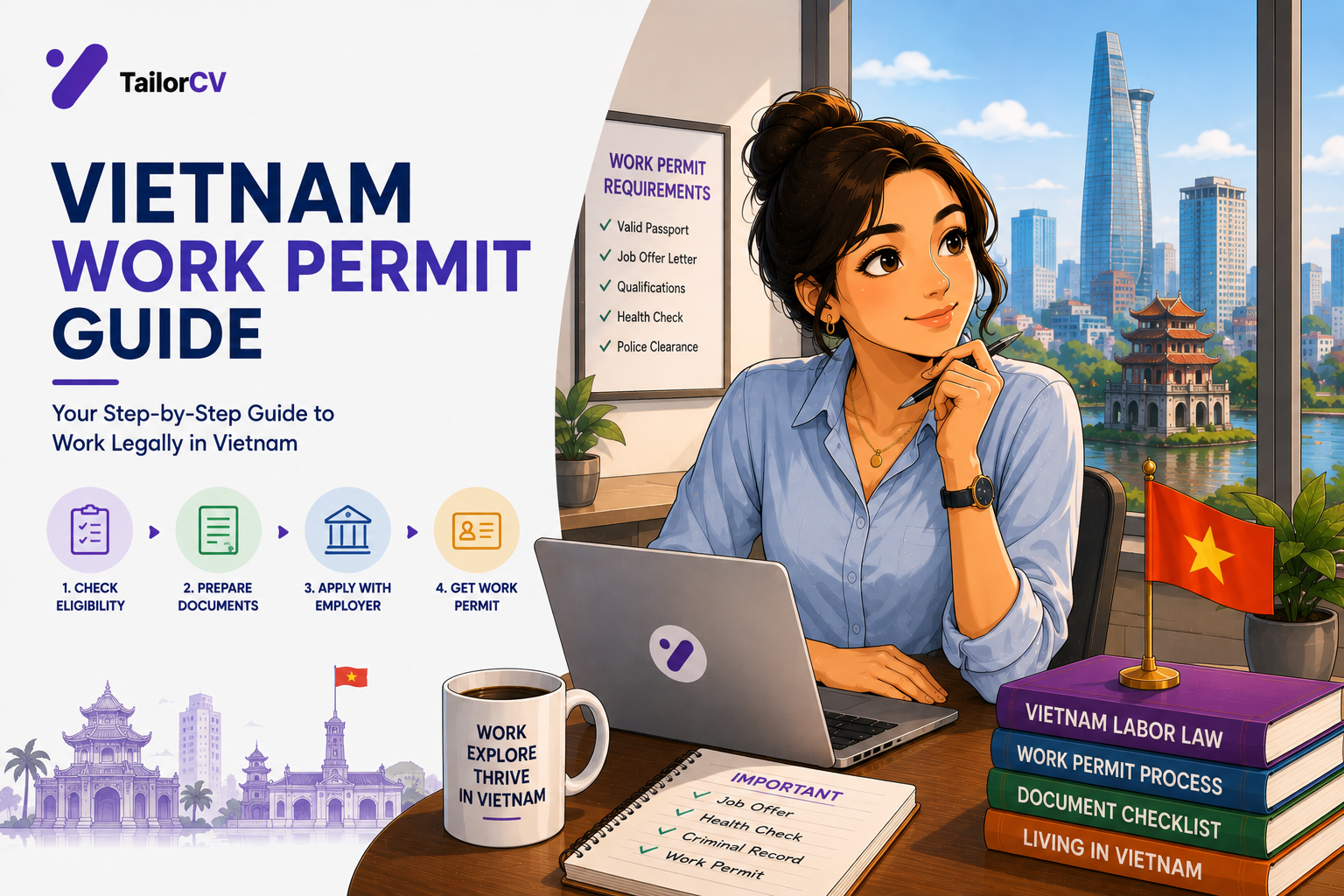
Work permit first, obtained by your employer before you can work legally.
Temporary residence card or a work-permit-linked visa, which follows and determines how long you can stay.
Criminal record certificate from your home country and from Vietnam if you have been there, both authenticated.
Health check at an approved facility.
Degree and experience documents, legalised and consularised — the slowest element.
Health insurance, since international care is the practical option and it is expensive without cover.
Bank account, which requires your residence documentation.
And expect the process to be employer-driven. Vietnam's work permit system runs through the employer, and the quality of their HR function largely determines how smoothly it goes.
Where roles are advertised
Vietnam's channels.
VietnamWorks is the largest professional job platform in the country.
LinkedIn works for the international and foreign-invested sector, which is where most foreign hiring happens.
ITviec covers technology roles specifically and is well used by the local engineering market.
Company career pages for the large foreign-invested manufacturers and international employers.
Recruitment agencies are active in executive and specialist search, particularly for the manufacturing and industrial sector.
Teaching-specific channels and school websites for the English teaching market, which operates separately.
Chambers of commerce — the European, American, British and other bilateral chambers — run networking and job listings and are genuinely useful for foreign professionals.
And referrals, which in a market where foreign hiring is relatively concentrated carry real weight.
Working culture
Worth calibrating before arriving.
Hierarchies are respected and seniority carries weight, more so than in Western workplaces.
Relationships underpin business and time spent building them is not preamble.
Indirect communication is normal. Disagreement is expressed carefully, and a direct Western style can land poorly.
Face matters. Public criticism is genuinely damaging and correction is best handled privately.
The pace is fast in a rapidly growing economy, and things change quickly.
Hours can be long, particularly in manufacturing and at local companies.
Tet — the lunar new year — stops the country for a substantial period, and business plans around it.
And Vietnamese colleagues are notably welcoming to foreigners who make an effort with the language and the customs, which is a genuine and low-cost advantage.
Building a career from Vietnam
Where the market leads.
Manufacturing and supply chain experience is highly portable. Vietnam sits inside global supply chains, and experience running quality, production or sourcing there transfers to Thailand, Malaysia, Mexico, India and beyond.
Regional roles are a natural progression. Many international companies use Vietnam as a base for wider Southeast Asian responsibility.
Language matters over time. Vietnamese is difficult and it materially changes your standing with local teams and partners.
The economy is growing quickly, which means responsibility arrives earlier than it would in a mature market — a genuine advantage for someone early in a career.
And the international community is well connected. The bilateral chambers, the industry associations and the expatriate business network are small enough to be genuinely useful.
The common pattern is a few years building regional or manufacturing expertise, then either a regional role, a move to another Southeast Asian market, or a return home with genuinely differentiated experience.
Common misreadings of the Vietnamese market
Five beliefs that lead people astray.
"It is cheap so anyone can move there." Living costs are low and work authorisation is not easy. The permit rests on expertise the local market lacks.
"Teaching leads into business." It puts you in the country legally, which matters. It does not build the credentials a professional permit requires.
"The local workforce is unskilled." It is young, growing rapidly in capability and inexpensive. Assuming otherwise leads to applications that go nowhere.
"I can work remotely on a tourist visa." Not lawfully, and enforcement has tightened.
"It is basically like Thailand." The economies differ substantially — Vietnam is manufacturing-led and Thailand more services and tourism-led, and the foreign employment patterns follow that.
Mini checklist
- unchecked: Work permit route understood — employer-sponsored
- unchecked: Sector matched to where foreigners are actually hired
- unchecked: Documents legalised and authenticated early
- unchecked: Criminal record certificate obtained
- unchecked: Health check requirements understood
- unchecked: Temporary residence card versus visa clarified
- unchecked: English teaching considered as an entry if applicable
- unchecked: City chosen — Ho Chi Minh City, Hanoi or Da Nang
- unchecked: Salary compared against genuinely low local costs
Scenarios
Scenario 1: You are a native English speaker with a degree
Teaching is the most accessible entry, and it puts you in the country with a legal work permit while you build a network. Treat it as a deliberate step rather than assuming it leads into corporate work by itself.
Scenario 2: You have manufacturing, quality or supply chain experience
This is where foreign professional demand genuinely is. The foreign-invested manufacturing sector needs experienced people, and the expertise argument for a work permit is straightforward.
Scenario 3: You are a software engineer
Be realistic. Vietnam has a strong and inexpensive local engineering pool, so a foreign hire needs to bring something specific — a niche specialism, client-facing capability in a foreign language, or leadership experience.
Tip: Understand that Vietnam has a large, capable and inexpensive domestic workforce. Foreign hiring happens where there is a genuine expertise gap or an international company's own requirement — so lead with what you bring that is not locally available.
Do's and Don'ts
Do
- Target foreign-invested companies and international employers
- Lead with genuinely scarce expertise
- Start document legalisation early
- Consider teaching as a legitimate entry
- Compare salary against very low local costs
- Learn some Vietnamese for daily life
Don't
- Assume a general professional role will justify a permit
- Expect to work without employer sponsorship
- Treat teaching as an automatic route into corporate work
- Underestimate the local talent pool
- Leave document authentication late
- Assume English works outside international contexts
Common Mistakes
- Underestimating local talent. Vietnam's workforce is capable and inexpensive, so the bar for foreign hiring is high.
- Expecting a general role to qualify. Permits rest on expertise not locally available.
- Treating teaching as a stepping stone. It gets you into the country; it does not build corporate credentials.
- Late document preparation. Legalisation and authentication take weeks.
- Ignoring manufacturing. It is where foreign professional demand genuinely concentrates.
- Assuming English suffices. It works in international contexts and not in the domestic market.
Related Guides
Keep building on this with the related guides in this series:
- Vietnam Work Permits Explained
- Technology Jobs in Ho Chi Minh City and Hanoi
- Manufacturing Careers in Vietnam
- English Teaching Jobs in Vietnam
- Southeast Asian Job Markets Compared
You can also check your resume's ATS score for free, generate a tailored cover letter, or build a portfolio website in minutes.
Frequently Asked Questions
Can foreigners work in Vietnam?
Yes, with an employer-sponsored work permit. The employer generally must demonstrate the role requires expertise not available in the local labour market.
What jobs do foreigners actually do in Vietnam?
English teaching by headcount, plus management and technical roles at foreign-invested manufacturers, senior specialist positions, hospitality management and services to foreign investors.
Is Vietnam good for software engineers?
The local engineering pool is strong and inexpensive, so a foreign hire needs to bring something specific — a niche specialism, foreign-language client capability or leadership experience.
Do I need Vietnamese?
For the domestic market, yes, and it is a tonal language that is genuinely difficult. English works at foreign-invested companies, international schools and within the expatriate business community.
Which city should I target?
Ho Chi Minh City for the largest international community and commercial activity, Hanoi for government-adjacent and northern manufacturing, Da Nang as a growing smaller option.
Is teaching a route into corporate work?
It is a route into the country with a legal permit and a network. It does not build corporate credentials by itself, so treat it as a deliberate step rather than an automatic ladder.
What do Vietnamese salaries look like for foreigners?
They vary enormously between an expatriate package at an international manufacturer — frequently including housing, schooling and flights — and a local contract, which pays at local rates.
What documents do I need for Vietnam?
An authenticated criminal record certificate, a health check at an approved facility, and legalised degree and experience documents. The legalisation is the slowest element, so start early.
Where should I look for jobs in Vietnam?
VietnamWorks for professional roles, ITviec for technology, LinkedIn for the foreign-invested sector, company career pages for large manufacturers, and the bilateral chambers of commerce which are genuinely useful for foreign professionals.
What is Vietnamese workplace culture like?
Hierarchical and relationship-led, with indirect communication and real importance placed on face. Tet stops the country for a substantial period and business plans around it.
Is Vietnam easy to move to for work?
Living costs are low but work authorisation is not easy. The permit rests on demonstrating expertise the local market lacks, and Vietnam's workforce is young, capable and inexpensive.
What is your resume scoring right now?
Scan it against a job description and get your ATS match score in about a minute.
Drop your resume here or choose a file
PDF only. Max 2 MB.
We never share your data or use it to train AI models.

Was this guide useful?
Be the first to rate it.