 TD
TD
Key Takeaways
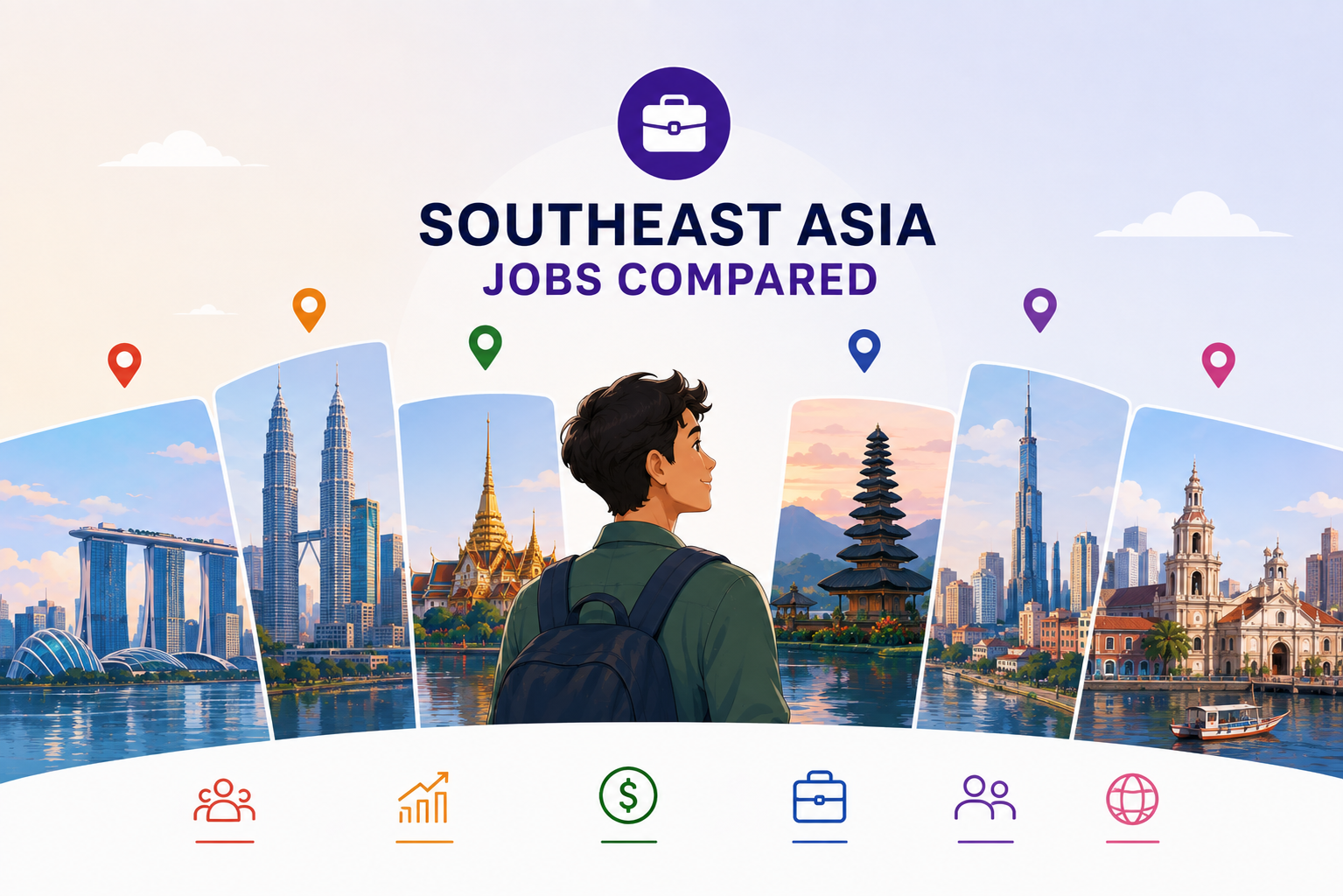
- Singapore is the regional hub with the highest salaries, deepest funding and the most competitive market.
- Vietnam has the strongest engineering depth outside Singapore, built on a long outsourcing heritage.
- Indonesia has the market scale, producing genuine engineering problems that smaller neighbours cannot.
- The Philippines has the English advantage, which makes it uniquely accessible and drives its remote-work economy.
- Thailand and Malaysia sit differently — Thailand restrictive but liveable, Malaysia the most balanced middle option.
The comparison at a glance
| Work authorisation | Working language | Standout sector | |
|---|---|---|---|
| Singapore | Salary-threshold based, competitive | English | Finance, regional HQs, deep tech |
| Vietnam | Employer-sponsored, expertise-based | Vietnamese, English in tech | Software engineering, outsourcing |
| Thailand | Restricted occupation list applies | Thai, English in some sectors | Manufacturing, tourism, teaching |
| Indonesia | RPTKA and KITAS, employer-driven | Indonesian | Consumer platforms at scale |
| Philippines | AEP plus 9(g), reserved professions | English genuinely | BPO, knowledge process, remote work |
| Malaysia | Employment Pass, tiered | Malay and English widely | Regional services, electronics |
No single country wins, and the honest answer depends entirely on what you do, what languages you have and what you want the next five years to look like.
For software engineers
Where the engineering work actually is.
Singapore has the highest salaries, the most sophisticated employers and the fiercest competition, with work authorisation genuinely hard at junior levels.
Vietnam has the deepest local engineering talent pool outside Singapore, with FPT, outsourcing heritage and a growing product sector. It is where the volume of serious engineering work is.
Indonesia offers scale problems — consumer platforms serving a very large population — which few places in the region can match.
The Philippines has a smaller product sector and an enormous remote-work economy, with many of the best engineers working directly for foreign employers.
Malaysia sits comfortably in the middle with good regional services work and widespread English.
Thailand has the smallest technology sector relative to its economy of the six.
For a foreign engineer, Singapore and Malaysia are the most accessible, Vietnam and Indonesia the most interesting technically, and the Philippines the easiest linguistically.
For everyone else
Beyond software.
Manufacturing and supply chain — Vietnam and Thailand lead, with Malaysia strong in electronics and Indonesia growing.
Finance — Singapore dominates, with Malaysia holding Islamic finance depth.
Teaching English — Thailand and Vietnam are the established markets, with Vietnam generally paying better and Thailand offering the more famous lifestyle.
Hospitality and tourism — Thailand and Indonesia at scale, with Vietnam growing.
Shared services and BPO — the Philippines and Malaysia lead comfortably.
Energy and resources — Indonesia and Malaysia.
And regional headquarters roles — Singapore first, with Kuala Lumpur and Bangkok holding real numbers.
Work authorisation compared
The practical differences that decide whether a move is possible at all.
Singapore operates salary and qualification thresholds through the Employment Pass, with a framework that has tightened considerably. It is transparent and genuinely competitive, and junior candidates struggle.
Malaysia runs a tiered Employment Pass with salary bands determining duration and dependant rights. It is among the clearer processes in the region.
Vietnam requires an employer-sponsored work permit demonstrating expertise and experience, with document legalisation being the usual bottleneck.
Thailand requires both a visa and a work permit, with a list of occupations reserved for Thai nationals and employer conditions on capital and Thai employee ratios.
Indonesia requires the employer's RPTKA manpower plan followed by the KITAS, with a levy payable and a genuine administrative burden.
The Philippines requires an Alien Employment Permit plus a 9(g) visa, with several professions constitutionally reserved for Filipino citizens.
The pattern across the region is that everything is employer-driven, none of it is accessible independently, and the employer's experience and willingness matter more than your qualifications in almost every case.
Cost, salary and what remains
The financial comparison that matters.
Singapore pays several times the regional average and costs several times as much, with housing being the dominant expense.
Malaysia offers the best ratio for many people — reasonable salaries against genuinely moderate costs.
Thailand has low costs outside central Bangkok and modest local salaries, which is why so many people there earn abroad and spend locally.
Vietnam has low costs and rising technology salaries, producing a genuinely favourable ratio for engineers.
Indonesia has low costs and modest salaries, with Jakarta housing being the main pressure.
The Philippines has low costs and the lowest local professional salaries of the six, which is precisely why the remote-work economy grew so large.
And the honest observation is that outside Singapore, the highest-earning option for a skilled professional in this region is frequently working for a foreign employer while living locally — a pattern that shapes the labour market in Vietnam, Thailand, Indonesia and the Philippines alike.
Long-term prospects
Where each leads over years rather than months.
Singapore offers permanent residence pathways that are genuinely competitive and a strong platform for a regional career.
Malaysia has residence pathways and the MM2H programme with conditions that have varied considerably.
Thailand has the LTR visa for qualifying categories and otherwise limited long-term routes.
Vietnam has temporary residence cards and limited permanent routes.
Indonesia has KITAP after a qualifying period.
The Philippines has SRRV for retirees and limited employment-based permanent routes.
Which means Singapore and Malaysia are the two places in the region where a foreign professional can realistically build a permanent life, and the others are better understood as chapters than as destinations.
Quality of life
The factors that decide whether people stay.
Singapore is efficient, safe, clean and expensive, with a reputation for being somewhat sterile that residents either mind a great deal or not at all.
Malaysia offers good infrastructure, genuine cultural diversity, widespread English and reasonable costs, and is consistently the most underrated in this respect.
Thailand has exceptional food, a well-established international community and genuine appeal, alongside air quality problems in Bangkok and Chiang Mai at certain times of year.
Vietnam is energetic and rapidly improving, with excellent food and lower costs, and traffic and air quality being the routine complaints.
Indonesia varies enormously between Jakarta, which is demanding, and Bali, which is a different proposition entirely.
The Philippines has genuine warmth, English everywhere and beautiful geography, alongside severe Manila traffic and infrastructure that lags its neighbours.
Healthcare is excellent privately in Singapore, Malaysia and Thailand, good in the major Vietnamese and Philippine cities, and thinner outside the capitals everywhere.
And international schooling is strong across Singapore, Malaysia, Thailand and the major cities elsewhere, which matters considerably for anyone relocating a family.
Choosing between them
A practical framework.
Start with your profession, since the gap between the best and worst option for any given field is larger than any general quality-of-life difference.
Then your languages, which eliminate or open entire markets immediately.
Then work authorisation, checking whether employers in your target country can realistically sponsor someone with your profile.
Then the financial ratio, comparing local salary against local cost rather than converting anything.
Then the time horizon, since a two-year chapter and a permanent move point to different countries entirely.
Then family requirements, which narrow the field faster than anything else.
And finally lifestyle, which is where most people start and which should genuinely come last, because it is the factor that matters most in month three and least in year five.
Four things people get wrong
Beliefs that lead to bad decisions about this region.
"It is all cheap." Singapore is expensive by any measure, Bangkok and Jakarta housing in convenient areas is not cheap locally, and the cost advantage applies to converted foreign income rather than to local salaries.
"English is enough." Genuinely true in the Philippines, Malaysia and Singapore. Substantially false everywhere else outside international companies.
"The technology sectors are all outsourcing." Vietnam has a real product sector, Indonesia has consumer platforms at genuine scale, and Singapore has serious deep technology.
"You can just move there." Every country in the region requires employer sponsorship, and the employer's willingness and eligibility to sponsor is the actual gate rather than your qualifications.
Regional mobility
What each base opens up.
Singapore is the strongest platform for a regional career, hosting the majority of Southeast Asian regional headquarters and offering the connectivity that goes with it.
Malaysia and Thailand both host regional functions and are well connected.
Vietnam, Indonesia and the Philippines are more domestically oriented, with regional roles being fewer.
ASEAN does not confer free movement in the way Mercosur or the EU does, and mutual recognition arrangements exist for a limited set of professions without amounting to genuine mobility.
Which means moving between countries in the region requires a fresh employer-sponsored process each time, and this is a meaningful difference from working in Europe or Mercosur.
And it means Singapore's platform value is real rather than merely reputational, because a regional role based there is one of the few ways to work across the region without repeating the visa process.
Mini checklist
- unchecked: Sector matched to country rather than the other way round
- unchecked: Language requirement assessed honestly
- unchecked: Work authorisation difficulty checked for your specific profile
- unchecked: Salary compared against real local costs, not converted
- unchecked: Long-term residence prospects considered
- unchecked: Family and schooling requirements factored in
- unchecked: Healthcare quality researched
- unchecked: Regional mobility from that base considered
- unchecked: Realistic view taken of English-only limitations
Scenarios
Scenario 1: You want the highest pay and can compete
Singapore, without much debate. The salaries, employers and career depth are the best in the region and the competition and cost of living match.
Scenario 2: You want serious engineering work at lower cost
Vietnam has the depth and Indonesia has the scale, and both are genuinely interesting places to build technically rather than compromises.
Scenario 3: You speak only English
The Philippines is the most accessible by a wide margin, with Malaysia and Singapore also workable. Vietnam, Thailand and Indonesia are considerably harder outside international companies.
Tip: Match the country to your sector rather than picking a country first. The gap between the best and worst option in the region for any given profession is far larger than the general quality-of-life differences that dominate most comparisons.
Do's and Don'ts
Do
- Match sector to country deliberately
- Assess language requirements honestly
- Check work authorisation for your specific profile
- Compare costs locally rather than converting
- Consider regional mobility from your base
- Research healthcare seriously
Don't
- Pick a country on lifestyle content alone
- Assume English suffices across the region
- Ignore restricted and reserved profession rules
- Convert salaries naively
- Overlook Malaysia, which is consistently underrated
- Assume Singapore is achievable at junior level
Common Mistakes
- Choosing on lifestyle alone. The career consequences outlast the novelty.
- Assuming English works everywhere. Only the Philippines, Malaysia and Singapore genuinely.
- Ignoring reserved professions. The Philippines and Thailand both restrict specific fields.
- Overlooking Malaysia. The most balanced option and consistently underrated.
- Expecting easy Singapore entry. Work authorisation is genuinely competitive.
- Naive salary conversion. Local purchasing power differs enormously from converted figures.
Related Guides
Keep building on this with the related guides in this series:
- Working in Vietnam as a Foreign Professional
- Working in Thailand as a Foreign Professional
- Working in Indonesia as a Foreigner
- Working in the Philippines
- Latin America versus Asia for Graduates
You can also check your resume's ATS score for free, generate a tailored cover letter, or build a portfolio website in minutes.
Frequently Asked Questions
Which Southeast Asian country is best for work?
It depends entirely on your sector and languages. Singapore for pay and career depth, Vietnam for engineering, Indonesia for scale, the Philippines for English accessibility, Malaysia for balance.
Where can I work with only English?
The Philippines by a wide margin, then Malaysia and Singapore. Vietnam, Thailand and Indonesia are considerably harder outside international companies.
Which has the strongest technology sector?
Singapore for sophistication and funding, Vietnam for engineering depth and volume, Indonesia for genuine consumer scale problems.
Which is easiest for work authorisation?
Malaysia and Singapore have the clearest processes, though Singapore is genuinely competitive. Thailand and the Philippines both restrict specific professions outright.
Where should I teach English?
Vietnam generally pays better and Thailand offers the more established lifestyle. Both have real markets with genuine demand.
Is Malaysia underrated?
Consistently. Widespread English, reasonable costs, a clear Employment Pass process and good regional connectivity make it the most balanced middle option in the region.
How does work authorisation compare across Southeast Asia?
All six are employer-driven and none are accessible independently. Singapore and Malaysia have the clearest processes, Thailand and the Philippines reserve specific professions, and Indonesia carries the heaviest administrative burden.
Where can I realistically settle long-term?
Singapore and Malaysia have the most genuine long-term residence pathways. Thailand, Vietnam, Indonesia and the Philippines are better understood as career chapters than as permanent destinations.
How should I choose between Southeast Asian countries?
Start with your profession, then languages, then whether employers can realistically sponsor your profile, then the local salary-to-cost ratio, then your time horizon and family needs — and put lifestyle last.
What is your resume scoring right now?
Scan it against a job description and get your ATS match score in about a minute.
Drop your resume here or choose a file
PDF only. Max 2 MB.
We never share your data or use it to train AI models.

Was this guide useful?
Be the first to rate it.