SS
SS
Key Takeaways
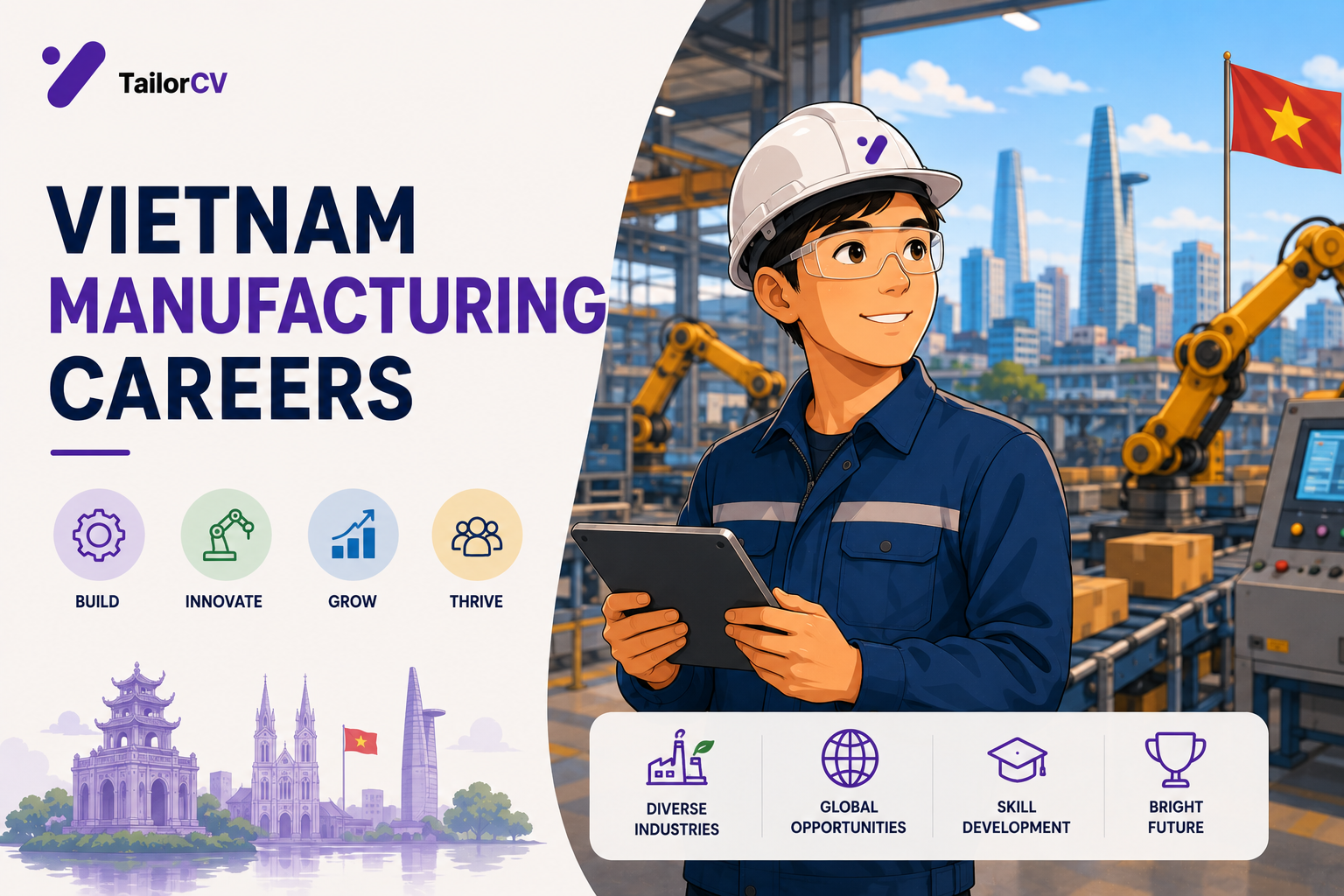
- Manufacturing is Vietnam's economic engine and the sector where foreign professional demand is genuinely strongest.
- Electronics dominates, with Samsung's operations among the largest, plus a deep components and assembly ecosystem.
- Textiles, footwear and furniture remain very large employers with substantial export volumes.
- Quality, production management, supply chain and engineering are the roles where expatriate expertise is most sought.
- The northern and southern industrial zones differ, and knowing which serves which industry matters.
Why manufacturing moved here
Understanding the driver explains where the jobs are.
Cost and capability together. Vietnam offered lower labour costs than China alongside a young, trainable workforce and improving infrastructure.
Supply chain diversification. International companies deliberately reduced concentration in a single country, and Vietnam was the primary beneficiary in several categories.
Trade agreements. Vietnam's network of free trade agreements, including with the EU, made it attractive as an export base.
Government investment in industrial zones, ports and roads, which materially improved the practicalities.
And proximity to existing supply chains in southern China, which made component sourcing straightforward.
The result: a manufacturing base that grew quickly and continues to, with a persistent shortage of experienced management and technical people — which is precisely where foreign hiring happens.
Where the industries are
| Region | What concentrates there |
|---|---|
| Northern zones (Bac Ninh, Thai Nguyen, Hai Phong) | Electronics, including major smartphone and component manufacturing |
| Southern zones (Binh Duong, Dong Nai, HCMC outskirts) | Diverse — textiles, footwear, furniture, food processing, electronics |
| Central (Da Nang, Quang Nam) | Growing industrial presence, automotive components |
| Hai Phong and the northern ports | Logistics, heavy industry, export handling |
The north is electronics-heavy, driven substantially by large-scale smartphone and component production and the supplier ecosystem around it.
The south is more diverse, with a longer industrial history and a broader mix.
Industrial parks are the organising unit. Most manufacturing sits inside designated zones with their own infrastructure and administration, and knowing the major parks in your target region is genuinely useful.
The roles foreigners fill
Where expatriate hiring concentrates.
Plant and production management. Running a facility, its output, its people and its performance.
Quality management. QA and QC leadership, supplier quality, and the systems and audits that international customers require.
Supply chain and sourcing. Managing suppliers, logistics and inventory across a complex regional network.
Process and industrial engineering. Line design, efficiency, automation and continuous improvement.
Maintenance and reliability engineering for complex equipment.
Health, safety and environment, increasingly important as international customers audit their supply chains.
Compliance and social audit, particularly in textiles and footwear where customer scrutiny is intense.
And technical training, transferring capability into local teams — which is frequently an explicit part of a foreign hire's remit.
The common thread: foreign hires are brought in for experience that the fast-growing local workforce has not yet had time to accumulate, and transferring that capability is usually part of the job.
Compensation and conditions
What manufacturing roles actually offer.
Expatriate packages at international manufacturers are the attractive category — frequently including housing, schooling, flights and sometimes a hardship or location allowance for remote postings.
Local-contract roles pay local rates, which for a foreigner is generally only workable if you have other reasons to be there.
Site postings carry allowances where the location is remote from the cities.
Hours can be long, particularly during ramp-ups, audits and peak production periods.
Six-day weeks exist in some manufacturing environments, which is worth clarifying before accepting.
Accommodation is frequently provided or allowanced for site-based roles.
And the savings potential is genuine for someone on an expatriate package against Vietnamese living costs.
Making the application work
Practical mechanics for this sector.
Name the standards. ISO certifications, IATF for automotive, GMP for food and pharmaceutical, and any customer-specific systems you have operated under.
Quantify by the industry's units — output volumes, defect rates, headcount managed, line count, cost reductions achieved.
Name the methodologies — lean, six sigma, TPM, 5S — and be ready to discuss what you actually implemented rather than what you attended training on.
Highlight multi-cultural team leadership if you have it, since managing local teams across a language and culture gap is the core challenge of these roles.
State your permit position and your willingness to be based at a plant location.
Apply directly to the foreign-invested manufacturers, and use recruiters who specialise in industrial search in the region.
And be realistic about the environment. These are working factories in industrial zones, frequently hot, frequently far from the city, and the job is on the floor rather than in an office. People who go in clear-eyed do well.
The broader supply chain sector
Beyond the factory floor.
Sourcing and procurement offices. Many international retailers and brands maintain buying offices in Vietnam, staffed partly by expatriates, managing supplier relationships and product development.
Quality and inspection agencies — third-party firms providing inspection and audit services to international buyers.
Logistics and freight forwarding, substantial given Vietnam's export volumes.
Trade compliance and customs, an area of genuine complexity given the free trade agreement network.
Sustainability and social compliance, growing quickly as international buyers face regulatory and reputational pressure on their supply chains.
Product development and technical services, particularly in footwear and apparel where design and development sit close to production.
And testing laboratories serving the manufacturing base.
For someone with retail, brand or sourcing experience, these roles are frequently a better fit than plant management and they are considerably less well known.
Living the manufacturing life
The practical realities.
Locations are industrial. Bac Ninh, Binh Duong, Dong Nai — these are working industrial provinces rather than tourist destinations.
Commutes can be long or you live close to the plant, and neither option is a city-centre lifestyle.
Some employers provide transport and accommodation for site-based staff.
Facilities vary. Larger industrial parks have decent amenities; smaller sites do not.
The expatriate community at plant locations is small, which suits some people and isolates others.
Ho Chi Minh City and Hanoi are reachable at weekends from most southern and northern industrial zones respectively.
And the work is genuinely demanding — long hours during ramp-ups, real accountability for output and quality, and the constant challenge of managing across a language and culture gap. People who find that energising do very well; people who wanted an office job do not.
Getting into the sector
Realistic entry routes.
Transfer from within a multinational. If your employer has Vietnamese operations, an internal move is by far the cleanest route — the permit case is straightforward and the company handles it.
Join a company with Vietnamese operations from your home country, then move internally after establishing yourself.
Specialist recruiters. Industrial and manufacturing search firms operating across Southeast Asia place a substantial number of these roles.
Direct applications to the large foreign-invested manufacturers, whose careers pages carry vacancies.
Industry networks and trade bodies, including the bilateral chambers which are active in the manufacturing sector.
And regional moves. Someone with manufacturing experience elsewhere in Southeast Asia — Thailand, Malaysia, Indonesia, China — is a natural candidate for Vietnam, and this lateral regional movement is very common.
What rarely works is a cold application from outside the region with no manufacturing background, since the permit case depends on demonstrable relevant expertise.
Skills that transfer well into Vietnam
What Vietnamese manufacturers most consistently look for from abroad.
Systems implementation. Building a quality system, a maintenance regime or a planning process from a low base is a common brief.
Customer audit experience. Preparing a plant to pass international customer audits is genuinely valuable given how much Vietnamese production serves foreign brands.
Ramp-up experience. Taking a new line or a new product from pilot to volume is a specific skill and Vietnam does a great deal of it.
Supplier development. Bringing local suppliers up to international standard is a persistent need across the industrial base.
Automation and industry 4.0. As labour costs rise, Vietnamese manufacturers are investing in automation and the expertise is scarce locally.
Sustainability and environmental compliance, rising quickly with international regulation.
And cross-cultural team leadership, which is the underlying requirement in almost all of these — technical expertise alone does not succeed if you cannot transfer it to a local team.
Mini checklist
- unchecked: Industry matched — electronics, textiles, footwear, food, furniture
- unchecked: Region matched to that industry
- unchecked: Standards and certifications named on your CV
- unchecked: Specific systems and methodologies listed
- unchecked: Work permit expert category evidenced
- unchecked: Documents legalised early
- unchecked: Industrial park locations researched
- unchecked: Willingness to be outside the city centres considered
- unchecked: Capability-transfer experience highlighted
Scenarios
Scenario 1: You have plant or production management experience
This is where Vietnamese demand for foreign professionals is strongest, and the work permit expert-category argument is straightforward. Target the foreign-invested manufacturers directly.
Scenario 2: You work in quality or supplier auditing
International customers impose serious quality and social compliance requirements on Vietnamese suppliers, and people who can build and run those systems are genuinely sought.
Scenario 3: You are early in your career
Manufacturing is harder to enter as a foreigner at junior level, since local graduates fill those roles. A graduate scheme at a multinational with Vietnamese operations, entered from your home country, is a more realistic route.
Tip: Highlight any experience transferring capability to local teams — training, systems implementation, building a function from scratch. Vietnamese manufacturers frequently hire foreign managers explicitly to do that, and it is a stronger argument than technical competence alone.
Do's and Don'ts
Do
- Target foreign-invested manufacturers
- Name the standards and systems you know
- Highlight capability-transfer experience
- Research the relevant industrial zones
- Accept locations outside city centres
- Start document legalisation early
Don't
- Expect junior manufacturing roles as a foreigner
- Assume all regions serve the same industries
- Overlook quality and compliance roles
- Underestimate the pace of growth
- Ignore the language and culture dimension with local teams
- Expect a city-centre posting
Common Mistakes
- Applying at junior level. Local graduates fill those roles; foreign hiring is for experience.
- Ignoring the regional split. Electronics in the north, diversified industry in the south.
- Underselling capability transfer. It is frequently an explicit part of the remit.
- Overlooking compliance roles. International customer scrutiny makes them genuinely important.
- Expecting urban postings. Manufacturing sits in industrial zones, not city centres.
- Late document preparation. The permit rests on legalised qualifications and experience letters.
Related Guides
Keep building on this with the related guides in this series:
- Working in Vietnam as a Foreign Professional
- Vietnam Work Permits Explained
- Technology Jobs in Ho Chi Minh City and Hanoi
- English Teaching Jobs in Vietnam
- Southeast Asian Job Markets Compared
You can also check your resume's ATS score for free, generate a tailored cover letter, or build a portfolio website in minutes.
Frequently Asked Questions
Why did manufacturing move to Vietnam?
Lower costs than China combined with a young trainable workforce, deliberate supply chain diversification by international companies, an extensive free trade agreement network, and government investment in industrial infrastructure.
What manufacturing roles do foreigners fill?
Plant and production management, quality leadership, supply chain and sourcing, process engineering, maintenance, health and safety, and compliance — generally where experience exceeds what the fast-growing local workforce has accumulated.
Where are the industrial zones?
Electronics concentrates in northern zones around Bac Ninh, Thai Nguyen and Hai Phong; the south around Binh Duong and Dong Nai is more diversified across textiles, footwear, furniture and food.
Can I enter manufacturing in Vietnam as a graduate?
Rarely as a direct foreign hire, since local graduates fill junior roles. A graduate scheme at a multinational with Vietnamese operations, joined from your home country, is more realistic.
Do I need to live outside the cities?
Frequently yes. Manufacturing sits in industrial zones rather than city centres, and a willingness to be based accordingly is part of the job.
What makes a strong application?
Named standards and systems, specific methodologies, and evidence of transferring capability to local teams — which is often an explicit part of why a foreign manager is hired.
What do manufacturing packages in Vietnam include?
Expatriate packages at international manufacturers frequently include housing, schooling, flights and location allowances for remote sites. Local-contract roles pay local rates.
What should a manufacturing CV for Vietnam emphasise?
Named standards and certifications, quantified output and headcount figures, specific methodologies you implemented rather than trained in, and experience leading teams across a language and culture gap.
What supply chain roles exist beyond factories?
Sourcing and buying offices for international brands, third-party quality and inspection agencies, logistics and freight forwarding, trade compliance, sustainability and social compliance, and product development in apparel and footwear.
What is life like at a Vietnamese plant location?
Industrial provinces rather than cities, with long commutes or living near the plant, small expatriate communities, and demanding work — though major cities are reachable at weekends.
How do I actually get into Vietnamese manufacturing?
Internal transfer within a multinational is cleanest, followed by specialist industrial recruiters, direct applications to foreign-invested manufacturers, and lateral moves from elsewhere in Southeast Asia.
What skills do Vietnamese manufacturers want from foreign hires?
Systems implementation from a low base, customer audit preparation, ramp-up experience, supplier development, automation expertise, environmental compliance — and above all the ability to transfer capability to local teams.
What is your resume scoring right now?
Scan it against a job description and get your ATS match score in about a minute.
Drop your resume here or choose a file
PDF only. Max 2 MB.
We never share your data or use it to train AI models.

Was this guide useful?
Be the first to rate it.