SS
SS
Key Takeaways
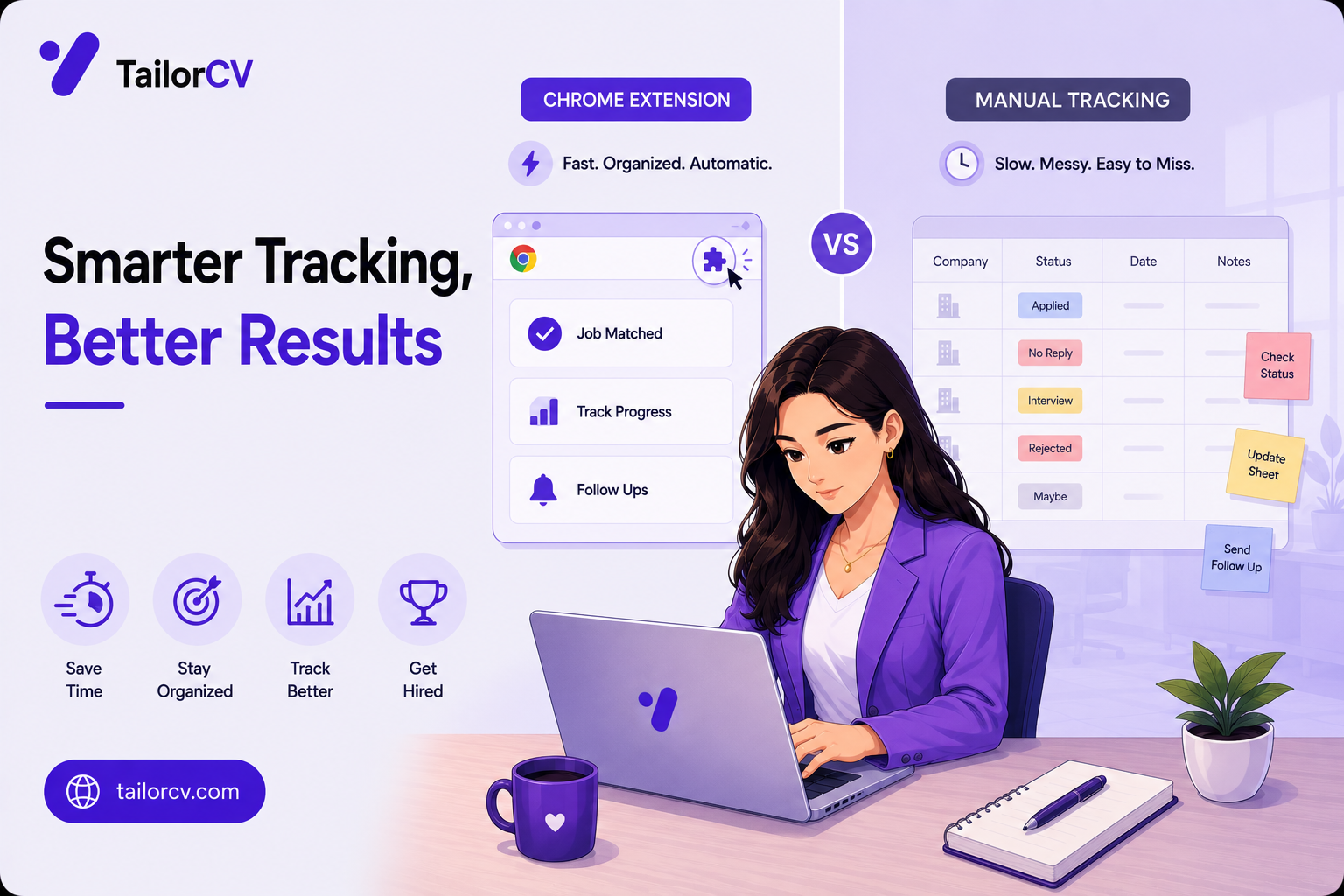
- Manual trackers fail for a predictable reason: logging happens after the application, when the motivation has already been spent.
- The extension logs applications automatically and saves each tailored resume against the job it was written for.
- The thing a spreadsheet cannot store is the actual document you sent — which is what you need when the call comes.
- Tracking matters most six to twelve weeks in, exactly when manual discipline has usually collapsed.
- A tracker's real job is not organisation. It is making your own search legible to you so you can improve it.
Why spreadsheets get abandoned
Almost everyone starts one. Almost nobody has it two months later.
The logging happens at the wrong moment. You finish an application, you feel the small relief of having sent it, and the last thing you want is to open a spreadsheet and type the company name into it. So you tell yourself you will do it later, and later is a batch of eleven applications you can no longer reconstruct.
It gets stale silently. A tracker with three weeks missing is worse than no tracker, because you trust it and it is wrong.
It stores the wrong things. Company, role, date, status. What it does not store is the resume you actually sent, which is the thing you need when someone rings about a role from a month ago.
And it is one more chore in a process that is already generating more chores than motivation.
What automatic logging changes
It happens at the right moment — during, not after. The application is logged as part of doing it, so there is no separate discipline to maintain.
It stores the document. Every tailored resume is saved to your account on the My Resumes page, against the job it was generated for. That is the piece a spreadsheet structurally cannot hold.
It survives your motivation. In week nine, when you are applying without enthusiasm, the record still gets kept, because it does not depend on you feeling like keeping it.
It gives you data about your own search. Which kinds of role responded, which did not, how your response rate changed after you rewrote your base resume. This is the information that turns a search from a slog into something you can actually improve.
What still needs you
Automatic logging is not the whole tracker, and pretending otherwise is unhelpful.
Outcomes. Whether a company replied, whether you got an interview, what happened at it — these are events outside the application and they need a note.
Follow-up dates. A system can record that you applied; deciding to chase in ten days is your call.
Contacts. The recruiter's name, the person you spoke to, what they said. This is the highest-value information in any search and it lives nowhere automatic.
Your notes on fit. Why you wanted the job, what worried you about it, what you would ask if they called. Five sentences written at the time is worth more than an hour of reconstruction later.
The practical setup: let the system hold the applications and the documents, and keep a very light personal note against the ones that progress. That division of labour survives a long search in a way a full manual tracker does not.
When tracking actually matters
Early on it feels unnecessary, which is why people skip it, which is why it fails later.
Weeks one to three. You remember everything. Tracking feels like overhead.
Weeks four to eight. The applications blur. You are no longer certain whether you applied to a company, and you have started occasionally applying twice.
Weeks six to twelve. Responses start arriving for applications made a month ago. This is when you need to know what you sent, and this is exactly when a manual tracker has usually gone stale.
Beyond three months. Patterns become visible if you have the data — which sectors respond, which application sources are wasting your time, whether a change you made helped. Without data, three months of search teaches you almost nothing.
What good notes look like
Five sentences at the time beats an hour of reconstruction later. Here is what is worth writing.
Why you applied. One line. It is remarkably easy to forget what appealed about a role, and it is the first thing an interviewer asks.
What worried you. Salary, location, a vague job description, a company you could not find much about. If they call, this is your question list already written.
Who you contacted. Name, role, how you found them, what they said. This is the highest-value information in a search and it exists nowhere else.
What you sent. The system holds the resume; note if you customised anything unusual.
The follow-up date. A specific day, not "in a while".
Keep it in one file, not five. A single running document ordered by date beats an elaborate structure you will not maintain.
Reviewing the data monthly
The point of any record is what you learn from it.
Response rate by source. If one board has produced forty applications and zero responses, stop using it. This is the single most common thing a search never notices.
Response rate by sector or role type. Sometimes an adjacent role type responds far better, and the data shows it long before intuition does.
Response rate before and after changes. If you rewrote your resume in week five, compare weeks one to four against six to nine. Without the record, you are guessing about whether your own improvements worked.
Time to response. Knowing that your market typically replies within ten days tells you when to stop hoping about a specific application and move on, which is worth real emotional energy.
And notice what you are avoiding. A month of applications with no tier-one entries usually means the jobs you actually want feel too intimidating to apply for — which is worth knowing, and is not a scheduling problem.
Tracking follow-ups properly
The follow-up is where most tracked information actually earns its keep.
Set a date, not an intention. "Follow up 12 March" is actionable; "follow up soon" is not, and soon never arrives.
One follow-up, then let it go. A polite message a week to ten days after applying is normal in most markets. Repeated chasing damages more than it helps almost everywhere except the Gulf.
Follow up to a person where you can. A message to a named recruiter or hiring manager on LinkedIn outperforms a reply into an application portal by a wide margin.
Keep the message short and specific. Reference the role, the date you applied, and one sentence about why you are a fit. Three lines.
Record the response, including silence. Knowing that a company never replies to follow-ups is useful information about that company.
Batch them. All follow-ups on one day of the week rather than as they occur to you, which is both more efficient and less anxiety-producing.
When a spreadsheet still earns its place
Automatic logging is not the answer to everything, and there are cases where a manual file is genuinely better.
Networking and referrals. People you have spoken to, who introduced you, what was said and when to reconnect. None of this touches an application form, so nothing captures it automatically.
Speculative approaches. Companies you wrote to without an advertised role. They have no posting to log against.
Interview pipelines. Once a process starts, it has stages, dates, names and preparation notes. That belongs somewhere you control.
Salary information. Ranges you were quoted, offers received, what you asked for. This is the most valuable data you will collect and it is worth keeping deliberately.
Your own reflections. What went well in an interview, what you fumbled, what you would say differently. This is how interviewing actually improves, and it exists nowhere but in a note you wrote.
The working split: the system holds applications and documents; a single simple file holds people, pipelines, numbers and reflections. Neither replaces the other, and trying to make one do both is why the elaborate spreadsheet always dies.
Reading your own search after three months
The data only pays off if you sit down with it.
Count the funnel. Applications, responses, first interviews, later stages, offers. Each ratio tells you about a different gate, and the one that drops off hardest is where your effort belongs.
Look for a source that is wasting you. It is common to find that one board produced a quarter of your applications and none of your responses.
Look for a role type that responded. Frequently it is adjacent to what you were targeting rather than the thing itself, and the data shows it before intuition does.
Check your timing. If most responses came from applications made within a day of posting, your sourcing cadence matters more than your document.
Compare before and after your changes. Whatever you altered in week five — the resume, the targeting, the cover letters — the data tells you whether it worked. Without a record, three months of effort teaches you nothing you can act on.
Then change one thing. Not everything at once, because then the next three months are equally uninterpretable.
Mini checklist
- unchecked: Extension installed and logged in
- unchecked: My Resumes page checked once to see what it records
- unchecked: A light personal note kept for applications that progress
- unchecked: Follow-up dates set on a fixed weekly day
- unchecked: Contact names recorded when you get them
- unchecked: Response patterns reviewed monthly
- unchecked: Duplicate applications checked before sending
- unchecked: Base resume revisited if response rates are flat
Scenarios
Scenario 1: A recruiter calls about a role from three weeks ago
Open My Resumes, find the version you sent, and read it before you speak. This is the single most concrete argument for keeping the documents rather than just the dates.
Scenario 2: You cannot remember whether you applied somewhere
Check the record before sending again. Applying twice to the same role is a small, avoidable embarrassment that happens constantly in long searches.
Scenario 3: Three months in with nothing to show
Look at the pattern rather than adding volume. Which sources produced responses, which sectors ignored you, whether anything changed after you updated your resume. Without a record there is nothing to look at.
Tip: Keep the automatic log for applications and one short note per application that progresses. The full manual tracker is the thing that always gets abandoned; this split survives a six-month search.
Do's and Don'ts
Do
- Let the system log applications automatically
- Keep light notes on anything that progresses
- Record contact names when you get them
- Review response patterns monthly
- Check for duplicates before applying
- Read the sent version before a call
Don't
- Rely on remembering
- Maintain a heavy manual tracker you will abandon
- Track dates without keeping the documents
- Skip tracking early because it feels unnecessary
- Add volume when the pattern says the resume is the problem
- Trust a tracker with three weeks missing
Common Mistakes
- Logging after the fact. The motivation is spent by then, which is why spreadsheets die.
- Storing dates but not documents. The document is what you need on the call.
- Skipping it early. It feels unnecessary in week two and essential in week eight.
- Trusting a stale tracker. Partial data is worse than none.
- Applying twice. Common, avoidable, and slightly embarrassing.
- Never reviewing patterns. Three months without data teaches you nothing.
Related Guides
Keep building on this with the related guides in this series:
- Fifty Applications Without Losing Your Mind
- The One-Click Apply Workflow
- Getting an ATS Score on Any Job Posting
- Applying on Indeed Faster
- What the Extension Can and Cannot See
- The Best Chrome Extension for Students Job Hunting (2026)
You can also check your resume's ATS score for free, generate a tailored cover letter, or build a portfolio website in minutes.
Frequently Asked Questions
Why do job search spreadsheets fail?
Because the logging happens after the application, when the motivation is already spent. Three weeks of missing entries makes the whole thing untrustworthy.
What does the extension record?
Each tailored resume is saved to your TailorCV account against the job it was generated for, and applications are logged as you make them.
What does a spreadsheet miss that this catches?
The actual document you sent. Dates and company names are easy to reconstruct; the specific tailored resume is not, and it is what you need when someone calls.
Do I still need my own notes?
Yes, lightly. Outcomes, follow-up dates, contact names and your own view on fit all live outside the application and are worth five sentences each.
When does tracking start to matter?
Around week six, when responses begin arriving for applications made a month earlier — which is exactly when manual trackers have usually gone stale.
How do I use the data?
Review monthly. Which sources responded, which sectors ignored you, and whether response rates changed after you revised your resume.
What should I write in my notes?
Why you applied, what worried you, who you contacted, anything unusual you sent, and a specific follow-up date. Five sentences at the time beats reconstruction later.
What should I review monthly?
Response rate by source and by role type, whether rates changed after you revised your resume, and typical time to response so you know when to stop waiting.
When should I follow up on an application?
A week to ten days afterwards, once, to a named person where possible. Keep it to three lines and batch all follow-ups on one day of the week.
What should stay in a manual file?
People you have spoken to, speculative approaches, interview pipelines, salary information and your own reflections after interviews. None of that touches an application form.
Check your match before you install anything
Same score the extension shows on a job page - run it here on any resume and job description.
Drop your resume here or choose a file
PDF only. Max 2 MB.
We never share your data or use it to train AI models.

Was this guide useful?
Be the first to rate it.