SS
SS
Key Takeaways
- The German CV is called a Lebenslauf, and the standard form is tabellarisch — a tabular, reverse-chronological layout rather than the prose-and-bullets style used in the US and UK.
- A photograph is still conventional at most German employers, unlike UK, US, Canadian and Australian practice where it is actively discouraged.
- German applications are usually a complete package (Bewerbungsmappe): cover letter, Lebenslauf, and scanned certificates — not a CV on its own.
- Two pages is normal and accepted, and gaps in your timeline are expected to be explained rather than hidden.
- Your degree may need formal recognition; the anabin database is where you check how a foreign qualification is classified before you apply anywhere.
What a Lebenslauf actually is
The word translates as "course of life", and the document lives up to it more literally than an English-language CV does. Where a US resume is a marketing document that selects the most relevant highlights, a Lebenslauf is closer to a complete, verifiable record presented in a fixed layout.
The standard form is the tabellarischer Lebenslauf — a two-column tabular layout with dates on the left and detail on the right, running in reverse chronological order. It is not a design exercise. German recruiters expect a predictable structure and read it quickly because every candidate's document is laid out the same way.
That predictability is the point, and it is where most international applicants go wrong: they submit a beautifully designed one-page resume that signals unfamiliarity with local convention before a single line is read.
How it differs from a UK or US resume
| Element | Germany (Lebenslauf) | UK / US convention |
|---|---|---|
| Photograph | Conventional at most employers, professionally taken | Never included |
| Date of birth | Commonly included | Never included |
| Length | Two pages is normal | One page for a graduate |
| Layout | Tabular, dates in a left column | Prose bullets under headings |
| Gaps | Expected to be accounted for | Often glossed over |
| Signature | Place, date and signature at the foot | Not used |
| Attachments | Scanned certificates included | References "on request" |
The photograph is the difference that surprises people most. Germany has anti-discrimination legislation (the AGG) and some large employers have moved to anonymous applications, so a CV without a photo will not be rejected outright. But at the majority of employers it remains conventional, and a professionally taken photo is a normal cost of applying.
The signature at the bottom is the second surprise. Adding the place, the date and your signature is standard practice and signals that the document is a formal declaration rather than a marketing sheet.
The application package
A German application is usually submitted as a set of documents rather than a CV alone.
- Anschreiben — the cover letter. Genuinely read, and weighted more heavily than a UK cover letter typically is.
- Lebenslauf — the CV itself, in the tabular form described above.
- Zeugnisse — scanned certificates: your degree, and where you have them, references from previous employers.
That third item has no real equivalent in UK or US hiring. German employers expect documentary evidence attached to the application, not offered later on request. Assemble scans of your degree certificate and transcripts before you start applying, because collecting them under deadline pressure is where applications slip.
Arbeitszeugnis is worth knowing about as a term even if you have never held a German job. It is a formal written reference an employer is legally obliged to provide when you leave, written in a conventional coded language, and it forms part of the package for anyone with German work history.
Getting your degree recognised
Before you invest time applying, check how your qualification is classified.
anabin is the official database maintained by the German authorities that records how foreign qualifications and institutions are assessed. Looking your own university and degree up there takes a few minutes and tells you whether your qualification is recognised as equivalent — which matters both for employers and for visa routes like the EU Blue Card.
For regulated professions — medicine, law, teaching, some engineering roles — recognition is a formal legal requirement rather than a helpful signal, and the process is separate and considerably longer. Start it early if it applies to you.
Language, honestly
German language ability determines the shape of your job search more than any other single factor.
Berlin's startup and technology scene has a genuine English-operating segment, and international companies with German offices frequently run in English. Outside those, most employers expect German, and many roles that do not strictly require it in the work still expect it socially and administratively.
Certification is worth having. The Goethe-Zertifikat and TestDaF are the recognised benchmarks, and stating a certified level — B2, C1 — is more credible to a German employer than a self-described claim. B2 is broadly the level at which a German-language professional environment becomes workable; C1 is where it stops being a limiting factor.
Section by section, what goes in
Persönliche Daten. Name, address, phone, email, and conventionally date and place of birth. Nationality is commonly included. Marital status and religion appear on older templates but are no longer expected and can be left out.
Berufserfahrung. Work experience, reverse chronological, with dates in the left column. For each role: employer, location, job title, and two to four lines on what you actually did. Outcomes and numbers work here exactly as they do anywhere — "reduced weekly reporting from three hours to twenty minutes" beats "responsible for reporting".
Ausbildung. Education, reverse chronological. Include your degree, the institution, the dates, and your final grade. German grades run 1.0 (best) to 4.0 (pass), so converting or at least explaining your own grading scale is genuinely helpful to a reader who has no idea what a 2:1 or a 3.6 GPA means.
Kenntnisse. Skills — languages with levels, technical skills, software. Be specific and defensible.
Weiterbildung / Zertifikate. Courses and certifications, where relevant.
Interessen. Optional, and more conventional in Germany than in the US. Keep it short and avoid the generic.
The grade conversion problem
This is worth its own attention because it silently costs international candidates.
A German reader knows exactly what a 1.7 means. They do not necessarily know what an upper second, a 3.4 GPA, or a first-class honours degree means, and if your grade is unreadable they will either guess or ignore it.
| German scale | Roughly equivalent to |
|---|---|
| 1.0 – 1.5 | Excellent — a First, or a GPA near the top of the scale |
| 1.6 – 2.5 | Good — an upper second (2:1) or a strong GPA |
| 2.6 – 3.5 | Satisfactory — a lower second (2:2) or a mid GPA |
| 3.6 – 4.0 | Sufficient — a pass |
State your grade in your own system, then add a short parenthetical showing where it sits. "First Class Honours (equivalent to approx. 1.3 in the German scale)" removes the ambiguity in one line. Where your university issues a formal transcript supplement with a conversion, attach it.
Where the applications actually go
Germany has its own recruiting platforms, and searching only on the international ones misses a large share of the market.
StepStone and Indeed Deutschland are the two largest general job boards. XING is the domestic professional network — smaller than LinkedIn globally but still genuinely used in German-speaking markets, particularly by recruiters at mid-sized companies. LinkedIn is widely used too, especially at international employers and in Berlin.
The Bundesagentur für Arbeit runs its own job portal, which carries a very large volume of listings including many from smaller employers who never post to commercial boards.
The Mittelstand is the part people miss. Germany's economy runs heavily on mid-sized, often family-owned companies — many of them world leaders in a narrow industrial niche, many outside the big cities, and most of them far less contested than a graduate role at a household name. They recruit through their own websites and the Bundesagentur portal more than through LinkedIn, which is precisely why they stay under-applied.
Mini checklist before you send
- unchecked: Lebenslauf in tabular, reverse-chronological form
- unchecked: Professional photograph, unless the employer explicitly runs anonymous applications
- unchecked: Every date accounted for, with gaps briefly explained
- unchecked: Place, date and signature at the foot of the document
- unchecked: Anschreiben written specifically for this employer
- unchecked: Degree certificate and transcripts scanned and attached
- unchecked: Your qualification checked on anabin
- unchecked: German level stated with a certification where you hold one
- unchecked: Saved as PDF, named with your own name
Scenarios: what to submit
Scenario 1: You are applying to a Berlin startup that advertises in English
A clean English-language CV is generally fine here, and the photo becomes optional. Do not over-correct into a full German-format package for a company whose own job advert is written in English — match what they signal.
Scenario 2: You are applying to a mid-sized German engineering firm
Use the full package: Anschreiben, tabular Lebenslauf with photo, and scanned Zeugnisse. This is the case where a US-style one-pager reads as unfamiliarity with local practice.
Scenario 3: Your degree is from outside the EU
Check anabin before applying anywhere, and state the outcome plainly on your CV. If the classification is favourable, it removes a question the employer would otherwise have to resolve themselves.
Tip: Search your university on anabin before you write anything. Its classification affects both how employers read your degree and whether you qualify for the EU Blue Card salary route — and finding out after you have applied to twenty companies helps nobody.
Do's and Don'ts
Do
- Use the tabular reverse-chronological layout
- Include a professional photograph unless the employer says otherwise
- Account for every date, including gaps
- Sign and date the document at the foot
- Attach scanned certificates with the application
- State a certified German level where you have one
Don't
- Submit a one-page US-style resume to a traditional German employer
- Use a casual or cropped photo
- Leave unexplained gaps in the timeline
- Send the CV alone when the advert asks for a full package
- Claim a German level you cannot demonstrate in interview
- Assume anabin recognition is automatic for every institution
Common Mistakes
- A US-style one-pager. German convention expects a tabular two-page Lebenslauf, and a designed one-page resume reads as unfamiliarity with the market.
- Omitting the photograph by default. It is still conventional at most employers, even though anonymous applications exist at some large firms.
- Unexplained timeline gaps. German readers expect a complete account, and a gap left silent invites the question you did not answer.
- Sending the CV alone. Most adverts expect the Anschreiben and scanned Zeugnisse alongside it.
- Skipping anabin. Your degree's classification affects both employer perception and visa eligibility, and checking costs minutes.
- Overstating German. It surfaces immediately in a phone screen, and B2 stated honestly beats C1 claimed loosely.
Related Guides
Keep building on this with the related guides in this series:
- Graduate Jobs in Germany - How the Market Actually Works
- The EU Blue Card for Graduates
- The Opportunity Card (Chancenkarte) Explained
- Technology Jobs in Berlin and Munich
- Resume Format Differences by Country
You can also check your resume's ATS score for free, generate a tailored cover letter, or build a portfolio website in minutes.
Frequently Asked Questions
Do I really need a photo on a German CV?
At most employers, yes — it remains conventional. Some large firms run anonymous application processes and say so explicitly; follow what the employer signals rather than applying one rule everywhere.
How long should a Lebenslauf be?
Two pages is normal and accepted, unlike the one-page convention for UK and US graduates. Completeness matters more than compression here.
What is anabin and why does it matter?
It is the official German database recording how foreign qualifications and institutions are classified. The result affects how employers read your degree and whether you meet the requirements for routes like the EU Blue Card.
Can I apply in English?
At international companies and much of the Berlin startup scene, yes. At traditional German employers, expect German to be required both for the application and the work itself.
What is an Arbeitszeugnis?
A formal written reference that German employers are obliged to provide when you leave a job, written in a conventional coded style. It forms part of the application package for anyone with German work history.
Should I sign my CV?
Yes — place, date and signature at the foot is standard German practice and its absence is noticed.
How do I present my grade to a German employer?
State it in your own system and add a short conversion in brackets, because a German reader knows the 1.0–4.0 scale and may not know what a 2:1 or a 3.6 GPA represents.
Which job boards should I actually use?
StepStone, Indeed Deutschland, XING and the Bundesagentur für Arbeit portal, alongside LinkedIn for international employers. The Bundesagentur portal in particular carries listings from smaller companies that never reach commercial boards.
What is the Mittelstand and why does it matter?
Germany's mid-sized, frequently family-owned companies — often world leaders in a narrow niche. They are a very large share of the job market and considerably less contested than the household names most applicants target.
Does your formatting survive the parser?
Upload your resume and see what an ATS actually reads back.
Drop your resume here or choose a file
PDF only. Max 2 MB.
We never share your data or use it to train AI models.

A layout that parses cleanly
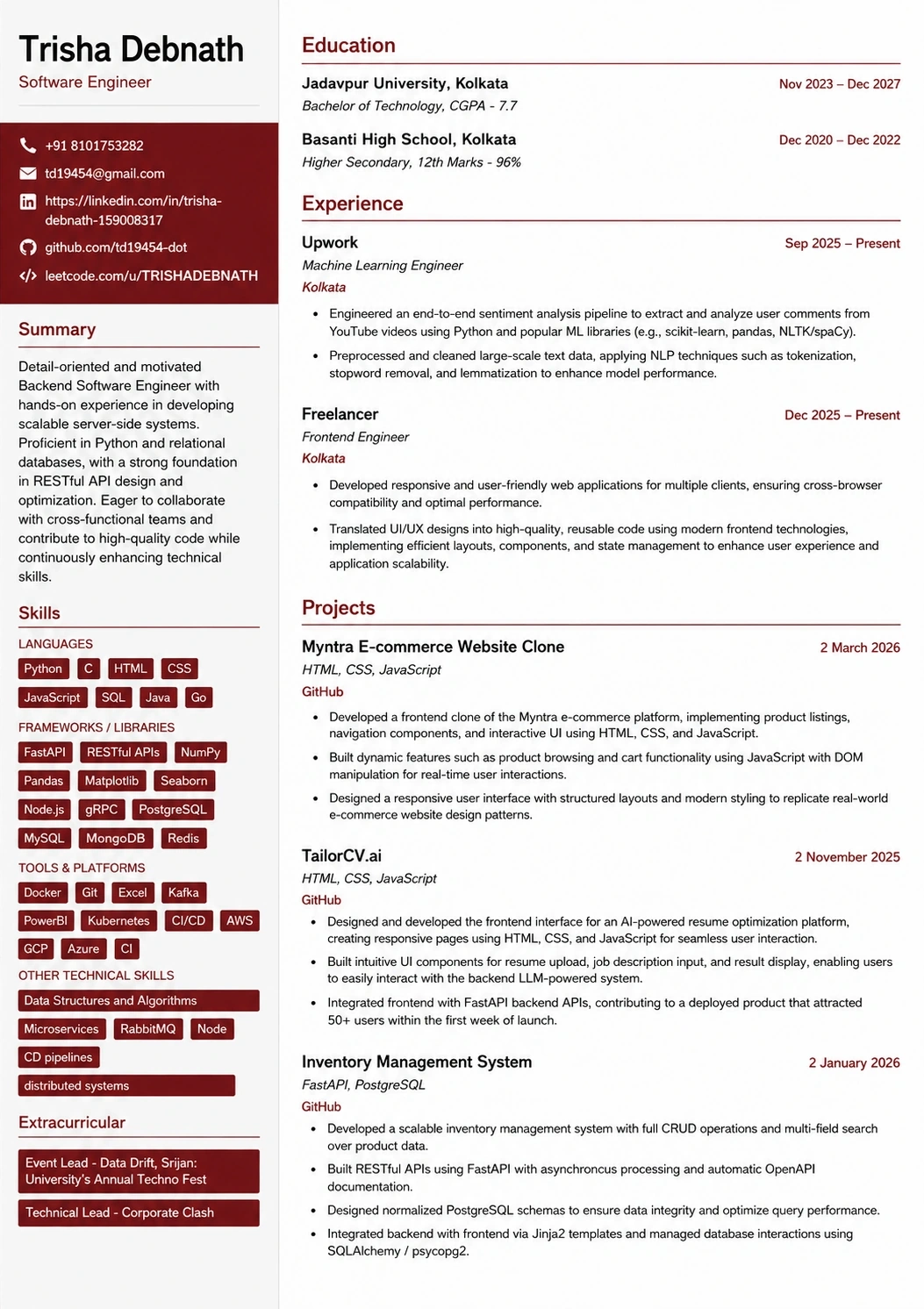
Single column, standard headings, no text boxes — the formatting rules in this guide, already applied.
Was this guide useful?
Be the first to rate it.