 SS
SS
Key Takeaways
- Taiwan is the centre of the global semiconductor industry, with TSMC and an enormous supporting ecosystem.
- The Employment Gold Card allows qualifying professionals to obtain a combined work permit, residence visa and re-entry permit without a job offer.
- Standard work permits use a points system for recent graduates, which is genuinely accessible.
- Mandarin helps considerably but a real English-language market exists in technology, education and multinationals.
- Costs are low relative to salaries in Taipei compared with Tokyo, Seoul, Singapore or Hong Kong.
The economy
Taiwan is small, densely industrial, and globally systemic in one particular area.
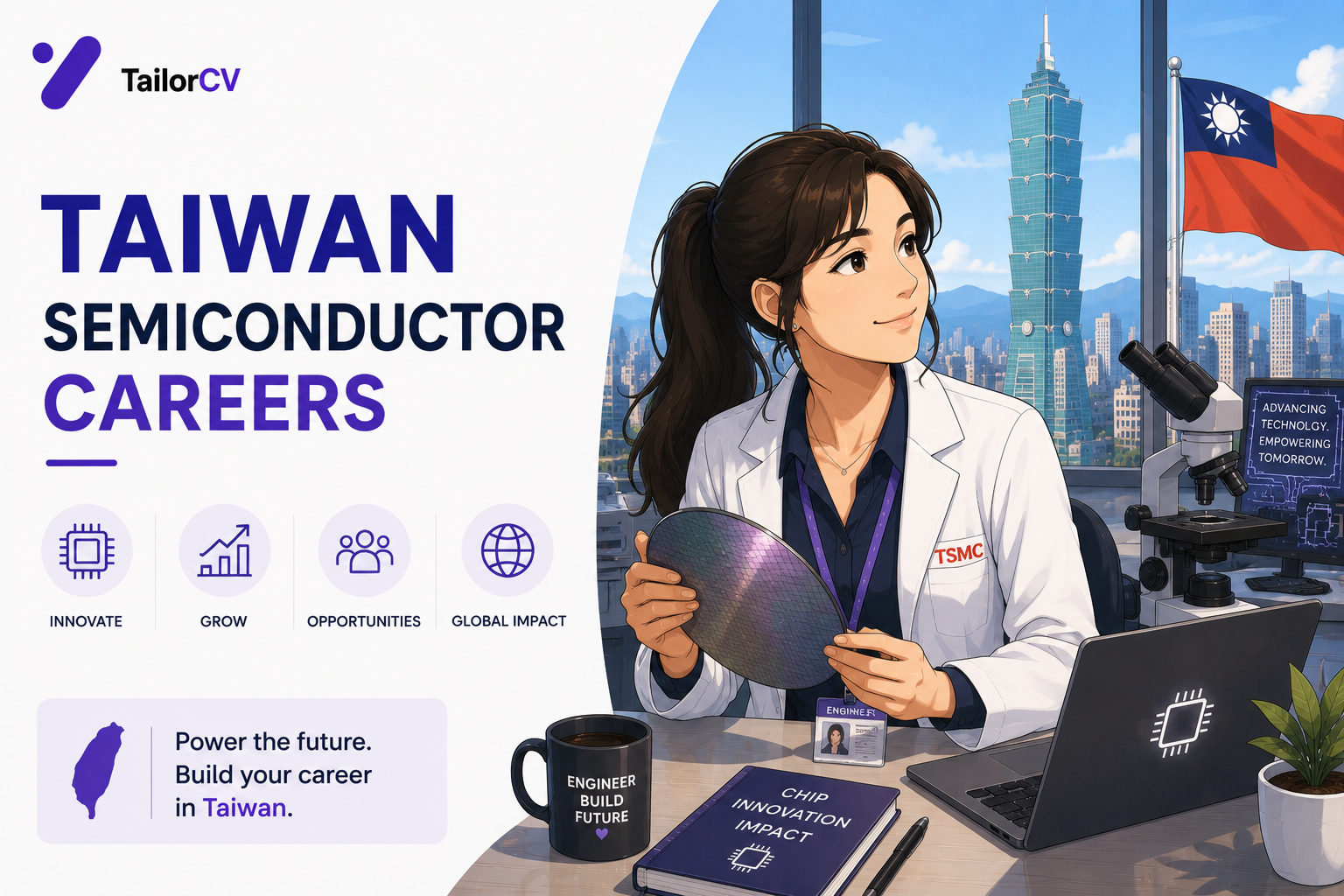
Semiconductors above all. TSMC is the world's most important contract chip manufacturer, and around it sits an ecosystem of design houses (MediaTek), packaging and testing companies (ASE), equipment suppliers and materials firms. This is not one company; it is an entire industrial complex.
Electronics manufacturing. Foxconn, Quanta, Compal and Pegatron manufacture a substantial share of the world's consumer electronics, with design and engineering functions in Taiwan.
Hardware and components across networking, displays, batteries and precision components.
Machinery and precision manufacturing, an under-noticed strength in central Taiwan.
Biotechnology and medical devices, a deliberate growth area.
Software and startups, a smaller sector than the hardware base but growing, with government support.
And a large education market for English teaching, which is the most accessible entry route for native English speakers and is a genuinely different career from the technology sector.
The Gold Card
Taiwan's most distinctive offering and considerably under-known.
The Employment Gold Card combines a work permit, resident visa, alien resident certificate and re-entry permit into a single document.
No employer sponsorship required. You apply on your own qualifications, and once you hold it you can work for anyone, change jobs freely, or work for yourself.
Qualification categories span science and technology, economy, education, culture and arts, sports, finance, law, architecture and several others, with defined criteria for each — typically a combination of salary history, professional achievement, qualifications or recognised expertise.
A common route is the salary-based criterion in the economy category, which is straightforward to evidence for anyone earning above the threshold.
Duration is multi-year and renewable, and time on it counts toward permanent residency.
Tax benefits exist for qualifying foreign special professionals for a defined period on income above a threshold.
Family members can obtain dependent status, and spouses generally receive work rights.
This is genuinely unusual in Asia — a self-sponsored, portable work authorisation obtainable before you have a job — and it is the single most useful thing for a qualified professional to know about Taiwan.
The points system for graduates
The other accessible route, aimed specifically at people early in their careers.
Recent foreign graduates — of Taiwanese universities and, under defined conditions, of qualifying foreign institutions — can obtain a work permit through an evaluation point system rather than the standard requirement of two years' work experience.
Points are awarded across education level, salary, work experience, Mandarin ability, other language ability, growth potential of the employer, and having studied in Taiwan, among other criteria.
Reaching the threshold allows an employer to hire you without you meeting the usual experience requirement, which is exactly the barrier that blocks most new graduates in Asian labour markets.
Graduates of Taiwanese universities additionally have a job-seeking extension allowing them to remain and look for work after finishing.
The practical point: Taiwan has deliberately built routes for young foreign professionals that most of its neighbours have not, and they are considerably less known than Japan's or Korea's systems.
Living in Taiwan
The practical picture, which is a large part of the appeal.
Costs are low relative to salaries, particularly compared with Tokyo, Seoul, Singapore or Hong Kong. Taipei housing is the main expense and it is manageable; the science park cities are considerably cheaper.
Public transport is excellent. Taipei's metro is fast, clean and cheap, and the high speed rail connects the west coast efficiently.
Healthcare is outstanding. Taiwan's National Health Insurance is comprehensive, inexpensive and widely regarded as one of the best systems in the world.
Food is exceptional and cheap, and eating out is a normal daily habit rather than an expense.
Safety is very high and daily life is straightforward.
English is limited outside professional contexts. Daily life without Mandarin is possible in Taipei and harder elsewhere.
The international community is real but modest, concentrated in Taipei and around the science parks.
And the country is small and well connected, with mountains, coast and the rest of Asia all easily reachable.
Where roles are advertised
Taiwan's channels.
104 Job Bank and 1111 are the dominant domestic platforms, largely in Mandarin.
LinkedIn works for international companies and the technology sector.
Company career pages for TSMC, MediaTek, ASE and the large employers, which recruit through their own systems.
Contact Taiwan is a government platform aimed specifically at connecting foreign professionals with Taiwanese employers, and it is genuinely useful.
Startup and technology platforms including Yourator and Meet.jobs cover that end of the market.
University career services if you studied in Taiwan.
And the Gold Card community is an informal but real network — holders are connected and the ecosystem around them generates opportunities.
The English teaching route, honestly
Worth its own treatment because it is the most common entry and the most misunderstood.
Demand is genuine and continuous. Taiwan employs a substantial number of foreign English teachers across cram schools (buxiban), public schools and kindergartens.
Requirements are modest — typically a bachelor's degree in any subject and native or near-native English, with a teaching certificate improving your options considerably.
The work permit is straightforward relative to other routes and the employer handles it.
It gets you into the country, which is the main argument for it. Being present, learning Mandarin and building a network changes everything about your subsequent options.
But it is a separate track. Teaching English does not build the qualifications or experience that an E-7-equivalent professional role or a Gold Card application requires, and treating it as a stepping stone into industry without a deliberate plan rarely works.
Conditions vary enormously between employers, and the cram school sector in particular ranges from excellent to exploitative. Research specific schools rather than the sector.
Public school programmes are generally better structured than private cram schools.
And the honest framing: it is a good year or two if you want to be in Taiwan and are deliberate about what you do alongside it. It is a poor plan if you expect it to lead somewhere by itself.
Making the move work
Practical steps.
Check the Gold Card first, always. Arriving self-sponsored transforms your position.
Learn Mandarin seriously if you intend to stay. It is difficult but it is the difference between a slice of the market and most of it.
Target the science parks if you are technical, and accept that they are not Taipei.
Use Contact Taiwan and the government platforms, which genuinely exist to connect foreign professionals with employers.
Build a network before arriving where you can — the Gold Card community and the technology community are both accessible online.
And be specific about why Taiwan. Employers ask, and semiconductors, the Gold Card and quality of life are all better answers than a general interest in Asia.
Working culture in Taiwan
Worth calibrating before arriving.
Hierarchies are present and respect for seniority matters, though less rigidly than in Korea or Japan.
Communication is indirect relative to Western norms, and disagreement is expressed carefully. Reading between the lines is a skill you develop.
Hours can be long, particularly in manufacturing and at local companies. International companies and startups vary.
Relationships underpin business, and time spent building them is not wasted.
Food is central to workplace culture — shared meals, snacks and the general seriousness with which eating is treated are genuine features of daily life.
English is limited outside professional international contexts, and Mandarin transforms both your work options and your daily experience.
Taiwanese colleagues are notably welcoming to foreigners, and the social barrier is lower than in several other East Asian markets.
And the work-life balance varies enormously between a multinational office in Taipei and a fab in Hsinchu, which is worth establishing before you accept anything.
Mini checklist
- unchecked: Gold Card eligibility checked against all categories
- unchecked: Points system assessed if you are a recent graduate
- unchecked: Sector matched — semiconductors, electronics, software, education
- unchecked: Mandarin level assessed honestly
- unchecked: ARC and residency process understood
- unchecked: Tax benefit eligibility checked if applying as a special professional
- unchecked: Salary compared against Taipei costs
- unchecked: Health insurance enrolment understood
- unchecked: Documents authenticated for the application
Scenarios
Scenario 1: You are an experienced professional earning above the threshold
Check the Gold Card immediately. Self-sponsored, portable, multi-year and obtainable before you have a job — it is one of the most useful work authorisations available anywhere in Asia.
Scenario 2: You are a recent graduate
Look at the points system, which was designed specifically to let employers hire graduates without the usual experience requirement. Studying in Taiwan improves your position further.
Scenario 3: You are a semiconductor or hardware engineer
Taiwan is the global centre of your industry. TSMC, MediaTek, ASE and the equipment ecosystem all hire internationally, and the work is at the front of the field.
Tip: Check every Gold Card category, not just the obvious one. The criteria span science, economy, education, arts, sports, finance and more, and people frequently qualify under a category they never thought to read.
Do's and Don'ts
Do
- Check Gold Card eligibility across all categories
- Use the points system if you are a recent graduate
- Target the semiconductor and hardware ecosystem
- Learn Mandarin for the wider market
- Check the tax benefit for special professionals
- Consider studying in Taiwan as a route
Don't
- Assume you need a job offer first
- Overlook the points system for graduates
- Treat English teaching as a route into technology
- Assume Taiwan resembles Japan or Korea administratively
- Underestimate how much Mandarin opens up
- Ignore the machinery and precision sector
Common Mistakes
- Not knowing about the Gold Card. Self-sponsored work authorisation is rare in Asia and widely unknown.
- Assuming an offer is required first. Both the Gold Card and the graduate job-seeking route say otherwise.
- Only checking one Gold Card category. The criteria are broad and people qualify unexpectedly.
- Comparing Taiwan to Japan or Korea. Its system is genuinely more open to young foreign professionals.
- Ignoring central Taiwan. The machinery and precision cluster is real and under-applied.
- Expecting English teaching to lead into industry. It is a separate track.
Related Guides
Keep building on this with the related guides in this series:
- The Taiwan Gold Card Explained
- Semiconductor Careers in Taiwan
- Working in South Korea as a Foreign Graduate
- Graduate Jobs in Hong Kong
- The Hong Kong IANG Visa Explained
You can also check your resume's ATS score for free, generate a tailored cover letter, or build a portfolio website in minutes.
Frequently Asked Questions
Can I move to Taiwan without a job offer?
Yes, if you qualify for the Employment Gold Card, which combines work permit and residence in a self-sponsored document. Graduates of Taiwanese universities also have a job-seeking extension.
What is Taiwan strongest in?
Semiconductors above all — TSMC, MediaTek, ASE and the surrounding ecosystem — plus electronics manufacturing, hardware components, precision machinery and a growing biotech sector.
Do I need Mandarin?
It helps considerably and opens the wider market. Technology multinationals, some local technology firms and the education sector operate in English.
What is the points system?
An evaluation route letting recent foreign graduates be hired without the usual two-year experience requirement, scoring education, salary, languages and other factors.
Is Taiwan expensive?
Considerably less than Tokyo, Seoul, Singapore or Hong Kong, with salaries that go further as a result. Taipei housing is the main cost.
Does Gold Card time count toward permanent residency?
Yes, time held on the Gold Card counts toward the residence requirement for permanent residency.
What is living in Taiwan like?
Low costs relative to salaries, excellent public transport, an outstanding national health insurance system, exceptional and cheap food, very high safety — with limited English outside professional contexts.
Where should I look for jobs in Taiwan?
104 Job Bank and 1111 for domestic volume, LinkedIn and company portals for international and technology roles, and Contact Taiwan, a government platform aimed specifically at foreign professionals.
Is teaching English a good way into Taiwan?
It gets you into the country with modest requirements and a straightforward permit, which matters. It does not build the qualifications a professional role or Gold Card requires, so treat it as a deliberate year rather than a stepping stone.
How do I make a move to Taiwan work?
Check Gold Card eligibility first, learn Mandarin seriously if staying, target the science parks if technical, use Contact Taiwan, and have a specific answer for why Taiwan rather than Asia generally.
What is Taiwanese workplace culture like?
Hierarchical but less rigidly than Korea or Japan, with indirect communication, relationship-led business, long hours in manufacturing and local companies, and notably welcoming attitudes toward foreigners.
What is your resume scoring right now?
Scan it against a job description and get your ATS match score in about a minute.
Drop your resume here or choose a file
PDF only. Max 2 MB.
We never share your data or use it to train AI models.

Was this guide useful?
Be the first to rate it.