 SS
SS
Key Takeaways
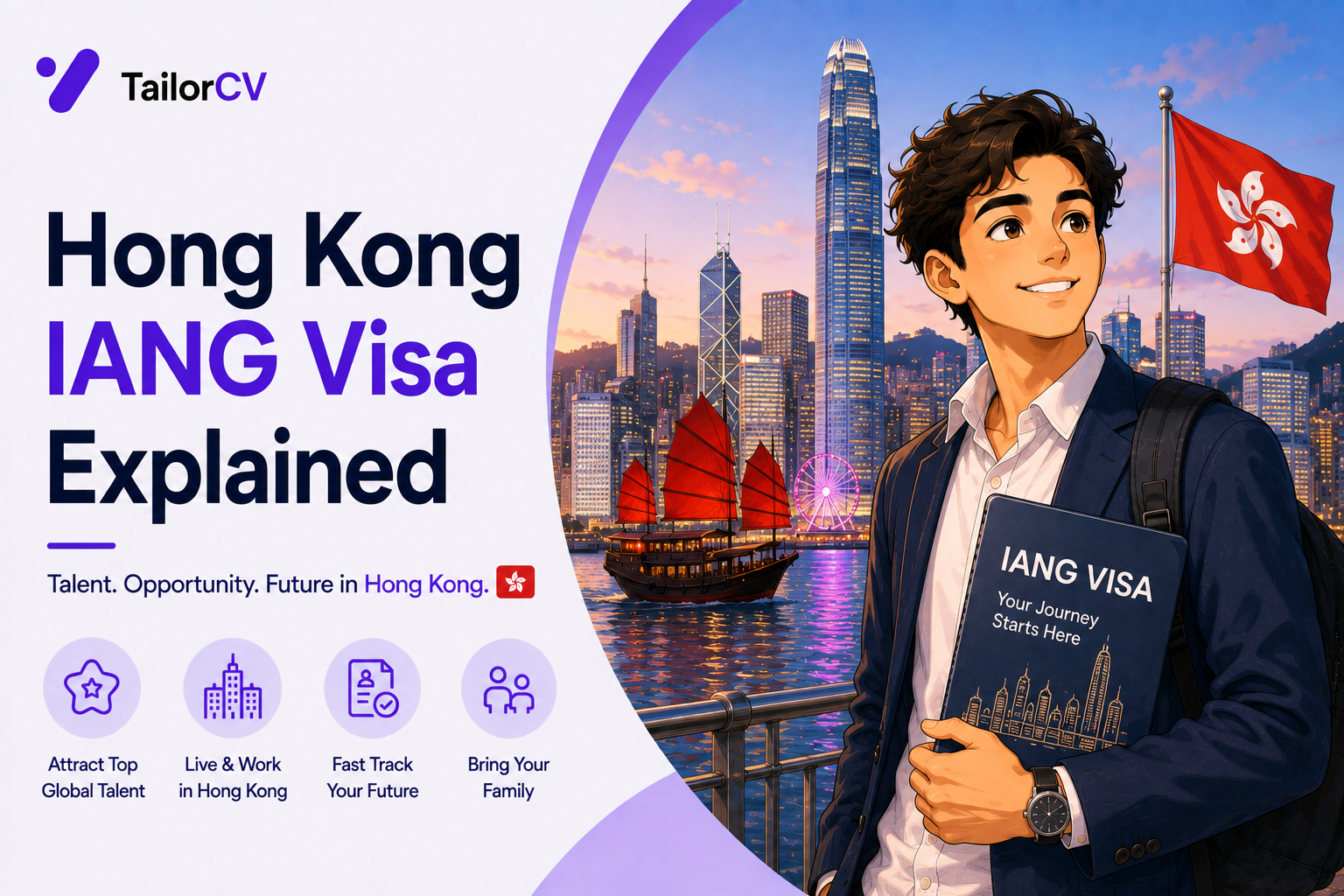
- IANG — Immigration Arrangements for Non-local Graduates — lets graduates of Hong Kong institutions work with no employer sponsorship and no restriction on the type of work.
- No job offer is required if you apply within the eligible period after graduating.
- Returning graduates who left Hong Kong can also apply, subject to holding a job offer — a route many people never discover.
- IANG time counts toward permanent residency, achieved after a qualifying period of continuous ordinary residence.
- For an employer, an IANG holder is administratively identical to a local hire — which is the whole point, and worth stating on your CV.
What IANG actually gives you
The defining feature is the absence of conditions.
No sponsor. No employer applies for anything, pays anything, or waits for anything.
No occupation restriction. You can work in any field, in any role, regardless of what you studied. This is unusually open — Korea's E-7 ties you to an occupation code, Ireland's permits eventually require a listed occupation, and Hong Kong's IANG simply does not.
No salary threshold for the initial grant.
Full flexibility. Full time, part time, multiple jobs, self-employment, changing employers freely without any immigration step.
Extendable. IANG can be extended, and continuous residence under it counts toward permanent residency.
Dependants. Spouses and children can generally apply to accompany you, subject to conditions.
The practical effect: for the duration of your IANG, you are competing in the Hong Kong job market on the same administrative footing as a local graduate.
Who qualifies
Non-local graduates of Hong Kong institutions who obtained an undergraduate or higher qualification in a full-time, locally-accredited programme in Hong Kong.
Two application windows exist.
Immediate applicants — those applying within the eligible period after graduating — do not need a job offer. This is the more generous route and it is the one to use if you are eligible.
Returning applicants — those who have left Hong Kong after graduating and wish to return — need a job offer that is at a level commonly taken up by degree holders, with remuneration at market rate. There is no time limit on returning, which means a Hong Kong degree from years ago is still an asset.
Check the current eligibility period and conditions with the Hong Kong Immigration Department, because the arrangement has been adjusted, including extensions to the period of stay granted.
The route to permanent residency
This is what makes IANG strategically significant rather than merely convenient.
Permanent residency in Hong Kong is available to people who have ordinarily resided in Hong Kong for a continuous qualifying period and who take Hong Kong as their place of permanent residence.
IANG residence counts. Time spent in Hong Kong on IANG contributes toward that qualifying period, as does time on a subsequent employment visa.
Continuity matters. "Ordinarily resident" and "continuous" are terms with specific meanings, and long absences can complicate a claim. If permanent residency is the goal, keep records and understand how absences are treated.
Study time may count too in defined circumstances, which is worth investigating because it can shorten the timeline meaningfully for someone who did a full degree in Hong Kong.
Permanent residency confers the right of abode — the right to live and work in Hong Kong without any immigration restriction at all, permanently.
Applying, step by step
The process is administratively light compared with most work visas.
Apply online or by post to the Immigration Department, with the required form and supporting documents.
Documents you will need: passport, graduation certificate or official proof of award, academic transcript, proof of your Hong Kong study, and — for returning applicants — the job offer and employment details.
No employer involvement is required for immediate applicants, which is what makes this route unusual.
Processing is generally straightforward where the documentation is complete, and the Immigration Department publishes indicative processing times.
On approval you receive a period of stay endorsed in your passport, and you collect or activate it according to the instructions given.
Hong Kong Identity Card. All residents staying beyond a short period must register for an HKID, and it is required for essentially everything — bank accounts, employment, healthcare and government services.
Extensions are applied for before the current period expires, usually with evidence of your employment or continued residence. Apply early rather than at the deadline.
Alternatives if IANG does not apply
Four routes for people without a Hong Kong degree, all recently expanded.
Top Talent Pass Scheme (TTPS). For high earners in the preceding year, and separately for graduates of highly ranked universities worldwide. It grants a period of stay without a job offer, which makes it the closest equivalent to IANG for non-local graduates.
General Employment Policy (GEP). The standard employer-sponsored route, requiring a genuine vacancy, appropriate qualifications and market-rate remuneration.
Quality Migrant Admission Scheme (QMAS). Points-based, assessing age, qualifications, experience, language and family background, and not requiring a job offer.
Technology Talent Admission Scheme (TechTAS). A streamlined route for technology companies operating in designated areas to bring in overseas talent.
Check the Immigration Department for current criteria. Hong Kong has broadened these schemes noticeably, and guidance more than a couple of years old understates what is available.
Using IANG strategically
The visa is open; the way you use it still matters.
Take a role that builds a case. IANG carries no occupation restriction, but your subsequent employment visa — if you ever need one — and your professional trajectory both benefit from coherent, degree-level work. A string of unrelated short jobs is legal and unhelpful.
Stay continuously if permanent residency is the goal. Long absences complicate an ordinary-residence claim, and the qualifying period is measured in years. Plan travel accordingly.
Move employers freely, but not carelessly. Hong Kong professional circles are small and reputations circulate. The visa lets you change jobs instantly; the market still notices a pattern.
Extend early. Applying before expiry with evidence of continued employment is routine; applying late is not.
Consider converting later. Some IANG holders move onto an employment visa via GEP as circumstances change, and others go straight to permanent residency. Understand which applies to you before you need to act on it.
Tell employers what it means. Many hiring managers, especially at smaller firms, do not know the arrangement. A single explanatory sentence is often the difference between an interview and a silent rejection.
What IANG does not cover
Three limits worth knowing before planning around it.
It is not permanent residency. It is a period of stay, extendable, and the residency clock runs alongside it rather than being granted by it.
It does not apply to every Hong Kong qualification. The programme must have been full-time and locally accredited at undergraduate level or above. Part-time, distance and non-local programmes delivered in Hong Kong generally do not qualify.
It does not remove the need to find a job. The permission is open; the market is competitive. IANG makes you administratively equivalent to a local candidate, which is an enormous advantage and not a substitute for a strong application.
And a fourth, practically: it does not automatically transfer to your dependants' own careers. A spouse joining you may or may not receive unconditional working rights depending on the visa they hold, so verify it rather than assuming.
Comparing IANG to the other post-study routes
Placing it against its peers makes clear why it is unusually generous.
No occupation restriction is the standout. Korea's E-7 ties you to an occupation code; Ireland's Stamp 1G is open but the follow-on permit is occupation-sensitive; New Zealand's route funnels you toward the Green List. IANG simply does not care what you studied or what you do.
No job offer for immediate applicants, which matches the Dutch orientation year and Ireland's Stamp 1G and beats routes that require an offer up front.
No time limit on the returning route, which is genuinely unusual. Most post-study schemes expire permanently once their window closes; Hong Kong lets alumni come back years later with an offer.
Residency counts. Unlike the UK Graduate Route, where time generally does not count toward settlement, IANG residence contributes toward Hong Kong permanent residency.
The trade-off is that Hong Kong is a narrow economy dominated by finance, law and trade, with among the world's highest housing costs. The visa is generous; the market is specialised and expensive.
Mini checklist
- unchecked: Eligibility confirmed with the Immigration Department
- unchecked: Applied within the immediate window if you qualify
- unchecked: Job offer secured first if applying as a returning graduate
- unchecked: IANG status stated at the top of your CV
- unchecked: Extension timing understood before expiry
- unchecked: Absence records kept for the permanent residency claim
- unchecked: Whether study time counts checked for your case
- unchecked: Dependant applications considered if relevant
- unchecked: MPF and salaries tax registration handled
Scenarios
Scenario 1: You are about to graduate from a Hong Kong university
Apply immediately, within the eligible window, without waiting for a job offer. The no-offer route is the more generous one and it only exists for a limited period after graduating.
Scenario 2: You graduated in Hong Kong years ago and moved home
The returning-graduate route has no time limit. Secure a degree-level job offer at market remuneration and you can come back — a fact a surprising number of Hong Kong alumni never learn.
Scenario 3: You are aiming at permanent residency
Track your residence carefully from day one. Continuity and "ordinarily resident" are technical concepts, and a claim assembled from memory years later is much weaker than one supported by records.
Tip: Write "IANG holder — unrestricted right to work in Hong Kong, no sponsorship required" in the first three lines of your CV. It converts your immigration status into a hiring argument, and it puts you on exactly the same footing as a local candidate in the reader's mind.
Do's and Don'ts
Do
- Apply within the immediate window if you can
- State IANG status prominently on applications
- Keep records of your residence and absences
- Check whether study time counts toward residency
- Extend before expiry rather than at it
- Investigate the returning-graduate route years later
Don't
- Wait for a job offer if the no-offer route is open to you
- Assume a Hong Kong degree expires as an asset
- Bury your visa status at the bottom of the CV
- Let absences accumulate unrecorded
- Assume the conditions are the same as when a friend applied
- Confuse IANG with an employer-sponsored employment visa
Common Mistakes
- Waiting for a job offer. Immediate applicants do not need one, and the window is limited.
- Not knowing about the returning route. There is no time limit, and old Hong Kong degrees remain valuable.
- Understating the visa on a CV. It makes you administratively identical to a local hire.
- Losing track of residence. Permanent residency claims depend on documented continuity.
- Extending late. Extensions are simpler before expiry than after.
- Relying on old information. The arrangement has been adjusted, including the period of stay granted.
Related Guides
Keep building on this with the related guides in this series:
- Graduate Jobs in Hong Kong
- The Korean E-7 Visa Explained
- The UAE Golden Visa Explained
- The Third Level Graduate Scheme Explained
- The Dutch Orientation Year Visa Explained
You can also check your resume's ATS score for free, generate a tailored cover letter, or build a portfolio website in minutes.
Frequently Asked Questions
Do I need a job offer for IANG?
Not if you apply within the eligible period immediately after graduating. Returning graduates who left Hong Kong do need a degree-level offer at market remuneration.
Can I work in any field on IANG?
Yes. Unlike most post-study visas, IANG carries no occupation restriction — your job does not have to relate to what you studied.
How long can I stay?
The initial period of stay is granted by the Immigration Department and IANG can be extended. The period granted has been adjusted, so check the current position.
Does IANG lead to permanent residency?
Time on IANG counts toward the continuous ordinary residence required for permanent residency and the right of abode. Keep records of your residence and absences.
I graduated in Hong Kong years ago — can I still use it?
Yes, through the returning-graduate route, which has no time limit but requires a degree-level job offer at market remuneration.
Is IANG better than an employment visa?
For a graduate, considerably — no sponsorship, no occupation restriction, and complete freedom to change jobs without any immigration process.
What documents do I need for IANG?
Passport, graduation certificate or proof of award, academic transcript and proof of your Hong Kong study. Returning applicants also need the job offer and employment details.
What if I did not study in Hong Kong?
Look at the Top Talent Pass Scheme, which grants a period of stay without a job offer to high earners and graduates of highly ranked universities, or the points-based QMAS.
What is an HKID?
The Hong Kong Identity Card, required of all residents staying beyond a short period. Banking, employment, healthcare and government services all depend on it.
Should I change jobs often on IANG?
The visa allows it freely, but Hong Kong's professional circles are small and a pattern of short unrelated jobs is noticed. Use the flexibility deliberately.
How do absences affect permanent residency?
Long absences complicate an ordinary-residence claim, which is measured over years. If permanent residency is the goal, plan travel with that in mind and keep records.
What is your resume scoring right now?
Scan it against a job description and get your ATS match score in about a minute.
Drop your resume here or choose a file
PDF only. Max 2 MB.
We never share your data or use it to train AI models.

Was this guide useful?
Be the first to rate it.