 SS
SS
Key Takeaways
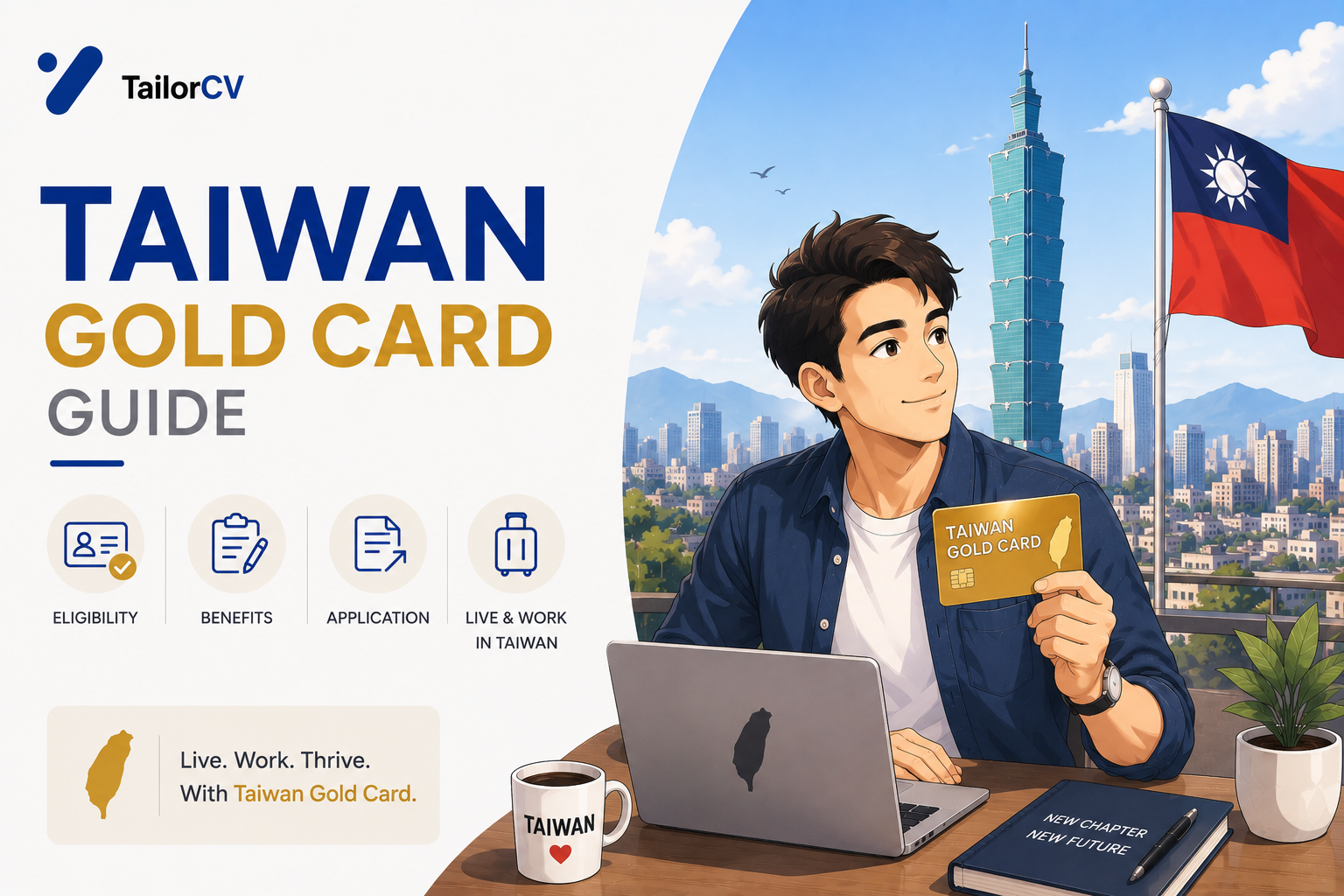
- The Employment Gold Card combines a work permit, resident visa, Alien Resident Certificate and re-entry permit into one document.
- No employer sponsorship and no job offer are required — you apply on your own qualifications.
- Qualification categories span science and technology, economy, education, culture and arts, sports, finance, law, architecture and more.
- Holders can work for anyone, change jobs freely, or work for themselves, and time on it counts toward permanent residency.
- A tax benefit applies to qualifying foreign special professionals on income above a threshold for a defined period.
What it actually is
The Gold Card's design is what makes it unusual.
Four documents in one. In most systems a work permit, a residence visa, a residence card and a re-entry permit are separate processes. Taiwan combines them.
Self-sponsored. No employer applies for you and no employer holds it. This is the crucial difference from almost every Asian work visa, including Korea's E-7, Japan's employment visas and the Gulf's employer-sponsored permits.
Portable. Change employers, work for several, freelance, or start a company — the card does not care.
Valid for a multi-year period and renewable, with the exact duration selectable within a range at application.
Applied for online through a single government portal that handles the whole process across the relevant ministries.
Available from abroad or from inside Taiwan if you are already there on another status.
The qualification categories
Broader than people assume, which is why checking all of them matters.
Science and technology. Recognised expertise, senior positions at notable companies, patents, or relevant advanced qualifications with experience.
Economy. Frequently the most accessible route, including a criterion based on having earned above a monthly salary threshold in a recent period. For anyone with a solid professional salary history this is straightforward to evidence.
Education. Teaching or research positions at recognised institutions, or relevant senior experience.
Culture and arts. Recognised achievement, awards, or professional standing in creative fields.
Sports. Competitive achievement, coaching credentials or professional standing.
Finance. Qualifications and experience in specified financial services fields.
Law. Qualified practice with defined experience.
Architecture. Licensed practice with recognised work.
And further categories including national defence and other specified fields.
Each has its own evidence requirements, published in detail, and the assessment is against those criteria rather than discretionary.
The single most common mistake is checking only the category that seems obvious and missing one you would qualify under.
What it gives you in practice
Immediate right to work for anyone, in anything, without further permission.
An ARC, which is your residence card and identity document for banking, phone contracts, health insurance and daily life.
National Health Insurance enrolment, which is comprehensive and inexpensive.
Re-entry permission built in, so travel is unrestricted.
Family dependants can obtain resident status, and spouses generally receive open work rights — which is materially better than several comparable schemes.
Tax benefit. Qualifying foreign special professionals receive a reduction on income above a defined threshold for a defined number of years, which is meaningful for higher earners.
Path to permanent residency. Time held counts toward the residence requirement, and there are provisions that can shorten the path for Gold Card holders.
And the ability to leave and come back. Because it is not tied to an employer, losing or leaving a job does not put your status at immediate risk in the way an employer-sponsored permit does.
Practical application steps
The mechanics.
Apply online through the single government portal, which routes your application to the relevant ministries automatically.
Select your category and upload the evidence its criteria require.
Choose your validity period within the available range at application.
Pay the fee, which varies with the duration selected and whether you apply from abroad or within Taiwan.
Await the ministry assessment, which is against published criteria rather than discretionary.
On approval, collect or receive the card, which is simultaneously your work permit, resident visa, ARC and re-entry permit.
Enrol in National Health Insurance after the qualifying period.
And note you can apply from abroad or from inside Taiwan if you are already there on another status, which is more flexible than most systems.
After you have it
What to do with the card.
Register your address and complete the practical setup — bank account, phone, health insurance.
Understand the tax benefit if you qualify as a foreign special professional, including the income threshold and the number of applicable years.
Track your residence if permanent residency is a goal, since time on the card counts toward it.
Renew before expiry, with the same category criteria applying.
Consider family applications — dependants can obtain resident status and spouses generally receive open work rights.
And use the portability. The card's whole advantage is that it is not tied to an employer, which means you can change roles, freelance, consult or found something without touching your immigration status.
Who the Gold Card genuinely suits
An honest assessment.
Experienced professionals with a solid salary history who want optionality — the ability to arrive, look around, and decide.
Freelancers and consultants, since self-sponsorship makes independent work straightforward in a way employer-tied visas never do.
Founders, who need to be present and working before there is a company to sponsor them.
People with a partner who needs to work, given the open spouse work rights.
Specialists in fields Taiwan wants — semiconductors, technology, research and the other listed categories.
It suits less well someone who needs an employer to fund relocation, or who would not qualify under any category and would be better served by a standard employer-sponsored permit.
And it is worth applying for even if you are not sure you will move. It is a multi-year permission, it costs relatively little, and holding it means the decision stays open.
Common questions and misunderstandings
The things people get wrong about the scheme.
"It is only for very senior people." The categories are broad and the criteria specific. Mid-career professionals qualify routinely, particularly under the economy category's salary criterion.
"I need to already have a job in Taiwan." You do not, and that is the entire point of the scheme.
"It is the same as a work permit." It is a work permit plus a resident visa plus an ARC plus a re-entry permit, in one document, without an employer.
"Applying is complicated." It is a single online application through one portal, which routes to the relevant ministries automatically. It is considerably simpler than most immigration processes described in this series.
"The tax benefit applies to everyone." It applies to qualifying foreign special professionals on income above a threshold for a defined period, which is narrower than the general Gold Card eligibility.
"It leads automatically to permanent residency." Time counts toward it and there are favourable provisions, but permanent residency remains a separate application with its own requirements.
Using it strategically
How people actually deploy the card.
Apply before you need it. It is multi-year, the cost is modest, and holding it means you can move when an opportunity appears rather than starting a process then.
Use it to explore. Arriving and looking around is possible in a way it is not on an employer-sponsored visa, and Taiwan is a country that rewards being seen in person.
Use it to negotiate. An employer hiring a Gold Card holder incurs no sponsorship cost or delay, which is a genuine and quantifiable advantage worth stating.
Use it for independent work. Consulting, freelancing and founding are all straightforward on self-sponsorship.
Use it as an Asian base. Taiwan is well connected regionally, costs are low, and the card's re-entry permission makes travel unrestricted.
And track your residence from the start if permanent residency is a longer-term goal, because the clock begins immediately.
Costs, fees and the practicalities
The administrative details.
Application fees vary with the validity period selected and whether you apply from abroad or within Taiwan.
Processing involves the relevant ministry for your category plus the immigration authority, handled through the single portal.
Documents required depend on your category — employment evidence and salary documentation for the economy route, achievement evidence for talent categories, qualifications for others.
Authentication requirements vary, and checking what your specific category needs before submitting saves a resubmission.
National Health Insurance enrolment follows a qualifying period of residence, so arrange interim cover.
Tax registration and the special professional benefit application where you qualify.
And renewals are applied for before expiry against the same category criteria, so keeping your evidence current matters.
Mini checklist
- unchecked: Every qualification category read, not just the obvious one
- unchecked: Evidence gathered for your chosen category
- unchecked: Salary history documented if applying on the economy criterion
- unchecked: Application duration selected deliberately
- unchecked: Documents authenticated as required
- unchecked: Tax benefit eligibility checked
- unchecked: ARC and health insurance process understood
- unchecked: Family dependant provisions checked
- unchecked: Permanent residency timeline noted
Scenarios
Scenario 1: You earn a solid professional salary
Check the economy category's salary criterion. It is frequently the most straightforward route and requires evidencing recent earnings rather than making a subjective case about expertise.
Scenario 2: You are in a creative or sporting field
Check those categories specifically. The Gold Card is unusual in covering culture, arts and sports explicitly, and people in those fields rarely think to look at a work visa scheme.
Scenario 3: You want to freelance or start something
The Gold Card supports it. Self-sponsorship means you are not tied to an employer, which makes it one of the better bases in Asia for independent work.
Tip: Read every qualification category before concluding you do not qualify. The Gold Card covers science, economy, education, arts, sports, finance, law and architecture, and the most common failure is people checking only the one they expected to fit.
Do's and Don'ts
Do
- Read all qualification categories
- Consider the salary-based economy criterion
- Gather documentary evidence carefully
- Check the tax benefit eligibility
- Note that time counts toward permanent residency
- Consider it before you have a job offer
Don't
- Assume you need an employer
- Check only one category
- Assume it works like Korea's or Japan's systems
- Overlook the family and spouse work provisions
- Forget to select your preferred duration
- Leave document authentication late
Common Mistakes
- Checking one category. The most common reason people wrongly conclude they do not qualify.
- Assuming employer sponsorship is needed. It is not, and that is the scheme's whole point.
- Missing the tax benefit. Meaningful for higher earners and easy to overlook.
- Not realising spouses get work rights. Better than several comparable schemes.
- Treating it like other Asian visas. Its portability is genuinely unusual.
- Applying without full evidence. The assessment is against published criteria, so documentation decides it.
Related Guides
Keep building on this with the related guides in this series:
- Working in Taiwan as a Foreign Graduate
- Semiconductor Careers in Taiwan
- The Hong Kong IANG Visa Explained
- The Korean E-7 Visa Explained
- The UAE Golden Visa Explained
You can also check your resume's ATS score for free, generate a tailored cover letter, or build a portfolio website in minutes.
Frequently Asked Questions
Do I need a job offer for the Taiwan Gold Card?
No. It is self-sponsored, applied for on your own qualifications, and once granted you can work for anyone or for yourself.
Which qualification categories exist?
Science and technology, economy, education, culture and arts, sports, finance, law, architecture and further specified fields — each with its own published evidence criteria.
Is there a salary-based route?
Yes, within the economy category, based on having earned above a monthly threshold in a recent period. It is frequently the most straightforward criterion to evidence.
Can my spouse work?
Generally yes. Dependants can obtain resident status and spouses typically receive open work rights, which is more favourable than several comparable schemes.
Is there a tax benefit?
Qualifying foreign special professionals receive a reduction on income above a defined threshold for a defined number of years.
Does it lead to permanent residency?
Yes. Time held on the Gold Card counts toward the residence requirement, with provisions that can shorten the path for holders.
How do I apply for the Taiwan Gold Card?
Online through a single government portal that routes your application to the relevant ministries, selecting your category, uploading its required evidence and choosing your validity period.
What should I do after receiving the Gold Card?
Register your address, set up banking and health insurance, understand the tax benefit if you qualify, track residence toward permanent residency, and use the portability to change roles freely.
Who does the Taiwan Gold Card suit best?
Experienced professionals wanting optionality, freelancers and consultants, founders who need to be present before a company exists, and people whose partner needs open work rights.
Is the Gold Card only for senior professionals?
No. The categories are broad with specific published criteria, and mid-career professionals qualify routinely — particularly under the economy category's salary-based criterion.
How do people use the Gold Card strategically?
Applying before they need it so they can move when an opportunity appears, using it to explore in person, using it as a negotiating advantage since it removes sponsorship cost, and as a base for independent work.
What does the Taiwan Gold Card cost and require?
Fees vary with the validity period selected and application location. Documents depend on your category — employment and salary evidence for the economy route, achievement evidence for talent categories.
What is your resume scoring right now?
Scan it against a job description and get your ATS match score in about a minute.
Drop your resume here or choose a file
PDF only. Max 2 MB.
We never share your data or use it to train AI models.

Was this guide useful?
Be the first to rate it.