TD
TD
Key Takeaways
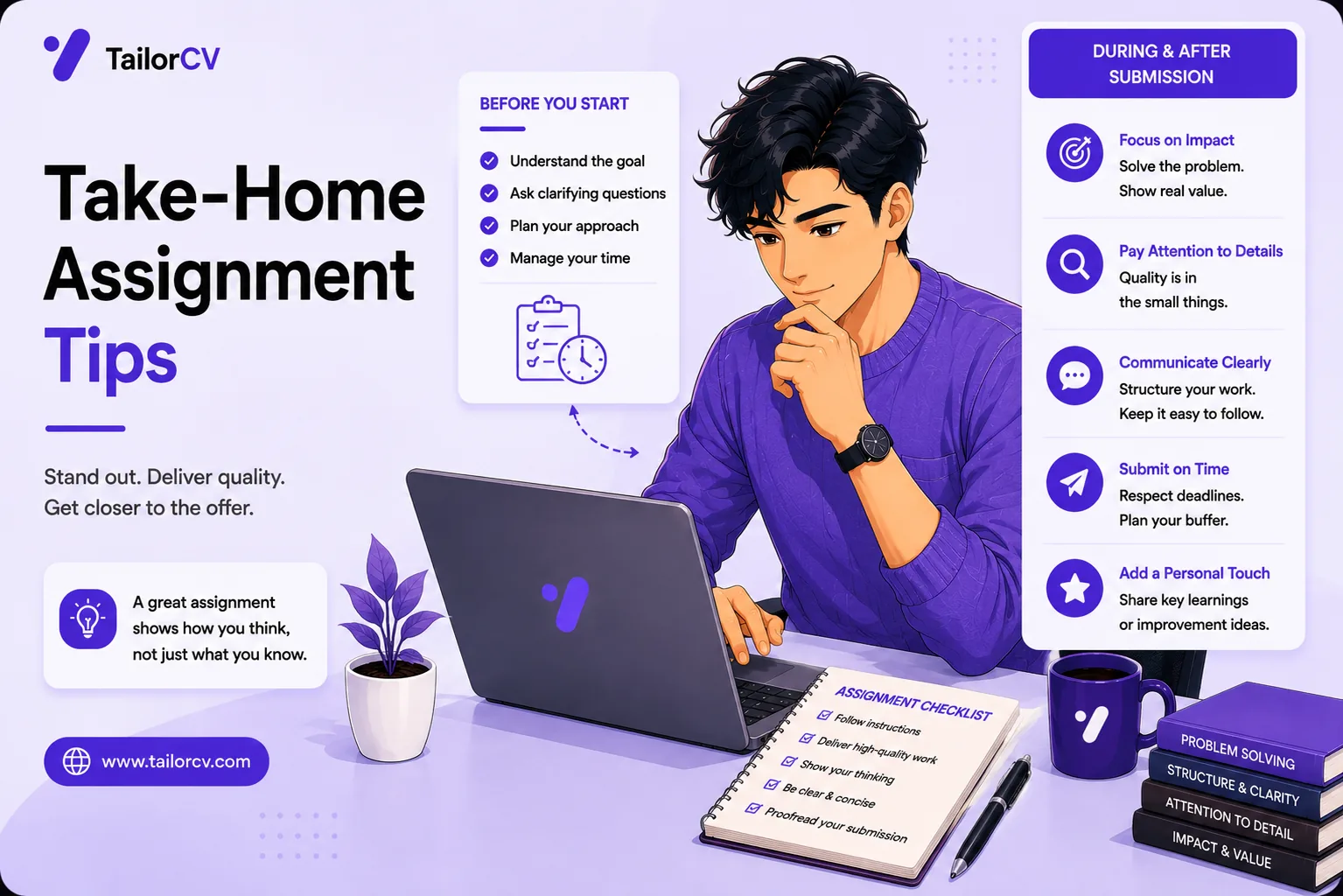
- Employers use take-homes because they predict on-the-job performance better than abstract questions.
- Clarify the goal, constraints and expected format before writing a single line.
- Scope your work to the time given - over-investing twenty hours on a two-hour task signals poor judgment.
- Reviewers care about how you work as much as the final artifact, so include a short note explaining your thinking.
- Occasionally a take-home is unpaid work in disguise, and it is reasonable to ask about scope.
Take-home assignments are increasingly common across interview processes — a design task, a coding challenge, a data analysis, a strategy memo. They let you show real skill instead of just talking about it, but they also eat time and can spiral into a weekend-consuming project. The candidates who win these are focused, clear, and know exactly when to stop. This guide shows you how to deliver a standout assignment without over-investing.
Your take-home usually comes after you've passed the initial screen, so treat it as a serious step. Keep your resume and story consistent with the work you submit, and prepare for the follow-up conversation with a free AI mock interview and the interview prep tool.
Why companies use take-home assignments
Employers use take-homes because they predict on-the-job performance better than abstract questions. They reveal how you structure a problem, how you communicate, and what you consider "done." That's also your opportunity: a thoughtful submission can set you apart from more experienced candidates who phoned it in. Understanding this intent — they're evaluating judgment, not just output — shapes how you approach the whole task.
Clarify the brief before you start
Before writing a single line, make sure you understand the goal, the constraints, and the expected format. Re-read the prompt carefully and note what success looks like. If anything is genuinely ambiguous, a short, specific clarifying question shows maturity and communication skill — the same qualities that make a strong behavioral interview answer. Don't pepper them with questions, but one sharp email beats guessing wrong for hours.
Scope your work to the time given
This is where most candidates go wrong. If they say "a few hours," respect it. Over-investing 20 hours on a two-hour task signals poor judgment about scope and priorities — and it sets an unhealthy precedent for how you'd work on the job. Deliver a strong, complete-but-bounded solution rather than an exhausting, over-engineered one. Knowing when to stop is itself a skill employers value, and it protects you from job-search burnout during a long process.
Show your thinking, not just the output
Reviewers care about how you work as much as the final artifact. Include a short note — a README, a summary section, or a few comments — explaining your assumptions, the trade-offs you made, and what you'd do next with more time. This narrative often matters more than perfection, because it shows judgment and self-awareness. It's the same principle as quantifying achievements on your resume: don't just do the work, make the value visible.
Polish the presentation
Clean formatting, a clear structure, and zero typos make your work easy to evaluate — and sloppy presentation undercuts even strong work. For a coding task, that means readable code, a working setup, and clear instructions. For a written task, it means a tidy document with headings and a short summary up top. Presentation signals the care you'd bring to real work, just like a well-formatted, ATS-friendly resume signals professionalism. Proofread the whole thing before you send it.
Prepare for the follow-up discussion
Many assignments lead to a review conversation where you walk through your solution. Be ready to defend your choices, explain what you'd improve, and respond to challenges calmly — this is often where the offer is decided. Rehearse talking through your work out loud with a free AI mock interview, and review the technical interview guide if it's an engineering role or the case interview guide for consulting-style tasks. Product designers should also review the product designer resume guide, since design take-homes are common.
See it in action: a resume-based mock interview
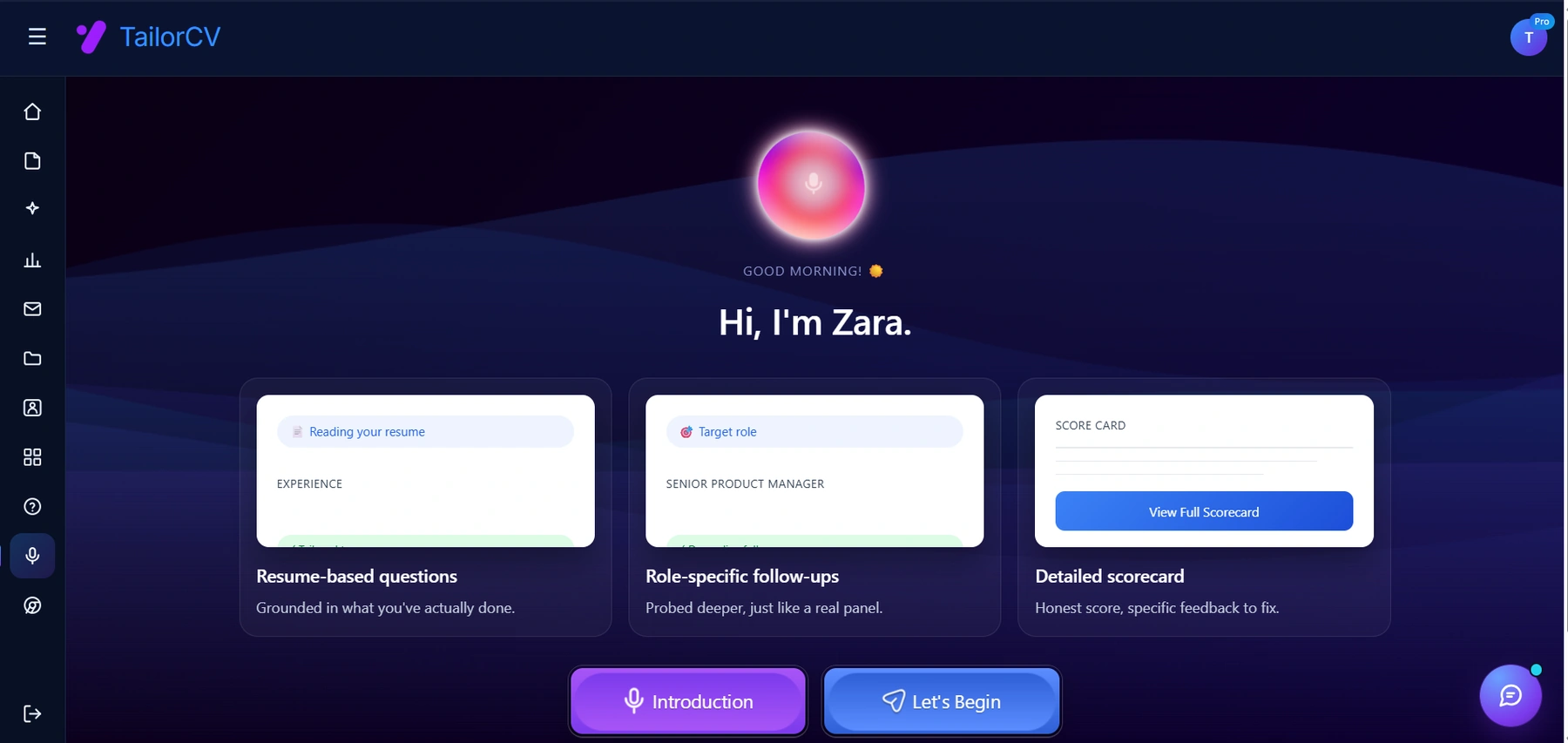
Practising out loud is the part most people skip. Here the session is built from your own resume and target role, and ends with a scorecard naming what to fix.
When a take-home feels unreasonable
Occasionally a "take-home" is really unpaid work in disguise — a full feature, a complete campaign, or days of effort. It's reasonable to ask about scope and time expectations, and to politely decline or propose a scaled-down version if it's excessive. A respectful employer won't penalize a thoughtful boundary. Trust your judgment, and remember the job search is a two-way evaluation — how they treat your time tells you something too.
Take-home assignment checklist
Before you submit, confirm you've:
- unchecked: Clarified the brief and understood what "done" means.
- unchecked: Scoped to the time given — strong but bounded, not over-engineered.
- unchecked: Explained your thinking — assumptions, trade-offs, and next steps.
- unchecked: Polished the presentation — clean, structured, proofread.
- unchecked: Prepared for the follow-up with a mock interview.
Nail those and your take-home becomes a genuine advantage. Keep the rest of your process just as sharp: a tailored resume scored with the ATS checker, a strong cover letter, and a prompt thank-you email after the review.
Was this guide useful?
Be the first to rate it.