TD
TD
Key Takeaways
- Amsterdam concentrates payments, platforms and international technology headquarters; Eindhoven is the deep-tech and semiconductor centre; Delft and Enschede are engineering hubs around their technical universities.
- Dutch technology companies hire in English almost universally, which makes the market unusually accessible.
- ASML in Eindhoven anchors one of the most strategically significant technology supply chains in the world, and it hires at scale.
- Salaries sit below US and Swiss levels and are broadly competitive within Europe; the 30% ruling changes the net picture significantly for those who qualify.
- The IND recognised sponsor register tells you immediately which of these companies can hire you.
Amsterdam: payments, platforms, headquarters
Amsterdam's technology scene has a distinct centre of gravity.
Payments and fintech. Adyen is one of Europe's most significant payments companies and grew entirely in Amsterdam. Mollie, Bunq and a wide ecosystem of payments, banking and financial infrastructure companies sit around it.
Marketplaces and platforms. Booking.com is one of the largest technology employers in the country. Uber, Netflix, Elastic, Databricks and many others run European operations from the city.
Data and infrastructure. Elastic originated here, and Amsterdam has a genuine cluster of open-source and infrastructure companies.
The character of the work skews toward large-scale distributed systems, payments correctness, and platform engineering — problems where reliability matters more than velocity.
Eindhoven: the deep-tech case
Eindhoven is the Netherlands' most underrated destination for engineers, and for hardware, physics and systems people it is arguably the best in Europe.
ASML builds the lithography machines that essentially the entire advanced semiconductor industry depends on. It is a genuinely extraordinary engineering environment — optics, precision mechanics, control systems, enormous software complexity — and it hires internationally at very large scale.
Philips retains substantial health-technology research and engineering in the region.
The Brainport ecosystem around them includes NXP, VDL, Signify and a dense supply chain of high-precision engineering companies. The High Tech Campus is one of the densest concentrations of R&D activity in Europe.
Housing and living costs are dramatically easier than Amsterdam, which for a graduate is not a minor consideration — it is frequently the difference between saving money and not.
Delft, Enschede, Groningen, Rotterdam
- Delft — TU Delft spins out engineering and robotics companies continuously, and the aerospace, civil and mechanical engineering ecosystem around it is real.
- Enschede — the University of Twente has an unusually strong record of technical spin-offs for its size.
- Groningen — energy, life sciences and a growing technology scene, with the lowest costs of any Dutch university city.
- Rotterdam — logistics technology, port automation and maritime engineering, driven by Europe's largest port.
How hiring runs
- Application, usually direct to the company. Dutch companies rely less on aggregator boards than the UK or Australia.
- Recruiter call — motivation, work rights, salary expectations. Dutch recruiters ask about salary early and directly; have a number ready.
- Technical screen — a take-home assignment is more common in the Netherlands than a live algorithmic grilling.
- Technical interviews, often including a discussion of your take-home rather than fresh problems.
- Team fit conversation, which is weighted seriously — Dutch teams care about how you disagree.
- Offer, with the 30% ruling and sponsorship both worth raising explicitly.
Take-home assignments are the norm at many Dutch companies, which suits candidates who interview poorly under time pressure and disadvantages those who will not invest a weekend. Ask what the expected time investment is, and hold to it.
Compensation, and how to read a Dutch offer
Dutch technology salaries sit in a middle band: below the US and Switzerland, above much of southern and eastern Europe, broadly comparable with Germany.
Check whether holiday allowance is included. Dutch employers pay a statutory vakantiegeld — a holiday allowance of a set percentage of annual salary, usually paid in May. Some offers quote a figure including it and some exclude it, and the difference is not trivial. Ask which convention the number uses.
Pension contributions are common and often through a sector-wide fund. Employer and employee both contribute, and the employee share comes out of your pay.
The 30% ruling changes everything for those who qualify. Its percentage, duration and conditions have been adjusted by legislation, so verify the current position rather than relying on what a colleague experienced three years ago. Where it applies, it can move net pay by a margin larger than any negotiation you would win.
Equity is thin outside startups. Scale-ups and venture-backed companies offer it; established Dutch employers largely do not. Judge an offer on base plus holiday allowance plus the ruling.
Living costs vary enormously by city. An Eindhoven or Groningen salary at a lower headline number frequently leaves more in your account at the end of the month than an Amsterdam one, because Amsterdam rent is in a different category entirely.
Working culture, honestly
Worth calibrating before you arrive rather than discovering in month one.
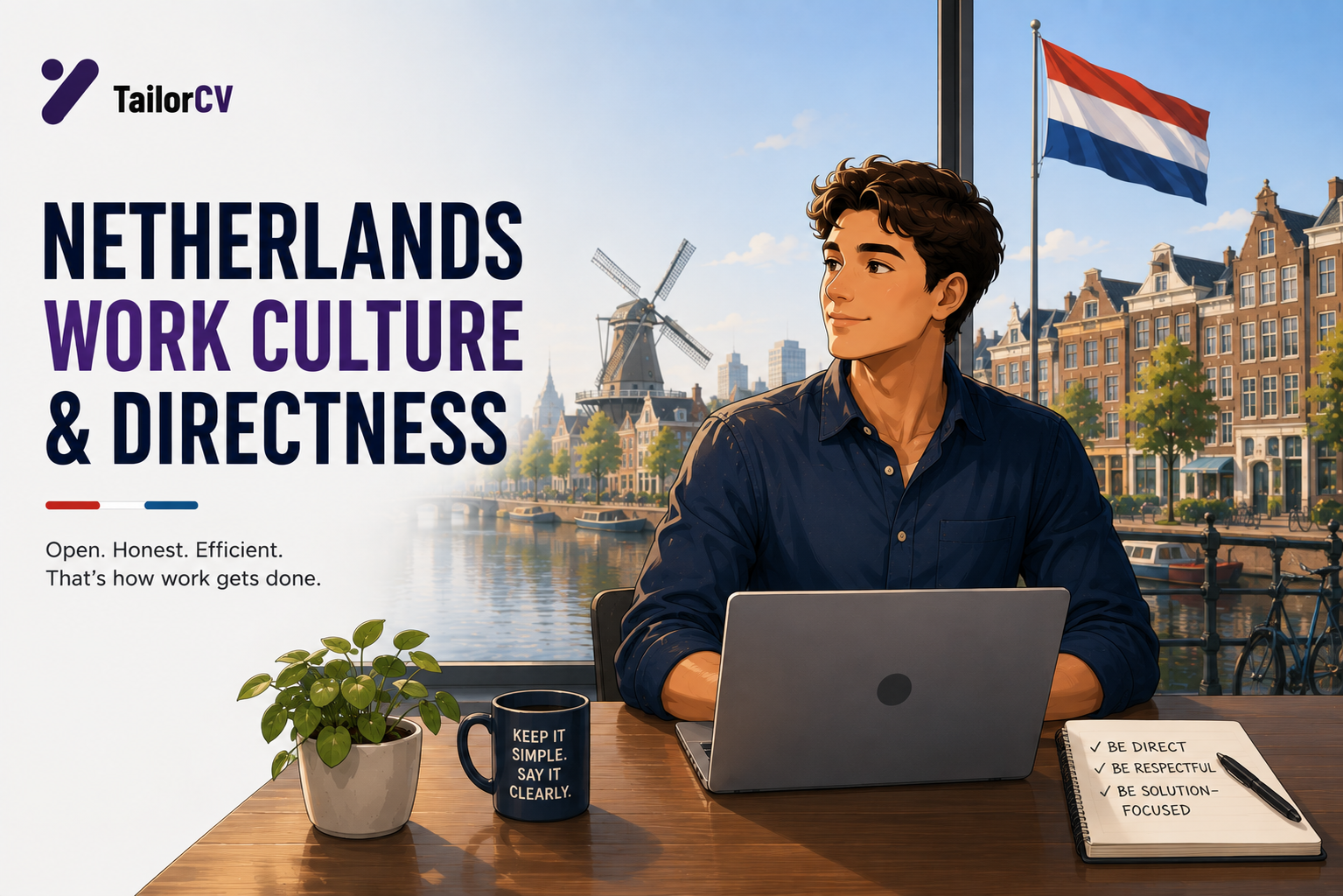
Flat hierarchies are real. Disagreeing with a senior person in a meeting is normal and expected. Deferring silently is read as having no opinion rather than as being respectful.
Part-time work is genuinely normal, including for senior professionals, and a four-day week is common across the country in a way it is nowhere else in Europe.
Meetings aim at consensus — the poldermodel in miniature. Decisions can take longer than in a top-down culture, and everyone is expected to have said their piece before one is made.
Hours are protected and holidays are taken. Statutory minimum leave is four times your weekly working days, so twenty days on a five-day week, and most employers offer more. Working late routinely is read as poor planning rather than as commitment.
Lunch is genuinely modest. The cheese sandwich at your desk is not a stereotype, and the Friday afternoon drink very much is.
Preparing the application itself
The mechanics are ordinary; the emphasis is what differs.
Ship something reviewers can open. A deployed project with a URL outperforms four repositories a reviewer has to clone and run. A portfolio site works while your application sits in a queue.
Write the CV to Dutch convention — two pages, plain, reverse chronological, outcomes rather than duties. The Dutch CV guide covers the specifics, and the biggest single mistake is a designed document that parses badly.
Mirror the stack in the advert exactly. Automated screening at larger employers is literal: "Kubernetes" is not matched by "container orchestration". Run the document through an ATS check once and the whole category of risk disappears.
Write a real motivation letter. Dutch employers read them, and a letter that names a specific product decision or technical problem of theirs does more than a page of enthusiasm.
Startups versus scale-ups versus corporates
Three different bargains, and choosing wrongly is a common regret.
Early startups give breadth and ownership, rarely sponsor, and often cannot meet the highly skilled migrant salary threshold. Excellent if you already have work rights; frequently impossible if you do not.
Scale-ups — companies past product-market fit and hiring hard — are usually the best graduate bargain in the Netherlands. They sponsor, they are on the recognised sponsor register, they pay competitively, and the work is still broad.
Corporates and international headquarters offer structure, mentoring, the 30% ruling handled competently by an HR team who has done it a hundred times, and narrower work. For a first role needing sponsorship, the administrative competence alone is worth something.
Check the register before falling in love with a startup. It takes ten seconds and it prevents a great deal of wasted hope.
Working in Dutch technology teams
A few cultural specifics that show up quickly.
Engineers are expected to have opinions. Dutch teams run flat, and a junior developer disagreeing with an architectural decision in a meeting is normal rather than presumptuous. Silence is read as disengagement.
Code review is direct. Comments are blunt about the code and not about you, and the register can surprise people arriving from cultures where feedback is heavily softened.
Planning is taken seriously. Sprint commitments mean something, and consistently over-promising is noticed faster than in a more chaotic environment.
Documentation matters. Dutch engineering culture tends to write things down, which is genuinely useful and slightly slower than shipping first and explaining later.
And the four-day week is real. Many Dutch engineers work four days, including senior ones, and asking about it in an offer conversation is an ordinary thing to do rather than a red flag.
Mini checklist
- unchecked: Cities shortlisted by sector, not just by Amsterdam
- unchecked: Eindhoven considered seriously if you are an engineer
- unchecked: Sponsor register checked for each target company
- unchecked: One deployed project reviewers can open
- unchecked: Take-home format prepared for
- unchecked: Salary expectation number decided before the recruiter call
- unchecked: 30% ruling eligibility asked about
- unchecked: CV in Dutch convention and ATS-clean
- unchecked: Direct-to-company applications prioritised over boards
Scenarios
Scenario 1: You are a software engineer wanting scale problems
Amsterdam — Adyen, Booking.com, Elastic and the international headquarters. Payments and marketplace platforms at genuine volume.
Scenario 2: You are a hardware, physics or systems engineer
Eindhoven, and ASML specifically. Very few places in the world offer engineering problems at that level of difficulty, and it hires internationally at scale with housing you can afford.
Scenario 3: You interview badly under live pressure
Target Dutch companies deliberately. Take-home assignments are common here, and they reward people who build well rather than people who perform well in forty-five minutes.
Tip: Have a salary number ready before your first recruiter call. Dutch recruiters ask early and directly, and "I am flexible" is read as unprepared rather than as agreeable.
Do's and Don'ts
Do
- Consider Eindhoven seriously, not just Amsterdam
- Apply directly to companies rather than only through boards
- Prepare properly for take-home assignments
- Have a salary figure ready
- Check the sponsor register before investing in an application
- Ask about the 30% ruling
Don't
- Assume Amsterdam is the only technology city
- Treat a take-home as optional effort
- Say you are flexible on salary
- Ignore housing costs when comparing cities
- Apply to companies that cannot sponsor you when you need it
- Underestimate the team fit conversation
Common Mistakes
- Overlooking Eindhoven. For engineers it is arguably the strongest destination in the country, with far lower living costs.
- Under-investing in the take-home. It is the main technical filter at many Dutch companies.
- Having no salary number. Dutch recruiters ask directly in the first call.
- Applying only through job boards. Dutch companies rely on direct applications more than most markets.
- Skipping the sponsor register. It tells you in seconds whether an application can go anywhere.
- Comparing gross salaries. The 30% ruling can change which offer is actually better.
Related Guides
Keep building on this with the related guides in this series:
- How to Write a Dutch CV That Gets Read
- The Dutch Orientation Year Visa Explained
- Finding a Job in Amsterdam as an International Graduate
- Technology Jobs in Berlin and Munich
- Technical Interview Preparation for New Graduates
You can also check your resume's ATS score for free, generate a tailored cover letter, or build a portfolio website in minutes.
Frequently Asked Questions
Do I need Dutch for a technology job?
Almost never. Dutch technology companies hire and operate in English as standard, which makes the market unusually accessible to international candidates.
Is Eindhoven worth considering over Amsterdam?
For engineers, frequently yes. ASML, Philips and the Brainport supply chain offer engineering work of a difficulty few places match, with much lower housing costs.
Are take-home assignments common?
Yes, more so than in the UK or US. Many Dutch companies use a take-home as the main technical filter rather than a live algorithmic interview.
How do Dutch tech salaries compare?
Below US and Swiss levels, broadly competitive within Europe. The 30% ruling, where it applies, changes the net picture significantly.
What technology companies are actually Dutch?
Adyen, Booking.com, Elastic, Mollie, Bunq, TomTom and ASML among others — a genuinely substantial home-grown ecosystem rather than only foreign offices.
Should I apply through job boards?
Direct applications to company career pages work better in the Netherlands than in most markets. Boards are a supplement, not the main channel.
What is vakantiegeld?
A statutory holiday allowance, a set percentage of annual salary, usually paid in May. Some offers quote a figure including it and some exclude it — always ask which.
Is part-time work really common?
Yes, unusually so. Four-day weeks are normal across the Netherlands, including in senior professional roles, in a way they are not elsewhere in Europe.
How much holiday do Dutch employees get?
The statutory minimum is four times your weekly working days — twenty days on a five-day week — and most employers offer more.
Should I join a startup or a scale-up?
For a graduate needing sponsorship, a scale-up is usually the best bargain — they are on the sponsor register, pay competitively, and the work is still broad. Early startups frequently cannot sponsor at all.
How do I check whether a company can sponsor me?
Search the IND recognised sponsor register. It takes seconds and it tells you whether an application can lead anywhere.
What are Dutch engineering teams like to work in?
Flat, direct and documentation-oriented. Juniors are expected to voice disagreement, code review is blunt about the code rather than the person, and four-day weeks are common even at senior level.
What is your resume scoring right now?
Scan it against a job description and get your ATS match score in about a minute.
Drop your resume here or choose a file
PDF only. Max 2 MB.
We never share your data or use it to train AI models.

Was this guide useful?
Be the first to rate it.