TD
TD
Key Takeaways
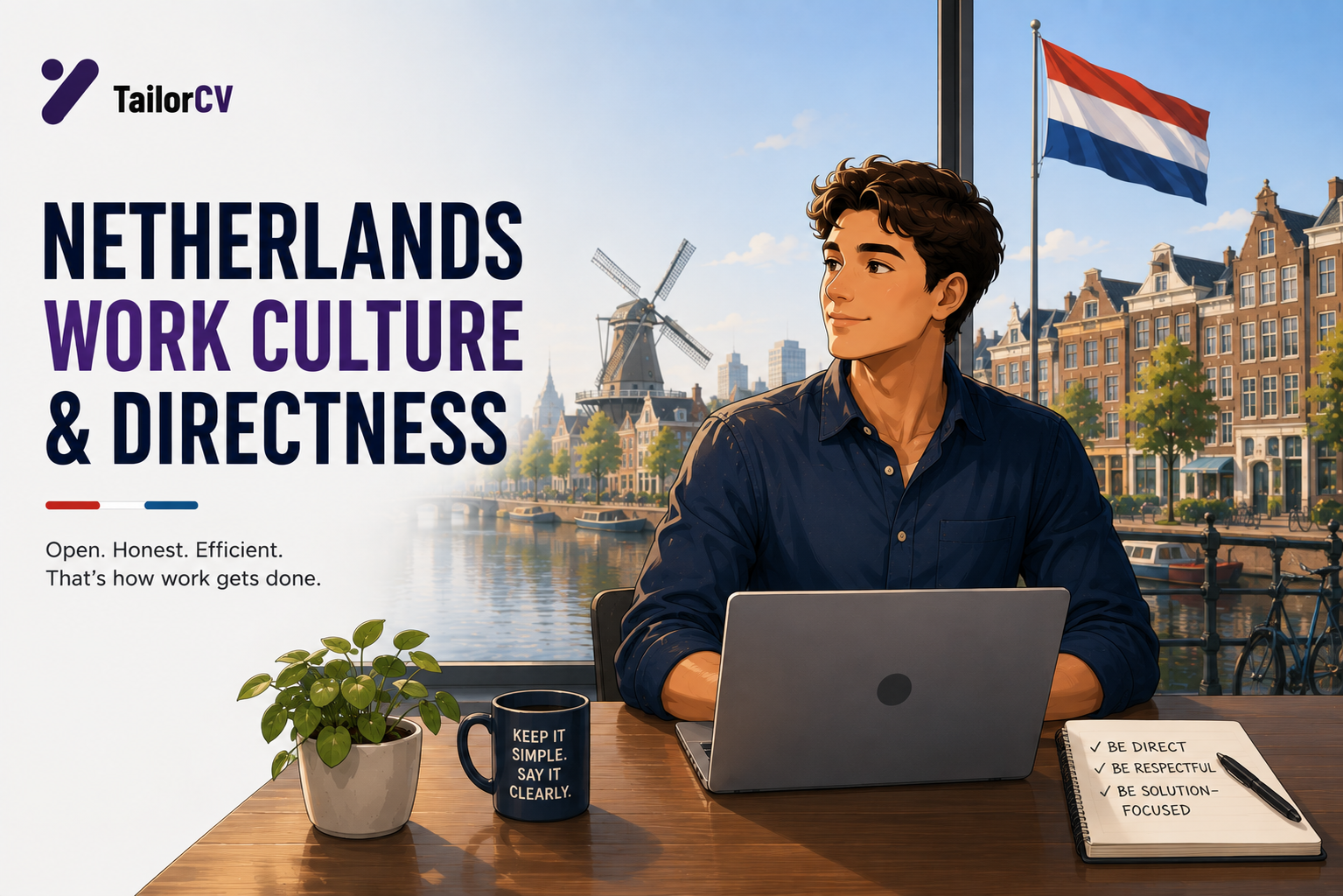
- Dutch directness is real and it is not rudeness — opinions are stated plainly and are expected back the same way.
- The polder model shapes everything: decisions are made by consensus after everyone has genuinely been heard.
- Hierarchy is flat. Junior staff are expected to disagree with senior people openly, and staying quiet reads as disengagement.
- Part-time work is normal and respected, including among senior professionals, in a way that has no real equivalent elsewhere.
- Work-life separation is strong, and long hours signal poor organisation rather than commitment.
Directness, explained properly
The thing every guide mentions and few explain.
Dutch colleagues say what they think, including about your work, in plain terms, without the elaborate cushioning that British or American workplaces use.
"I don't agree" is a complete and polite sentence. It carries no aggression and expects a reasoned response rather than an apology.
The purpose is efficiency. If the point is stated clearly, it can be addressed clearly, and everyone gets to a decision faster.
It applies upward as much as downward. A graduate telling a director that the plan has a flaw is normal behaviour and is generally welcomed.
The mistake foreigners make is either taking offence, or continuing to hedge so heavily that Dutch colleagues genuinely miss the criticism. "I wonder whether we might possibly consider" registers as agreement here.
The other mistake is confusing directness with permission to be unkind. The Dutch attack ideas, not people, and personal remarks land as badly here as anywhere.
The adjustment is simple: say the thing, give the reason, invite disagreement, and do not apologise for having an opinion.
The polder model and how decisions get made
A national habit with a long history.
The polder model describes consensus-based decision-making between parties with different interests, and it comes historically from the practical necessity of managing water together.
In a workplace it means decisions take longer than in hierarchical cultures because everyone affected is consulted, and once made they stick because everyone has bought in.
Meetings are for genuine discussion, not for ratifying a decision already made elsewhere. Turning up with a finished proposal and expecting a rubber stamp goes badly.
Everyone speaks. Silence in a meeting is read as having nothing to contribute, which affects how you are assessed.
Overruling by seniority is unusual and is regarded as a failure of the process rather than an exercise of authority.
The cost is speed. Foreigners from faster-moving cultures find the consultation exhausting.
The benefit is implementation. Decisions made this way rarely need to be relitigated, and people execute them without the passive resistance that top-down decisions generate elsewhere.
The rhythm of the working week
Practical details that shape daily life.
Part-time is genuinely normal. The Netherlands has among the highest rates of part-time work anywhere, and four-day weeks are common at every level including management.
Working from home is embedded, with most office roles operating hybrid by default rather than by exception.
The working day starts early and finishes accordingly. Being in the office at eight and gone by five is standard.
Lunch is modest and short — bread, cheese, milk, at your desk or in a canteen, in twenty minutes. Long restaurant lunches are not a Dutch business habit.
Coffee is social infrastructure. The morning round and the mid-afternoon break are where informal information moves.
Birthdays are institutional. You bring cake for your own birthday, colleagues congratulate you and often your family members too, and the whole thing is taken more seriously than newcomers expect.
Borrels — informal drinks, often Friday afternoon — are where relationships are built, and skipping them consistently is noticed.
And the agenda rules. Dutch professional life runs on calendars booked well ahead, and dropping in unannounced, socially or professionally, is unusual.
Hierarchy, or the absence of it
How authority actually works.
Titles carry little weight. First names are used with everyone including the CEO, and elaborate deference reads as strange rather than respectful.
Managers justify decisions rather than issue them, and a manager who cannot explain the reasoning loses authority quickly.
Expertise beats rank in most discussions. The person who knows the subject is expected to lead on it regardless of level.
Initiative is expected, not requested. Waiting to be told what to do reads as passivity.
Feedback flows upward freely and managers are expected to receive it as readily as give it.
Works councils — ondernemingsraad — exist at larger employers with genuine legal rights, extending the consultation habit into formal structure.
Which means the adjustment for people from hierarchical cultures is substantial and runs in an unfamiliar direction: you will be judged on speaking up, not on deferring.
Language at work
The practical picture.
English proficiency is exceptionally high, among the best in the world for a non-native-speaking country.
Many companies operate in English entirely, particularly in technology, at international employers and across Amsterdam.
Dutch still matters for public sector roles, healthcare, law, education, client-facing work outside the international sector, and for social integration.
Meetings switch to English readily when a non-Dutch speaker is present, and revert afterwards — which is reasonable and also where informal context lives.
Learning Dutch is harder than it sounds precisely because everyone switches to English the moment you struggle, so progress requires deliberate insistence.
And it changes your position. English gets you hired in the international segment; Dutch opens the rest of the market and the informal layer of the workplace.
Getting on with people
The informal layer that decides how well the job goes.
Be reliable about time. Dutch professional life runs on agendas, and being late or rescheduling repeatedly damages you quietly.
Say no clearly when you cannot take something on. A direct no is respected; an unenthusiastic yes that fails later is not.
Do not oversell. Understatement is the local register, and describing your work in the grand terms that play well in American workplaces reads as unserious here.
"Doe maar normaal" — just act normally — captures a real cultural preference against conspicuous self-promotion.
Join the borrel and the coffee rounds. Relationships built there make the direct feedback in meetings much easier to hear.
Bring cake on your birthday. It sounds trivial and it genuinely matters.
And separate the argument from the person. You can disagree sharply with a colleague at eleven and have a friendly lunch at twelve, and that is the expected pattern rather than an awkward one.
Regional and sector differences
The country is small and not uniform.
Amsterdam is the most international, with a large English-speaking professional population and a startup and scale-up sector to match.
The Hague is government, international law and institutions, notably more formal.
Rotterdam is logistics, port, energy and engineering, with a more direct and less polished self-image than Amsterdam.
Eindhoven and Brainport are high-tech, semiconductors and engineering, with a strong international engineering community.
Utrecht covers services, health and technology in a smaller, well-connected city.
Groningen and the north are cheaper, quieter and less international.
And sector matters as much as city — a Rotterdam shipping firm, a Hague ministry and an Amsterdam scale-up run at genuinely different registers despite sharing the same national culture.
Four honest cautions
Things the enthusiasm about Dutch work culture tends to skip.
Consensus is slow. If you come from a market where a decision takes a day, the polder process genuinely will frustrate you, and there is no shortcut around it.
The social circle closes early. Dutch adults form durable friendship groups young, and while colleagues are friendly, breaking into personal life takes longer than the workplace warmth suggests.
Housing is the real constraint, particularly in Amsterdam and Utrecht, and it shapes where you can realistically take a job more than salary does.
And English fluency cuts both ways. It makes arriving easy and makes learning Dutch hard, which quietly keeps many internationals in an expat layer of the labour market for years longer than they intended.
Your first ninety days
What actually builds standing in a Dutch team.
Speak in your first meeting. Waiting three months to establish yourself before contributing is read as having nothing to say.
Ask direct questions rather than working things out silently. Curiosity is respected and quiet confusion is not rewarded.
Book time with people rather than hoping for corridor conversations — the agenda culture means nothing informal happens by accident.
Deliver what you promised on the date you promised, and renegotiate early if you cannot.
Take your holiday. Not doing so raises questions about your planning rather than admiration for your commitment.
Join the borrel in your first weeks, when the social cost of joining is lowest.
And start Dutch immediately if you intend to stay, before the convenience of everyone speaking English makes it permanently easy not to.
Mini checklist
- unchecked: Opinions stated plainly rather than hedged
- unchecked: Criticism received without personalising it
- unchecked: Meetings treated as genuine discussion
- unchecked: Contributions made rather than staying quiet
- unchecked: Agenda and preparation taken seriously
- unchecked: Working hours respected in both directions
- unchecked: Part-time and flexible arrangements understood
- unchecked: Lunch treated as the modest affair it is
- unchecked: Birthdays and the coffee round learned early
Scenarios
Scenario 1: A colleague criticises your proposal bluntly in a meeting
Answer the substance. Ask what specifically fails and argue back if you disagree. This is the interaction working correctly, and defending your position well earns more respect than gracefully conceding.
Scenario 2: You are the most junior person in the room
Speak anyway. Silence is read as having no view, and Dutch colleagues genuinely expect input regardless of seniority.
Scenario 3: A decision is taking weeks of consultation
That is the process, not a failure of it. Use the time to make your case to the people who have not been convinced yet, because that is where the decision is actually being made.
Tip: If you come from a culture that softens criticism, deliberately over-correct for your first few months. What feels uncomfortably blunt to you will land as normal and clear here — and the hedged version genuinely does not register as criticism at all.
Do's and Don'ts
Do
- State your view plainly with a reason
- Disagree with senior colleagues openly
- Speak up in meetings regardless of seniority
- Prepare properly and read the agenda
- Respect the end of the working day
- Treat part-time colleagues as full professionals
Don't
- Take blunt feedback personally
- Hedge until your point disappears
- Bring a finished decision to a consultation meeting
- Stay silent to seem respectful
- Work late to signal commitment
- Confuse directness with licence to be personal
Common Mistakes
- Personalising criticism. It is aimed at the idea, every time.
- Over-hedging. Dutch colleagues miss indirect criticism completely.
- Pre-deciding before a meeting. The consultation is the decision.
- Staying quiet as a junior. It reads as disengagement, not deference.
- Long hours as signalling. It suggests you cannot organise your work.
- Assuming part-time means less serious. Senior professionals work four days routinely.
Related Guides
Keep building on this with the related guides in this series:
- Jobs in the Netherlands for International Graduates
- The Dutch CV Format
- Dutch Salary and Holiday Allowance
- The 30% Ruling Explained
- The Orientation Year and Zoekjaar
You can also check your resume's ATS score for free, generate a tailored cover letter, or build a portfolio website in minutes.
Frequently Asked Questions
Are Dutch colleagues really that blunt?
Yes, and it is not hostility. Opinions are stated plainly to get to a decision efficiently, and the same directness is expected back from you regardless of your seniority.
What is the polder model?
Consensus-based decision-making where everyone affected is genuinely consulted. Decisions take longer to reach and stick far better once made.
Should I speak up as a junior employee?
Yes. Silence is read as having nothing to contribute. Disagreeing with senior colleagues openly is normal and generally welcomed.
Is part-time work respected?
Genuinely. Four-day weeks are common among senior professionals and carry no implication of reduced commitment or ambition.
Do long hours help my career?
No. They signal poor organisation rather than dedication, and Dutch workplaces value delivering within working hours.
How do I adjust if I come from an indirect culture?
Over-correct deliberately at first. Heavily hedged criticism does not register as criticism here, so state the point and the reason plainly.
Is part-time work really common in the Netherlands?
Yes, among the most common anywhere. Four-day weeks are normal at every level including management and carry no implication of reduced ambition.
How hierarchical are Dutch workplaces?
Very flat. First names are used with everyone, managers justify decisions rather than issue them, expertise outweighs rank, and initiative is expected rather than requested.
Do I need Dutch to work in the Netherlands?
Not for much of the international and technology sector, where English is the working language. Dutch matters for public sector, healthcare, law, education, client-facing roles and social integration.
How do I build good relationships at a Dutch workplace?
Be reliable about time, say no clearly rather than over-committing, avoid conspicuous self-promotion, and join the informal coffee rounds and Friday borrels where relationships are actually built.
Does work culture vary across the Netherlands?
Yes. Amsterdam is international and startup-heavy, The Hague more formal and institutional, Rotterdam direct and industrial, and Eindhoven engineering-focused.
How do I settle into a Dutch workplace quickly?
Speak up in your first meetings rather than waiting to establish yourself, ask direct questions, book time with colleagues since nothing informal happens by accident, and join the social borrels early.
What is your resume scoring right now?
Scan it against a job description and get your ATS match score in about a minute.
Drop your resume here or choose a file
PDF only. Max 2 MB.
We never share your data or use it to train AI models.

Was this guide useful?
Be the first to rate it.