 SS
SS
Key Takeaways
- A Dutch CV runs to two pages and is expected to be plain, factual and well organised rather than designed.
- A photo is optional and increasingly omitted. International employers in Amsterdam generally prefer you leave it off; some traditional Dutch firms still expect one.
- Dutch professional culture prizes directness. Overstated claims read as untrustworthy, and hedged language reads as evasive.
- English is genuinely sufficient for a large share of roles in Amsterdam, Rotterdam, Eindhoven and Utrecht — but state your Dutch level honestly rather than omitting it.
- The motivatiebrief (motivation letter) is still standard and is genuinely read, unlike cover letters in some other markets.
The shape of a Dutch CV
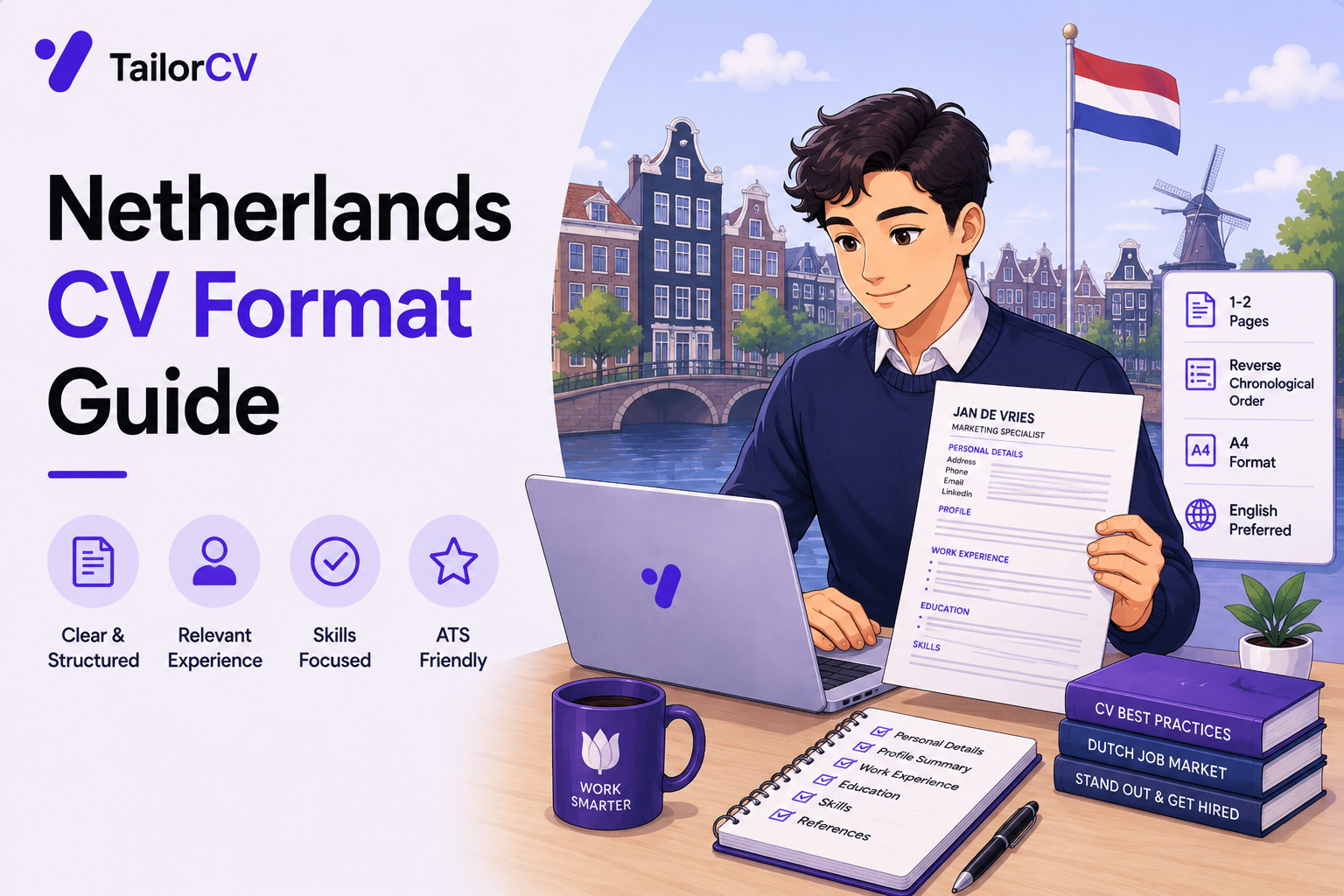
Dutch employers want a document that answers questions quickly. Two pages is the norm and a graduate can reasonably use one and a half.
Personal details at the top: name, phone, email, city, and LinkedIn. Date of birth and nationality still appear on many Dutch CVs — this is a local convention rather than something an employer may demand, and international employers do not expect it. Include it or not; neither will cost you.
A short profile of three or four lines. This is genuinely read in the Netherlands, more so than in the UK. It should state what you do, what you are looking for, and one concrete thing that distinguishes you.
Work experience, reverse chronological, with employer, role, dates and outcomes.
Education, including your institution, your degree in full, and your graduation date. If your degree has no obvious international equivalent, one clarifying line helps.
Skills, with languages listed explicitly and levels stated using the CEFR scale (A1 through C2) rather than words like "basic" or "fluent", which mean different things to different readers.
Extracurriculars matter more here than you expect. Dutch student culture involves substantial committee work, board years at student associations, and organising roles — and Dutch employers read these as genuine management experience rather than as filler. If you did something similar, describe it as the responsibility it was.
The photo question, answered properly
This is the question every international candidate asks, and the honest answer is that it depends on the employer.
| Employer type | Convention |
|---|---|
| International companies in Amsterdam | Usually no photo; many actively prefer none |
| Dutch corporates and traditional firms | A photo is still common and unremarkable |
| Startups and scale-ups | Rarely, and it makes no difference |
| Public sector | Increasingly discouraged for bias reasons |
The safe default is no photo, particularly for international employers. If you do include one, it should be a plain professional headshot, not a casual crop.
Directness, and why it changes your writing
Dutch communication norms are noticeably blunter than British or American convention, and this shows up in how a CV is read.
Overstatement is penalised. "Expert in data analysis" from a graduate reads as either naive or dishonest. "Built and maintained the reporting pipeline for a 12-person research group" reads as credible because it is checkable.
Hedged language reads as evasive. "Helped to contribute towards improving" is the kind of phrasing that survives in some cultures and actively hurts you here. Say what you did.
Claim the level you actually have. If your Dutch is A2, write A2. Claiming B2 and being tested in the interview is far worse than being honest and being hired for a role that runs in English.
The motivatiebrief
Unlike markets where cover letters are ignored, the Dutch motivation letter is still standard and is read.
Keep it to one page — three or four short paragraphs.
Answer three questions: why this company specifically, why this role, and what you bring that is concrete. Generic enthusiasm is transparent and counts against you.
Write it in the language of the advert. If the posting is in English, write in English. If it is in Dutch and your Dutch is genuinely good, write in Dutch — but a poor Dutch letter is worse than a strong English one.
Do not restate your CV. The letter connects your specific background to their specific need, and a reader who has just read your CV notices immediately when you are padding.
If you want a starting point, a tailored cover letter generated against the actual posting solves the blank-page problem, though you should always rewrite the specifics yourself.
Automated screening and Dutch employers
Larger Dutch employers and the big international offices in Amsterdam screen with software before anyone reads your document, which imposes a few unglamorous constraints.
Use section headings a parser recognises — Work Experience, Education, Skills. A creatively named section is a section that does not get extracted.
Avoid multi-column layouts and text inside images. Dutch design culture tempts people toward attractive documents, and attractive documents frequently parse into nonsense.
Mirror the advert's vocabulary exactly. If the posting says "Power BI", write "Power BI" rather than "business intelligence tooling". The matching is literal.
Export as PDF unless the advert explicitly asks for Word, and name the file with your own name in it rather than "CV_final_v3".
Running your base document through an ATS check once removes this entire category of risk before you send the first application rather than after a month of silence.
Turning a graduate CV into something with weight
Most Dutch graduate CVs fail for the same reason: they list what the candidate was enrolled in rather than what they did.
Describe the thesis as a project, not a title. "Master's thesis: machine learning for demand forecasting" tells a reader nothing. "Built a demand-forecasting model on three years of retail transaction data; compared gradient boosting against a seasonal baseline and documented where the baseline won" tells them how you think.
Internships and part-time work count fully. Dutch employers do not discount a supermarket job or a call-centre stint — they read it as evidence you can hold responsibility. Describe the scale: how many customers, how many shifts, what you were trusted with.
Include a link to something real. A repository, a deployed project, a portfolio site that opens in a browser. Dutch reviewers are practical and will click, and a working thing outranks a paragraph describing a thing.
Cut coursework lists. A list of module names is the least informative thing on any graduate CV. One project described properly replaces ten module titles.
Formatting details that quietly matter
Dates in a consistent format, month and year, with no gaps you have not accounted for. Dutch readers notice gaps and would rather see one honest line — travel, illness, a failed startup — than an unexplained hole.
Reverse chronological throughout. Functional or skills-first CVs are read in the Netherlands as an attempt to hide something, whether or not that is fair.
Plain fonts, generous white space, no colour blocks. The Dutch aesthetic preference in professional documents runs toward clarity rather than personality.
One file, named with your own name. "Anna_Kowalski_CV.pdf" is retrievable from a folder of two hundred applications; "cv_definitief.pdf" is not.
Keep a master version and cut it down per application. Tailoring is expected, and a document that visibly matches the advert outperforms a general-purpose one every time.
Tailoring without rewriting everything
Dutch employers expect a CV aimed at the role, and the efficient way to do that is a master document you cut down rather than a new document each time.
Keep one long master version containing everything you have ever done, described properly. It is never sent to anyone.
For each application, cut rather than write. Remove the experience that is irrelevant, reorder so the relevant sits highest, and adjust the profile paragraph to name the role and the company. Twenty minutes of cutting beats two hours of writing.
Match the advert's own nouns. If the posting asks for "stakeholder management", the phrase "stakeholder management" should appear on your CV describing something you genuinely did. This is not keyword stuffing; it is removing the translation step from the reader's job.
Keep a log of what you sent where. Dutch hiring processes can run over several weeks, and being asked about a document you cannot remember sending is a bad position to be in.
Mini checklist
- unchecked: Two pages maximum, one and a half for a graduate
- unchecked: Photo decision made deliberately for this employer type
- unchecked: Profile of three or four concrete lines
- unchecked: Languages listed with CEFR levels
- unchecked: Committee, board and organising roles described as real experience
- unchecked: Outcomes rather than duties in every bullet
- unchecked: No overstated claims and no hedged phrasing
- unchecked: A one-page motivatiebrief written for this specific role
- unchecked: Document parsed cleanly and exported as PDF
Scenarios
Scenario 1: You are applying to an international company in Amsterdam
No photo, no date of birth, English throughout, and a profile that leads with your technical or commercial specialism. Treat it as an international application that happens to be in the Netherlands.
Scenario 2: You are applying to a traditional Dutch employer
A photo is unremarkable, personal details in the Dutch convention are expected, and a Dutch-language motivatiebrief helps if your Dutch supports it. Match the language of the advert.
Scenario 3: You had a board year at a student association
Describe it properly: budget managed, people coordinated, events run, decisions owned. Dutch employers read this as management experience, and burying it under "extracurricular activities" wastes it.
Tip: State your Dutch level in CEFR terms and leave it there. Candidates routinely inflate it, get tested in the first interview, and lose an offer they would have got by being honest — most Amsterdam roles run in English anyway.
Do's and Don'ts
Do
- Keep it to two pages
- State languages in CEFR levels
- Describe committee and board roles as real responsibility
- Write a specific motivatiebrief for each application
- Be direct and concrete
- Match the language of the advert
Don't
- Overstate your skill level or your Dutch
- Use hedged, softened phrasing
- Include a photo without thinking about the employer
- Restate your CV in the motivation letter
- Assume the cover letter goes unread here
- Design the document heavily
Common Mistakes
- Inflating your Dutch level. You will be tested, and most roles in the big cities run in English anyway.
- Overstating skills. Dutch readers discount claims that are not checkable, and it damages the rest of the document.
- Hedged, softened language. "Helped to contribute towards" reads as evasive rather than modest.
- Skipping the motivation letter. It is still standard here and it is genuinely read.
- Burying board and committee experience. Dutch employers count it as management experience.
- Adding a photo reflexively. Decide by employer type; the safe default is none.
Related Guides
Keep building on this with the related guides in this series:
- Finding a Job in Amsterdam as an International Graduate
- The Dutch Orientation Year Visa Explained
- Technology and Startup Jobs in the Netherlands
- Resume Format for Germany
- A Practical Checklist for Your First Job Abroad
You can also check your resume's ATS score for free, generate a tailored cover letter, or build a portfolio website in minutes.
Frequently Asked Questions
Should I put a photo on a Dutch CV?
The safe default is no, particularly for international employers in Amsterdam. Traditional Dutch firms still see photos regularly, so decide by employer type rather than by rule.
How long should a Dutch CV be?
Two pages. A graduate can reasonably use one and a half. Anything longer signals you cannot prioritise.
Do I need to speak Dutch?
For a large share of roles in Amsterdam, Rotterdam, Eindhoven and Utrecht, no — they run in English. Client-facing roles, the public sector and many traditional Dutch employers do require it.
Is the cover letter actually read?
Yes. Unlike some markets, the Dutch motivatiebrief is standard and is genuinely read, so a generic one is actively harmful.
Should I include my date of birth?
It is a Dutch convention that still appears on many local CVs, but international employers do not expect it and it is fine to leave off.
How should I list my language levels?
Use CEFR levels — A1 to C2 — rather than words like "basic" or "fluent", which are interpreted very differently by different readers.
Do Dutch employers use automated screening?
Larger employers and the international offices in Amsterdam do. Use standard headings, avoid multi-column layouts, mirror the advert's exact vocabulary, and check the document parses before applying.
Should I list my university coursework?
No. Module lists are the least informative thing on a graduate CV. One project described with what was difficult and what came out of it replaces ten module names.
Can I use a skills-based CV instead of chronological?
It is a bad idea in the Netherlands. Functional CVs are widely read as an attempt to hide a gap, whether or not that is fair.
Do gaps in my dates matter?
They are noticed. One honest line explaining a gap works far better than leaving an unexplained hole in the timeline.
Should I tailor my CV for every application?
Yes, but by cutting a master document rather than writing a new one. Remove the irrelevant, reorder so the relevant sits highest, and adjust the profile to name the role.
Does your formatting survive the parser?
Upload your resume and see what an ATS actually reads back.
Drop your resume here or choose a file
PDF only. Max 2 MB.
We never share your data or use it to train AI models.

Was this guide useful?
Be the first to rate it.