 SS
SS
Key Takeaways
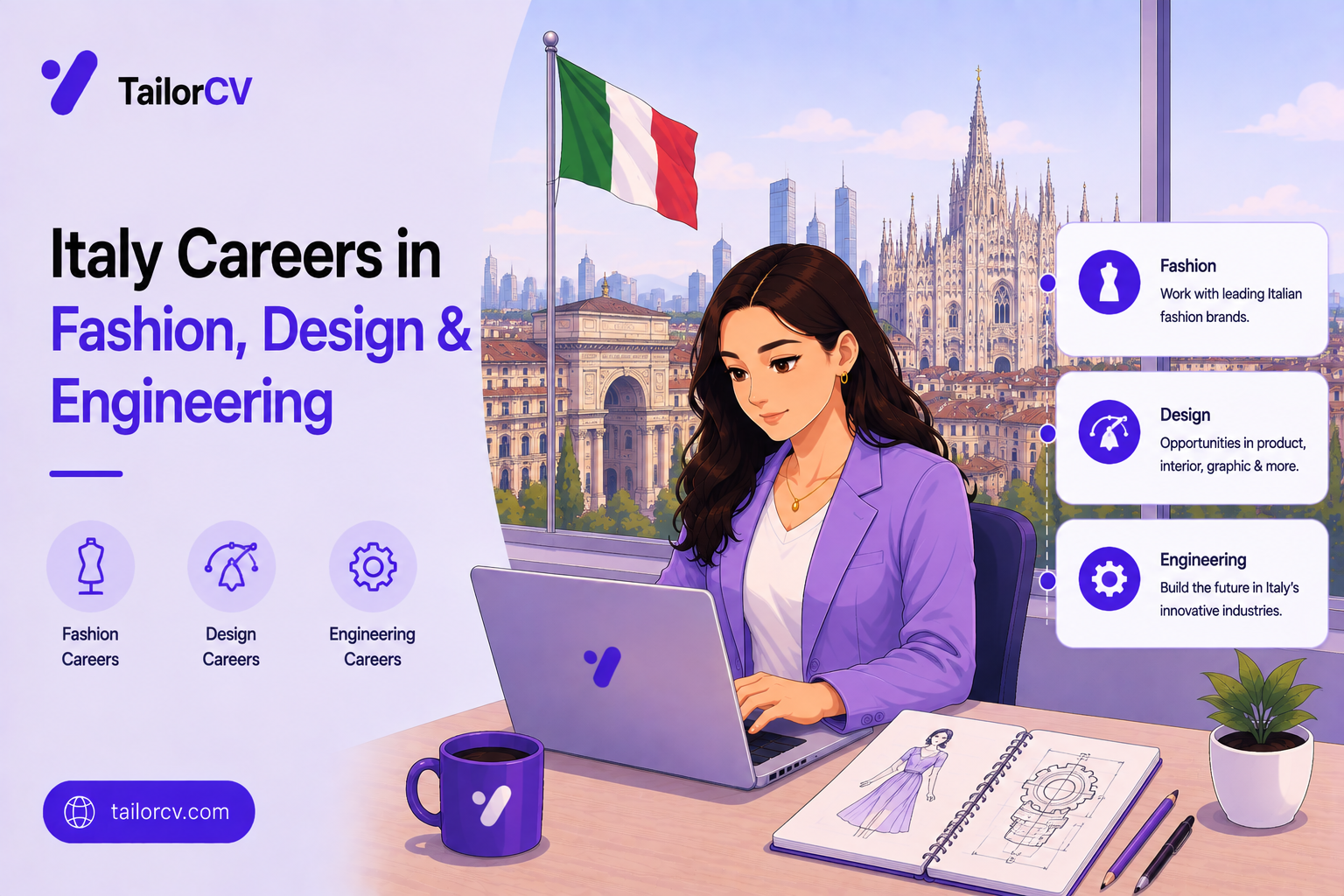
- Italy leads globally in fashion and luxury, industrial and product design, packaging machinery, automotive engineering and food technology.
- Milan is the fashion and design capital, Emilia-Romagna the machinery and motor cluster, Turin the automotive engineering centre.
- These industries hire internationally because their markets are global, which makes them the accessible entry into Italy.
- Internships and portfolios do more than CVs in design and fashion; technical specificity does the work in engineering.
- Pay is lower than Northern Europe but the industry access is genuinely unavailable elsewhere.
Fashion and luxury
Italy is one of two or three countries on earth where this industry is genuinely centred.
The houses. Prada, Armani, Versace, Valentino, Dolce & Gabbana, Bottega Veneta, Fendi, Gucci — headquartered or with major operations in Italy, mostly around Milan and Florence.
The groups. Kering and LVMH both run substantial Italian operations because so much of their production and design capability sits there.
The supply chain is the hidden depth. Leather goods in Tuscany, knitwear in Umbria and the Veneto, eyewear in Belluno (Luxottica and its ecosystem), textiles in Como and Prato, footwear across several regions. These are technically sophisticated manufacturers, and they are where a great deal of the actual employment is.
Roles that hire internationally: design, product development, merchandising, buying, supply chain, retail management, digital and e-commerce, and increasingly sustainability and traceability functions.
Milan Fashion Week and the trade fairs are genuine networking venues rather than spectacles.
The honest note: entry-level fashion pay in Italy is low and internships are frequently the only door. People do it because the industry access is real and unavailable in most of the world.
Design
Distinct from fashion, and Italy's other genuine global lead.
Furniture and product design. The Brianza area north of Milan is one of the world's densest furniture manufacturing regions, and companies like Kartell, Cassina, B&B Italia, Molteni and Flos are internationally significant.
Salone del Mobile in Milan is the world's most important furniture and design fair, and it functions as an annual industry gathering that genuinely generates work and contacts.
Industrial and transport design. Pininfarina, Italdesign and the studios around Turin have shaped global automotive design for decades.
Design education is a route in. Politecnico di Milano, Domus Academy, IED and NABA attract international students precisely because studying design in Milan puts you inside the network.
Portfolios decide everything. In design, the work is the application, and a strong portfolio outweighs credentials, language and almost anything else on the CV.
Engineering: machinery, automotive and food technology
The largest of the three by employment and the least visible from outside.
Packaging machinery. The Bologna cluster — Coesia, IMA, Marchesini, Sacmi and dozens more — dominates global packaging equipment. This is precision mechanical engineering, automation and controls at a world-leading level, and almost no graduate outside Italy knows it exists.
Motor Valley. Ferrari, Lamborghini, Ducati, Maserati and Dallara, concentrated in Emilia-Romagna, alongside a motorsport supply chain that also serves Formula 1.
Automotive volume. Stellantis's Italian operations and the Turin engineering base, plus a broad components sector.
Aerospace and defence. Leonardo, Avio and the clusters around Turin, Rome and Naples.
Food processing technology. Italy builds much of the world's food and beverage processing equipment, an unglamorous sector with excellent engineering.
Energy. Eni and Enel are global companies with substantial technical employment.
For a mechanical, automation, controls or materials engineer, Italy is genuinely competitive with anywhere in Europe on the interest of the work, if not on the pay.
How hiring runs in these sectors
The processes differ enough between the three to be worth separating.
Fashion and luxury. Portfolio or experience-led screening, then interviews that are as much about taste and cultural fit as about competence. Internships are the standard entry, seasonal hiring follows the collection calendar, and the industry is genuinely relationship-driven.
Design. Portfolio first, always. Studios hire on the strength of the work and often on a project or freelance basis initially. Salone and the design weeks generate a meaningful share of connections.
Engineering. Conventional and technical. CV screening on discipline and software, a technical interview on your actual competence, and frequently a plant or site visit. Machinery companies in Emilia-Romagna hire steadily rather than seasonally.
Across all three, English is more common than in the rest of the Italian market because the customers are global — but Italian remains necessary for daily working life at most of these employers.
Trade fairs are real recruitment venues. Salone del Mobile, Milano Unica, IPACK-IMA, EIMA and the motorsport events all bring the industry into one place, and turning up with something to show works.
Careers and where they lead
Fashion and luxury experience travels to Paris, London, New York and increasingly to the Gulf and Asia, where the same groups operate.
Design experience from Milan carries genuine weight internationally — the city's design reputation is a real credential.
Machinery and automation engineering transfers to Germany, Switzerland and the wider European industrial base directly.
Motorsport engineering is a small international world, and Emilia-Romagna experience is recognised in the UK's Motorsport Valley and vice versa.
The salary catch-up happens abroad. A common pattern is a few years in Italy building industry-specific expertise, then a move north or to a global hub where that expertise pays considerably more.
And plenty of people stay because the work is the point and the life is good, which is a legitimate answer rather than a compromise.
Building a portfolio that works here
Specific to the Italian design and fashion market.
Show process, not only outcome. Italian design culture values craft and iteration, and sketches, prototypes and rejected directions demonstrate thinking that a finished render does not.
Show materials knowledge. In a country whose advantage is manufacturing sophistication, understanding what a material can actually do sets you apart from someone who designs shapes.
Keep it curated. Six strong projects beat twenty. A portfolio that includes weak work reads as an inability to judge your own output.
Make it openable in a browser. A portfolio site beats a 60MB PDF that nobody downloads.
Include one manufacturing-aware project if you can — something where you engaged with how it would actually be made.
Caption in English and Italian if you can manage it credibly. In a market this international it signals both audiences.
Practical entry, sector by sector
Fashion. Apply to the internship programmes at the houses, and separately to the supply chain manufacturers where technical roles are less contested. Milan and Florence for the brands, the regional clusters for production.
Design. Study in Milan if you can, build a portfolio, and use Salone as an annual objective — many studios do their hiring around it.
Machinery and automation. Apply directly to the Emilia-Romagna companies. Their websites carry vacancies, they attend the international trade fairs, and they hire engineers steadily throughout the year.
Motorsport. A small world entered through internships, university formula programmes and personal connection more than through advertisements.
Aerospace. Leonardo and Avio run structured graduate recruitment.
And in every case, learn Italian. These are Italian companies with Italian working cultures, and English gets you through the interview rather than the career.
Pay and progression, sector by sector
The financial reality, stated plainly, because it varies more between these three than people expect.
Engineering pays best of the three at entry level, particularly in machinery, automotive and aerospace, and it follows collective agreement scales that give you a visible floor.
Design pays moderately and is highly variable — established studios pay reasonably, small ones often do not, and freelance is common early.
Fashion pays worst at entry and best at the top. Internships are frequently poorly paid or unpaid in practice, and the industry relies on that. It is worth going in clear-eyed about it.
Progression is faster in engineering and more relationship-dependent in fashion and design.
Milan costs more than Bologna, Turin or Florence, which matters given that fashion and design concentrate in the most expensive city and engineering does not.
And the international move is the compensation. Building Italian industry-specific expertise and then moving to Germany, Switzerland, France or a global hub is an extremely common and financially rational trajectory.
Mini checklist
- unchecked: Industry chosen — fashion, design or engineering
- unchecked: Region matched to that industry
- unchecked: Portfolio prepared if design or fashion
- unchecked: Technical vocabulary and standards named if engineering
- unchecked: Trade fairs identified for your sector
- unchecked: Internship routes accepted as the likely entry
- unchecked: Italian study started
- unchecked: Salary expectations calibrated honestly
- unchecked: Blue Card route checked if you need a permit
Scenarios
Scenario 1: You are a mechanical or automation engineer
Target the Bologna packaging machinery cluster specifically. It is world-leading, it hires internationally, and it is almost entirely unknown to graduates outside Italy — which is exactly why it is worth applying to.
Scenario 2: You want to work in fashion
Milan, with a portfolio and a willingness to start on an internship. Also look at the supply chain — Belluno eyewear, Tuscan leather, Veneto knitwear — where the technical roles are less contested than the brand-side ones.
Scenario 3: You are a designer
Build the portfolio first and consider studying in Milan. Salone del Mobile is a genuine annual opportunity to meet the industry, and design education there is a recognised route into the network.
Tip: Look at the Bologna packaging machinery cluster if you are a mechanical or automation engineer. It is a genuinely world-leading industry that almost no international graduate has heard of, which means the applicant-to-role ratio is far better than anywhere with a famous name.
Do's and Don'ts
Do
- Target Italy's genuinely world-leading niches
- Build a portfolio for design and fashion
- Name standards and software precisely for engineering
- Use trade fairs as networking venues
- Consider the supply chain, not just the brands
- Accept internships as a realistic entry
Don't
- Expect Northern European salaries
- Apply only to famous brand names
- Send a CV without a portfolio for a design role
- Ignore Emilia-Romagna's machinery cluster
- Assume English suffices outside Milan's corporate sector
- Underestimate how much the network matters
Common Mistakes
- Only targeting brands. The supply chain holds much of the actual technical employment.
- Ignoring packaging machinery. World-leading and almost unknown internationally.
- No portfolio for design roles. In this field the work is the application.
- Expecting Northern European pay. Italian salaries in these sectors are genuinely lower.
- Skipping the trade fairs. They are real recruitment and networking venues here.
- Assuming English is enough. Outside Milan's corporate offices, Italian is needed.
Related Guides
Keep building on this with the related guides in this series:
- Working in Italy as an International Graduate
- The Italian CV and Lettera di Presentazione
- Italian Work Visas and the Nulla Osta
- Working in Spain as an International Graduate
- Working in France as an International Graduate
You can also check your resume's ATS score for free, generate a tailored cover letter, or build a portfolio website in minutes.
Frequently Asked Questions
Which industries is Italy genuinely world-leading in?
Fashion and luxury, furniture and product design, packaging machinery, automotive and motorsport engineering, food processing technology, and parts of aerospace.
Where is the Italian machinery cluster?
Around Bologna in Emilia-Romagna — Coesia, IMA, Marchesini, Sacmi and many others dominate global packaging equipment manufacture.
Do fashion companies in Italy hire internationally?
Yes, because their markets are global. Design, merchandising, buying, supply chain, digital and retail roles all recruit internationally, though entry-level pay is low and internships are common.
What is Motor Valley?
The concentration of Ferrari, Lamborghini, Ducati, Maserati and Dallara in Emilia-Romagna, with a motorsport supply chain that also serves Formula 1.
Do I need a portfolio?
For design and fashion, absolutely — the work is the application. For engineering, technical specificity about standards, software and project scale does the equivalent job.
Is the pay worth it?
Lower than Northern Europe, honestly. People come for industry access that genuinely does not exist elsewhere, and for a daily life that salary comparisons do not capture.
How does hiring differ between Italian fashion, design and engineering?
Fashion runs on portfolios, relationships and the collection calendar; design on portfolios and often project work; engineering on conventional technical screening with steady year-round hiring.
Does Italian experience in these industries travel?
Yes. Fashion experience moves to Paris, London, New York and the Gulf; Milan design carries real international weight; and machinery and motorsport engineering transfer directly to Germany, Switzerland and the UK.
What should an Italian design portfolio show?
Process as well as outcome — sketches, prototypes and rejected directions — plus genuine materials knowledge, tightly curated to six strong projects and openable in a browser rather than sent as a huge PDF.
How do I apply to the Emilia-Romagna machinery companies?
Directly through their own websites, and by attending the international packaging and machinery trade fairs. They hire engineers steadily year-round rather than on a seasonal calendar.
Which of these Italian sectors pays best?
Engineering, particularly machinery, automotive and aerospace, with visible collective agreement scales. Design is variable, and fashion pays worst at entry and best at the top.
What is your resume scoring right now?
Scan it against a job description and get your ATS match score in about a minute.
Drop your resume here or choose a file
PDF only. Max 2 MB.
We never share your data or use it to train AI models.

Was this guide useful?
Be the first to rate it.