 SS
SS
Key Takeaways
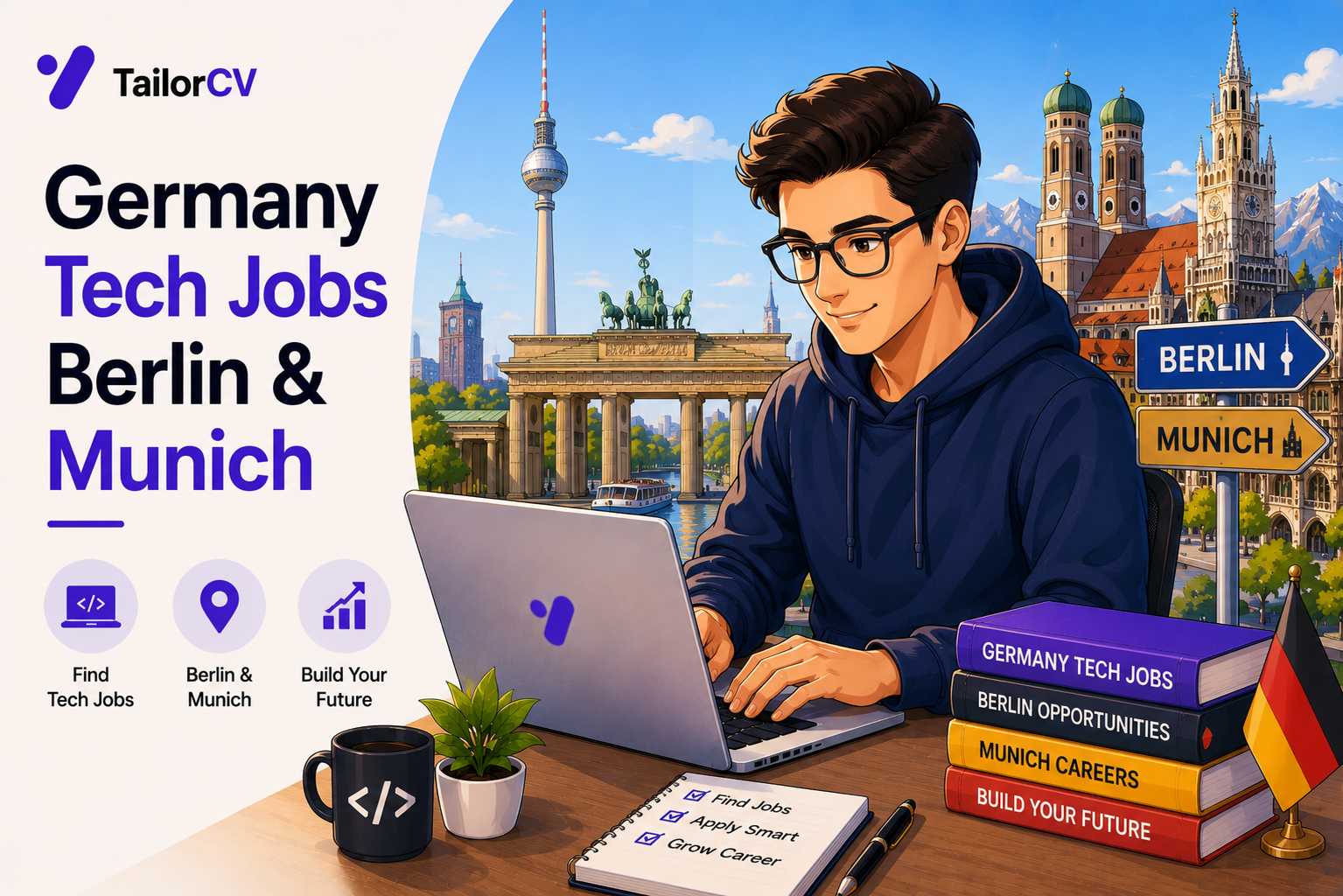
- Berlin and Munich are genuinely different markets, not two versions of the same one — Berlin runs on startups and English, Munich on corporates, deep tech and German.
- Berlin has the largest concentration of English-operating engineering teams in Germany, which makes it the most accessible entry point without German.
- Munich pays more on paper and costs considerably more to live in; the real comparison is much closer than the salary gap suggests.
- Hamburg, Cologne, Stuttgart, Frankfurt, Karlsruhe and Dresden all have real tech employment and are far less contested than the two headline cities.
- Technical interviews follow international convention closely, so standard preparation transfers almost entirely.
Berlin: startups, English, volume
Berlin is where Germany's startup ecosystem concentrated, and it is the reason a foreign engineer with no German can realistically get hired in Germany at all.
What is there. A dense startup and scale-up scene — companies like Zalando, Delivery Hero, N26 and SoundCloud grew there, and a long tail of smaller companies followed. Large international employers run Berlin engineering offices too, and the city hosts a substantial share of Germany's venture funding.
Why it is accessible. A meaningful proportion of Berlin startups operate internally in English, because their teams are international by default. Job adverts are frequently written in English, interviews run in English, and the working language stays English.
The trade-off. Berlin salaries generally sit below Munich and Frankfurt. Startup roles carry the usual risk profile — funding position matters, and "we just raised" is not the same as "we are stable". Berlin's cost of living has also risen sharply, and the cheap-Berlin reputation is now well out of date.
Munich: corporates, deep tech, German
Munich is the other pole and it behaves almost oppositely.
What is there. BMW, Siemens, Allianz and Infineon are headquartered in or near the city. Google, Apple, Microsoft, Amazon and Intel all run substantial Munich engineering operations — not sales offices. Two strong technical universities, TUM and LMU, feed the talent pipeline, and the surrounding region carries real depth in semiconductors, automotive software and industrial technology.
The language reality. Outside the international employers' own teams, Munich expects German far more consistently than Berlin does. A German corporate's engineering division generally runs in German.
The cost. Munich is the most expensive major German city for housing by a clear margin. A higher Munich salary can leave you with less disposable income than a Berlin one after rent — worth calculating with actual listings rather than assuming the bigger number wins.
Berlin or Munich, side by side
| Berlin | Munich | |
|---|---|---|
| Dominant employers | Startups, scale-ups, international offices | Corporates, deep tech, big-tech engineering hubs |
| Working language | English common | German expected outside international teams |
| Salary | Lower on average | Higher on average |
| Cost of living | High and rising | Highest in Germany |
| Risk profile | Higher — funding-dependent employers | Lower — established corporates |
| Best for | Entering without German; product and web engineering | Embedded, automotive, semiconductors, research-adjacent work |
The cities nobody applies to
Concentrating on two cities means competing with everyone else who read the same advice.
- Hamburg — media, logistics technology, e-commerce, and a growing startup scene.
- Frankfurt — fintech and banking technology, unsurprisingly, plus a major internet exchange.
- Stuttgart — automotive and industrial software, Bosch and Mercedes-Benz territory.
- Cologne / Düsseldorf — media, insurance technology, and a solid mid-market.
- Karlsruhe — a genuine research and software cluster around KIT, well out of proportion to the city's size.
- Dresden / Leipzig — semiconductors and microelectronics in Dresden specifically, with markedly lower living costs.
These markets are smaller in absolute terms and considerably less contested per role. For a graduate, the applicant-to-seat ratio matters more than the headline size of the market.
What the hiring process looks like
- Application — CV, and at German-language employers the full package. English-operating startups usually want a CV and nothing more.
- Recruiter screen — 20 to 30 minutes on background, motivation and salary expectations.
- Technical screen — a coding exercise, a take-home, or a live session, closely matching international technical interview convention.
- Technical deep dive — your past projects in detail, plus system design at more senior levels.
- Team and culture conversation — genuinely weighted, not a formality.
- Offer and visa — the Blue Card process starts here if you need sponsorship.
Compensation, and how German tech pay is structured
German tech salaries sit below US levels and generally above most of Europe, and they are structured differently from what candidates coming from the US or UK expect.
Equity is much less common. Outside venture-backed startups, German employers rarely offer meaningful stock. A corporate offer is largely base salary plus a bonus, and the base is therefore the number that matters. Do not evaluate a German offer expecting an equity component to make up a gap.
The gross-to-net gap is large. Germany's combined income tax and social contributions mean take-home is a substantially smaller fraction of gross than in the UK or US. What you are paying into is real — statutory health insurance, pension, unemployment and long-term care cover — but the first payslip is a shock if you budgeted off the gross figure.
Tax class matters more than people expect. Germany assigns a Steuerklasse based on marital and family status, and it materially changes monthly net pay. Married couples in particular should look at which combination applies to them.
The 13th-month payment exists at some employers, particularly those under a collective agreement — an extra month's salary, usually paid toward the end of the year. Ask whether it applies, because it is a meaningful part of annual compensation and is easy to miss when comparing two offers.
Working culture, honestly
Worth calibrating before you arrive rather than discovering in month one.
Hours are genuinely protected. German working time law caps hours and mandates rest periods, and it is taken seriously rather than treated as a formality. Statutory minimum paid leave is 20 days on a five-day week, and most employers offer materially more — often 27 to 30.
Directness is normal and not hostility. German workplace communication tends to be blunter than UK or US convention. Feedback is plainer, disagreement in a meeting is not a personal attack, and softening every statement can read as evasive rather than polite.
Separation of work and private life is real. Contacting colleagues outside working hours is far less normal than in US tech culture, and expecting instant out-of-hours responses reads badly.
Process and documentation carry weight. Decisions tend to be made more deliberately, with more written record, than in an American startup. Some engineers find this steady and welcome; others find it slow. Knowing which you are is worth more than any salary comparison.
Building a profile German employers actually respond to
The technical bar is international, but how you present the work is not entirely.
A deployed project beats a repository of coursework. Something a reviewer can open in a browser, with a short honest note on what was hard about it, carries more weight than a longer list of finished modules. This is the same standard that holds in every technical market, and it matters more when your degree is from an institution the reviewer does not recognise.
Be precise about your stack. German technical adverts tend to be specific about technologies, and applications that mirror that specificity read better than ones claiming broad familiarity. Name versions, name what you actually built with it.
State your German level with a certificate, not an adjective. "B1, Goethe-Zertifikat" is a fact. "Conversational German" is a claim a recruiter has to test, and they will.
Say your work authorisation position in one line. Whether you hold an EU passport, need a Blue Card, or already have a permit - stating it plainly removes the largest unspoken question, particularly at smaller employers who have never sponsored anyone.
Mini checklist
- unchecked: Decided which market actually fits your German and risk appetite
- unchecked: Checked whether your target role is a Blue Card shortage occupation
- unchecked: A deployed project a reviewer can open
- unchecked: CV in the right format for the employer type
- unchecked: Rent researched for a specific district, not the city average
- unchecked: Applied to at least a few employers outside Berlin and Munich
- unchecked: Algorithmic interview practice done
- unchecked: Startup funding position checked before accepting
Scenarios
Scenario 1: You have no German and need a job now
Berlin, plus the international employers' German offices anywhere. Filter job adverts for those written in English — it is the most reliable signal that the working language really is English.
Scenario 2: You work in embedded, automotive or semiconductors
Munich, Stuttgart, or Dresden. This is where the work genuinely is, and Berlin's strengths lie elsewhere.
Scenario 3: You want the least contested route
Apply to Karlsruhe, Dresden, Hamburg and the Mittelstand engineering firms outside the big cities. Same quality of work, a fraction of the applicant volume.
Tip: If a Berlin job advert is written in German, treat that as the working language regardless of what the recruiter says on a call. Companies advertise in the language they operate in, and it is a more reliable signal than a reassurance.
Do's and Don'ts
Do
- Pick the city by what you want to build, not by reputation
- Compare salaries after real rent for a specific district
- Apply beyond Berlin and Munich
- Ask a startup directly about funding runway
- Prepare for algorithmic interviews as you would anywhere
- Check the Blue Card shortage list for your role
Don't
- Assume Berlin and Munich are interchangeable
- Take a Munich salary at face value against a Berlin one
- Assume all Berlin companies operate in English
- Rely on the outdated "Berlin is cheap" reputation
- Skip the smaller cities where competition is lower
- Leave the visa conversation until after the offer
Common Mistakes
- Treating the two cities as one market. They differ in language, employer type and risk profile in almost every respect.
- Comparing headline salaries. Munich's housing costs routinely erase the difference; run the numbers on real listings.
- Assuming Berlin means English. Many Berlin employers operate in German, and the advert's language tells you which.
- Applying only to the two famous hubs. Karlsruhe, Dresden, Hamburg and Stuttgart have real work and far less competition.
- Skipping the funding question at startups. It is a normal question and a vague answer is itself informative.
- Underpreparing technically. German technical interviews follow international convention; they are not softer.
Related Guides
Keep building on this with the related guides in this series:
- Graduate Jobs in Germany - How the Market Actually Works
- The EU Blue Card for Graduates
- The Opportunity Card (Chancenkarte) Explained
- The German Lebenslauf - CV Format for International Graduates
- Technical Interview Preparation for New Graduates
- Vancouver Tech Jobs Guide 2026 - Market, Pay, and the Housing Problem
You can also check your resume's ATS score for free, generate a tailored cover letter, or build a portfolio website in minutes.
Frequently Asked Questions
Can I get a tech job in Germany without German?
In Berlin and at international employers' German offices, realistically yes. Across the rest of the market it is considerably harder, and German-language employers generally expect German.
Does Munich pay better than Berlin?
On average yes, but Munich has Germany's highest housing costs. Compare both offers after subtracting real rent for a specific district before concluding which is better.
Are German technical interviews different?
Not substantially. Algorithmic problems, a project deep dive and a system design round at more senior levels — standard international preparation transfers.
Which cities should I look at besides Berlin and Munich?
Hamburg, Frankfurt, Stuttgart, Cologne, Karlsruhe and Dresden all have genuine tech employment with materially less competition per role.
Do Berlin startups sponsor visas?
Many do, and the Blue Card is the usual route. Ask directly whether they have sponsored before — an employer who has done it is a very different proposition from one who has not.
Is Berlin still cheap?
No. That reputation is out of date; Berlin rents have risen sharply. It remains cheaper than Munich, but budget on current listings rather than the city's old image.
Do German tech companies offer equity?
Rarely, outside venture-backed startups. Most offers are base salary plus a bonus, so evaluate the base rather than expecting equity to close a gap.
Why is my net pay so much lower than the gross?
German income tax plus social contributions — health, pension, unemployment and long-term care insurance — take a substantial share. Budget from net, not gross, and check which tax class applies to you.
How much holiday do German employees get?
The statutory minimum is 20 days on a five-day week, and most employers offer considerably more, commonly in the high twenties.
What is your resume scoring right now?
Scan it against a job description and get your ATS match score in about a minute.
Drop your resume here or choose a file
PDF only. Max 2 MB.
We never share your data or use it to train AI models.

Was this guide useful?
Be the first to rate it.