 SS
SS
Key Takeaways
- Recruiters assess clarity and structure far more than accent or vocabulary - being understood matters, sounding impressive does not.
- Most students who "fail on communication" actually failed on structure: rambling, no clear answer, or an unfinished thought.
- Speaking is a physical skill, so it improves through speaking out loud, not through reading or watching videos.
- Three months of daily practice produces a genuine, visible change - this is one of the most improvable areas in the whole process.
- Silence and one-word answers cost more offers than grammatical errors ever do.
Every placement season, technically capable students lose offers to candidates who know less but explain better. It feels unfair, and to some extent it is - but the underlying logic is not arbitrary. In almost any role you will be explaining your work to people, writing updates, and sometimes facing clients, and recruiters are assessing whether you can do that.
The good news is that this is among the most improvable areas in the whole process, more so than CGPA or project depth. The bad news is that it improves only through practice that most students find uncomfortable and therefore avoid.
This guide covers what is actually assessed, the real problem behind most "communication" rejections, and a three-month plan.
Before communication matters, your resume has to get you into the room - run it through the free ATS score checker.
What Recruiters Are Actually Assessing
Students assume it means fluent English with a polished accent. That is not what is on the scoring sheet.
Clarity. Can you make a point so the listener understands it the first time? This is the whole thing, and it is mostly about structure rather than vocabulary.
Structure. Does your answer have a beginning, a middle, and an end? Or does it wander and stop when you run out of momentum?
Conciseness. Can you answer in thirty to ninety seconds rather than four minutes?
Listening. Do you answer the question asked, or a nearby question you prepared for?
Confidence. Steady voice, eye contact, not trailing off. This is about delivery, not volume.
Technical explanation. Can you describe something complex to someone who does not already know it? This is specifically tested when interviewers ask you to walk through your project.
Notice what is not on that list: accent, vocabulary sophistication, and perfect grammar. Minor grammatical errors rarely cost offers. Unstructured, rambling answers routinely do.
The Real Problem Is Structure
Most students diagnosed with a "communication problem" do not have an English problem. They have a structure problem, and it shows up the same way every time.
The rambling answer. The question was "tell me about your project", and four minutes later the interviewer still does not know what it does. The information is all there, in no order.
The unfinished thought. The student starts a sentence, changes direction halfway, and trails off. The interviewer fills the silence and moves on.
The one-word answer. "Did you enjoy your internship?" "Yes." The interviewer now has to do all the work, and most will not.
Answering a different question. The student heard a keyword and delivered a prepared answer that does not fit.
All four are fixed by structure rather than by vocabulary. And structure can be prepared.
The structures worth memorising
For behavioural questions - STAR: Situation, Task, Action, Result. Keep the situation to two sentences and spend the answer on the action. Covered in behavioral interview questions and answers.
For technical explanations - what, why, how: what it does, why it exists, how it works. Two sentences each and you have a clean ninety-second explanation of any project.
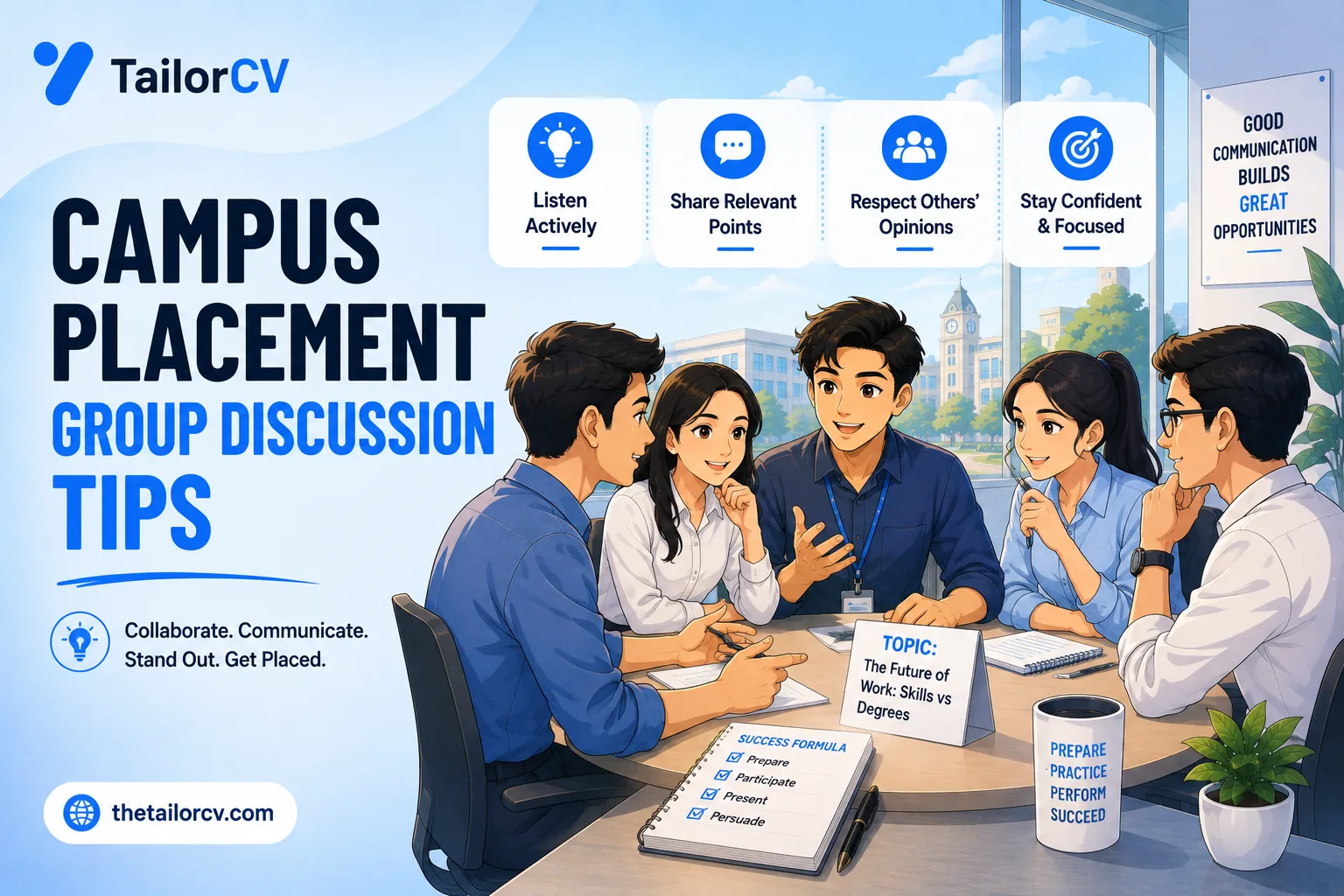
For opinion questions - point, reason, example: state your position, give the reasoning, give a concrete case. This also works directly in group discussions - see campus placement group discussion tips.
For "tell me about yourself" - who, focus, evidence, want: who you are academically, what you have focused on, your strongest evidence, what you are looking for. This is the highest-value answer to prepare - see campus placement HR interview questions.
Having a structure in mind removes the panic that causes rambling. You always know what comes next.
A Three-Month Plan
Speaking is a physical skill. It improves through speaking, not through reading about speaking or watching videos about it. The plan below is uncomfortable and it works.
Month 1: Get used to your own voice
Record yourself daily. Two minutes on any topic, on your phone. Then listen back - which is the part everyone hates and the part that does most of the work. You will immediately hear the filler words, the trailing sentences, and the places you lost the thread.
Read aloud for ten minutes a day. Anything - a newspaper, a textbook, documentation. This builds fluency in producing continuous speech, which is a separate muscle from knowing words.
Explain one technical concept aloud every day, as if to someone who does not know it. Your project, a data structure, how HTTP works. Out loud, standing up, no notes.
Month 2: Add structure and an audience
Answer prepared questions on camera. Take a list of common interview questions and record a structured answer to two each day. Watch them back.
Practise with one other person. Mock interviews with a classmate, alternating roles. Being the interviewer is unexpectedly instructive - you hear what a weak answer sounds like from the other side.
Join or start a group. Weekly group discussions with five or six classmates on random topics. This is the only realistic preparation for GD rounds.
Cut filler words deliberately. Count your "basically", "actually", "like", and "you know" in a recording. Awareness alone reduces them substantially.
Month 3: Pressure and polish
Full mock interviews with someone who will be honest. Ideally a senior who was placed, or a faculty member.
Practise the specific answers you will actually give - your introduction, your project explanation, your strengths and weaknesses, your reason for wanting the company.
Practise being interrupted and redirected, because real interviews do that.
Work on pace. Nervousness speeds people up. Deliberately slowing down improves clarity more than any other single adjustment.
If English Is Not Your Strong Language
This is a real situation for many students and it deserves a straight answer rather than encouragement alone.
Fluency matters less than you fear. Simple, correct sentences delivered clearly beat complex sentences delivered hesitantly. Short sentences are your friend, not a compromise.
Do not translate in your head. It causes the long pauses that read as uncertainty. Practising daily speech gradually removes the translation step, and nothing else does.
Build vocabulary for your own field first. You do not need general fluency - you need to explain your project, your skills, and your experience. That is a few hundred words, and it is learnable in weeks.
Prepare your core answers in writing, then internalise them - not memorised word for word, which sounds recited, but familiar enough that structure and key phrases come automatically.
Do not apologise for your English. It draws attention to it. Speak simply and confidently and most interviewers will not comment.
Accent is not a problem. Being understood is. Speak slightly slower and enunciate rather than trying to change how you sound.
Where It Gets Tested
Group discussions. The most communication-heavy round, and it is scored on contribution quality rather than volume - see campus placement group discussion tips.
HR interviews. Effectively a communication test with content attached - see campus placement HR interview questions.
Technical interviews. Explaining your project and reasoning aloud while solving problems. Interviewers explicitly want you to think out loud - see campus placement technical interview questions.
Service-based company rounds weight this particularly heavily, because many roles are client-facing - see service-based vs product-based companies.
Common Mistakes
Reading about communication instead of speaking. The skill is physical.
Practising only in your head. It is always harder out loud, and the gap is where interviews are lost.
Memorising answers word for word. It sounds recited, and one unexpected follow-up collapses it.
One-word answers. Leaves the interviewer doing your work.
Rambling for four minutes. Loses the listener regardless of content.
Speaking too fast when nervous. The most common and most fixable delivery problem.
Apologising for your English. Draws attention to it.
Trying to sound impressive. Complex vocabulary used uncertainly is worse than simple vocabulary used well.
Starting in the final month. Three months produces visible change; three weeks does not.
Frequently Asked Questions
How important are communication skills in campus placements?
Substantial, and decisive at some companies. Service-based employers with client-facing roles weight it heavily, and HR rounds at every company are partly a communication assessment. Technically strong students lose offers here every season.
Can I improve my communication in three months?
Yes, meaningfully - this is one of the most improvable areas in the whole process. It requires daily out-loud practice rather than passive learning, which is why most students do not improve despite intending to.
Does my accent matter?
Much less than students fear. Interviewers assess whether you are understood, not how you sound. Speaking slightly more slowly and enunciating clearly does more than any attempt to change your accent.
What if I go blank in interviews?
Usually a structure problem rather than a knowledge problem. Having a memorised framework - STAR, or what-why-how - gives you a next step when your mind empties, which is exactly when you need one.
How do I stop rambling?
Decide your ending before you start. Aim for thirty to ninety seconds, use a structure, and stop when you have made the point rather than continuing until someone interrupts.
Should I take a spoken English course?
It can help with confidence and provides a practice group, but only if it involves substantial speaking. A course you attend passively will not move you. Daily recorded practice with a classmate is free and often more effective.
Is it worse to say nothing or to say something imperfect?
Saying nothing is worse, in every round. Silence in a group discussion is usually an automatic elimination, and one-word answers in interviews leave the interviewer with nothing to assess.
Communication only matters once your resume gets you into the room. Check your ATS score free.
Make This Practical
Start recording yourself today - two minutes on any topic, then listen back. It is the part everyone avoids and it does most of the work, because you cannot fix filler words, trailing sentences, or lost threads that you have never heard yourself produce.
Then memorise four structures rather than four answers: STAR for behavioural questions, what-why-how for technical explanations, point-reason-example for opinions, and who-focus-evidence-want for your introduction. Structure is what prevents rambling and what gives you a next step when you go blank.
Finally, build in an audience over the following two months. Weekly group discussions with five or six classmates, mock interviews where you alternate roles, and full mocks with a senior who will be honest with you in the final month. Prepare the specific answers you will actually give, deliberately slow your pace, and confirm the resume behind it all is clearing screening with how to get shortlisted for campus placement and the free ATS score checker.
Was this guide useful?
Be the first to rate it.