 SS
SS
Key Takeaways
- Most etiquette rules reduce to one thing: demonstrating that you are reliable and considerate of others' position.
- Keigo — business Japanese — matters more than general fluency in how you are perceived.
- Punctuality means early, and lateness carries more weight than in most Western workplaces.
- Reporting proactively (horenso) is the workplace habit foreign professionals most often underestimate.
- Nobody expects perfection from a foreigner, but visible effort is noticed and rewarded.
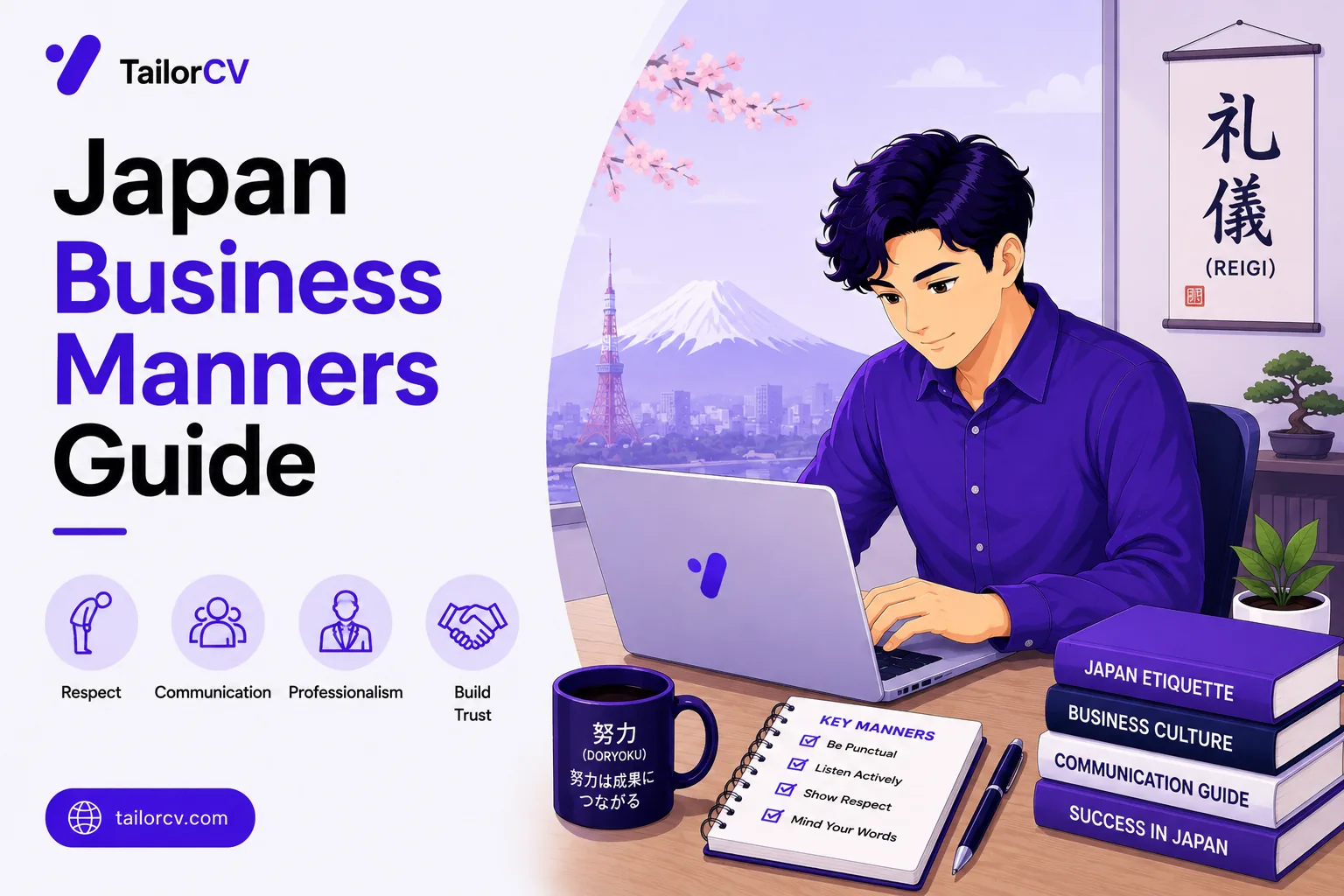
Japanese business etiquette has a reputation for being an elaborate system of rituals that foreigners inevitably violate. The reality is more forgiving and more practical: most of the conventions exist to signal reliability and to avoid putting other people in an awkward position, and once you understand that, the specific rules make sense rather than requiring memorisation.
Nobody expects a foreign professional to be flawless. Visible effort counts for a great deal.
This guide covers what genuinely matters day to day.
If you are still applying, check your documents work — the free ATS score checker.
Horenso — the habit that matters most
報連相 — hokoku (report), renraku (inform), sodan (consult). The single most important workplace convention and the one foreign professionals most often underestimate.
What it means in practice: you report progress proactively, you keep relevant people informed before they have to ask, and you consult before making decisions that affect others.
Why it matters here more than elsewhere: Japanese workplaces run on shared awareness. A manager who is surprised by something you were working on has been failed, even if the outcome was fine.
What foreign professionals get wrong: working independently and presenting finished results. In many Western workplaces that reads as autonomy. Here it frequently reads as having excluded people who should have been informed.
Practical version: update more often than feels necessary, flag problems early rather than solving them silently, and check before deciding anything with wider impact. This single habit affects how competent you are perceived to be more than your actual output does.
The same week, handled two ways
The gap is easiest to see in a concrete situation. You are three days into a five-day task and you discover the API you were told to use is deprecated.
| The instinct from a Western workplace | What horenso expects | |
|---|---|---|
| Day 3, on discovering it | Investigate quietly, find an alternative | Message your manager the same day: "The API is deprecated. I'm looking at two options and will confirm tomorrow" |
| Day 4, choosing an approach | Pick the better option and proceed | Confirm the choice briefly before building: "I'm going with B unless you see a problem" |
| Day 5, delivering | Present the finished work and the solved problem | Deliver, and note what changed and why |
| How it lands | "Why am I only hearing about this now?" | "Good — thanks for flagging it early" |
The left column produces a better story and a worse outcome. The work is identical. What differs is that in the right column nobody was surprised, and the manager had the chance to redirect on day three if they wanted to.
The rule of thumb: if someone would be uncomfortable learning about it later than they could have, tell them now. Over-reporting is barely noticed; under-reporting is the thing that gets remembered.
Keigo
Business Japanese — the honorific and humble forms — is a separate skill from conversational fluency, and it is not tested by the JLPT.
Why it matters: using casual forms with a client or a senior colleague is noticeable in a way that a grammatical error is not. It reads as carelessness rather than as a language gap.
The realistic approach for a foreign professional:
- Learn the standard set phrases for meetings, emails and phone calls. A relatively small number cover most situations.
- Default to polite forms (です/ます) universally until you know the workplace. Over-politeness is a much smaller error than under-politeness.
- Ask a colleague to check important emails early on. Most people are happy to.
Nobody expects native-level keigo from a foreigner, but visible effort is noticed and appreciated. See the JLPT for jobs guide.
The phrases that cover most of your week
Learn these as fixed blocks rather than deriving them. They handle the large majority of routine workplace exchanges.
| Situation | Phrase | Rough meaning |
|---|---|---|
| Opening an email to a colleague | お疲れ様です | Standard workplace greeting, no direct equivalent |
| Opening an email to a client | いつもお世話になっております | "Thank you for your continued support" |
| Closing an email | よろしくお願いいたします | Covers "thanks in advance", "regards", and more |
| Accepting a task | 承知いたしました | "Understood" — humble, correct to a superior |
| Arriving late or interrupting | 失礼いたします | "Excuse me" |
| Apologising properly | 申し訳ございません | Stronger and more formal than すみません |
| Leaving before others | お先に失礼します | "Excuse me for leaving first" |
| Someone else leaving | お疲れ様でした | Said to them as they go |
| Asking for something | 恐れ入りますが… | "I'm sorry to trouble you, but…" |
| Thanking for help received | ありがとうございました | Past form — for something already done |
Two notes that catch people out. 了解しました is common among peers but too casual to a superior — use 承知いたしました. And すみません is fine for small things but not for an actual mistake, where 申し訳ございません is expected.
Save the email phrases as a template on day one. Everyone does this, including Japanese colleagues, and reusing set constructions is correct rather than lazy.
Meetings and punctuality
Early is on time. Arriving five to ten minutes before a meeting is standard. Arriving exactly on time is arriving late by local convention, and actual lateness carries more weight than in most Western workplaces.
Seating follows seniority in formal settings — the seat furthest from the door is generally the most senior position. You will not be expected to know this perfectly, but following others' lead rather than sitting first is a safe habit.
Meetings frequently confirm decisions rather than making them. Much of the actual deciding happens beforehand in informal consultation — nemawashi. If you want a proposal accepted, discussing it with key people before the meeting is far more effective than arguing well during it.
Silence is not disagreement. Space in conversation is normal, and filling every pause is a common foreign habit that reads as impatience.
Nemawashi, concretely
The word means "digging around the roots" — preparing ground before transplanting a tree. In practice it means securing agreement one conversation at a time, before the meeting where the decision is formally made.
How to actually do it, for a proposal you want approved:
- Talk to your direct manager first, informally. Not a presentation — "I've been thinking about X, does that seem worth pursuing?"
- Then the people it affects most, individually. Ask what problems they see. Their objections raised privately are fixable; raised in the meeting they are a public disagreement.
- Adjust the proposal to address what they said, and tell them you did. This is the step that converts them from neutral to supportive.
- Then circulate anything written, ahead of the meeting rather than in it.
- The meeting confirms what is already broadly agreed.
Why arguing well in the meeting fails. Proposing something new in the room puts everyone present in the position of reacting publicly without preparation, which is precisely the discomfort the whole convention exists to avoid. A well-argued surprise proposal frequently gets a polite non-answer and quietly dies.
This is the single most useful thing to understand about getting anything done in a Japanese organisation, and it is invisible from the outside — from a foreign professional's perspective, decisions appear to happen in meetings, because that is where they are announced.
Business cards
Less ceremonial than it is often described, but the basics matter.
Present and receive with both hands, with the card facing the recipient.
Read it before putting it away. Glancing at the card is the point — it acknowledges the person.
Do not write on it or stuff it in a pocket in front of them. Place received cards on the table during the meeting, in front of you.
Have your own, in Japanese on one side if possible.
This matters most in client meetings and first introductions rather than internally.
Email and communication
More formal than most Western business email. Set phrases open and close messages, and skipping them reads as brusque.
Keep a template. Save the standard opening and closing constructions and reuse them — this is entirely normal and everyone does it.
Copy people appropriately. Under-copying is a horenso failure; over-copying is rarely criticised.
Respond promptly, even if only to acknowledge receipt and give a timeline.
What matters less than expected
Perfect bowing. A slight nod is fine for a foreign professional in most situations. Nobody is scoring the angle.
Drinking. After-work socialising remains common but attendance expectations have relaxed considerably, and declining alcohol is unremarkable now.
Extreme formality with close colleagues. Workplaces vary, and many modern companies are considerably more casual internally than the stereotype.
Being flawless. Effort and consideration matter far more than precision. Colleagues generally appreciate a foreign professional trying rather than expecting them to have mastered it.
Common Mistakes
Working independently and presenting finished results. It reads as excluding people who should have been informed, not as autonomy — horenso is the habit that most shapes how you are perceived.
Solving problems silently. Flagging early is expected; discovering a problem after it was resolved still counts as having been kept in the dark.
Using casual Japanese with seniors or clients. It reads as carelessness rather than as a language gap, which is why keigo matters more than general fluency.
Using 了解しました to a superior. Fine among peers, too casual upward — 承知いたしました is the correct form.
Arriving exactly on time. Five to ten minutes early is the convention, and arriving on the hour is effectively late.
Trying to win a decision during the meeting. Much of the deciding happens beforehand, and a surprise proposal puts everyone present in an uncomfortable position.
Skipping nemawashi because it feels like politicking. It is how objections get raised privately where they can be fixed rather than publicly where they cannot.
Filling every silence. Pauses are normal and rushing to fill them reads as impatience.
Pocketing a business card without reading it. Glancing at it is the whole point of the exchange.
Assuming you must be perfect. Visible effort counts for far more than precision, and colleagues generally respond well to a foreigner clearly trying.
Frequently Asked Questions
What is horenso?
Report, inform, consult — the convention of proactively updating colleagues, flagging issues early and consulting before decisions with wider impact. It is the workplace habit foreign professionals most often underestimate.
How much should I report?
More often than feels necessary. If someone would be uncomfortable hearing about it later than they could have, tell them now — over-reporting is barely noticed and under-reporting is remembered.
Do I need perfect keigo?
No. Learn the standard set phrases, default to polite forms, and ask a colleague to check important emails early on. Visible effort is appreciated.
Which phrases should I learn first?
お疲れ様です, いつもお世話になっております, よろしくお願いいたします, 承知いたしました and 申し訳ございません cover most of a normal working week.
How early should I arrive?
Five to ten minutes before a meeting. Arriving exactly on time is effectively arriving late by local convention.
What is nemawashi and how do I do it?
Securing agreement through individual conversations before the meeting. Speak to your manager, then to those affected, adjust the proposal based on what they say, circulate it in advance, and let the meeting confirm it.
Why did my well-argued proposal get a polite non-answer?
Almost certainly because it was raised for the first time in the meeting. New proposals in the room force people to react publicly without preparation, which is what nemawashi exists to prevent.
Do I have to attend after-work drinking?
Expectations have relaxed considerably. Attending occasionally builds relationships, but declining is unremarkable now and declining alcohol while attending is entirely normal.
Will colleagues be offended if I get things wrong?
Rarely. Nobody expects a foreign professional to be flawless, and effort is generally met with patience and appreciation.
Check your application documents. Check your ATS score free.
Make This Practical
Adopt horenso from your first week by applying one test: if someone would be uncomfortable learning about this later than they could have, tell them now. Flag the deprecated API on day three rather than presenting the solved problem on day five — the work is identical and only one version leaves your manager unsurprised.
Then save the ten set phrases as an email template on day one. お疲れ様です, いつもお世話になっております, よろしくお願いいたします and 承知いたしました cover most of a working week, and reusing fixed constructions is what Japanese colleagues do too.
Finally, learn nemawashi and use it before anything you actually want approved. Talk to your manager informally, then to the people affected individually, adjust for what they tell you, and circulate the proposal in advance — because a well-argued surprise in the meeting room usually gets a polite non-answer and quietly dies.
What is your resume scoring right now?
Scan it against a job description and get your ATS match score in about a minute.
Drop your resume here or choose a file
PDF only. Max 2 MB.
We never share your data or use it to train AI models.

Was this guide useful?
Be the first to rate it.