 SS
SS
Key Takeaways
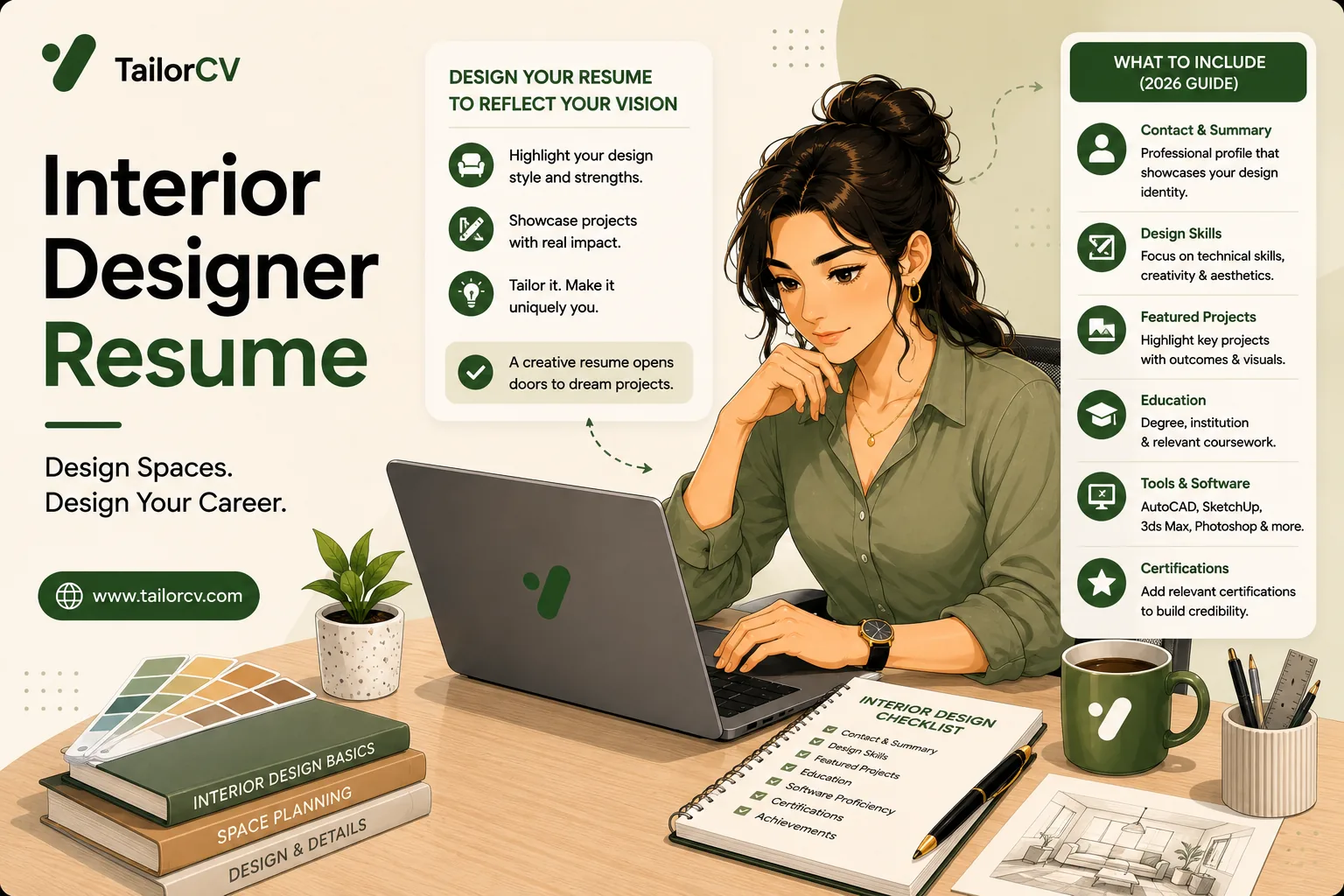
- Designers instinctively want to design their resume, and that instinct is exactly what breaks it.
- Name your tools clearly - AutoCAD, SketchUp, Revit, 3ds Max, V-Ray, Enscape, Adobe CC - along with your specialty.
- Interior design is judged by what you have delivered, so quantify scope and outcomes.
- Design roles hinge on visual proof, so link a polished portfolio prominently at the top.
- Save the visual flair for the portfolio; a heavily designed resume can break the ATS.
Interior design hiring weighs both aesthetic sensibility and the ability to deliver projects on budget. Your resume proves you can execute; your portfolio proves you have the eye. You need both working together — and because design firms and studios increasingly screen with an ATS, your keywords have to match the job description before a design lead ever sees your work.
Before applying, run your draft through the free ATS score checker, start from an ATS-friendly template, and read the ATS score guide. If you work in a related design field, the architect resume guide and UX designer resume guide follow the same principles.
The designer's resume paradox
Designers instinctively want to design their resume — and that instinct is exactly what breaks it. Two-column layouts, decorative fonts, and embedded graphics confuse the ATS, which reads text linearly and skips anything trapped in an image or table. The winning move is to keep the resume itself clean and text-based, and pour every ounce of visual talent into a separate portfolio website. Save the artistry for the place it's actually judged, and let the resume do the boring, essential job of getting you past the software.
Lead with software and specialties
Name your tools clearly — AutoCAD, SketchUp, Revit, 3ds Max, V-Ray, Enscape, and the Adobe Creative Suite — and your focus, whether that's residential, commercial, hospitality, or retail. These are the exact keywords firms screen for, so mirror the job description wherever it's genuinely true for you. A generalist "interior designer" reads weaker than a specialist who matches the posting's language.
A tight summary frames your value in three lines:
"Interior designer with 6 years in residential and boutique hospitality projects. Delivered 20+ full fit-outs from concept to installation, managing FF&E procurement and $500K budgets. Expert in SketchUp, AutoCAD, and Adobe Creative Suite."
See resume objective vs summary for the opening lines, and lead with a clear target so the ATS and the design lead both register the fit instantly.
Show projects with scope and outcomes
Interior design is judged by what you've delivered, so quantify it. Use the bullet point formula — a strong action verb, the work, and a measurable result:
- "Designed 20+ residential interiors from concept to installation."
- "Managed FF&E procurement on a $500K commercial fit-out, delivered on budget."
- "Delivered projects on schedule across a 12-project pipeline."
- "Presented mood boards and 3D renders that closed 8 of 10 client pitches."
Numbers make the depth obvious — the quantify achievements guide shows how to add them without overstating. Vague, task-only bullets are one of the most common reasons a talented designer's resume gets no responses.
Pair the resume with a portfolio
Design roles hinge on visual proof, so link a polished portfolio website prominently at the top of your resume. Read how to write a portfolio case study and portfolio examples that landed interviews to present your projects with context, not just pretty pictures. Understanding portfolio vs resume helps you decide what belongs where — the resume tells, the portfolio shows.
Structure an interior designer resume
- Header — name, title, phone, email, and portfolio link.
- Summary — three lines, software- and specialty-forward.
- Software & skills — CAD, rendering, FF&E, space planning.
- Experience — firm, role, quantified project bullets.
- Education & certifications — degree, NCIDQ if applicable.
This mirrors the layout in the resume builder, which handles the formatting for you. For ordering, see the resume section order guide, and format credentials with how to list certifications on a resume.
Keep the resume itself ATS-safe
Save the visual flair for the portfolio — a heavily designed resume can break the ATS. Use a simple template, a readable font, and standard headings, and keep it to the right length. Avoid tables and graphics for key content, per how to make your resume ATS-friendly and ATS formatting mistakes. Then confirm it parses with the ATS score checker, and if the score is low, why is my ATS score low explains the usual culprits.
Early-career or self-taught?
If you're a recent graduate or transitioning into interior design, lead with your degree, studio projects, internships, and software proficiency — the resume with no experience guide and projects in resume guide show how to present academic and personal work as real experience. A strong portfolio does a lot of the heavy lifting at this stage, and portfolio with no experience helps you build one even before your first job.
Where interior designers find roles
Interior design roles span studios, architecture firms, retail and hospitality brands, real-estate developers, and freelance work, so search broadly. Beyond job boards, designers find work through industry networks, design-focused recruitment agencies, showroom and vendor relationships, and direct outreach — a thoughtful cold email with a link to your portfolio can open a door before a role is posted. The best job search websites guide covers where to look, and networking is powerful in a relationship-driven field. Keep your resume current and ATS-ready so you can apply the moment the right role appears.
Tailor to each firm
A high-end residential studio, a corporate workplace-design firm, and a hospitality group all want different emphases. Tailor each application with the resume optimizer so your keywords match the exact role, and see how much to change your resume for every job.
Your resume after optimization
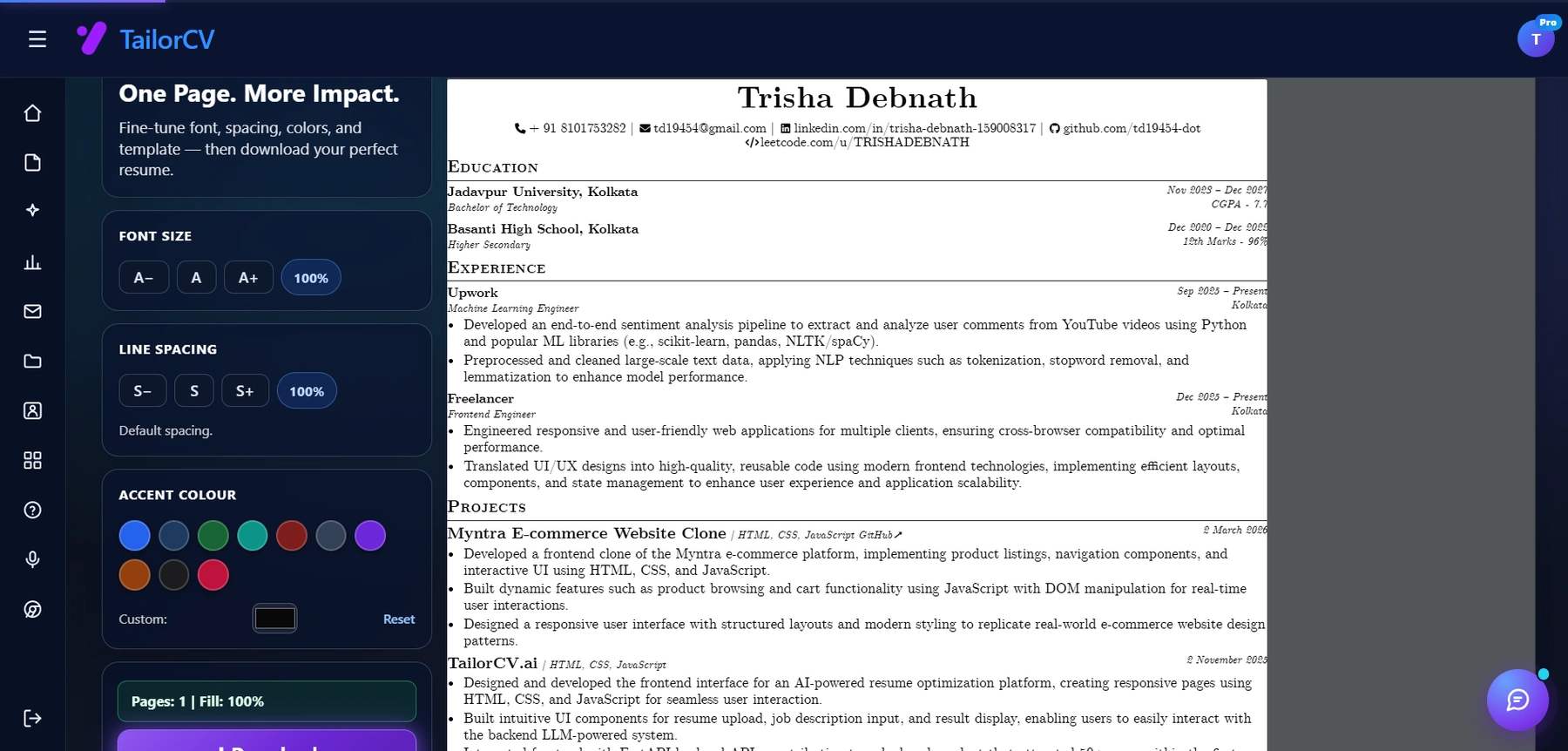
Font size, spacing, accent colour and template are all adjustable, with a live page counter.
Prepare for the interview and portfolio review
Design interviews almost always include a portfolio walkthrough, so be ready to explain your process and decisions, not just show the results. Prepare stories with a STAR story bank, practice with a free AI mock interview, and use the interview prep tool. Afterward, send a thank-you email and follow up. Generate a tailored cover letter if the role asks for one.
Sample interior designer resume bullets
Strong bullets pair a action verb with scope and a quantified result:
- "Designed 20+ residential interiors from concept to installation, managing client presentations and FF&E."
- "Delivered a $500K commercial fit-out on budget and two weeks ahead of schedule."
- "Grew repeat-client business 30% through a polished presentation and delivery process."
- "Sourced and specified furnishings across a 12-project pipeline with zero procurement delays."
Each shows delivery, not just aesthetics — the difference explained in how to write resume bullet points. Run yours through the resume optimizer to confirm they carry the keywords firms want.
Interior designer resume summary examples
Match your summary to your level:
- Junior: "Interior designer with 2 years in residential projects, proficient in SketchUp and AutoCAD, skilled in space planning and FF&E."
- Mid-level: "Interior designer with 6 years in residential and boutique hospitality, delivering 20+ full fit-outs and managing $500K budgets."
- Senior: "Senior interior designer with 10 years leading commercial and hospitality projects end to end, mentoring junior designers and owning client relationships."
Interior designer resume FAQ
Should the resume be visually designed? No — keep it ATS-safe and put visuals in your portfolio.
Do I need NCIDQ? It helps for commercial roles; list it if you have it, per how to list certifications on a resume.
I'm switching into interior design — what do I lead with? Transferable skills and self-directed projects, per the career change resume guide and projects in resume.
How do I negotiate the offer? Research market pay and use how to negotiate a salary offer.
Final checklist
Your interior designer resume is ready when it:
- unchecked: Leads with software and specialty keywords.
- unchecked: Shows projects with scope, budget, and quantified outcomes.
- unchecked: Links a polished portfolio website.
- unchecked: Stays clean, ATS-safe, and passes the ATS score checker.
Keep the resume clean, let the portfolio shine, and tailor every application. Start in the resume builder and score it with the free ATS checker.
What is your resume scoring right now?
Scan it against a job description and get your ATS match score in about a minute.
Drop your resume here or choose a file
PDF only. Max 2 MB.
We never share your data or use it to train AI models.

Templates that keep this structure intact
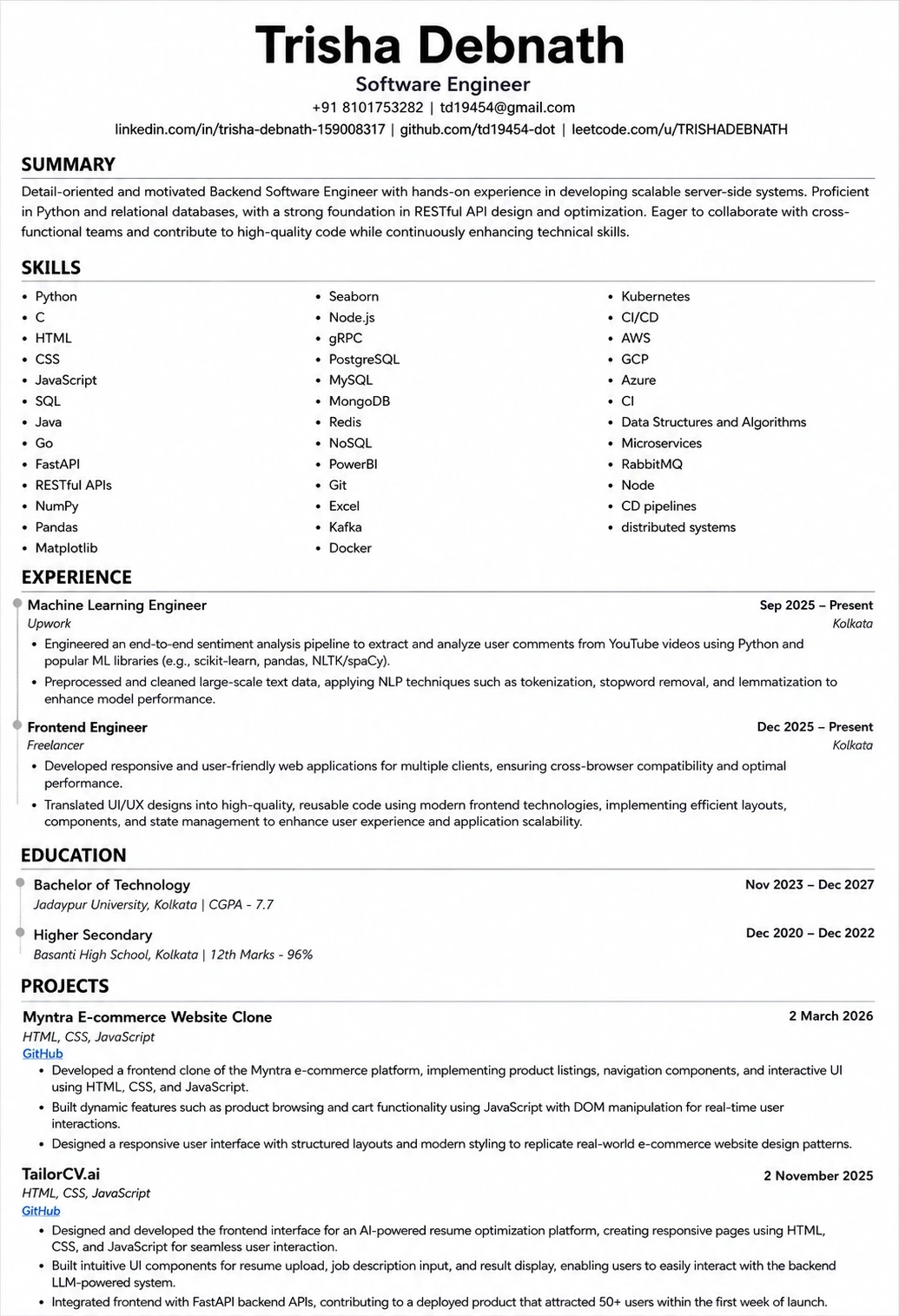
This template is ATS-tested — start from it and the formatting rules in this guide are already handled.
Was this guide useful?
Be the first to rate it.