TD
TD

Key Takeaways
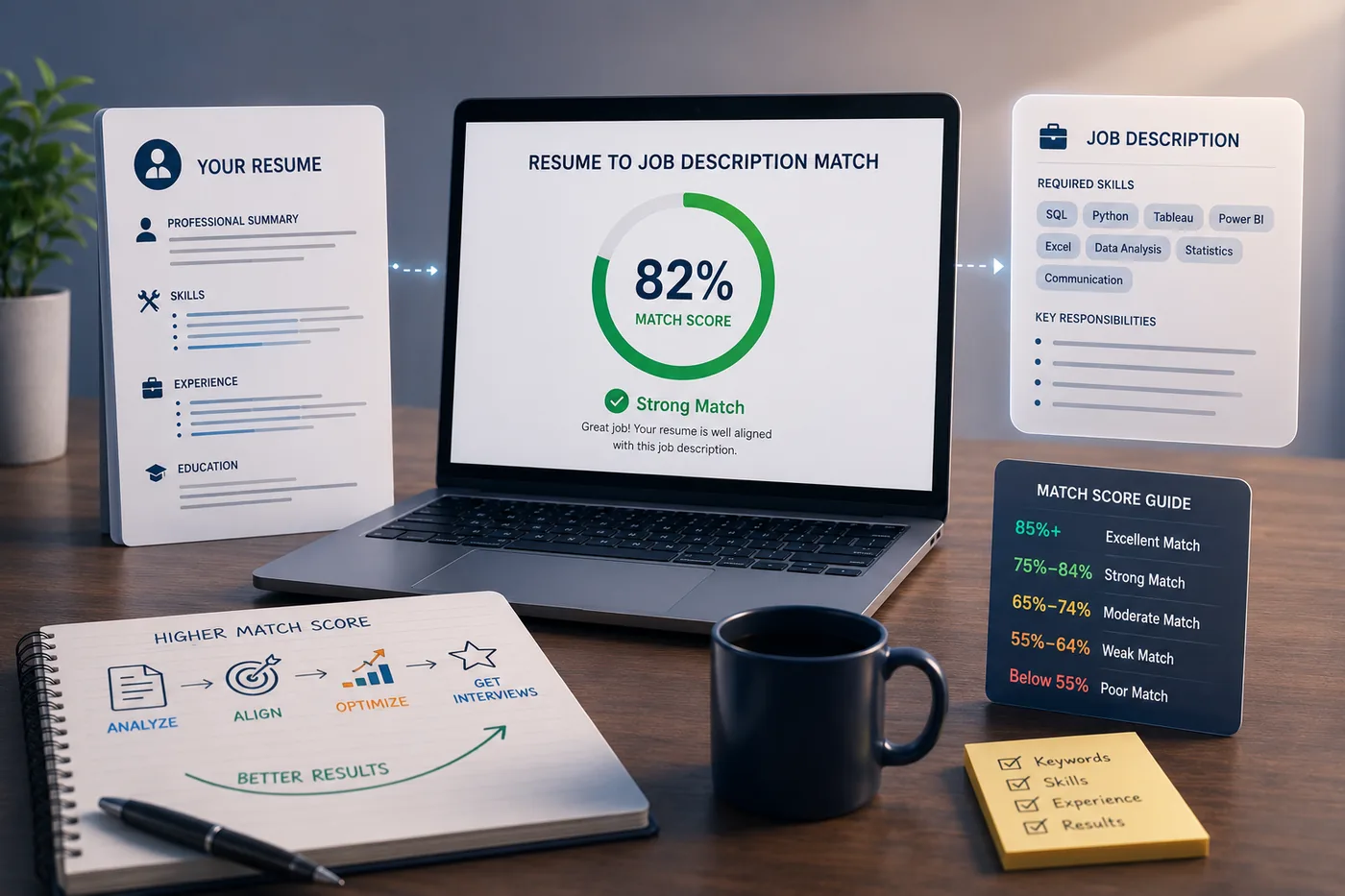
- A resume matcher tool evaluates how well your resume aligns with a job description by comparing hard skills, responsibilities, seniority signals, language, and qualifications.
- The match score reflects the overlap of required terms, semantic closeness in phrasing, experience-level alignment, and the depth of keyword presence in your resume.
- High match scores do not guarantee job suitability; they serve as a signal to refine your resume rather than a definitive measure of employability.
- A thorough reading of the job description is crucial for effective use of the matcher, focusing on required versus preferred qualifications and repeated terms.
A resume matcher tool takes your resume and a specific job posting and tells you, in concrete terms, how close a match you are on paper. That is a different exercise from reading the posting yourself and guessing what stands out - the tool runs the same comparison an ATS or recruiter would, without the fatigue of reading the two hundredth resume of the day. If you have not seen the underlying framework, start with Resume Matching With Job Description, then come back here to learn how to actually run and read a match report.
This post is about the tool itself: what it measures, how to work with its output, and how to avoid the two most common mistakes people make with it - treating a high score as a guarantee, and stuffing in keywords they cannot back up in an interview.
What a Resume Matcher Tool Actually Compares
At a basic level, a resume matcher takes two documents - your resume and a job description - and evaluates how well one maps onto the other. It is not just a word-count exercise. A useful matcher looks at several layers at once:
| Tool | What it does |
|---|---|
| Hard skills and tools | the specific technologies, platforms, certifications, or methods named in the posting |
| Responsibilities | what the role actually asks you to do day to day, not just what you know |
| Seniority signals | whether your bullets read like someone who owned a function versus someone who supported one |
| Language and phrasing | whether you describe your work the way the employer describes the role, even if the exact words differ |
| Must-have versus nice-to-have qualifications | the posting usually separates these, and a good matcher weighs them differently |
The output is usually a score plus a breakdown: what matched, what is missing, and what is present but weakly stated. Run yours through the free ATS score checker to see this in practice before you keep reading.
What the Match Score Is Actually Measuring
It helps to understand, at a conceptual level, what is happening behind that single number. You do not need to know the exact scoring formula to use the tool well - but you should know roughly what inputs feed it, so you stop treating the score like a black box.
Most matchers are combining a few signals into one figure:
- Overlap of required terms. Does the resume contain the skills, tools, and qualifications the job description names as essential? This is the most heavily weighted layer, because missing a hard requirement is the single fastest way to get filtered out.
- Phrasing and semantic closeness. A resume that says "led cross-functional stakeholder meetings" is close enough to "stakeholder communication" even without an exact match. Tools that only do literal keyword matching miss this; better ones account for synonyms and related phrasing.
- Experience-level alignment. A posting for a senior role expects verbs and scope that read as senior - ownership, strategy, mentoring - not task execution. A resume can contain every keyword and still score lower here if the tone reads junior.
- Presence versus depth. Having a keyword once, buried in a skills list, is treated differently than having it appear with context and a result in your experience section.
None of this is magic, and no tool can literally read your mind about what you are capable of. It is comparing text patterns against the posting's text patterns. That is exactly why the score is a signal to act on, not a certificate of employability - more on that below. For a deeper walkthrough of the mechanics, see How AI Resume Matching Works.
Why the Job Description Still Does Most of the Work
The matcher can only compare your resume against what is actually written in the posting, so a sloppy read of the job description produces a sloppy match, no matter how good the tool is. Before you run anything, read the posting the way the tool will: line by line, not skimmed.
- Note which qualifications are labeled "required" versus "preferred" - see Matching Resume to Required vs Preferred Qualifications for how to prioritize between the two.
- Pull out repeated terms - if a tool or concept shows up three times in one posting, it is not filler.
- Watch for qualifications that are implied rather than stated outright. See Hidden Keywords in a Job Description for how to catch those.
- Use a structured pass rather than a skim - the Job Description Analysis Checklist walks through this step by step.
If you would rather build a running list as you go, the Resume Keyword Map Template gives you a simple structure to capture required terms before you ever open the matcher tool.
Running the Match: A Step-by-Step Walkthrough
Once you have a resume draft and a job posting, the actual process is short:
- Paste the exact job description text into the tool - do not paraphrase or shorten it, since the tool is comparing against the employer's actual wording.
- Upload your current resume, ideally the version you are about to submit, not an old master copy.
- Review the missing and weak keyword list the tool returns.
- Sort that list into two piles: skills you genuinely have but did not mention, and skills you do not have at all.
- Add the truthful, missing keywords into your skills section, summary, and experience bullets.
- Rewrite any bullet that is technically accurate but reads generic, so it reflects the target role's language.
- Re-run the match and confirm the score moved before you submit.
If you are applying to several roles in a single sitting and need a faster version of this loop, see How to Match Your Resume to a Job Description Fast. If you want the manual, tool-free version of the same logic, How to Match Resume Keywords to a Job Description breaks it down without relying on software at all.
A Worked Example: From Job Posting to Match Report
Here is a simplified version of what this looks like in practice. Say the posting includes:
Looking for a Data Analyst with strong SQL skills, experience building dashboards in Tableau or Power BI, comfort presenting findings to non-technical stakeholders, and ownership of monthly KPI reporting.
And the resume currently has:
- Analyzed data and created reports for the marketing team
- Worked with Excel and internal tools to track performance
- Assisted with monthly business reviews
A matcher comparing these two would likely flag something close to this:
Match Score: 46/100 Matched: data analysis, reporting, monthly cadence Missing: SQL, Tableau, Power BI, stakeholder communication, KPI reporting Weak: "assisted with" reads as support-level, not ownership; posting implies you should be running the reviews, not helping with them
Nothing here is unfair. The candidate might genuinely know SQL and have presented to executives, but none of that is on the page, so the tool cannot credit it. Once the missing pieces are added honestly - "Queried and cleaned marketing datasets in SQL," "Built and maintained a weekly KPI dashboard in Power BI," "Presented monthly performance findings directly to department leads" - the same resume would score meaningfully higher, because the language now mirrors what the posting is actually asking for.
How to Read the Score Without Overreacting to It
A match score is a signal to act on, not a guarantee of anything. Treat it the way you would treat a spell-checker: useful, worth listening to, but not the final word on whether the writing is good.
- A high score tells you the resume is speaking the employer's language. It does not confirm your actual experience is strong enough for the role.
- A low score does not mean you are unqualified. It often means the resume is not yet describing the qualifications you do have in the posting's terms.
- Two candidates can have the same score and very different odds - one because the substance behind the keywords is real and specific, the other because the keywords were added without depth.
- The score is relative to one posting. A resume tuned for one role can score very differently against another, even a similar-sounding one.
If you want to see how match quality tends to relate to actual response rates, the Resume Match Score and Callback Rate Study is worth reading - it is a useful reminder that the score correlates with outcomes, it does not cause them on its own.
The Iterative Workflow: Run, Fix, Re-Run
The biggest mistake people make with a matcher tool is treating it as a one-shot pass or fail check. It is not a gate you clear once. It is a feedback loop you run until the resume is actually good, not just until it passes a threshold.
A realistic workflow looks like this:
- Run the match on your current resume against the target posting.
- Note the two or three biggest gaps - usually a missing hard skill, weak seniority language, or absent domain terms.
- Edit only those sections. Do not rewrite the whole resume in one pass.
- Re-run the match.
- Repeat until the remaining gaps are things you genuinely cannot claim - at that point, stop editing and decide whether the role is a real fit.
This loop usually takes two or three passes, not one. If the score barely moves between passes, that is itself useful information - it usually means the gap is structural rather than a wording issue, which is covered in the troubleshooting section below.
Closing Gaps Honestly vs Padding Keywords
There are two very different ways to respond to a missing-keyword list, and only one of them works past the resume stage.
Reframing real experience (honest, and effective). You did the work, but described it vaguely. "Helped with reports" becomes "Built weekly SQL-driven reports used by the sales team to track pipeline." Nothing here is invented - it is the same work, described precisely, using the employer's vocabulary.
Claiming skills you do not have (dishonest, and it backfires). Adding "Python" or "stakeholder management" to your skills list because the posting mentioned it, with no experience behind it, might bump your score. It will not survive a follow-up question in an interview, a technical screen, or your first week on the job. Recruiters and hiring managers routinely ask candidates to walk through the exact bullet that raised a flag - if there is nothing real underneath it, that conversation goes badly fast, and it damages trust for the rest of the interview.
The rule of thumb: if a keyword shows up in your resume, you should be able to describe a specific example of using it, unprompted, in under thirty seconds. If you cannot, either gain the experience first or leave the keyword out and let the honest gaps show. A resume that is 80% honestly matched beats one that is 100% matched on paper and falls apart under questioning. If you want to sharpen how you'll defend these bullets out loud, the AI mock interview tool is a good place to rehearse before the real thing.
Soft Skills and Qualification Tiers Matter Too
Matchers are often thought of as purely a hard-skills exercise, but most postings also embed soft skills and communication expectations that carry real weight in the score - "cross-functional," "stakeholder-facing," "fast-paced environment," "mentoring junior staff." These are not filler phrases; they describe how the role actually operates.
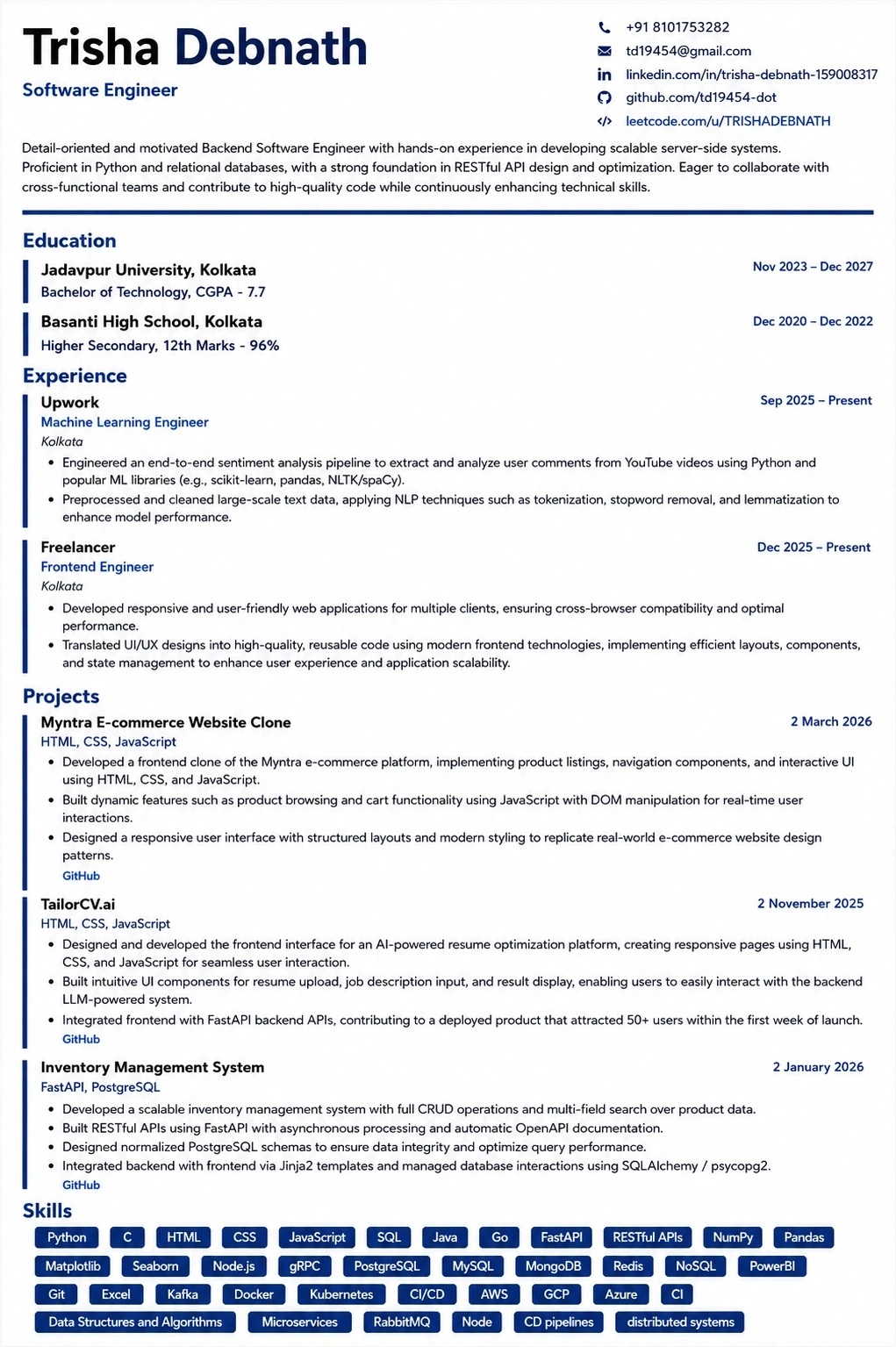
Your resume after optimization
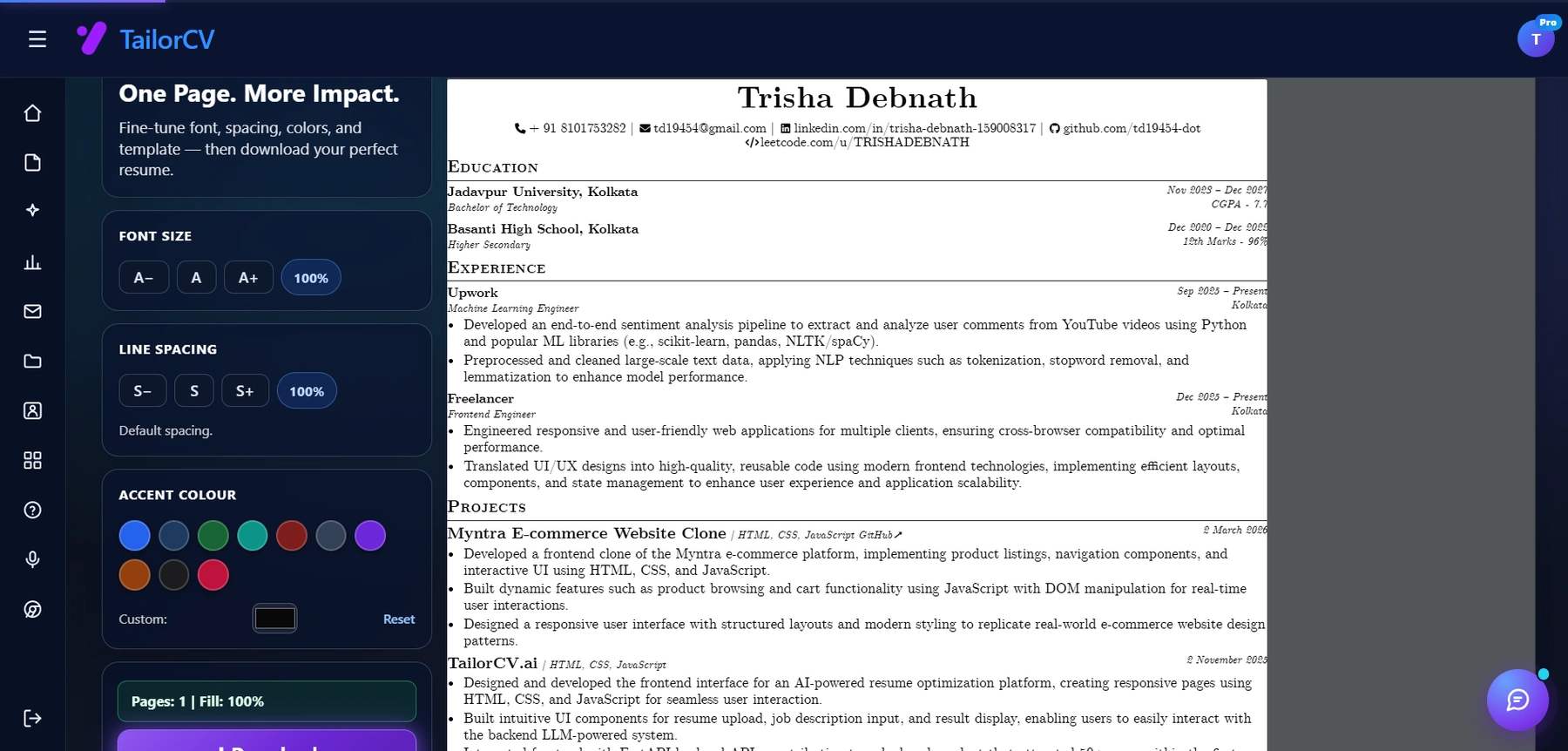
This is the resume after tailoring - the content is already matched, and these controls are how you fit it onto one page.
See Matching Your Resume to Soft Skills in a Job Description for how to surface these without resorting to vague adjectives like "excellent communicator" that carry no evidence.
It also matters where a qualification sits in the posting's hierarchy. Required qualifications should be treated as close to non-negotiable in your resume; preferred qualifications are worth including if you have them but should not be why you disqualify yourself from applying. Matching Resume to Required vs Preferred Qualifications covers how to weigh the two differently when you are deciding what to prioritize editing first.
Where to Physically Add the Missing Keywords
Once you know what is missing, placement matters almost as much as inclusion. There are three places a keyword can live, and they are not interchangeable:
- Skills section - good for scannable tools and technologies. See Skills to Add to Your Resume for how to keep this list relevant instead of bloated.
- Summary - useful for positioning yourself for the role in the first few lines, especially when you are pivoting slightly from your last title.
- Experience bullets - this is where the keyword actually gets proven. A keyword sitting in a bullet next to a measurable result is worth far more, to both the tool and a human reader, than the same word sitting in a list.
If you are only editing one section, edit the experience bullets first. A resume with a thin skills list but strong, specific bullets will usually out-score - and outperform in interviews - a resume with an exhaustive skills list and vague bullets.
Troubleshooting a Persistently Low Match Score
If you have gone through two or three rounds of editing and the score is still low, the issue is usually one of three things, and it is worth diagnosing which one before you keep tweaking wording.
- You are matching the wrong resume against the role entirely. If your background is in a genuinely different function, no amount of rewording closes that gap honestly. This shows up as a low score across almost every category, not just one or two missing terms.
- You are missing a specific hard requirement. Sometimes one non-negotiable qualification - a certification, a specific language, a security clearance - is dragging the whole score down even though everything else matches well. Isolate whether the missing items are concentrated in one category or spread evenly across the report.
- The formatting is hiding real content from the parser. Tables, text boxes, columns, and graphics can prevent a parser from reading content that is actually on the page, which makes the resume score lower than the underlying experience deserves. Check this against ATS Resume Formatting Mistakes and ATS Resume Parser-Friendly Format, or run a quick check with Does My Resume Pass ATS?
A quick way to tell which of these you are dealing with: strip your resume down to plain text and re-read it. If the content looks thin even in plain text, it is a substance gap. If it looks complete in plain text but scored low as a formatted document, it is a parsing problem, not a writing problem.
Make This Practical
Do not guess whether a resume is ready - upload it to the free ATS score checker and read the breakdown rather than just the headline number. Compare what you see against the ATS Score Guide so you know what a good result actually looks like for your situation.
Once the technical formatting is clean, shift to relevance. Revisit Resume Matching With Job Description, strengthen coverage with the Resume Keywords Guide, and avoid overcorrecting into keyword stuffing with ATS Keyword Mistakes. If the underlying layout is holding you back regardless of content, rebuild on an ATS-friendly resume template rather than continuing to patch a weak structure.
Career-specific detail also matters: developers should benchmark against Resume Matching for Software Engineers, analysts against Resume Matching for Data Analysts, and anyone changing fields should read Resume Matching for Career Changers to see how to translate older experience into new-role language. Once the resume itself is in good shape, pair it with a tailored AI-generated cover letter so the two documents reinforce the same story.
FAQ
What match score should I aim for?
There is no single universal number, but a strong resume usually covers most required skills and the core responsibilities, not just a handful of scattered keywords. Read What Is a Good ATS Score? for a fuller breakdown of what "good" means in context.
Should I try to match every keyword in the posting?
No. Match the important keywords you genuinely have, and skip the rest rather than forcing them in. Adding irrelevant or false skills usually lowers your credibility even if it raises the raw score slightly.
How many times should I run the matcher before submitting?
Two or three passes is typical - run it, fix the clearest gaps, re-run, and stop once the remaining gaps are things you honestly cannot claim. Running it more than that on the same draft usually means you are polishing wording rather than fixing substance.
Does a resume matcher replace reading the job description myself?
No. The tool compares text, but you still need to read the posting closely to understand tone, priorities, and anything implied rather than stated outright. See the Job Description Analysis Checklist for a structured way to do that read.
Can a resume matcher help with career changes?
Yes, often more than for a straightforward same-field application, because career changers need to translate old experience into new-role language rather than simply listing what they already know how to say. Resume Matching for Career Changers covers this in depth.
What if my score is high but I am still not getting interviews?
A high match score means the resume reads as relevant on paper - it does not account for application volume, timing, referrals, or how the rest of your application materials perform. Check your cover letter and consider whether the roles you are targeting are realistic for your current experience level.
Is it bad to tailor my resume differently for every job?
No - that is the point of using a matcher tool at all. See How Much to Change Your Resume for Every Job for guidance on how much variation is normal versus excessive.
Will formatting issues lower my match score even if the content is strong?
Yes. If a parser cannot read a table, text box, or graphic, the content inside it effectively does not exist to the tool, which drags the score down regardless of how strong that content actually is. Run a formatting check with Does My Resume Pass ATS? before assuming the problem is your wording.
Next Step
Paste your resume and a real job posting into the free resume matcher and ATS checker right now, and fix the top three flagged gaps before you submit anything else this week.
What is your resume scoring right now?
Scan it against a job description and get your ATS match score in about a minute.
Drop your resume here or choose a file
PDF only. Max 2 MB.
We never share your data or use it to train AI models.

Templates that keep this structure intact
This template is ATS-tested — start from it and the formatting rules in this guide are already handled.
Was this guide useful?
Be the first to rate it.