 TD
TD
Key Takeaways
- The rirekisho is a standardised form covering personal history, education and employment — not a freely designed document.
- Its structure is fixed, which means the differentiation Western resumes rely on is largely unavailable here.
- Conventions around photograph, handwriting, format and phrasing are specific and taken seriously.
- It is usually paired with a second document describing your work in detail, which is where substance goes.
- Foreign applicants who submit a Western-style resume instead are visibly working from the wrong playbook.
What it is and why it differs
A standardised personal history form. Rather than designing a document to present yourself as advantageously as possible, you complete a form with predetermined fields. Templates are widely available and broadly consistent.
Standardisation is the point. The form allows employers to compare candidates on identical fields in an identical order. It is a fundamentally different philosophy from a market where a resume is a marketing document and its design is part of the argument.
Which means differentiation happens elsewhere. You cannot lead with your strongest evidence, restructure sections, or emphasise what suits you — the form determines the order. Substance goes into the accompanying work history document and into the interviews.
Comparison with other markets. A US resume removes personal details entirely and rewards tailoring and design. The rirekisho requires personal details and rewards correctness and conformity. Neither approach is universal, and applying one in the other's market is the error — the same lesson as the country-by-country resume differences, in a more extreme form.
What the form contains
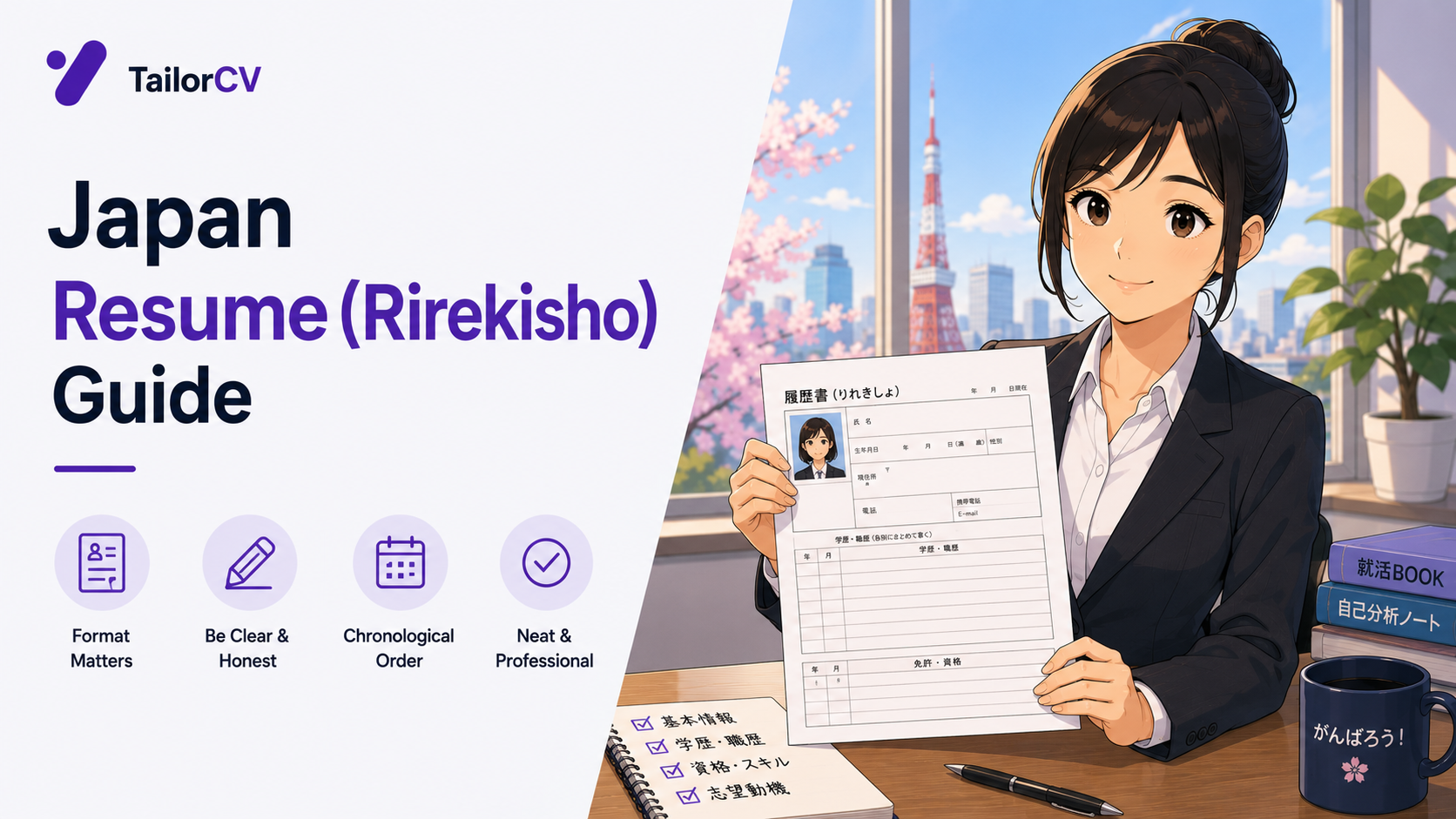
Personal details. Name, date of birth, address, contact details. Furigana readings are typically required alongside names.
A photograph. Conventionally expected, in a specific size, taken in business attire against a plain background. Photo booths producing compliant images are common in Japan. This is a genuine convention rather than an optional flourish.
Education history. Listed chronologically, typically from a defined point in your schooling onward, with entry and graduation entries.
Employment history. Chronological, with entry and departure entries for each employer.
Licences and qualifications. Listed with dates obtained. Language qualifications such as JLPT levels belong here and matter considerably for foreign applicants.
Motivation for applying. A free-text section, and the main place where you can actually differentiate yourself on the form itself.
Personal requests or notes. Conventionally used for preferences about location or conditions, and frequently left with a standard phrase indicating you defer to the company.
The conventions that matter
Chronological order, no gaps unexplained. The history is expected to be continuous and complete.
Consistent date formatting. Japanese applications may use either the Western calendar or Japanese era years, and the important thing is consistency throughout the document.
Handwriting versus typing. Traditionally these were handwritten, and neatness was itself part of the assessment. Typed submissions have become widely accepted, particularly for online applications, though some traditional employers still prefer handwritten. Check the employer's stated preference where one exists.
No correction fluid. If handwriting and you make an error, convention is to start again rather than correct.
Formal, standard phrasing. Conventional set phrases are used for entering and leaving education and employment, and using them correctly signals familiarity.
The photograph is not optional in practice. A missing or informal photograph is noticed.
Accuracy above all. Because the form is standardised and factual, errors are visible in a way they are not in a designed document.
For foreign applicants specifically
Submit a rirekisho, not a Western resume, when applying to Japanese companies through Japanese channels. Submitting the wrong document type is the clearest possible signal that you have not researched the market.
Foreign-affiliated companies frequently accept Western formats, and some prefer them. Check what the specific employer expects — the English-conducted job market generally follows different conventions.
Your language qualification belongs prominently in the qualifications section. For foreign applicants it is frequently the single most consequential line on the form.
Get a native speaker to check it if you are writing in Japanese. Set phrases and formal register are conventional and errors are conspicuous.
Explain overseas education clearly. Institution names unfamiliar to a Japanese reader benefit from a brief clarification of what the qualification is equivalent to.
Keep a master copy. You will complete this repeatedly, and having your dates, readings and standard phrasings settled once saves considerable time.
Filling out each specific section properly
The photograph should be a proper, formal photograph taken specifically for this purpose, not a casual photo, meeting the specific standard dimensions and presentation this document requires, this is a genuinely important detail and worth having done properly rather than treating casually.
Personal details are recorded with specific attention to accuracy and completeness, including sections that would be considered unusual to include on a resume in some other countries, this reflects the local convention for this specific document type rather than an unusual or invasive request from any individual employer.
Education and work history are recorded in a specific chronological format this document requires, follow the standard structure precisely rather than adapting it to a format you may be more familiar with from another country.
The motivation and self-promotion sections, where included, require genuine, specific content, generic statements are noticed and reflect poorly, exactly the same principle that applies to written applications everywhere, applied within this document's specific local convention and structure.
Handwritten versus digital versions
Some employers and situations still expect a handwritten version of this document, reflecting a traditional convention around this specific document type, while digital submission has become more common and accepted at many employers, worth checking the specific expectation for each application rather than assuming one format is universally acceptable.
If a handwritten version is expected, take genuine care with the presentation, this document's neatness and care are themselves considered part of what is being assessed, not merely the content.
Common formatting pitfalls specific to this document
Leaving sections blank rather than writing a clear indication that a section does not apply, an unexplained gap reads as an oversight, worth completing every section deliberately even where the honest answer is brief.
Using casual or overly informal language in the motivation section, this document generally expects a measured, formal register throughout, consistent with the broader formal presentation expected in Japanese interviews and applications.
Submitting a document with visible corrections or an untidy presentation, particularly relevant for a handwritten version, where care in presentation is itself part of what is being assessed.
A final review before submitting
Read through the entire completed document once more specifically checking for consistency, dates that align correctly across sections, information that matches what you present elsewhere in your application, and no contradictions between this document and any accompanying materials.
Have someone genuinely familiar with the local convention review it if possible, a career centre advisor, a mentor, or a friend experienced with this specific process, a second set of eyes familiar with the format catches issues you may not notice in your own document after extended work on it.
Keep a copy of exactly what you submitted for each specific application, useful for your own reference during subsequent interview stages when you may be asked about details from the document itself.
Do's and Don'ts
Do
- Use the standard form and fill every field
- Get the photograph taken properly at a studio
- Keep date formats consistent throughout
- Write the motivation section fresh for each company
- Start again on a fresh sheet if you make an error
Don't
- Substitute a Western-style resume
- Use a casual or cropped photo
- Mix calendar systems within one document
- Treat the motivation section as filler
- Use correction fluid on a handwritten form
Your resume after optimization
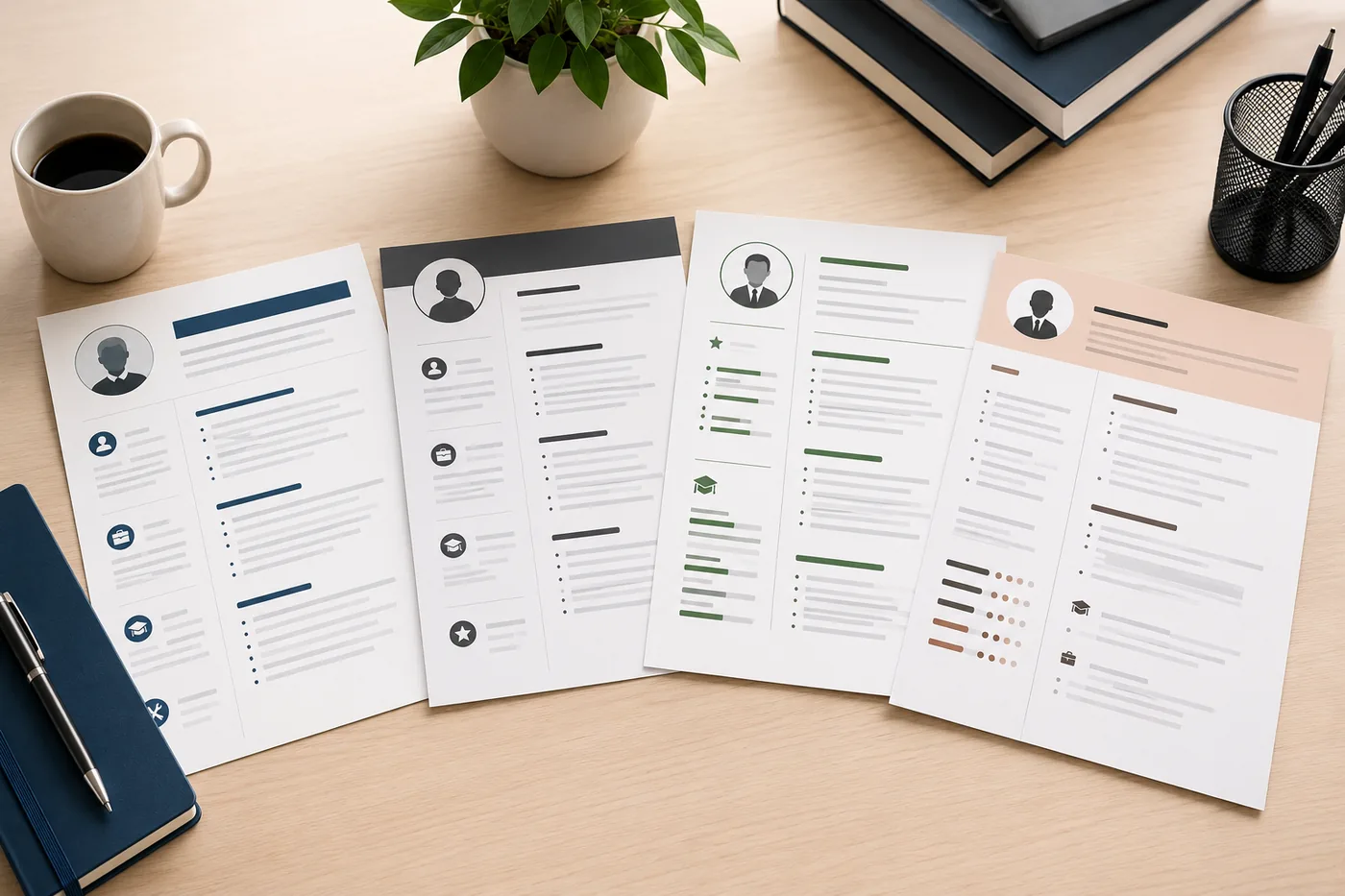
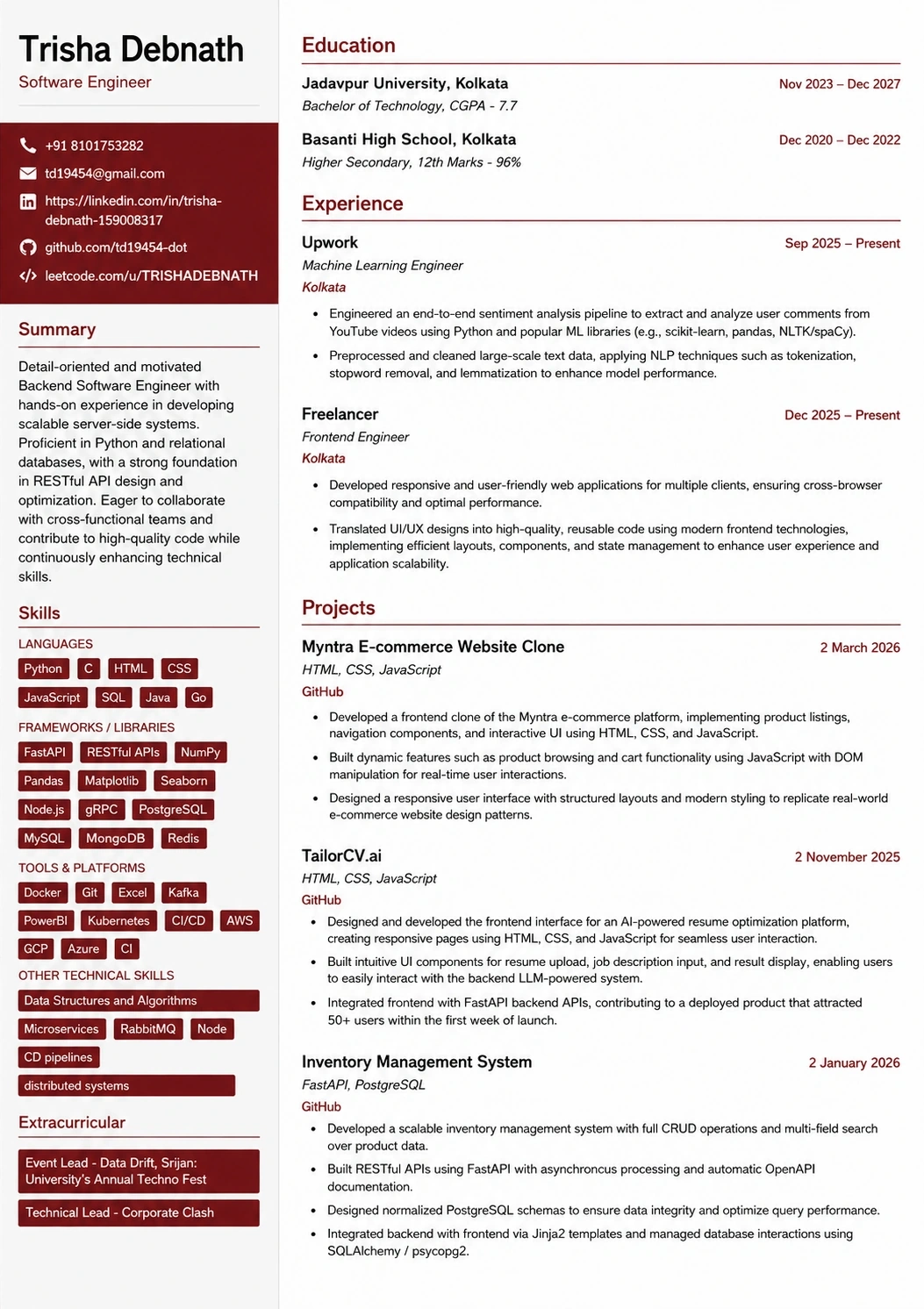
Templates here are for the Western-style resume used by foreign-affiliated employers — the rirekisho itself follows its own standardised form.
Tip: Get the photograph taken at a proper photo studio, not a booth or a phone. It sits at the top of a standardised form where every other field looks identical, which makes it one of the few things a reader actually notices.
Common Mistakes
- Submitting a Western-style resume instead. Submitting a Western-style resume instead the most visible signal of unfamiliarity with the market.
- A missing or casual photo. Omitting the photograph, or using a casual one rather than the proper formal standard. Conventionally expected and its absence or informality is noticed.
- Writing generic motivation statements. Writing generic motivation statements rather than content specific to each individual company.
- Inconsistent date formats. Mixing calendar systems within one document.
- Leaving gaps in the chronology. Leaving gaps in the chronology the history is expected to be continuous.
- Using correction fluid on a handwritten form. Convention is to start again.
- Assuming a digital version is always acceptable. Assuming a digital version is always acceptable without checking the specific employer's expectation.
- Treating the motivation section as filler. It is the one part of the form where you can genuinely differentiate.
Related Guides
Keep building on this with the related guides in this series:
- English-Speaking Jobs in Japan - Where They Actually Are
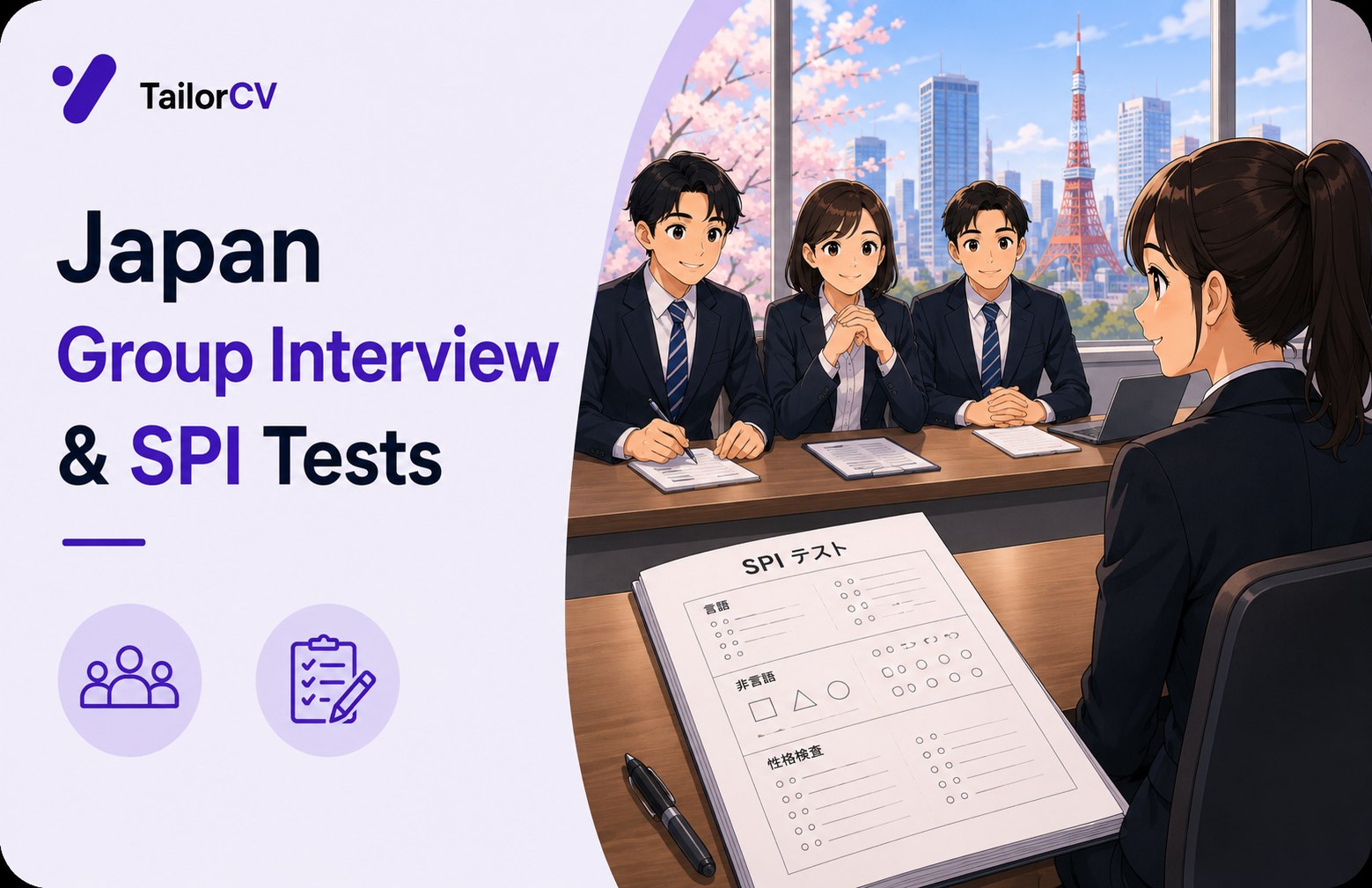
- Group Discussions and Aptitude Tests in Japanese Recruiting
- Internships in Japan for International Students
- Japanese Language Requirements for Jobs in Japan
- Teaching in Japan - The JET Programme and the Alternatives
- JLPT N2 and N1 - What They Actually Mean for Employment in Japan
You can also check your resume's ATS score for free, generate a tailored cover letter, or build a portfolio website in minutes.
Frequently Asked Questions
Is this document the same as a resume from another country?
Related in general purpose, distinct in specific structure and convention, worth learning the actual standard format for this specific document type rather than adapting a document built for a different country's convention.
Do I need a professionally taken photograph?
Generally yes, a proper, formal photograph meeting the specific standard this document requires, worth having this done properly rather than using a casual photo.
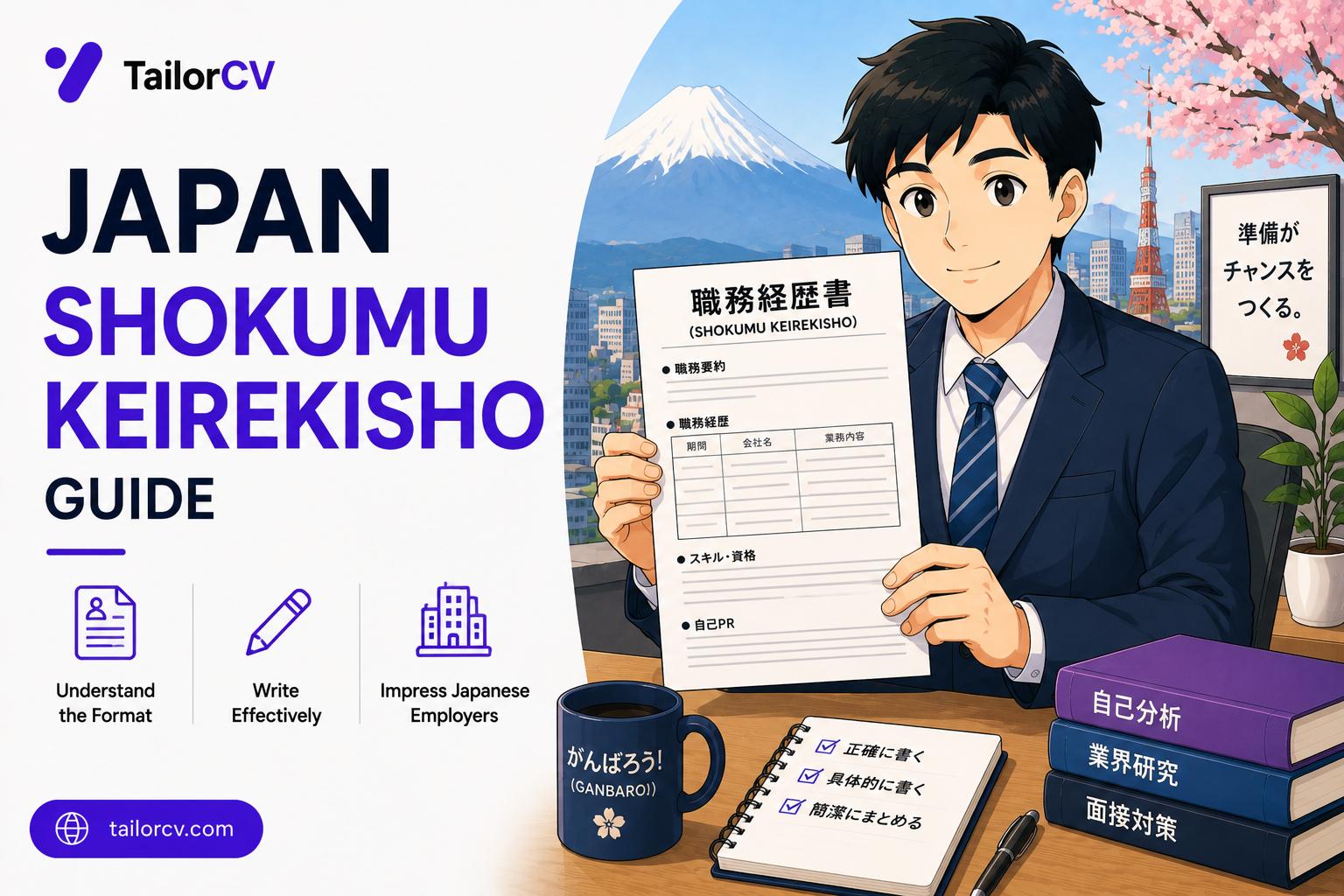
How does this differ from the other application document, the shokumu keirekisho?
Covered in the separate guide to that document, the two generally serve somewhat different purposes and are often submitted together.
Do I have to handwrite it?
Typed versions are widely accepted now, particularly for online applications. Some traditional employers still prefer handwritten, so check where a preference is stated.
Is the photograph really necessary?
By convention, yes, for applications to Japanese companies. It should be a formal photograph in business attire, and compliant photo booths are widely available in Japan.
What if my education system does not map neatly onto the form?
List it clearly and chronologically, adding a brief clarification of what the qualification is equivalent to where the institution or degree would be unfamiliar.
Can I use the same rirekisho for every application?
The factual sections stay the same. The motivation section should be written fresh for each company, exactly as the why this company answer matters in any market.
Do foreign-affiliated companies want one?
Frequently not — many accept or prefer Western-style resumes. Check the specific employer rather than assuming either way.
What else do I submit alongside it?
Typically a shokumu keirekisho, the work history document where actual substance about your experience goes.
Does your formatting survive the parser?
Upload your resume and see what an ATS actually reads back.
Drop your resume here or choose a file
PDF only. Max 2 MB.
We never share your data or use it to train AI models.

A layout that parses cleanly
Single column, standard headings, no text boxes — the formatting rules in this guide, already applied.
Was this guide useful?
Be the first to rate it.