 TD
TD
Key Takeaways
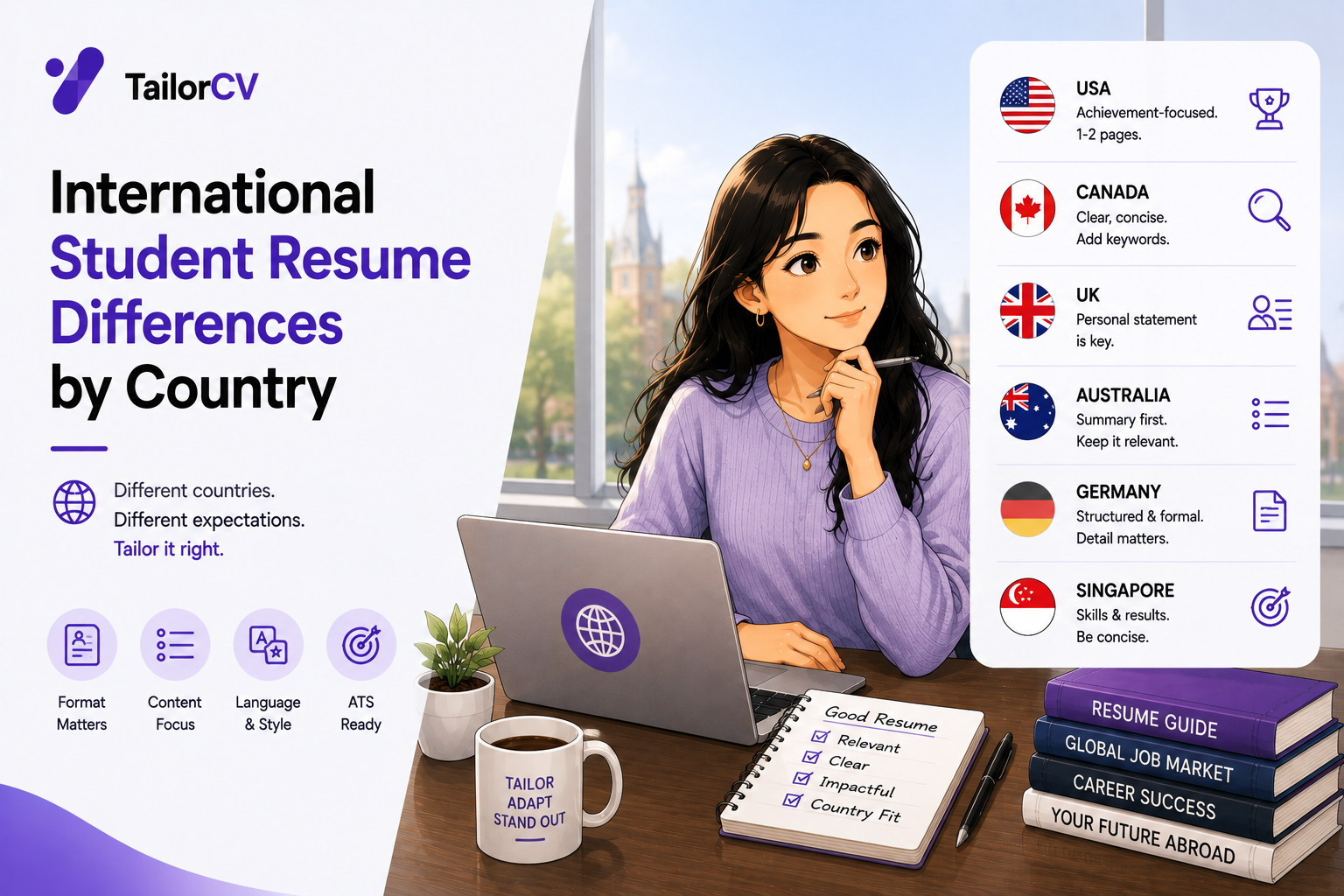
- The photo is the biggest single difference. Required in some countries, actively harmful in the US and Canada.
- "CV" means different documents in different markets — a one-page industry document in the UK, an academic record in the US.
- Personal details that are standard in parts of Asia and Europe create legal risk for US employers.
- Grades are stated in the UK and Singapore far more routinely than in the US.
- Every market screens with software first, so parsing matters everywhere even where conventions differ.
The comparison
| Photo | Typical length | Personal details | Grades | Status on document | |
|---|---|---|---|---|---|
| USA | Never | 1 page | Never | If strong | No |
| Canada | Never | 1-2 pages | Never | Optional | Rarely |
| UK | No | 2 pages | Minimal | Usually | Right to work, briefly |
| Singapore | Not expected | 1-2 pages | Common | Usually | Yes, commonly |
The photo
The US and Canada: never. This is not aesthetic preference. Anti-discrimination law means a resume showing your age, gender, race or national origin creates evidence risk for the employer. Some companies discard photo resumes as policy so they cannot be accused of having considered protected characteristics.
The UK: no. Not for legal reasons of the same kind, but convention is firmly against it and it reads as unprofessional.
Singapore: increasingly not expected, though you will still see them and it is not disqualifying.
If you are adapting a resume from a market where photos are standard — much of continental Europe, parts of Asia and Latin America — deleting the photo is the first edit, and it is the one most commonly missed.
Personal details
The block of date of birth, marital status, nationality, gender, father's name and passport number is standard in several countries and is a problem in others.
US and Canada: remove all of it. Same reasoning as the photo.
UK: remove most of it. Name, phone, email and general location. Right to work status can be stated briefly if relevant.
Singapore: some is expected, particularly work pass status, because pass eligibility is genuinely part of the hiring decision.
That last row is the exception worth remembering. In the US, stating visa status on the resume takes space from evidence and volunteers information the screen does not need — the US resume format keeps it off entirely. In Singapore it is normal and useful.
Length
US: one page for students and recent graduates. The convention is strong enough that exceeding it is itself a signal.
Canada: one to two. Two is more acceptable than in the US.
UK: two pages is standard for a graduate CV, and one can look thin. The UK CV format covers the expected structure.
Singapore: one to two, with two common.
An American recruiter receiving a two-page student resume reads it as an inability to prioritise. A British recruiter receiving a one-page CV may read it as insufficient. Same document, opposite conclusions.
Resume or CV
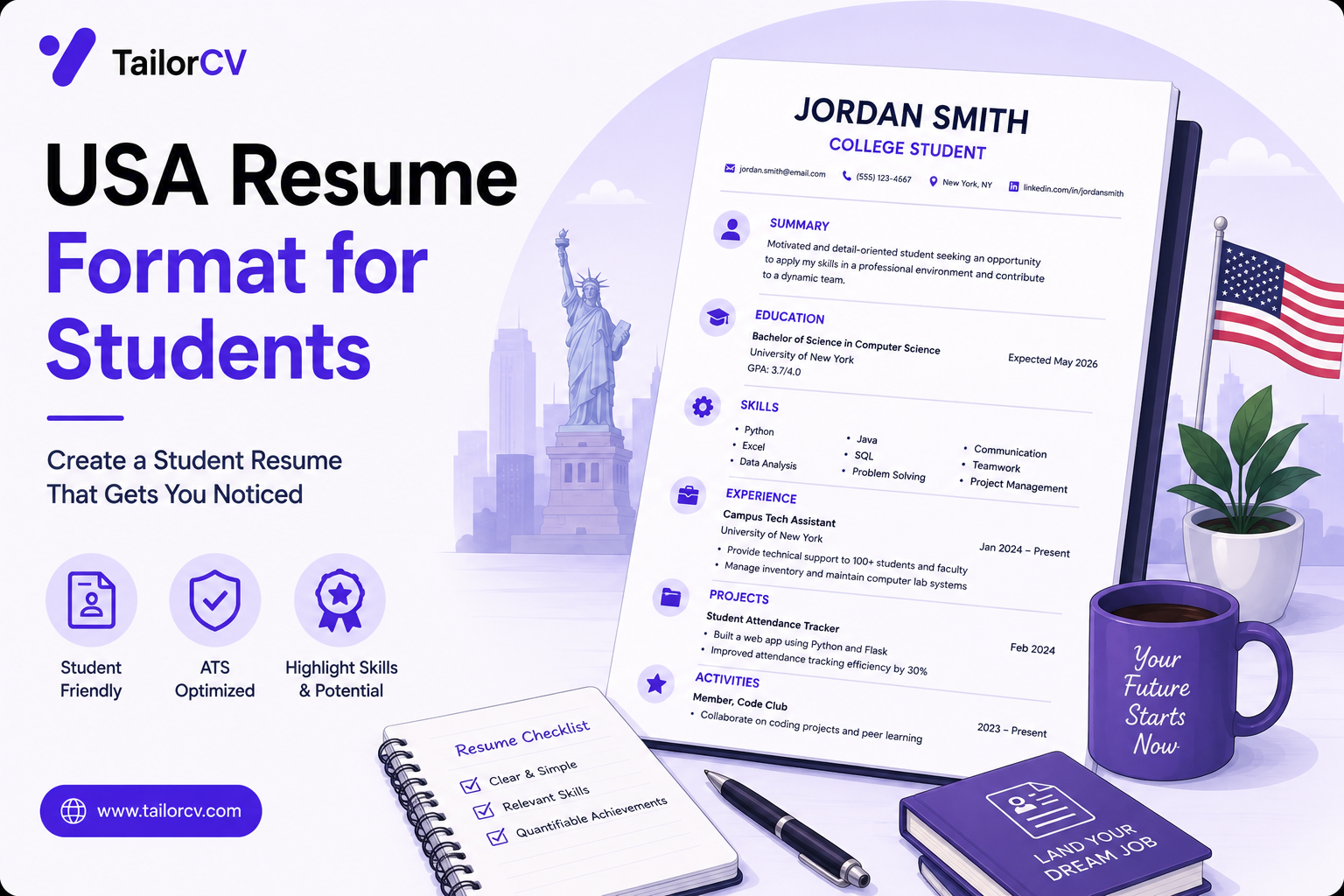
In the US these are different documents. A resume is short and targeted, used for essentially all industry roles. A CV is long and comprehensive — publications, teaching, grants — used for academic and research positions.
In the UK, "CV" is the ordinary word for the two-page industry document. There is no distinction.
So a British graduate sending a "CV" to a US employer may receive it correctly as a resume, or may confuse the reader if it is titled that way and formatted at length. Titling the document at all is unnecessary in the US.
Grades
US: include GPA if strong, omit it otherwise. Omitting is unremarkable — GPA screening is concentrated in a few industries.
UK: degree classification is normally stated, and often A-level results too for graduates.
Singapore: classification is normally stated and matters at structured employers.
Canada: optional, closer to US practice.
If you are moving between systems, translate rather than transplanting. "8.4 CGPA" or "First Class" means nothing to a US screener without context. Either convert, or state the scale alongside it.
What does not change
Four things are constant across every market, and they matter more than any of the conventions above.
Software screens first, everywhere. Every employer of size parses your document before a person reads it. A resume that does not extract cleanly fails identically in London, Toronto, Singapore and New York. This is the one universal, it is invisible unless you check, and an ATS scan settles it in a minute.
Outcomes beat duties. "Responsible for the weekly report" describes a job description. "Cut the weekly reconciliation from three hours to twenty minutes" describes a person. Every market rewards the second.
Tailoring beats volume. The screen compares your text against a specific posting, in every country. Matching the language of the role moves your interview rate more than any formatting decision on this page.
Evidence carries entry-level applications. With little work history, what you built, ran or organised is what distinguishes you — and a project that exists and runs is legible to a recruiter in any market, regardless of whether they recognise your university.
A practical way to handle all of it: keep one master document containing every piece of evidence you have, then generate market-specific versions from it. The adaptation is mechanical — photo in or out, personal details in or out, one page or two, grades in the local idiom — and it takes ten minutes once the master exists. What you must not do is maintain four unrelated documents that drift apart, or edit a single one under pressure the night before a deadline and forget to remove the photograph.
A practical adaptation checklist
Moving a resume from a photo-and-personal-details market to the US or Canada:
- Delete the photo
- Delete date of birth, marital status, gender, nationality, passport, parents' names
- Delete the full postal address; keep city
- Cut to one page (US) or two (Canada)
- Remove the document title and any declaration or signature
- Remove "references available on request"
- Convert or explain the grading scale
- Rewrite duty bullets as outcome bullets
- Check it parses
Steps one, two and eight account for most of the improvement.
The photo, and why it is not a style choice
The single largest difference between markets, and the one that does real damage when carried across.
The US and Canada: never. This is not a preference. US employers operate under anti-discrimination rules that make a photograph a legal exposure, and many recruiters are instructed to discard resumes containing one rather than risk a claim that a hiring decision was influenced by appearance. Some applicant systems strip images automatically, which mangles the layout of a document built around one. A photo on a US resume is not a neutral flourish; it can remove you from consideration for reasons entirely unrelated to your suitability.
The UK: no. Not for legal reasons of the same weight, but conventions are firmly against it and it reads as unfamiliarity with the market.
Singapore: increasingly not expected, though it persists at some employers and in some sectors. Where a posting does not ask for one, leave it off.
Where photos are standard — parts of Europe, parts of Asia, some Middle Eastern markets — they are genuinely expected and their absence can read as an incomplete application.
What to do: maintain two versions of your document from the start rather than editing one under time pressure. This is the recurring theme of adapting across markets — the underlying evidence is identical, and the packaging differs in a handful of specific, learnable ways.
Personal details, and the same logic
The details that are routine on a resume in one country create problems in another, for the same reason as the photograph.
US and Canada: remove all of it. Date of birth, age, marital status, nationality, gender, religion, a photograph, and a national identity number. None of it belongs on the document, all of it is legally sensitive for the employer, and including it signals that you are working from a template built for a different market.
UK: remove most of it. Date of birth, marital status and nationality are not included. A note on your right to work is occasionally included and generally unnecessary.
Singapore: some is expected. Nationality and work pass status are commonly stated and genuinely relevant to the hiring decision, which is why the local conventions differ here from US practice. Age and marital status are increasingly omitted.
What everyone needs: name, phone, professional email, city, and a link to something — a portfolio, a repository, a professional profile.
One specific trap. International students sometimes add their visa status to a US resume, reasoning that transparency is helpful. It is not: it takes space from evidence, it invites the reader to think about immigration before they think about your work, and the question is better answered in conversation where a single sentence closes it.
The comparison, in one table
| US | Canada | UK | Singapore | |
|---|---|---|---|---|
| Photo | Never | Never | No | Usually not |
| Date of birth / age | Never | Never | No | Sometimes still seen |
| Nationality | Never | Never | No | Commonly stated |
| Marital status | Never | Never | No | Increasingly omitted |
| Work authorisation | Off the document | Off the document | Rarely needed | Commonly stated |
| Length | One page | One to two | Two pages | One to two |
| "CV" means | Academic document | Academic document | The standard document | The standard document |
| Grades | Above ~3.0 only | Inconsistent | Classification expected | Commonly expected |
| Referees | Not listed | Not listed | "Available on request" or omitted | Sometimes listed |
| Address | City and state only | City and province | City only | City, sometimes full |
Two things to read out of this. The US and Canada columns are almost identical, and both are defined by what must be removed. The Singapore column retains the most personal detail, and that is not carelessness — work pass status is genuinely part of the hiring decision there, which is why stating it is expected rather than awkward.
An adaptation checklist
Fifteen minutes per market, once you have a master document containing all your evidence.
Applying to the US or Canada:
- unchecked: Remove the photograph, date of birth, nationality, marital status, gender
- unchecked: Remove any visa or work authorisation line
- unchecked: Cut to one page
- unchecked: Include GPA only if above roughly 3.0
- unchecked: City and state or province only, no full address
- unchecked: No referees listed
- unchecked: Confirm it parses cleanly
Applying to the UK:
- unchecked: Remove photograph, date of birth, nationality, marital status
- unchecked: Two pages
- unchecked: State your degree classification
- unchecked: Include A-level or equivalent results for graduate schemes
- unchecked: Referees omitted or "available on request"
Applying to Singapore:
- unchecked: Photograph optional, generally omit unless asked
- unchecked: State nationality and work pass status plainly — expected here
- unchecked: One to two pages
- unchecked: State classification or GPA
- unchecked: Include your availability date
In every case:
- unchecked: Lead with evidence, not with education, unless you have no experience at all
- unchecked: Outcomes rather than duties
- Match the language of the specific posting
- unchecked: Export as PDF, named with your own name
- unchecked: Open the PDF, select all, copy, paste into a plain text file, and read what comes out
That last step is the one nobody does and it catches the failure mode that costs the most — a document that looks correct on the page and extracts as scrambled text. It applies in every market equally, and it takes thirty seconds.
Applying to several markets at once
Common for international students, and it introduces failure modes that single-market applicants never meet.
Keep the files physically separate and named unambiguously. Sharma_Priya_Resume_US.pdf and Sharma_Priya_CV_UK.pdf. The error that costs the most is sending the wrong regional version, and it happens when four similar files sit in one folder with names like resume_final_2.pdf.
Set your phone number in international format. +65 8xxx xxxx rather than a local format a foreign recruiter cannot dial. Small, and it has cost people interviews.
Use one professional email across all of them, and check it. A student address that expires at graduation is a genuine problem when an employer replies in August.
State your location honestly and usefully. "London, UK — relocating to Singapore, available from June" tells a recruiter everything they need. Listing a city you do not live in yet, without context, reads as misleading when it surfaces.
Expect the timezone question in interviews and offer flexibility explicitly. "I'm currently in London but happy to take calls at any time that suits Singapore hours" removes an objection before it forms.
Track which version went where. When a recruiter calls in six weeks referring to something on your resume, you need to know which resume they have.
And do not apply to every market simultaneously by default. Applying seriously to two markets is considerably more productive than applying superficially to four, because each one needs its own work-rights answer, its own employer research and its own calendar. Spreading thin is how candidates end up with forty applications and no interviews across four countries.
Common Mistakes
- Sending the same document everywhere. The conventions genuinely conflict.
- Keeping the photo for US applications. In some pipelines it removes you outright.
- A one-page CV for UK graduate schemes. Often reads as insufficient.
- A two-page resume for US campus hiring. Reads as unable to prioritise.
- Untranslated grades. Meaningless to a screener from another system.
- Assuming a nicer template is a better resume. Design that breaks parsing fails before anyone sees it.
Length, naming, and grades
Length.
US: one page for a student or new graduate, essentially without exception. Two pages signals someone who has not read the market.
Canada: one to two. One is safer for a graduate.
UK: two pages is standard and expected. A one-page UK CV can read as thin.
Singapore: one to two, with two more normal than in the US.
What "CV" means. The words are not interchangeable across markets and the confusion causes real errors.
US: "resume" is the one-to-two page industry document. "CV" means an academic document — full publication list, teaching, grants, no length limit — used for academia, research and some medical roles. Sending an academic CV to a US company is a visible mismatch.
UK: "CV" is the standard two-page industry document. Nobody says resume.
Canada: "resume" for industry, "CV" for academia, as in the US.
Singapore: both terms are used for the same industry document.
Grades.
UK: degree classification is stated routinely and frequently filtered on. A-level results are often included for graduate schemes.
Singapore: classification and GPA are commonly expected, particularly by banks and the public sector.
US: GPA convention is to include above roughly 3.0 and omit below, and omitting is entirely normal.
Canada: included less consistently than in the UK, and rarely a hard filter outside a few structured programmes.
Converting grades across systems. State your grade in the local idiom where you can, and add a brief clarification where the system will not be recognised — "First Class Honours (top 10% of cohort)" or "3.8/4.0". Do not convert dishonestly, and do not leave a foreign scale unexplained, because a reader who cannot interpret it will simply skip past it.
Common cross-market errors
The specific mistakes that come from carrying one market's habits into another.
A photograph on a US application. The most damaging single error, for the legal reasons above. It can remove you from consideration entirely.
An academic CV sent to a US company. Six pages, publication list, no summary. It signals that you did not know the word means something different there.
A one-page CV for a UK graduate scheme. Reads as thin against a two-page norm, and you have given away space your competitors used.
Visa status on a US resume. Takes room from evidence and moves the reader's attention to immigration before they have looked at your work.
An unexplained foreign grading scale. "First Division" or "8.4/10" means nothing to a reader who does not know the system, and they will not look it up. Convert or contextualise.
Referees with full contact details, unasked. Standard in some markets, unnecessary and space-consuming in the US, Canada and UK.
A full home address. City-level is what is expected across all four of these markets now.
Editing one document under deadline pressure. How the photograph survives into the US version. Keep separate files generated from a master, not one file you remember to change.
And the error that is not about conventions at all: assuming that adapting the format is the work. It is fifteen minutes. What actually decides the outcome is whether the evidence is strong and whether the language matches the posting, and those are the same problem in every country.
The master-document approach
The efficient way to handle four markets, and it takes one afternoon to set up.
Build one master file with everything. Every role, every project, every bullet you have ever written, at full length. Nobody sees this document. It exists so that you never have to remember what you did or reconstruct a description under deadline pressure.
Generate market versions from it. US one-pager, UK two-pager, Singapore version with pass status, Canada version. Each is a selection and a reformatting of the master, not a separate document with its own history.
Then tailor per posting from the market version. Adjust emphasis and language to the specific role. This is the step that actually moves your interview rate, and it is fast because the underlying material is already written.
Why this ordering matters. The failure mode it prevents is version drift — four documents that were once the same, edited independently over months, one of which still has the photograph and one of which has a role the others do not. That is how a photograph reaches a US employer, and it happens under time pressure the night before a deadline.
Keep the master current. Add things as you do them, in the same week. The single hardest resume task is remembering in March what you achieved in October, and it is entirely avoidable.
Frequently Asked Questions
Can I keep one master resume?
Keep a master content file, then produce country-specific versions from it. The content is largely reusable; the format and personal-details handling are not.
Which country's conventions are strictest?
The US, because the one-page norm and the prohibition on photos and personal details are firmly enforced by convention and, in the case of personal details, by legal caution.
Do I mention visa status?
Singapore yes, briefly. UK briefly if relevant. US and Canada no — it is raised in conversation, not on the document.
Is a two-page resume acceptable anywhere for a student?
The UK, routinely. Canada and Singapore, often. The US, rarely.
Should I use a designed template?
Only single-column, standard-heading designs. Templates with sidebars and columns look better and parse worse, and parsing comes first.
What about the address?
City and country is enough everywhere. A full street address is unnecessary and, for international applications, occasionally counterproductive.
Find out where a fresher resume stands
Score yours against a real posting - no account, no cost.
Drop your resume here or choose a file
PDF only. Max 2 MB.
We never share your data or use it to train AI models.

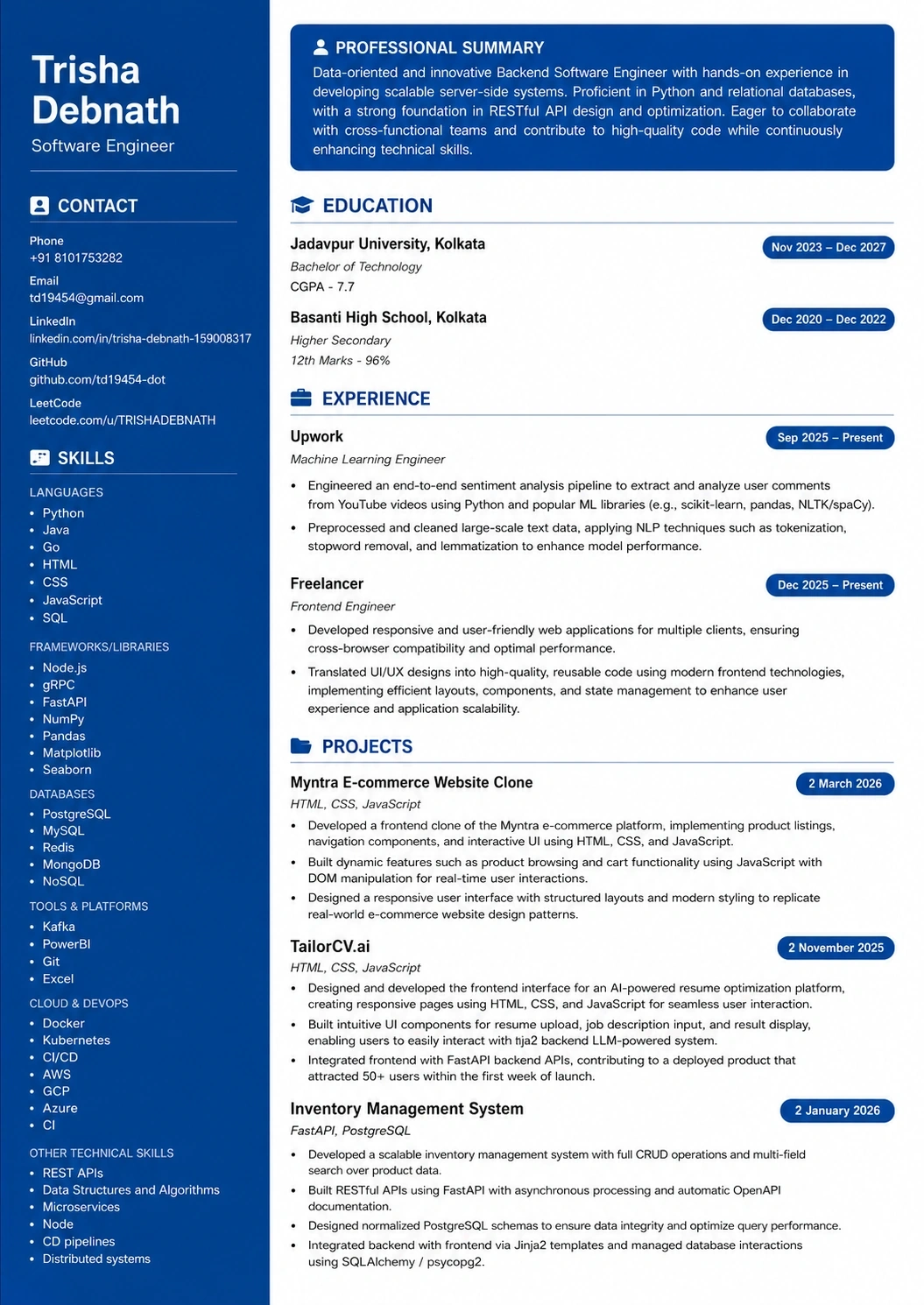
A layout that works with a short history
Leads with skills and projects instead of years of experience you do not have yet.
Was this guide useful?
Be the first to rate it.