TD
TD
Key Takeaways
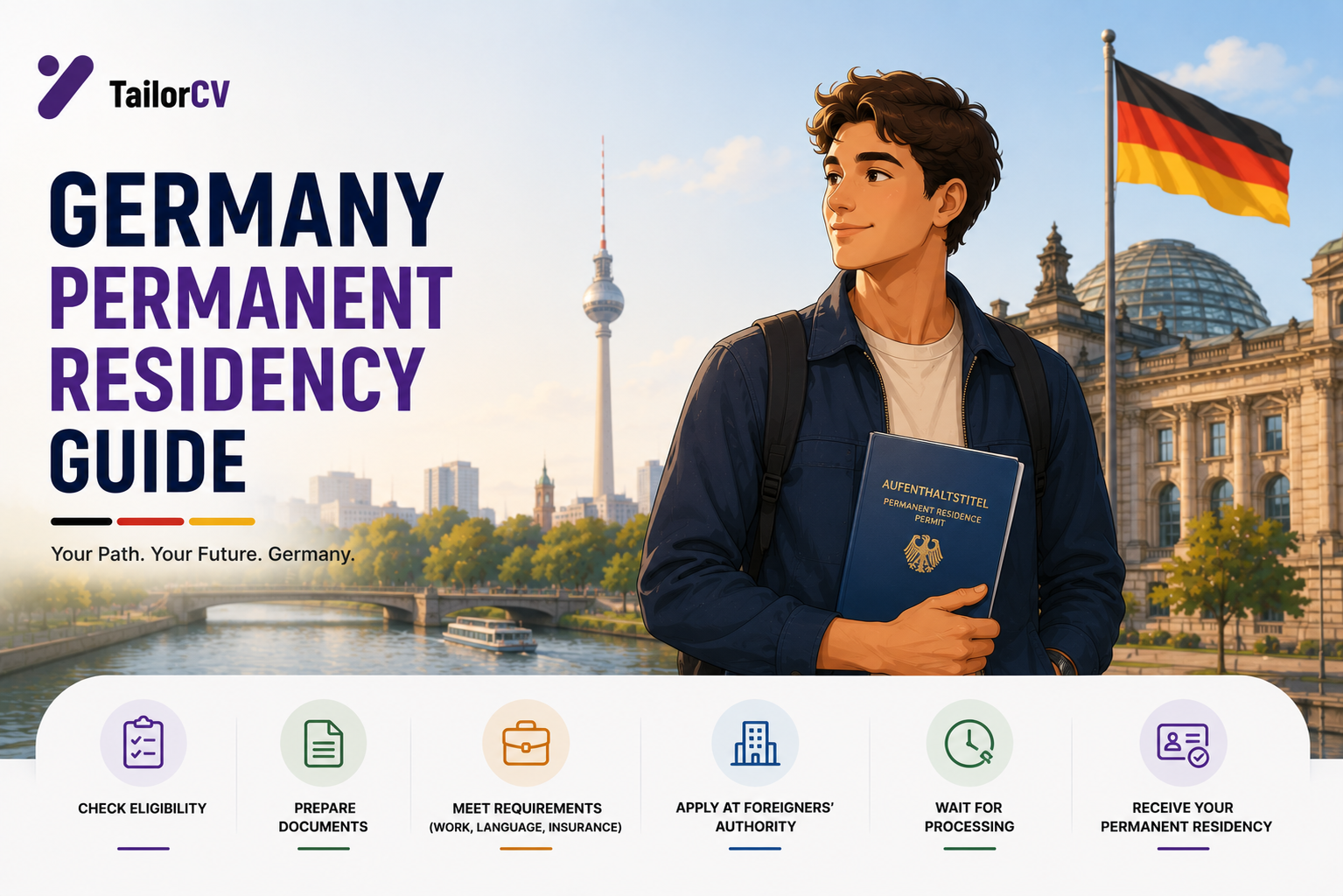
- The Niederlassungserlaubnis is Germany's settlement permit — unlimited in time, not tied to an employer, and the normal destination for skilled workers.
- The standard route takes five years of residence with contributions, though several categories qualify considerably sooner.
- EU Blue Card holders qualify faster, with the timeline shortening further at a higher German language level.
- Pension contributions are a hard requirement, which catches people who spent years self-employed without paying in.
- German language and civic knowledge are tested, and B1 is the usual threshold for the standard route.
What the permit gives you
Why it is worth pursuing rather than renewing indefinitely.
It has no expiry date and does not need renewal, which removes the recurring administrative cycle entirely.
It is not tied to an employer, so changing jobs, going freelance or starting a business no longer requires permission.
It carries an unrestricted right to work in any occupation and any employer.
It survives longer absences from Germany than a temporary permit, though extended absence can still cause it to lapse.
It is a prerequisite step toward naturalisation for many people.
Family members can generally be included or join on more favourable terms.
And it removes the anxiety that structures life on temporary permits — the sense that a redundancy or a company failure is also an immigration event.
The main routes and their timelines
Who qualifies when.
| Route | Typical residence required | Notes |
|---|---|---|
| Standard skilled worker | 5 years | Contributions, language, self-sufficiency |
| EU Blue Card | Shorter, reduced further with stronger German | The fastest common route |
| Graduate of a German university | Shorter than standard | Study time counts partially |
| Spouse of a German citizen | Shorter | Family-based conditions apply |
| Self-employed | Varies | Business viability assessed |
The Blue Card route is the reason so many skilled migrants pursue that permit specifically rather than a general work permit — the settlement timeline is materially shorter, and improving your German shortens it again.
Graduates of German universities benefit from study time counting toward the qualifying period in defined ways, which rewards the study-then-work sequence.
The Skilled Immigration Act reforms changed several of these timelines, so verify against the current rules rather than relying on any summary, this one included.
What actually gets checked
The requirements in practice.
Sufficient period of residence on a qualifying permit.
Pension contributions for a minimum number of months, which is the requirement that most often catches people. Periods of self-employment without voluntary contributions simply do not count.
Secure livelihood — you support yourself and your dependants without recourse to public assistance.
Adequate living space for you and your family, evidenced by your tenancy.
German language at B1 for the standard route, with the Blue Card fast track requiring a higher level for the shortest timeline.
Basic knowledge of the legal and social order, usually demonstrated through the Leben in Deutschland test.
No relevant criminal record.
And health insurance, continuously maintained.
The application itself
What the process involves.
You apply at your local Ausländerbehörde, and appointment waits vary enormously by city — Berlin and Munich are notoriously slow, smaller towns considerably faster.
Book early. Applying close to your eligibility date frequently means waiting months for a slot, and your existing permit must remain valid throughout.
The document set typically includes your passport, current permit, employment contract, recent payslips, pension record, language certificate, Leben in Deutschland certificate, tenancy agreement, health insurance confirmation and registration certificate.
Everything is checked, and missing documents cause a second appointment rather than a pause.
Fees apply and vary by category.
Processing takes weeks to months, and a Fiktionsbescheinigung bridges the gap if your existing permit expires meanwhile.
And decisions are frequently made in person, so arriving with a complete, well-ordered file matters more than it should.
Naturalisation, the step after
Where the route continues.
Citizenship becomes available after a qualifying residence period, which recent reform shortened considerably, with a further reduction for outstanding integration achievements.
Requirements include language at a defined level, the citizenship test, self-sufficiency, and a commitment to the constitutional order.
Germany now permits dual citizenship more broadly following reform, which removed the single biggest deterrent for many long-term residents.
Time on a settlement permit counts, and in most cases time on qualifying temporary permits does too.
Children born in Germany to long-resident parents have their own provisions.
And German citizenship carries EU free movement, which is the practical prize — the right to live and work across the whole Union without any of this again.
Verify before you act
Requirements change and this article should be checked against the sources.
Your local Ausländerbehörde for the categories, documents and appointment process, since practice genuinely varies between authorities.
Deutsche Rentenversicherung for your contribution record — request a Versicherungsverlauf and count the months yourself.
BAMF for language and integration course requirements and the Leben in Deutschland test.
Make it in Germany, the official portal, for current rules on the Blue Card and skilled worker routes.
And a specialist lawyer if your case involves self-employment gaps, long absences or a complicated permit history, because those are the cases where a wrong assumption costs years.
Keeping the clock running
Practical habits over the qualifying years.
Do not let permits lapse. A gap between permits can break continuity, and re-establishing it costs the whole period in the worst cases.
Keep every payslip and permit, digitally and in order. Reconstructing five years of documentation at application time is miserable and sometimes impossible.
Maintain health insurance across job changes, including any gap between roles.
Track absences. Extended time outside Germany can interrupt the qualifying period, and the limits are stricter than most people assume.
Make voluntary pension contributions during any self-employed or non-employed period, because that decision cannot be made retroactively.
Take the language exam early rather than at the end, since certificates do not expire and it removes the single most common last-minute obstacle.
And if you change from a Blue Card to another permit type, check the effect on your timeline before you do it, not after.
Comparing Germany regionally
Where it sits among European settlement routes.
Against the Netherlands. Both have five-year standard routes with language requirements; the Dutch process is generally regarded as more administratively predictable.
Against Austria. Austria's route is longer and more points-driven, and generally considered harder.
Against Sweden and Denmark. Both have their own frameworks with language and self-sufficiency conditions, and Denmark's are notably demanding.
Against Ireland. A different system entirely, with long-term residence available after a qualifying period and no equivalent language test.
Against Portugal and Spain. Both offer shorter routes to citizenship for some nationalities, which changes the calculation for applicants from Latin America and Lusophone countries.
The German advantage is the Blue Card fast track and, since reform, a genuinely shortened citizenship timeline with dual nationality accepted.
The German friction is administrative — appointment waits, document exhaustiveness and variation between local authorities.
Four things people get wrong
Beliefs that cost applicants time.
"Any five years counts." Only qualifying permit types count, and time on a student permit or certain temporary statuses is treated differently.
"My employer handles it." Employers handle work permits. Settlement is your own application, on your own timeline, with your own documents.
"I can do the language test later." The certificate is required at application, waiting lists exist, and this is the most common avoidable delay.
"Permanent means permanent." It lapses after extended absence, so it still requires attention once granted.
A note on changing employers
Something people worry about more than they need to.
On a temporary work permit, a change of employer generally requires notification or approval depending on your permit type, and the Blue Card has its own rules for the early period.
Redundancy does not immediately end your right to stay — there is normally a period to find new employment, though the length depends on your permit.
Keep the authority informed. Silence causes more problems than any change of circumstances does.
Gaps between jobs are survivable but must be documented, insured and, where possible, covered by voluntary pension contributions.
And once you hold settlement, none of this applies. That is precisely the point of pursuing it.
What it costs to wait
A short argument for treating this as a priority.
Every renewal cycle costs time — appointments, documents, fees and the low-level anxiety of a permit with an end date.
Job mobility is constrained while your right to stay depends on a specific employer relationship.
Mortgage access improves materially with settled status at many German banks.
Family planning is simpler when your status does not need re-establishing every couple of years.
And the language requirement gets no easier later. People who postpone B1 for five years generally find it harder, not simpler, than people who took the course in year one.
Mini checklist
- unchecked: Qualifying permit type confirmed
- unchecked: Pension contribution months counted, including any gaps
- unchecked: German certificate obtained at the required level
- unchecked: Leben in Deutschland test booked or passed
- unchecked: Tenancy agreement showing adequate space
- unchecked: Continuous health insurance evidenced
- unchecked: Income and employment documentation gathered
- unchecked: Absences from Germany checked against limits
- unchecked: Appointment booked well ahead at the Ausländerbehörde
Scenarios
Scenario 1: You hold an EU Blue Card
You are on the fastest common route. Improving your German to the higher threshold shortens the timeline further, and it is one of the highest-return language investments available.
Scenario 2: You studied in Germany and then started working
Study time counts toward your qualifying period in defined ways. Confirm exactly how much with your local authority, because the answer changes your application date meaningfully.
Scenario 3: You have spent years freelancing
Check your pension contribution record before anything else. Self-employed periods without voluntary contributions do not count, and this is the single most common reason applications fail.
Tip: Check your pension contribution record early, not when you apply. Request a Versicherungsverlauf from Deutsche Rentenversicherung and count the qualifying months yourself. Gaps from self-employment or time abroad are the most common reason otherwise-strong applications are refused.
Do's and Don'ts
Do
- Verify your pension contribution months early
- Push your German past the minimum if on a Blue Card
- Keep health insurance continuous
- Track absences from Germany
- Book appointments well ahead
- Keep every payslip and permit document
Don't
- Assume self-employed years count automatically
- Leave the language certificate to the last moment
- Let health insurance lapse between jobs
- Ignore the adequate-housing requirement
- Rely on outdated timeline summaries
- Forget that study time may partly count
Common Mistakes
- Missing pension months. The most frequent cause of refusal.
- Underestimating the language requirement. B1 must be certificated, not claimed.
- Insurance gaps. Continuity is checked across the whole period.
- Overlooking the Blue Card fast track. Many eligible people apply late.
- Ignoring absence limits. Long periods abroad can reset the clock.
- Using old guidance. The Skilled Immigration Act changed several timelines.
Related Guides
Keep building on this with the related guides in this series:
- The EU Blue Card for Graduates
- Graduate Jobs in Germany
- German Work Culture
- The Opportunity Card and Chancenkarte
- Salary Negotiation in Germany
You can also check your resume's ATS score for free, generate a tailored cover letter, or build a portfolio website in minutes.
Frequently Asked Questions
What is a Niederlassungserlaubnis?
Germany's settlement permit — unlimited in duration, not tied to an employer, and carrying an unrestricted right to work in any occupation.
How long does it take?
Five years of qualifying residence on the standard route, materially shorter for EU Blue Card holders and shorter again with stronger German. Graduates of German universities also qualify sooner.
Why do pension contributions matter?
A minimum number of contribution months is a hard requirement. Self-employed periods without voluntary contributions do not count, which is the most common reason applications fail.
What German level do I need?
B1 for the standard route, certificated rather than self-assessed. The Blue Card fast track to the shortest timeline requires a higher level.
Does time studying in Germany count?
Partly, in defined ways. Confirm the exact treatment with your local authority since it can move your eligible application date meaningfully.
Can I lose permanent residence?
It can lapse after extended absence from Germany, so track time spent abroad even after you hold the permit.
Where do I apply for permanent residence?
At your local Ausländerbehörde. Appointment waits vary enormously by city, so book well before your eligibility date while your current permit is still valid.
Can I become a German citizen afterwards?
Yes. Recent reform shortened the qualifying period considerably and broadened acceptance of dual citizenship, with language, a citizenship test and self-sufficiency among the requirements.
Where should I verify the current rules?
Your local Ausländerbehörde for practice, Deutsche Rentenversicherung for your contribution record, BAMF for language and integration requirements, and the official Make it in Germany portal.
How do I protect my qualifying period?
Never let permits lapse, keep every payslip and permit document, maintain continuous health insurance across job changes, track absences from Germany, and make voluntary pension contributions during any non-employed period.
How does Germany compare to other European settlement routes?
The Blue Card fast track and reformed citizenship timeline with dual nationality are genuine advantages. The friction is administrative — appointment waits and variation between local authorities.
What is your resume scoring right now?
Scan it against a job description and get your ATS match score in about a minute.
Drop your resume here or choose a file
PDF only. Max 2 MB.
We never share your data or use it to train AI models.

Was this guide useful?
Be the first to rate it.