 SS
SS
Key Takeaways
- Australian resumes commonly run two to three pages — longer than the US one-page convention and closer to a UK CV.
- Referees are usually listed by name on the document, or offered explicitly, unlike the US "available on request" habit.
- No photo, no date of birth, no marital status — Australia follows UK and US practice here, not European.
- Australian spelling follows British forms: organise, analyse, centre, labour, programme for a scheme.
- Government applications frequently require responses to selection criteria, which is a separate written task from the resume itself.
Length, and why it differs
The single biggest adjustment for anyone coming from a US-style resume is that Australia does not expect one page.
Two to three pages is standard and unremarkable. A graduate with limited experience might reasonably use two; someone with a few years' work will use three. Compressing genuine relevant experience onto one page to satisfy a convention that does not apply here reads as thin rather than disciplined.
That said, length is not the goal — completeness is. Three pages of padded description is worse than two pages of specifics.
The differences worth getting right
| Element | Australia | US convention |
|---|---|---|
| Length | Two to three pages | One page for a graduate |
| Referees | Commonly named on the document | "Available on request", or omitted |
| Photo / DOB | Never | Never |
| Spelling | British forms — organise, analyse, centre | American forms — organize, analyze, center |
| Term for the document | "Resume" and "CV" used interchangeably | Resume for industry, CV for academia |
| Selection criteria | Required for most government roles | No equivalent |
"Resume" and "CV" mean the same thing in Australian usage. In the US, a CV implies a long academic document; in Australia the two words are used interchangeably for the same two-to-three page document. An advert asking for a "CV" is not asking for an academic publication list.
Referees, done properly
This is the convention international applicants most often get wrong.
Australian employers commonly expect referees listed on the resume itself: name, job title, organisation, relationship to you, and contact details. Two is typical, three is common for more senior roles.
Ask them first, every time. A referee contacted without warning is a poor referee, and Australian employers do call. Give each person your resume and the role description so they can speak to the right things.
If you genuinely cannot list referees — a confidential search, or referees overseas in a very different timezone — writing "Referees available on request" is accepted. But it is the fallback, not the default.
Selection criteria, for government roles
If you apply to any Australian government role — federal, state or local — you will likely meet selection criteria.
These are specific stated requirements, and you are expected to respond to each one individually in writing, with evidence. This is a separate document from your resume and it is what the panel actually scores.
The STAR method — Situation, Task, Action, Result — is the expected structure for each response, and Australian government recruitment explicitly teaches it. A response that describes a real situation, what you specifically did, and what resulted will outscore one that asserts a capability without evidence.
Word limits are usually stated and they are real. A criterion with a 250-word limit is being marked, and using 90 words of it is leaving marks on the table.
Structure that works
Australian resumes follow a recognisable order, and deviating from it without reason makes a reader work harder than they will.
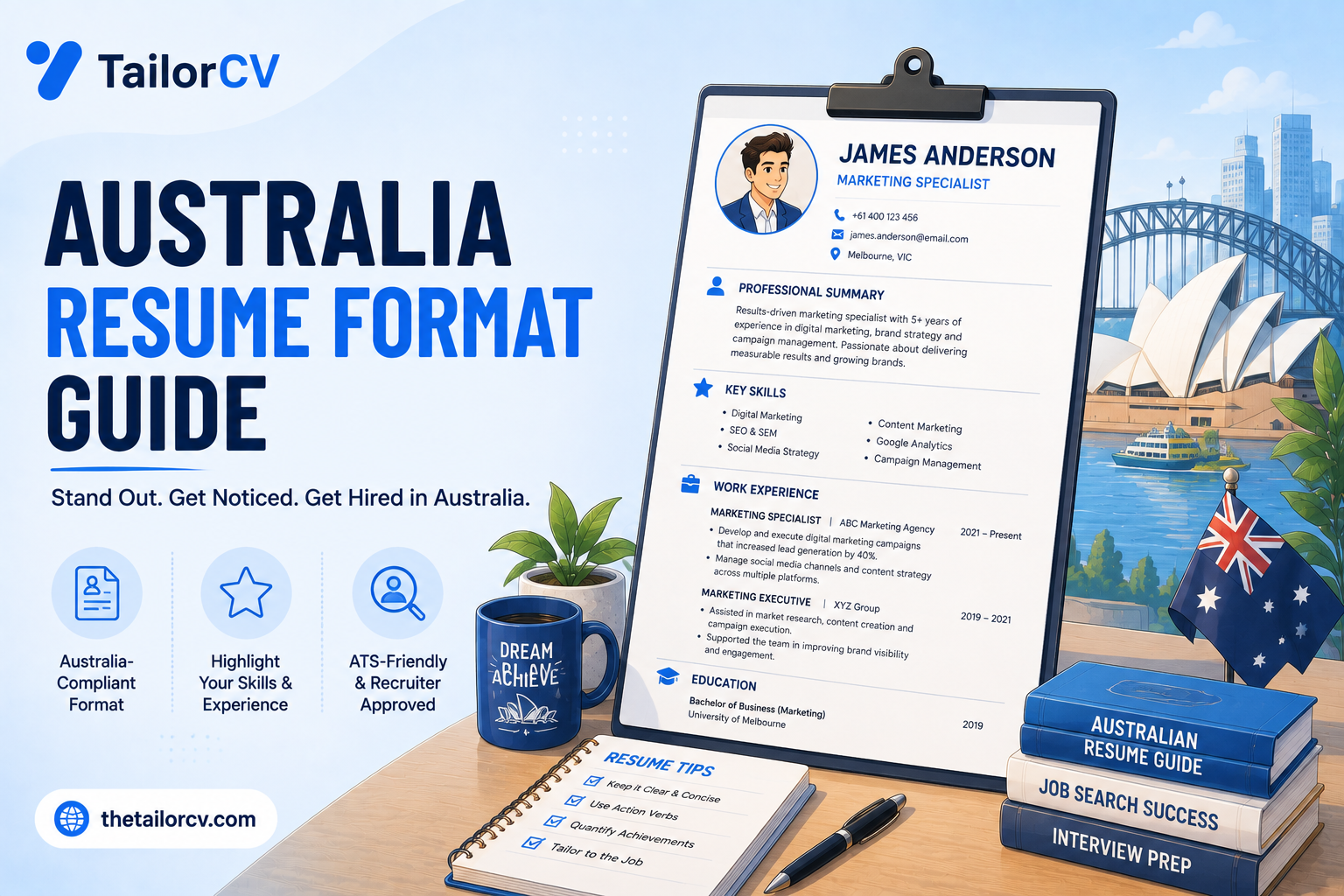
- Contact details — name, phone in Australian format, professional email, and city plus state (Melbourne, VIC). No full street address.
- Professional summary — three or four lines, specific. Optional but useful when it says something real rather than listing adjectives.
- Key skills — a short scannable block, particularly useful for technical roles and for automated screening.
- Employment history — reverse chronological, with employer, location, title, dates, and outcomes rather than duties.
- Education — degree, institution, completion date, and any notable results.
- Certifications and licences — including anything role-critical such as a driver's licence, a White Card for construction sites, or a Working with Children Check.
- Referees — named, with permission.
The licences section matters more in Australia than elsewhere. Roles in construction, healthcare, education and childcare frequently require specific clearances, and stating that you hold one — or that it is in progress — answers a screening question directly.
Writing bullets that actually score
The principle is the same everywhere and Australian employers apply it strictly: describe outcomes, not responsibilities.
"Responsible for customer enquiries" describes a job description. "Resolved an average of 40 customer enquiries daily while maintaining a 92% satisfaction rating" describes you.
Three things make a bullet work: a specific action, a measurable result, and enough context to judge the scale. Numbers do not have to be impressive — they have to be real. "Coordinated a team of four across a six-week project" is more credible and more useful than "extensive leadership experience".
For graduates with limited work history, the same standard applies to projects, society roles and volunteering. A university project described with what was difficult about it and what came out of it outperforms a longer list of coursework.
Automated screening in Australia
Employers of any size in Australia screen with software before a human reads anything, and the large graduate programs process very high volumes.
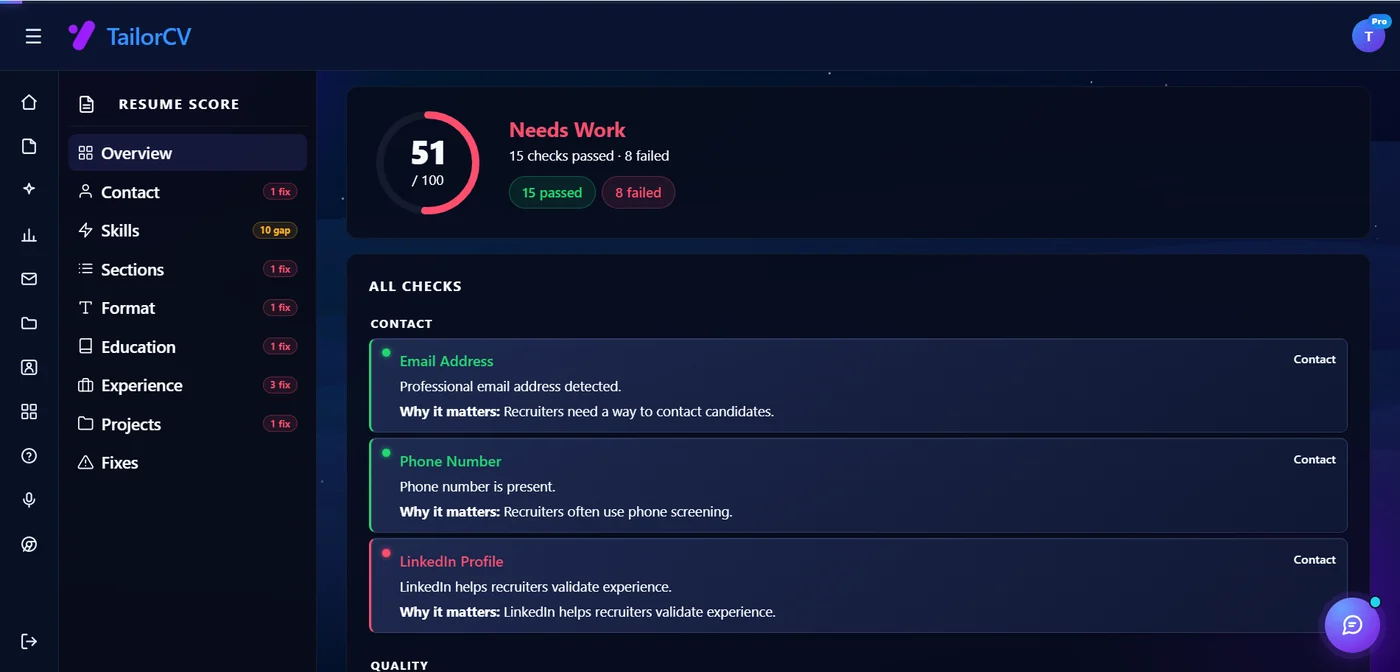
The practical implications are unremarkable but they are load-bearing: use standard section headings the parser recognises, avoid text inside images or complex multi-column layouts that extract badly, mirror the specific terminology of the advert rather than a synonym for it, and export as PDF unless the advert asks for Word.
Running your base document through an ATS check once removes this whole category of risk, and it is worth doing before your first application rather than after a month of silence.
The cover letter, and when it matters
Australian employers ask for a cover letter more consistently than US employers do, and at smaller organisations a person genuinely reads it.
One page, three or four short paragraphs. Open with something specific about the employer rather than announcing that you are applying. Use the middle to give one piece of evidence your resume cannot hold - what you did, what was hard about it, what changed. Close briefly with availability.
The paragraph that decides it is the one explaining why this employer rather than a comparable competitor. The test is simple: if a competitor's name could be dropped in without changing anything else, the paragraph has not done its job.
For large graduate programs with an online form, the written questions on the form are usually the real cover letter - they are scored, they often carry a word limit, and a separate attached letter frequently is not read at all.
Tailoring, which moves the interview rate most
Sending one document everywhere is the single most expensive habit in an Australian graduate search, because both the software screen and the human reader are checking against the specific advert.
Mirror the advert's own terminology rather than a synonym. If it says "stakeholder engagement", use that phrase where it is true of you, not "worked with people across the business". Reorder your bullets so the most relevant experience sits at the top of each role. Adjust the key skills block per application.
None of this means inventing anything. It means presenting what is already true in the language the reader is scanning for - which is exactly what tailoring to each posting does everywhere, and it matters more here because the volumes at large programs are so high.
Adapting the same resume for different Australian sectors
One base document, adjusted per sector, beats maintaining five separate files that drift out of sync.
Professional services and banking. Lead with academic results - the Big 4 and the banks still weigh transcripts, and a strong WAM or GPA belongs near the top. Emphasise analytical work, client-facing experience and anything involving numbers under deadline.
Technology. The key skills block does more work here than anywhere else, and a link to something deployed matters more than another line of coursework. Name specific technologies rather than claiming broad familiarity.
Government. The resume is secondary to the selection criteria responses. Keep it factual and complete, make every date account for itself, and put your effort into the criteria document where the marks actually are.
Health, education and childcare. Clearances and registrations come high on the page - a current Working with Children Check, AHPRA registration, or a teaching accreditation answers the first screening question before anything else is read.
Resources and engineering. Site-relevant tickets and licences matter, as does any willingness to work FIFO rosters if that is genuinely true. Say it plainly if so, because it narrows the field considerably.
Mini checklist
- unchecked: Two to three pages, not compressed to one
- unchecked: British spelling throughout — organise, analyse, centre, labour
- unchecked: Referees named, with permission asked
- unchecked: No photo, date of birth or marital status
- unchecked: Outcomes and numbers in each role
- unchecked: Selection criteria responses written separately, if government
- unchecked: STAR structure used for each criterion
- unchecked: Australian phone format and city/state in contact details
- unchecked: Work rights stated plainly if you are on a visa
- unchecked: Checked it parses cleanly before applying
Scenarios
Scenario 1: You are converting a US one-page resume
Expand rather than trim. Add the detail you cut to reach one page, switch every spelling to British forms, and add named referees at the end.
Scenario 2: You are applying to an APS or state government role
Write the selection criteria responses as a separate document, one heading per criterion, STAR structure, using the full word count. This is what gets scored — the resume alone will not carry the application.
Scenario 3: All your referees are overseas
List them anyway with their timezone noted, and warn them that a call may come at an unusual hour. An overseas referee who answers is far better than "available on request".
Tip: Set your word processor's language to English (Australia) before the final read. It catches "organize" and "center" automatically — a US spell-checker will silently reintroduce American spelling every time you edit.
Do's and Don'ts
Do
- Use two to three pages where you have the content
- Switch to British spelling throughout
- List referees by name, having asked them first
- Answer every selection criterion for government roles
- Use the STAR structure and the full word count
- State your work rights plainly if on a visa
Don't
- Compress to one page out of US habit
- Leave American spelling in the document
- List a referee you have not warned
- Treat selection criteria as optional
- Assume "CV" means an academic document here
- Include a photo or date of birth
Common Mistakes
- Forcing one page. Australian convention accepts two to three, and over-compression reads as thin.
- American spelling. A US spell-checker silently undoes British forms on every edit; set the language to English (Australia).
- Unwarned referees. Australian employers do call, and a surprised referee is a weak one.
- Ignoring selection criteria. For government roles this is the scored component, not an optional extra.
- Under-using the word count. A 250-word criterion answered in 90 words leaves marks unclaimed.
- Assuming CV means academic. In Australia the terms are interchangeable.
Related Guides
Keep building on this with the related guides in this series:
- Australian Graduate Programs - How the Intake Works
- The Skilled Visa Points System for Graduates
- Technology Jobs in Sydney and Melbourne
- Your First Australian Job - Tax and Superannuation
- Resume Format Differences by Country
- Chef & Culinary Resume Guide 2026
You can also check your resume's ATS score for free, generate a tailored cover letter, or build a portfolio website in minutes.
Frequently Asked Questions
How long should an Australian resume be?
Two to three pages is standard. The US one-page convention does not apply, and compressing genuine experience to fit it reads as thin.
Do I list referees on the resume?
Usually yes — name, title, organisation, relationship and contact details, having asked permission first. "Available on request" is an accepted fallback, not the default.
Is it a resume or a CV in Australia?
The terms are used interchangeably for the same document. An advert asking for a CV is not asking for an academic-style publication list.
What are selection criteria?
Specific stated requirements on government job adverts, answered individually in writing with evidence, usually using the STAR structure. They are scored separately from your resume.
Which spelling should I use?
British forms — organise, analyse, centre, labour. Set your word processor to English (Australia) so a US spell-checker does not undo them.
Should I include a photo?
No. Australia follows UK and US practice here — no photo, no date of birth, no marital status.
What order should the sections go in?
Contact details, optional professional summary, key skills, employment history, education, certifications and licences, then referees. Deviating without reason makes the reader work harder.
Do licences really need their own section?
In Australia, frequently yes. Roles in construction, healthcare, education and childcare often require specific clearances, and stating that you hold one answers a screening question directly.
Do Australian employers use automated screening?
Yes, and the large graduate programs process very high volumes. Use standard headings, avoid complex layouts, mirror the advert's terminology, and check the document parses cleanly before applying.
Does your formatting survive the parser?
Upload your resume and see what an ATS actually reads back.
Drop your resume here or choose a file
PDF only. Max 2 MB.
We never share your data or use it to train AI models.
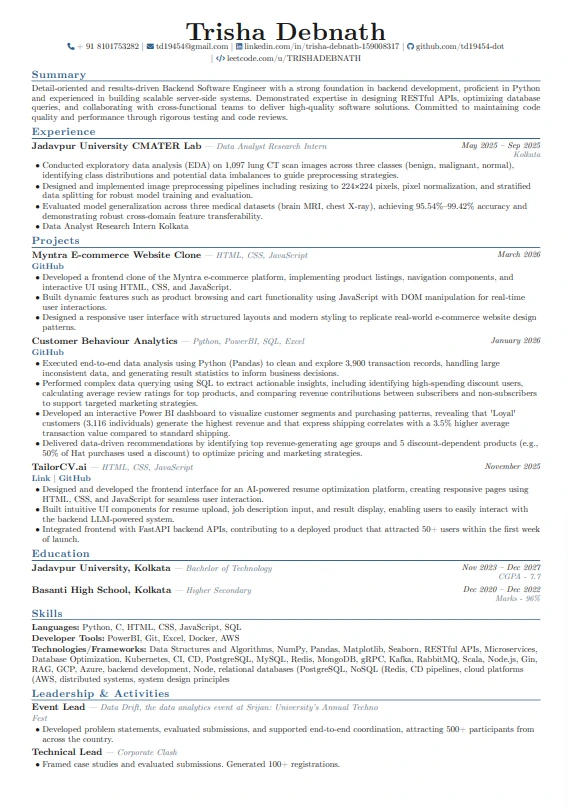
A layout that parses cleanly
Single column, standard headings, no text boxes — the formatting rules in this guide, already applied.
Was this guide useful?
Be the first to rate it.