SS
SS
Key Takeaways
- Canadian English mixes British and American spelling — "colour," "centre," and "labour" follow British form, but "organize" and "program" follow American form. A US spell-checker will silently wrong-foot the British-form words.
- "College" means something different here than in the US: a community or technical college granting diplomas, distinct from a university granting degrees — say which one you attended, since the words aren't interchangeable.
- Federal government applications (jobs.gc.ca) work nothing like private-sector hiring: you respond directly to listed "merit criteria" in your application text, and bilingual positions are scored on an official Second Language Evaluation (reading, writing, oral, each rated separately).
- One to two pages, no photo, outcomes over duties — this part matches US convention exactly.
- Running the document through an ATS check once catches formatting issues before they cost you weeks of silence.
The spelling split, with the actual words
Canadian English isn't a simple British-or-American choice — it's genuinely mixed, and knowing which specific words fall on which side is what makes this useful rather than a vague, unhelpful warning:
| Follows British form | Follows American form |
|---|---|
| colour, favour, labour, honour | organize, realize, analyze |
| centre, theatre | program (not "programme") |
| cheque, licence (noun) | tire (not "tyre") |
| travelled, cancelled (double L) | truck, gas, apartment (vocabulary) |
If you take a US resume template and run it through a default US spell-checker, "colour" becomes "color" and "centre" becomes "center" silently — the checker doesn't know it's supposed to be Canadian, and neither will the reader who notices later. Set your word processor's language to Canadian English (not just "English") before your final pass; it's a two-click fix that most applicants skip.
"College" doesn't mean what it means in the US
In Canadian usage, a college is a distinct institution type — typically a community or technical college awarding diplomas and certificates — separate from a university, which awards degrees. An American reader defaults to using "college" loosely for any post-secondary institution, including a four-year university. On a Canadian resume, naming the correct institution type isn't pedantry; it tells the reader something real about your credential (diploma vs. degree) that "college" alone, used the American way, would obscure.
A further wrinkle: some institutions blur the line deliberately. A number of larger colleges (Seneca, Humber, and others) now offer their own applied degree programs alongside traditional diplomas, and some universities run affiliated college-style applied programs. Where your specific credential sits — diploma, applied degree, or traditional degree — is what actually matters to a reader, more than which broad institution type issued it; state the credential type explicitly on your resume rather than relying on the institution's name alone to convey it.
Federal government applications run on a completely different process
Applying through jobs.gc.ca (the Government of Canada's job site) doesn't work like private-sector hiring. Postings list specific merit criteria — essential qualifications, sometimes asset qualifications — and you're expected to address each one directly, often in a separate written response rather than relying on your resume alone to make the case. Skipping a listed criterion, even one that seems implied by your resume, is a common way qualified candidates get screened out before a human ever compares candidates side by side.
Bilingual positions carry a formal language requirement, assessed through the Public Service's Second Language Evaluation — separate ratings for reading comprehension, written expression, and oral proficiency, each on its own scale. A posting listing a bilingual requirement expects you to know or find out your current standing on that evaluation, not just self-report "fluent" or "conversational" the way you might on a private-sector resume.
Don't confuse jobs.gc.ca with the Canada Job Bank (jobbank.gc.ca). They're different sites serving different purposes — jobs.gc.ca is specifically for federal public service positions and runs the merit-criteria process described above; the Job Bank is a general national employment portal covering private-sector and other public postings across the whole country, with a much more conventional application process. Searching only one when your target role is actually posted on the other is a common, easily-avoided mistake.
What's genuinely the same as US convention
Length: one to two pages for a graduate applicant, regardless of accumulated experience — a new grad with genuinely limited work history is better served by one focused page than stretching to two with padded descriptions; length should follow from actual content, not the other way around. No photo, no date of birth, no marital status — matching US and UK convention, and worth actively removing if you're adapting a resume originally built for a market where these details are conventional. Outcomes over duties: "resolved an average of forty customer enquiries daily, maintaining a satisfaction rating above ninety percent" beats "responsible for customer service," the same principle that improves a resume anywhere. Reverse chronological structure, with projects given real weight when work history is thin.
Mentioning your work permit status
Canadian graduates on a post-graduation work permit sometimes briefly note their open work authorization on the resume — genuinely useful information for an employer who isn't familiar with how the PGWP works, since it tells them upfront that no sponsorship is needed. This differs from US convention, where visa status is typically kept off the document entirely. It's a judgment call rather than a strict rule; a one-line mention ("Open work permit valid until [date]") near your contact details is the common approach when you choose to include it.
Structure that works
Contact details (name, phone, professional email, city and province — no full postal address) → optional three-to-four-line professional summary, specific rather than generic → Education, stating institution type (college or university) plainly → Work and internship experience, outcomes stated specifically → Projects, particularly valuable for technical graduates where something built and running outweighs a longer coursework list → Skills, specific and defensible → Language ability, including French proficiency where relevant, and your Second Language Evaluation rating if you're applying to a bilingual federal role and know it.
A specific note on GPA formatting. Canadian universities don't all use the same scale — some report on a 4.0 or 4.3 scale, others on a 9.0 scale, and some report a percentage average instead of a GPA at all. Stating a bare number like "3.7" without the scale it's measured on is genuinely ambiguous to a reader who doesn't know your specific institution's convention; write it as "3.7/4.0" or "8.2/9.0" explicitly, the same discipline that matters on any resume crossing between different grading conventions.
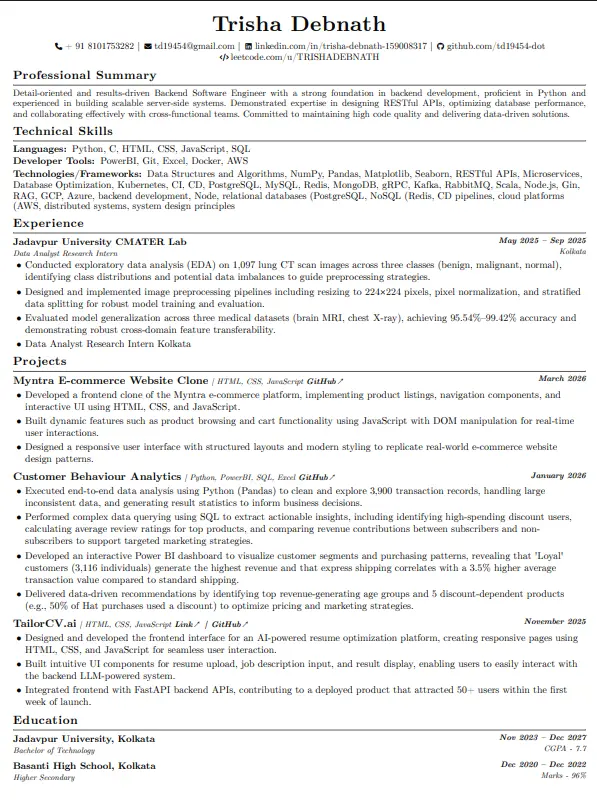
Your resume after optimization
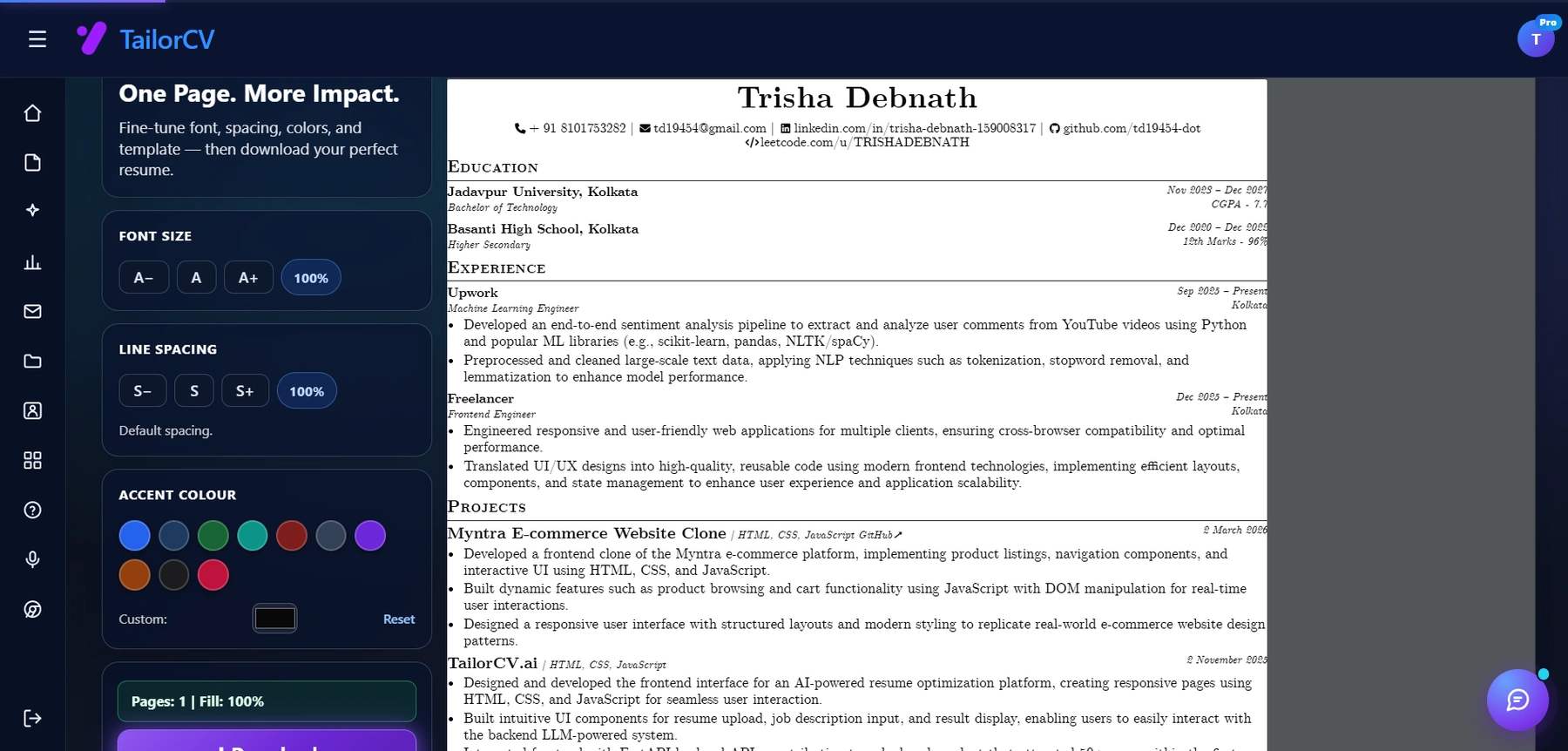
Font size, spacing, accent colour and template are all adjustable, with a live page counter — useful when a Canadian resume needs to stay within one to two pages.
Do's and Don'ts
Do
- Use Canadian spelling — colour, centre, labour — and set your word processor's language accordingly
- State plainly whether you attended a college or a university, since the words differ here
- Keep it to one to two pages with outcomes, not duties
- Address every listed merit criterion directly on a federal application
- Note your open work permit in one line if it helps the employer
Don't
- Run a US template through a default US spell-checker
- Use "college" loosely the American way
- Pad to two pages when one focused page says more
- Rely on your resume alone to imply you meet federal criteria
- Self-report "fluent" French without knowing your SLE rating
Tip: Set your word processor's language to English (Canada), not just English, before your final read-through. It is two clicks and it is the only thing that reliably catches "color" where you meant "colour" — a US spell-checker will silently undo Canadian spelling every time you edit.
Common Mistakes
- US spell-checker on a Canadian resume. Running a US resume template through a default US spell-checker. Silently converting "colour" to "color" and "centre" to "center" without you noticing.
- Using "college" the American way. Using "college" the American way when the institution was actually a Canadian university, or vice versa — the words carry different meaning here.
- Applying to a federal posting. Relying on the resume alone to imply you meet them.
- Self-reporting "fluent" or "conversational" French. Self-reporting "fluent" or "conversational" French for a bilingual federal role without knowing your actual Second Language Evaluation standing, when the role requires it.
- One generic document for every posting. Sending the same generic document to every posting instead of matching the language of each specific listing.
- Skipping an ATS check. Skipping an ATS check before sending out applications and finding out about a formatting problem only after weeks of silence.
Related Guides
Keep building on this with the related guides in this series:
- Canadian Bank Graduate Programs
- Canadian Cover Letters - When They Matter and How to Write One
- Express Entry for New Grads - How the Points System Actually Works
- Your First Canadian Job - Taxes, Benefits and Your First Payslip
- The French Language Advantage in the Canadian Job Market
- Federal and Provincial Government Jobs for Canadian Graduates
- Event Planner Resume Guide 2026
You can also check your resume's ATS score for free, generate a tailored cover letter, or build a portfolio website in minutes.
Frequently Asked Questions
Is Canadian spelling really different enough to matter?
Yes, and it's a specific, checkable difference — "colour," "centre," and "labour" follow British spelling while "organize" and "program" follow American spelling. Setting your word processor to Canadian English catches this in one pass.
What's the actual difference between a Canadian "college" and "university"?
A college typically grants diplomas and certificates through technical or applied programs; a university grants degrees. State which one you attended — the terms aren't interchangeable here the way "college" is used loosely in American English.
How is applying for a federal government job different?
You respond directly to specific listed merit criteria, often in a separate written response, rather than relying on your resume alone. Missing a listed criterion is a common reason qualified candidates get screened out early.
What does the Second Language Evaluation actually assess?
Reading comprehension, written expression, and oral proficiency, each rated separately, used to determine whether you meet a bilingual federal position's specific language requirement.
Should I mention my work permit on my resume?
It's a judgment call — a brief line noting your open work authorization is common and often well received, unlike the US norm of leaving visa status off entirely.
Do I need a French version of my resume?
Depends on the region and role — genuinely relevant for Quebec and many federal positions, worth confirming the specific expectation for your target posting directly.
What's the difference between jobs.gc.ca and the Job Bank?
jobs.gc.ca is specifically for federal public service hiring and runs on the merit-criteria process described above. The Job Bank (jobbank.gc.ca) is a general national employment portal for private-sector and other public postings, with a much more conventional application process — check both if you're not sure which one covers your target role.
Does your formatting survive the parser?
Upload your resume and see what an ATS actually reads back.
Drop your resume here or choose a file
PDF only. Max 2 MB.
We never share your data or use it to train AI models.

A layout that parses cleanly
Single column, standard headings, no text boxes — the formatting rules in this guide, already applied.
Was this guide useful?
Be the first to rate it.