 SS
SS
Key Takeaways
- The Turkish CV is typically one to two pages, in Turkish for domestic employers and English for international ones.
- Photographs remain common, more so at traditional employers than in technology.
- Military service status appears on Turkish CVs for male candidates and is a genuine convention rather than an oddity.
- Kariyer.net screens applications, so structure and keyword alignment matter.
- English proficiency is a clear differentiator and should be stated precisely and honestly.
What a Turkish CV contains
The expected structure.
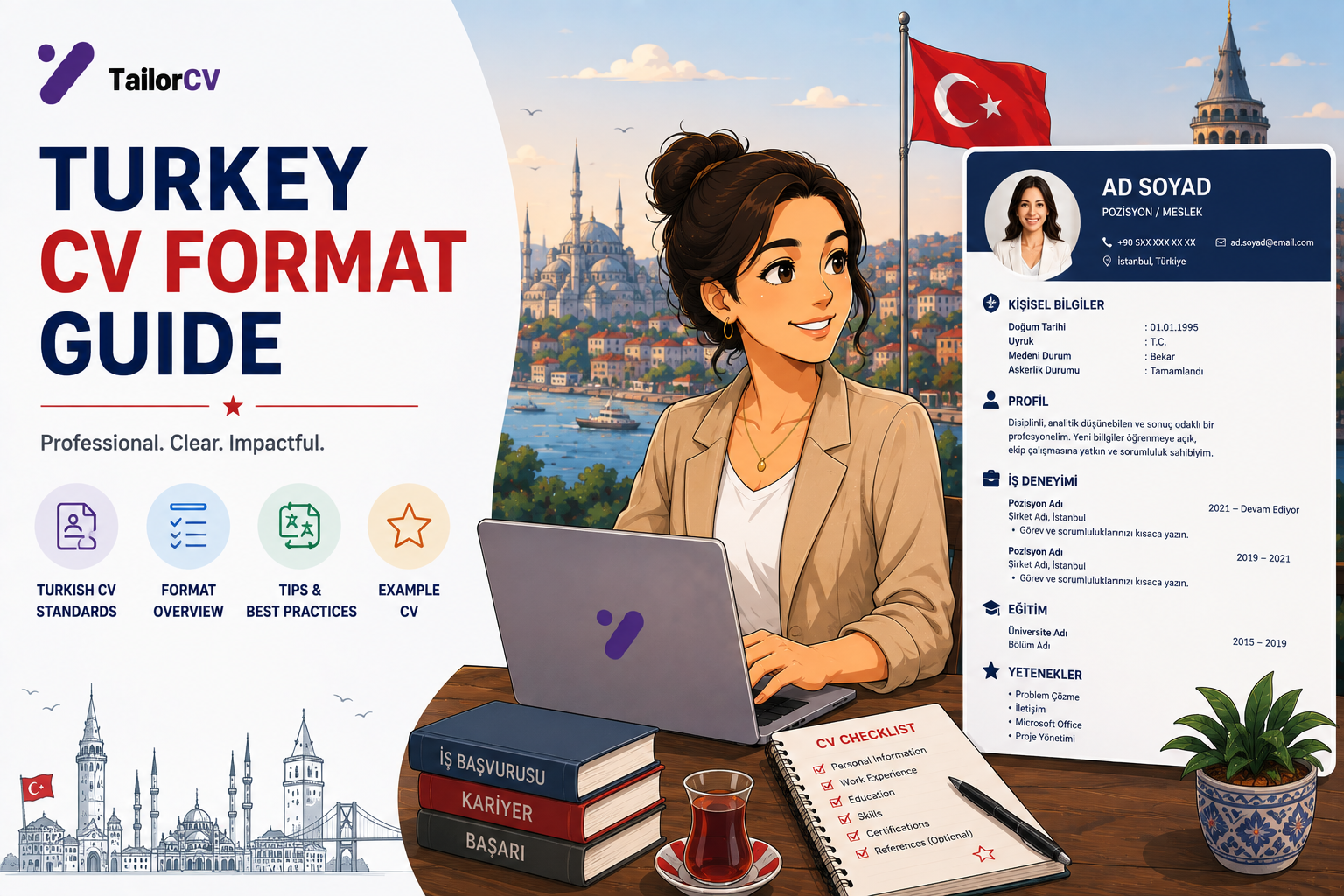
Kisisel bilgiler — name, city, phone, email and LinkedIn. Full address is no longer expected.
Ozet or profil — a short professional summary, standard at modern employers.
Is deneyimi in reverse chronological order with company, role, dates and achievements.
Egitim — degree, institution and year, with the university being recognised and read.
Yabanci diller — languages with explicit levels, read closely.
Sertifikalar ve kurslar — certifications and courses, which carry genuine weight.
Yetkinlikler — skills, technical and professional.
Askerlik durumu — military service status for male candidates, which is a genuine Turkish convention.
And referanslar, either listed or noted as available.
The military service convention
Worth explaining because it surprises foreign readers and matters domestically.
Military service is compulsory for Turkish male citizens, and employers ask about status because it affects availability.
Turkish CVs for male candidates commonly state it — completed, deferred, or exempt — and omitting it invites the question rather than avoiding it.
Deferred status matters to employers because it means a future absence of a defined length, and being straightforward about it is better than leaving it to be discovered.
Paid exemption arrangements have existed at various points and the current position varies, which is why status is stated rather than assumed.
Foreign candidates do not include this, and it does not apply.
And for applications to international companies, it is less commonly expected even from Turkish candidates, though including it does no harm.
Photographs and personal details
The conventions and where they are heading.
Photographs are common on Turkish CVs, particularly at traditional employers and in customer-facing sectors.
Technology companies and gaming studios increasingly do not expect one, following international practice.
Date of birth and marital status appear on traditional Turkish CVs and are declining.
The practical approach is to omit photographs and personal details for technology, gaming and international employers, and to consider a plain professional headshot for traditional and regional ones.
Never include your Turkish identification number, which is requested at hiring and has no place on a document sent to strangers.
And if uncertain, omit. No good employer rejects a strong candidate for the absence of a photograph, and the direction of travel is clear.
How Turkish screening works
The mechanics behind the document.
Kariyer.net is where much domestic hiring runs, and it parses and ranks applications before a human reads them.
Secretcv and Yenibiris operate similarly at smaller volume.
Larger employers run their own systems, particularly the corporates and manufacturers.
Which means standard ATS discipline applies — conventional section headings, clean structure, no text buried in images or complex tables, and terminology matching the posting.
Gaming studios read more directly and weight the portfolio far above the CV, which changes the priority entirely for that sector.
LinkedIn matters independently, and Turkish technology recruiters use it heavily.
Referrals bypass much of this, which is why the relationship-driven nature of Turkish professional life is worth engaging with.
Run an ATS check before submitting to anywhere that screens.
Writing the experience section
Where applications are decided.
Lead with achievement rather than responsibility.
Quantify — users, revenue, retention, volumes, percentage improvements. Turkish technology reviewers read numbers closely, and gaming reviewers read them very closely indeed.
Name specific tools, engines and systems, since employers screen on them.
Three to five bullets for recent roles, fewer for older ones.
Give one line of company context where the name will not be recognised.
Write natural Turkish rather than translating English action verbs literally, which produces stilted results.
And tailor each application — a tailored document consistently outperforms one generic version, and the difference is visible to the reader.
Education and certifications
Weighted meaningfully in this market.
The institution is read. Bogazici, METU, ITU, Bilkent, Koc and Sabanci carry particular weight, and Turkish employers recognise the hierarchy immediately.
Degree, department and year, with the department mattering as much as the degree in technical fields.
Certifications — cloud, project management, quality standards, engine-specific credentials — which are valued and worth listing prominently.
Language certificates supporting your stated levels, which matters because levels are checked.
Yuksek lisans and doctoral study, which carry real weight particularly in defence and research-adjacent sectors.
And ongoing study, which employers generally regard positively.
Turkish and international CVs compared
| Turkish CV | American resume | |
|---|---|---|
| Length | One to two pages | One page strongly preferred |
| Photograph | Still common, declining in tech | Never |
| Military service | Standard for male candidates | No equivalent |
| Personal details | Traditional, declining | Never |
| Language | Turkish, English for internationals | English |
| Languages section | Standard and read closely | Uncommon |
| University | Recognised and weighted heavily | Matters less after early career |
The practical implication is that a Turkish CV going to an international employer needs the photograph, personal details and military service line removed and the length compressed.
And an international resume coming into the Turkish market needs a languages section added, certifications listed more fully, and a decision on the photograph based on the specific employer.
The cover letter
Selectively worth doing.
On yazi is not universally expected and is read where offered.
Three or four paragraphs covering why this company, what you bring and what you want.
In Turkish for domestic employers, English for international ones.
Address a named person where you can identify one.
Reference something specific about the company, since generic letters read as generic everywhere.
And a tailored cover letter for applications that matter is worth the time, while a generic one attached to everything adds nothing.
Applying as a foreigner
The additional considerations.
Address the work permit directly. Turkish employers know the quota condition and will want to understand your position, and silence invites the least favourable assumption.
State your Turkish level honestly, and be clear if you have none, since it determines which roles are realistic.
Target the sectors where foreign hiring actually happens — gaming, international companies, technology and specialist roles — rather than the general market.
Explain why Turkiye, because a specific answer about the gaming cluster or the market reads far better than general interest.
Have any Turkish reviewed by a native speaker, since errors confirm the reviewer's existing concern.
And note that gaming is genuinely international, which makes it the most realistic entry point by a considerable margin.
Phrasing that marks a document as foreign
Small things Turkish reviewers notice.
Literally translated English action verbs, which produce Turkish that is grammatically correct and stylistically odd.
Job titles translated word for word rather than mapped to the Turkish equivalent, which can misrepresent seniority in either direction.
Degree names untranslated, where mapping to the closest Turkish equivalent helps the reader considerably.
Company names without context, since a well-known employer elsewhere means nothing here.
Date formats, where Turkish convention is day-month-year.
And addressing conventions, since Turkish professional address uses titles in ways that a directly translated cover letter frequently gets wrong.
A note on the gaming portfolio
Because for that sector the CV is secondary.
What you shipped — the title, the platform, the scale of the audience.
Your specific contribution, stated precisely rather than claiming credit for the whole product.
The numbers, since mobile gaming is a metrics-driven business and reviewers expect you to speak that language.
Playable or viewable work where you have it.
Your own projects and game jam entries, which count for genuinely more here than side projects do in most fields.
And a portfolio site that presents all of it cleanly, since studios will click and a well-organised presentation is itself a signal about how you work.
Regional and sector variation
Turkiye is not uniform and conventions differ.
Gaming studios and international technology companies follow international practice closely — English, no photograph, portfolio-led.
Istanbul corporates span the full range from very traditional to entirely modern.
Ankara and the public-adjacent sector including defence contractors are considerably more formal, with qualifications and institutions weighted heavily.
Manufacturing employers in Bursa, Kocaeli and Izmir tend conservative, with certifications and technical qualifications mattering most.
And the practical response is to read the employer rather than the country — look at their careers page, their LinkedIn presence and how the posting itself is written, and match that register.
Mini checklist
- unchecked: Written in Turkish for domestic employers
- unchecked: English version prepared for international ones
- unchecked: One to two pages
- unchecked: Photograph decision made per employer
- unchecked: Identification number omitted
- unchecked: Military service status included if applicable
- unchecked: Language levels stated honestly
- unchecked: Certifications listed
- unchecked: ATS check run before submitting
Scenarios
Scenario 1: You are applying to a gaming studio
Prepare it in English, omit the photograph, lead with shipped titles and your specific contribution, and treat the portfolio as the primary document rather than the CV.
Scenario 2: You are applying to a traditional Turkish employer
A more conservative format applies, a photograph is more likely to be expected, and formal qualifications and the institution you attended carry proportionally more weight.
Scenario 3: You are a foreigner applying in Turkiye
Write in English unless you can produce genuinely good Turkish, state your Turkish level honestly, and address your work permit position directly since the employer will need to sponsor it.
Tip: Never put your Turkish identification number on a CV. It is requested at the hiring stage, it adds nothing to an application, and putting it on a document you send to strangers is an unnecessary exposure.
Do's and Don'ts
Do
- Write in Turkish for domestic employers
- Prepare an English version for international ones
- State language levels honestly
- Include military service status where it applies
- List certifications and named tools
- Run an ATS check before submitting
Don't
- Include your identification number
- Overstate your English
- Add a photograph to a technology application by default
- Include marital status or date of birth
- Exceed two pages
- Send an obviously translated document
Common Mistakes
- Including the identification number. Unnecessary and a genuine exposure.
- Overstating English. It is tested at international employers.
- Omitting military service status. It invites the question rather than avoiding it.
- Photograph by default. Increasingly unwelcome in technology.
- Ignoring Kariyer.net screening. Structure matters where systems parse first.
- Generic applications. Turkish reviewers notice specificity like anyone else.
Related Guides
Keep building on this with the related guides in this series:
- Working in Turkiye as a Foreign Professional
- Turkiye Work Permits Explained
- Technology and Startup Jobs in Istanbul
- The Mexican Curriculum Vitae Format
- The Brazilian Curriculo and Resume Format
You can also check your resume's ATS score for free, generate a tailored cover letter, or build a portfolio website in minutes.
Frequently Asked Questions
Should I include a photograph on a Turkish CV?
It depends on the employer. Technology companies and gaming studios increasingly do not expect one; traditional and customer-facing employers still commonly do.
Why does military service appear on Turkish CVs?
Service is compulsory for Turkish male citizens and status affects availability, so employers ask. Stating it is better than leaving it to be raised.
Should I write in Turkish or English?
Turkish for domestic employers, English for gaming studios, international companies and anywhere the posting is in English.
How long should a Turkish CV be?
One to two pages. The convention favours brevity and longer documents are read less carefully.
Do Turkish employers use screening systems?
Yes. Kariyer.net and the larger employers parse and rank applications, which makes clean structure and keyword alignment worth the effort.
Should I include my identification number?
No. It is requested at the hiring stage and putting it on an application document is an unnecessary exposure with no benefit.
Do Turkish employers use applicant tracking systems?
Yes. Kariyer.net handles much domestic hiring and parses and ranks applications before a human reads them, and larger employers run their own systems.
Does the university matter in Turkiye?
Considerably. Bogazici, METU, ITU, Bilkent, Koc and Sabanci carry particular weight and Turkish employers recognise the hierarchy immediately, with the department mattering as much as the degree in technical fields.
How does a Turkish CV differ from an American resume?
It runs one to two pages, may carry a photograph, includes military service status for male candidates, has a languages section read closely, and weights the university considerably more heavily.
Should I write a cover letter for Turkish applications?
Not universally expected and read where offered. Three or four paragraphs, in Turkish for domestic employers and English for international ones, addressed to a named person where possible.
What matters most for a games industry application in Turkiye?
The portfolio rather than the CV — what you shipped, your specific contribution stated precisely, the numbers, and playable or viewable work including personal projects and game jam entries.
Does your formatting survive the parser?
Upload your resume and see what an ATS actually reads back.
Drop your resume here or choose a file
PDF only. Max 2 MB.
We never share your data or use it to train AI models.

Was this guide useful?
Be the first to rate it.