 SS
SS
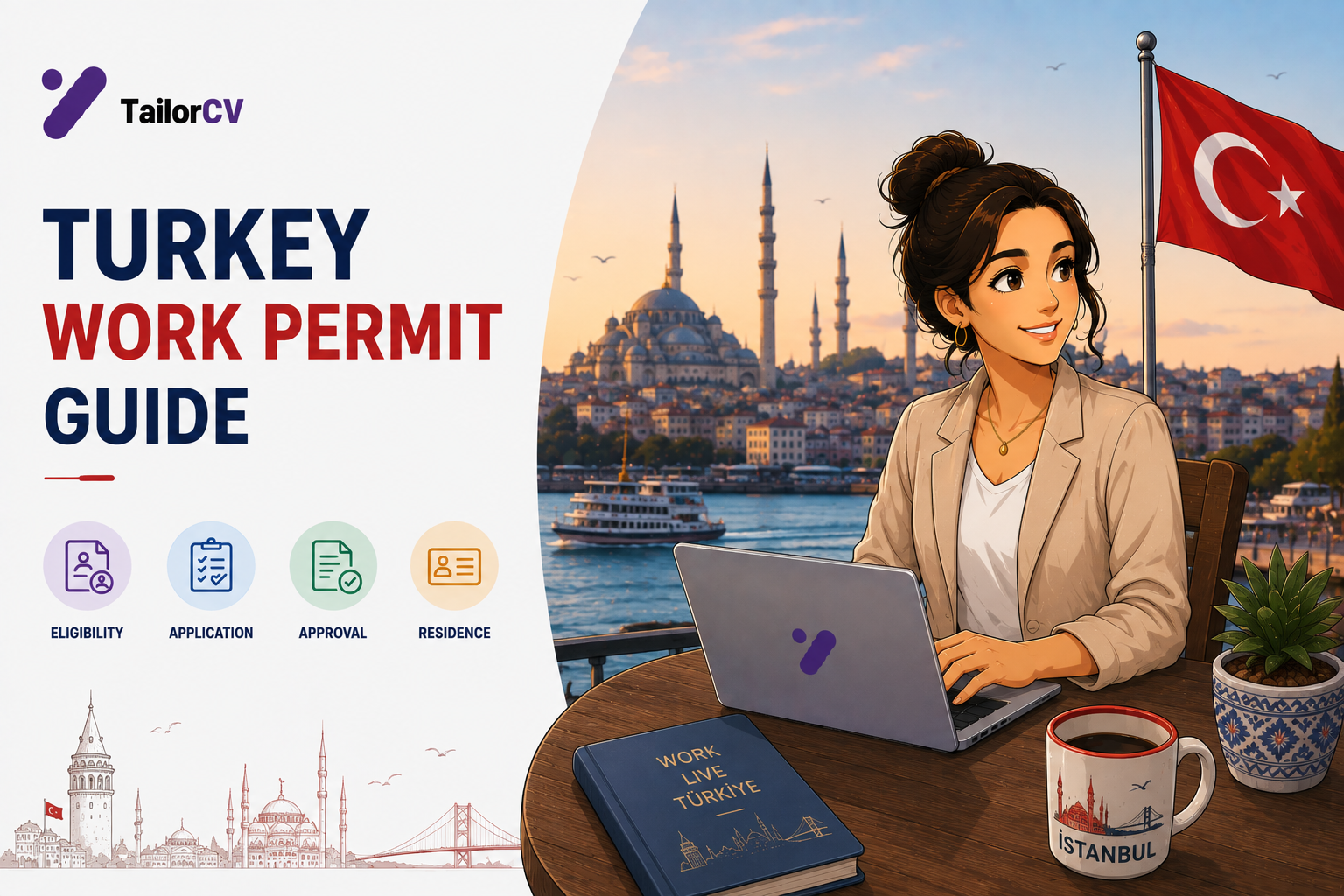
Key Takeaways
- Work permits are applied for by the employer through the Ministry of Labour and Social Security.
- Quota conditions generally require a ratio of Turkish employees to each foreign worker, which small employers frequently cannot meet.
- Minimum salary conditions are set as multiples of the minimum wage and vary by occupation.
- The work permit doubles as a residence permit, which simplifies the picture considerably.
- The Turquoise Card offers indefinite work rights for qualified applicants in defined categories.
How the standard process works
The employment route.
Your employer applies to the Ministry of Labour and Social Security, either from within Turkiye or with you applying at a Turkish consulate abroad in parallel.
The employer must meet conditions, principally a ratio of Turkish employees per foreign worker and a paid-in capital or turnover threshold, with exemptions for certain categories.
A minimum salary applies, expressed as a multiple of the Turkish minimum wage and set higher for senior and specialist occupations than for general ones.
Documents are submitted electronically through the ministry system, with the employer holding responsibility for the filing.
A decision issues within a period that varies with completeness and category.
The permit is employer and role specific and does not transfer, meaning a change of employer requires a new application.
And the permit serves as a residence permit for its duration, which removes a step that most comparable countries require separately.
The conditions that decide applications
Where most refusals originate.
The employment ratio is the most common obstacle. Employers generally need a defined number of Turkish employees registered with social security for each foreign worker they employ, which means small companies and early-stage startups frequently cannot sponsor even when they genuinely want to.
Exemptions exist for certain categories including some professions, spouses of Turkish citizens, and specific arrangements.
The capital or turnover condition requires the employer to demonstrate a threshold of paid-in capital, gross sales or exports.
The salary condition varies by occupation, with senior management, engineering and specialist roles requiring higher multiples of the minimum wage.
Occupation-specific restrictions apply, and certain professions are reserved for Turkish citizens under specific legislation.
Which means the single most useful question you can ask a prospective Turkish employer is whether they have sponsored a foreign worker before, because the conditions are genuinely restrictive and enthusiasm is not the same as capability.
The Turquoise Card
Turkiye's route for qualified professionals.
It offers indefinite work rights rather than a fixed-term employer-tied permit.
Eligible categories include highly qualified professionals, those with recognised achievements in science, culture, art or sport, investors making a defined contribution, and people whose activities are assessed as strategically valuable.
A transition period applies before it becomes indefinite, during which conditions are monitored.
Family members receive corresponding rights.
It is discretionary rather than points-based in the way several European schemes are, which makes the outcome harder to predict.
And it remains relatively little used compared with the standard permit, which means fewer people know how it works in practice.
Documents and preparation
What the process requires.
Passport with adequate validity, and a translated notarised copy where requested.
Employment contract signed by both parties.
Qualification certificates, apostilled in the issuing country.
Diploma equivalence through the Council of Higher Education where the role or profession requires it, which is a separate process worth starting early.
Photographs to specification.
Employer documents including trade registry records, tax and social security compliance evidence and the capital or turnover demonstration, all of which the employer provides.
Sworn translation into Turkish where required, by a translator recognised for the purpose.
And fees, payable at permit issue and again on renewal.
Start the apostille and equivalence steps first, since they sit outside the employer's control and routinely take longer than expected.
Other routes
Beyond standard employment.
Spouse of a Turkish citizen, which carries exemptions from several of the standard conditions and is a considerably simpler position.
Independent work permit, available to foreigners meeting long-term residence and other conditions, which permits self-employment.
Student work rights, limited and defined, with different provisions for undergraduate and postgraduate students.
Investment-based residence, including the property investment route which has a defined threshold and has been widely used.
Citizenship by investment, which Turkiye operates with a property or capital investment threshold and which is one of the better-known such programmes.
Academic and research appointments, which have their own provisions.
And short-term assignment arrangements for specific temporary work, which sit outside the standard permit.
Family members
The arrangements that follow.
Spouses and dependent children can obtain residence permits on the basis of your work permit.
A spouse's right to work is separate and requires their own work permit through their own employer, subject to the same conditions.
After a qualifying period of residence, family members may become eligible to apply for their own permits under more favourable conditions.
Schooling is available through a substantial international and private school sector in Istanbul and Ankara, with Turkish public education being free.
Healthcare through SGK for registered dependants, with private insurance being common and the private hospital sector being genuinely good.
And documents for family members require the same apostille and sworn translation treatment as your own, which is where family applications usually stall.
Restricted professions
The barrier that catches qualified people.
Certain professions are reserved for Turkish citizens under specific legislation, and this is a hard constraint rather than an administrative preference.
The affected fields have historically included several licensed professions, and the position on each should be confirmed rather than assumed.
Healthcare and legal practice carry particular restrictions and licensing requirements.
Engineering and architecture require chamber registration, which has its own conditions for foreign nationals.
Technology and most business roles are unrestricted, which is why foreign hiring concentrates there.
Diploma equivalence through the Council of Higher Education is a separate requirement from any of this and applies where a Turkish-recognised qualification is needed.
Check the specific profession with the relevant chamber or regulatory body before making any plan that depends on practising it.
Long-term status
Where the route leads.
Long-term residence becomes available after a qualifying period of continuous legal residence, subject to conditions including means and health insurance.
It carries broader rights than a work permit and removes the employer tie.
Independent work permits become accessible to those meeting long-term residence conditions, permitting self-employment.
Citizenship by naturalisation becomes available after a qualifying residence period, with Turkish language capability among the requirements.
Citizenship by investment operates as a separate and considerably faster route with a property or capital threshold, and it is one of the more widely used programmes of its kind.
Turkiye permits dual citizenship in practice for those acquiring it.
And the Turkish passport carries reasonably broad visa-free access, which is part of why the investment programme has attracted the interest it has.
Where to verify
Requirements change and this article should be checked against the sources.
The Ministry of Labour and Social Security for work permit categories, quota and salary conditions.
The Directorate General of Migration Management for residence permits and long-term status.
The Council of Higher Education for diploma equivalence.
The relevant professional chamber for restricted professions and registration requirements.
SGK for social security registration and entitlements.
And e-Devlet, which handles a wide range of administration once you hold the credentials.
Route comparison
Setting the options side by side.
| Route | Who it suits | Work rights |
|---|---|---|
| Standard work permit | Employed professionals with an offer | Yes, employer and role specific |
| Turquoise Card | Highly qualified, recognised achievers, investors | Indefinite after transition |
| Independent work permit | Long-term residents meeting conditions | Yes, including self-employment |
| Spouse of a Turkish citizen | Married to a citizen | Exemptions from several conditions |
| Student | Enrolled students | Limited and defined |
| Investment residence | Property or capital investors | Residence, work applied for separately |
The standard permit is the default, and the quota condition is what determines whether it is available at a given employer rather than anything about you.
The Turquoise Card is the underused option, worth investigating by anyone who might plausibly qualify given how much it changes the employer relationship.
Common problems
What actually goes wrong.
The employer fails the quota condition. By far the most common cause of refusal, and it has nothing to do with the candidate.
The salary falls below the occupation minimum, which is checked against the stated role.
Diploma equivalence is missing where the role or profession requires it.
Documents are not apostilled or the translation is not by a recognised translator.
Starting work before issue, which creates exposure for both parties.
Late renewal, which turns a routine step into a problem.
And assuming portability, since a change of employer requires an entirely new application rather than a transfer.
Mini checklist
- unchecked: Employer confirmed as meeting the quota condition
- unchecked: Salary confirmed as meeting the minimum for your occupation
- unchecked: Occupation checked against restricted professions
- unchecked: Turquoise Card eligibility considered
- unchecked: Documents apostilled and translated
- unchecked: Diploma equivalence checked if required
- unchecked: Consular route confirmed if applying from abroad
- unchecked: Renewal timeline understood
- unchecked: Family arrangements planned
Scenarios
Scenario 1: You have an offer from a large Turkish company
The standard employer-sponsored route applies and a large employer will comfortably meet the quota and capital conditions. Confirm the salary meets the minimum for your occupation category.
Scenario 2: You have an offer from a startup
Ask about the employment ratio before anything else. Early-stage companies frequently cannot meet the Turkish-employee condition, and this stops applications that would otherwise be straightforward.
Scenario 3: You are highly qualified in a recognised field
The Turquoise Card is worth investigating, since it offers indefinite work rights and removes the employer tie that shapes the standard permit.
Tip: Ask a prospective Turkish employer whether they have sponsored a foreign worker before, and specifically whether they meet the Turkish-employee ratio. It is the most common reason applications fail, and it stops small and early-stage employers regardless of how much they want to hire you.
Do's and Don'ts
Do
- Confirm the employer meets the quota condition
- Check the minimum salary for your occupation
- Investigate the Turquoise Card if you qualify
- Apostille and translate documents early
- Check whether your profession is restricted
- Plan renewals well ahead
Don't
- Assume any employer can sponsor
- Work before the permit issues
- Assume the permit transfers between employers
- Overlook diploma equivalence requirements
- Rely on outdated summaries of the conditions
- Ignore the separate residence position of family members
Common Mistakes
- Ignoring the employment ratio. The most common single reason applications fail.
- Assuming portability. Permits are employer and role specific.
- Missing the salary minimum. It varies by occupation and is checked.
- Overlooking restricted professions. Some are reserved for Turkish citizens.
- Late document authentication. The usual cause of delay.
- Not considering the Turquoise Card. Underused by people who would qualify.
Related Guides
Keep building on this with the related guides in this series:
- Working in Turkiye as a Foreign Professional
- Technology and Startup Jobs in Istanbul
- The Turkish CV Format
- Mexico Work Visas Explained
- Brazil Work Visas Explained
You can also check your resume's ATS score for free, generate a tailored cover letter, or build a portfolio website in minutes.
Frequently Asked Questions
Who applies for a Turkish work permit?
The employer, through the Ministry of Labour and Social Security. You cannot apply independently on the standard route.
What is the employment ratio condition?
Employers generally need a defined number of Turkish employees registered with social security for each foreign worker, which small companies and startups frequently cannot meet.
Is there a minimum salary?
Yes, expressed as a multiple of the Turkish minimum wage and set higher for senior management, engineering and specialist occupations than for general roles.
Do I need a separate residence permit?
No. The work permit functions as a residence permit for its duration, which is a genuine simplification compared with many countries.
What is the Turquoise Card?
A route offering indefinite work rights for highly qualified professionals, recognised achievers, investors and strategically valuable applicants, following a monitored transition period.
Can I change employers?
Not by transfer. The permit is employer and role specific, and a change requires a new application by the new employer.
What documents does a Turkish work permit need?
Passport, signed employment contract, apostilled qualification certificates, diploma equivalence where required, and employer documents covering trade registry, tax and social security compliance and the capital condition.
Can my family join me in Turkiye?
Spouses and dependent children can obtain residence permits based on your work permit. A spouse's right to work is separate and requires their own permit through their own employer.
Which professions are restricted in Turkiye?
Several licensed professions are reserved for Turkish citizens under specific legislation, with healthcare and legal practice carrying particular restrictions. Technology and most business roles are unrestricted.
Can I get long-term residence in Turkiye?
Yes, after a qualifying period of continuous legal residence subject to means and health insurance conditions. It removes the employer tie and opens independent work permits.
What is the most common reason Turkish work permits are refused?
The employer failing the Turkish-employee quota condition, which has nothing to do with the candidate and stops small and early-stage employers regardless of intent.
What is your resume scoring right now?
Scan it against a job description and get your ATS match score in about a minute.
Drop your resume here or choose a file
PDF only. Max 2 MB.
We never share your data or use it to train AI models.

Was this guide useful?
Be the first to rate it.