 SS
SS
Key Takeaways
- The Brazilian curriculo is typically one to two pages, written in Portuguese, and more personal in content than an American resume.
- Photographs and some personal details are still common, though the practice is shifting at the larger and more international employers.
- Gupy and similar platforms screen applications, so structure and keyword alignment genuinely matter.
- Portuguese matters more than polish — a naturally written Portuguese CV beats an obviously translated one.
- Language levels are stated explicitly and English proficiency is a genuine differentiator in the Brazilian market.
What a curriculo contains
The expected structure.
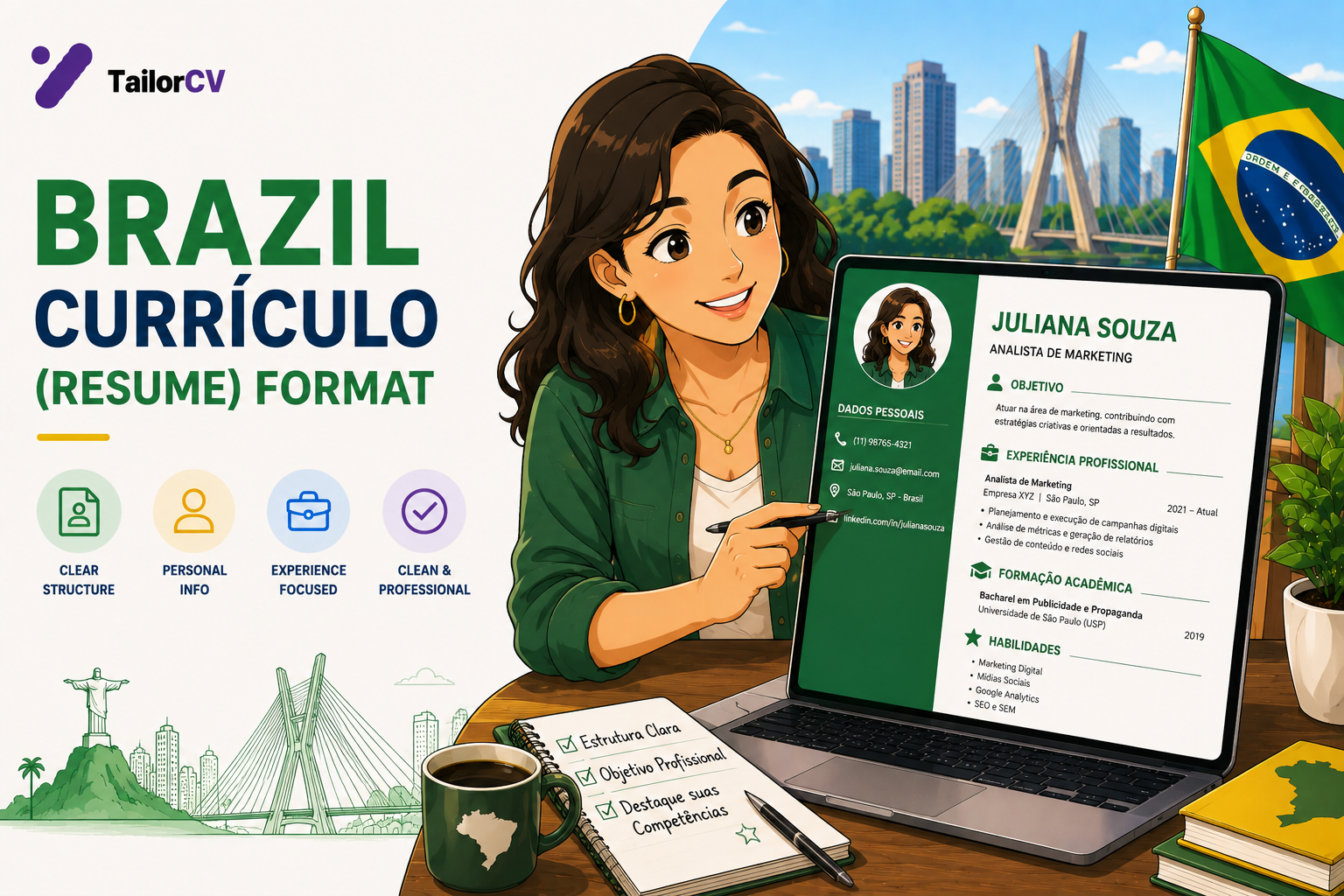
Dados pessoais — name, city and state, phone, email, LinkedIn. Full address is no longer expected and city and state remain standard.
Objetivo or resumo profissional — a short professional summary, which has largely replaced the older objective statement at the better employers.
Experiencia profissional in reverse chronological order, with company, role, dates and achievements.
Formacao academica — degree, institution, completion year.
Idiomas — languages with explicit levels, which Brazilian employers read closely.
Cursos e certificacoes — courses and certifications, which carry genuine weight.
Habilidades or competencias — skills, technical and otherwise.
And sometimes voluntary work, publications or additional information, depending on relevance.
The photograph question
A genuine point of divergence from Anglo-American practice.
Photographs remain common on Brazilian CVs, more so at traditional employers and less so at international and technology companies.
Some personal details still appear — marital status, date of birth, nationality — though this is declining and increasingly regarded as outdated at the better employers.
The direction of travel is clear. Larger and more international companies are moving away from photographs and personal details, partly on diversity grounds and partly following international practice.
Practically, the safe approach is to omit the photograph when applying to technology companies, multinationals and anywhere with a stated diversity policy, and to consider including it for traditional sectors and smaller regional employers.
Do not include marital status, date of birth or a national ID number unless specifically requested. It adds nothing and it dates the document.
And if you do include a photograph, make it a plain professional headshot rather than anything casual.
Writing in Portuguese
The part that decides most applications.
Write in Portuguese unless the posting is explicitly in English, in which case follow the posting.
Brazilian Portuguese specifically, since European Portuguese vocabulary and spelling read as foreign to a Brazilian reviewer.
A translated CV reads as translated, and it is noticeable. Having a native speaker review it is worth more than any amount of formatting work.
Avoid the temptation to translate American resume conventions literally. Some Anglo-American phrasing does not carry, and calqued expressions stand out badly.
Keep it clean and factual rather than heavily promotional, since Brazilian professional writing is somewhat less superlative-heavy than American practice.
And state your language levels precisely — basico, intermediario, avancado, fluente — because Brazilian employers read these carefully and overstating English is a common and costly error that gets tested at interview.
How Brazilian screening works
The mechanics behind the document.
Gupy is the platform much large-employer hiring runs through, and it parses and ranks applications before a human sees them.
Which means the same discipline that applies to any ATS applies here — clean structure, standard section headings, no text buried in images or tables, and terminology that matches the posting.
Vagas.com, Catho and InfoJobs run their own systems with similar characteristics.
Smaller employers read directly, and the document should work for both cases.
LinkedIn matters independently and Brazilian recruiters use it heavily, so the profile should be as carefully written as the CV and in Portuguese.
Referrals bypass much of this, which is why the relationship-driven nature of the Brazilian market is worth engaging with rather than working around.
Run an ATS check before submitting anywhere that screens, since a document that parses badly never reaches the reviewer whose opinion you wanted.
Writing the experience section
Where most CVs are won or lost.
Lead each role with what it was, then what you achieved rather than what you were responsible for.
Quantify — team size, budget, users, volume, percentage improvement. Brazilian reviewers read numbers as readily as anyone.
Three to five bullets per recent role, fewer for older ones.
Use active verbs in Portuguese naturally rather than translating English action verbs literally, which produces stilted results.
Include company context where the employer will not recognise the name, since a one-line description of what the company does costs little and helps considerably.
Explain gaps briefly rather than leaving them unaddressed.
And tailor to the posting. A tailored version for each significant application outperforms one generic document sent everywhere, and Brazilian reviewers notice specificity as much as anyone.
Certifications and education
Weighted differently here than in some markets.
Formal qualifications carry real weight, and the institution is recognised and read.
Pos-graduacao, MBA and specialisation courses are common and valued, with the Brazilian MBA being a broader category than the American one and generally shorter and less selective.
Technical certifications — cloud, project management, data, security — are genuinely valued and worth listing prominently.
Courses from recognised institutions, including short courses, appear on Brazilian CVs more readily than on American ones and are not regarded as padding.
Language certificates where you hold them, since they support the levels you claim.
And ongoing study is worth stating, since Brazilian employers generally regard continuing education positively.
Brazilian and international CVs compared
| Brazilian curriculo | American resume | |
|---|---|---|
| Length | One to two pages | One page strongly preferred |
| Photograph | Still common, declining | Never |
| Personal details | Sometimes present, declining | Never |
| Language | Portuguese | English |
| Courses | Listed readily and valued | Only if significant |
| Tone | Factual, less superlative | Achievement-forward, promotional |
| Languages section | Standard and read closely | Uncommon unless relevant |
The practical implication is that an American resume can be adapted rather than rewritten, but the adaptation is more than translation — the courses section, the languages section and the tone all need genuine attention.
And the reverse applies. A Brazilian professional applying abroad should strip the photograph and personal details, compress to one page and shift the tone toward achievement, since what reads as appropriately factual in Brazil can read as underselling elsewhere.
The cover letter
Less standard than in some markets and still worth doing.
Carta de apresentacao is not universally expected and it is not ignored where offered.
Keep it short — three or four paragraphs covering why this company, what you bring and what you want.
Write it in Portuguese to match the application.
Address a person where you can identify one, which matters more in a relationship-driven market.
Reference something specific about the company, since generic letters are visibly generic.
And a tailored cover letter for the roles you actually care about is worth the time, while a generic one attached to every application adds nothing.
Applying as a foreigner
The additional considerations.
Address work authorisation directly. Every Brazilian reviewer will wonder, and leaving it unstated invites the least favourable assumption.
State your Portuguese level honestly and prominently, since it is the first practical question.
Explain why Brazil, because employers ask and a specific answer about the market or the sector is far stronger than general enthusiasm.
Have the Portuguese reviewed by a native speaker — this matters more for a foreign applicant than for anyone else, since errors confirm the concern the reviewer already has.
Include international experience as an asset where it is relevant, since Brazilian employers value it particularly in export-facing and multinational contexts.
And be realistic about the categories where foreign hiring actually happens — senior specialist roles, multinational transfers and genuinely scarce skills, rather than general graduate positions where the local pool is deep.
Common phrasing that does not translate
Small things that mark a document as foreign.
Literal translations of American action verbs frequently produce Portuguese that is grammatically correct and stylistically odd.
"Objetivo" as a bare aspiration reads as dated at the better employers, where a professional summary has replaced it.
Job titles translated word for word rather than mapped to the Brazilian equivalent, which can make a senior role read as junior or vice versa.
Company names without context, where a well-known employer in your country means nothing to a Brazilian reviewer.
Degree names translated literally rather than mapped to the closest Brazilian equivalent, which is worth doing explicitly.
And date formats, since Brazilian convention is day-month-year and mixing conventions in one document looks careless.
Mini checklist
- unchecked: Written in Brazilian Portuguese
- unchecked: One to two pages
- unchecked: Native speaker review completed
- unchecked: Photograph decision made for the specific employer
- unchecked: Marital status and date of birth omitted
- unchecked: Language levels stated honestly
- unchecked: Certifications included
- unchecked: Keywords matched to the posting
- unchecked: ATS check run before submitting
Scenarios
Scenario 1: You are applying to a fintech or technology company
Omit the photograph and personal details, write in clean Brazilian Portuguese, lead with a professional summary and quantify your achievements. This is closest to international practice.
Scenario 2: You are applying to a traditional or regional employer
A photograph is more likely to be expected, the format is more conservative, and certifications and formal qualifications carry proportionally more weight.
Scenario 3: You are a foreigner applying to a Brazilian company
Write in Portuguese, state your Portuguese level honestly, and address your work authorisation position directly, since it is the first question every reviewer will have.
Tip: State your English level honestly. Brazilian employers read the idiomas section carefully and they will test it at interview. Claiming fluente and then struggling in an English round is one of the most common and most damaging errors in this market.
Do's and Don'ts
Do
- Write in Brazilian Portuguese
- Have a native speaker review it
- State language levels precisely
- Include certifications
- Match keywords to the posting
- Run an ATS check before submitting
Don't
- Submit an obviously translated document
- Include marital status or date of birth
- Overstate your English level
- Use European Portuguese spelling and vocabulary
- Add a photograph to a technology company application by default
- Exceed two pages
Common Mistakes
- Overstating English. It gets tested and the damage is immediate.
- An obviously translated CV. Reviewers notice and it undermines everything else.
- Including a photograph everywhere. Increasingly outdated at the better employers.
- European Portuguese. Reads as foreign to a Brazilian reviewer.
- Omitting certifications. They carry genuine weight in this market.
- Ignoring the platform. Gupy screens, and structure matters accordingly.
Related Guides
Keep building on this with the related guides in this series:
- Working in Brazil as an International Graduate
- Technology Jobs in Sao Paulo
- Brazil Work Visas Explained
- Startup and Fintech Careers in Brazil
- The Mexican Curriculum Vitae Format
- Dental Hygienist Resume Guide 2026
You can also check your resume's ATS score for free, generate a tailored cover letter, or build a portfolio website in minutes.
Frequently Asked Questions
Should I put a photograph on a Brazilian CV?
It depends on the employer. Technology companies and multinationals increasingly do not expect one; traditional and regional employers still commonly do.
How long should a curriculo be?
One to two pages. Longer documents are read less carefully and the convention is firmly toward brevity.
Should I write in Portuguese or English?
Portuguese unless the posting is explicitly in English. A naturally written Portuguese CV substantially outperforms an obviously translated one.
Do I include marital status and date of birth?
Not unless specifically requested. The practice is declining and it dates the document at the better employers.
How should I state language levels?
Precisely and honestly, using the standard scale. Brazilian employers read this section carefully and test claimed proficiency at interview.
Does Gupy screen applications?
Yes. Much large-employer hiring in Brazil runs through it, which makes clean structure and keyword alignment with the posting genuinely worth the effort.
Does Brazil use applicant tracking systems?
Yes. Gupy in particular handles much large-employer hiring and parses and ranks applications before a human reviews them, alongside Vagas.com, Catho and InfoJobs.
How much weight do certifications carry?
Considerable. Technical certifications, specialisation courses and pos-graduacao are genuinely valued and appear on Brazilian CVs more readily than on American ones without being read as padding.
How does a Brazilian CV differ from an American resume?
It runs one to two pages, still sometimes carries a photograph, lists courses readily, includes a languages section read closely, and uses a more factual and less promotional tone.
Should I write a cover letter for Brazilian applications?
It is not universally expected and it is not ignored. Keep it to three or four paragraphs in Portuguese, address a named person where you can, and reference something specific about the company.
Does your formatting survive the parser?
Upload your resume and see what an ATS actually reads back.
Drop your resume here or choose a file
PDF only. Max 2 MB.
We never share your data or use it to train AI models.

Was this guide useful?
Be the first to rate it.