 TD
TD
Key Takeaways
- Your Iqama — the residence permit — is sponsored by your employer, and it is your identity document for everything in the kingdom.
- Labour reforms substantially loosened job mobility, allowing transfers between employers and easing exit and re-entry requirements under defined conditions.
- The Premium Residency scheme allows qualifying individuals to live and work without an employer sponsor, which is genuinely unusual for the region.
- Qualification attestation is mandatory and is the step most likely to delay your start date.
- Professional accreditation is required for many regulated fields, and it takes real time.
The Iqama and the basic structure
Your employer sponsors your work visa and your Iqama. The employer applies, you receive an entry visa, and after arrival and a medical examination the Iqama is issued.
The Iqama is your identity document. Banking, phone contracts, renting, travel within the country and essentially every transaction depend on it.
It is renewed annually in most cases, by the employer, and lapsing has real consequences.
Family sponsorship is available at defined salary levels and job categories, allowing you to bring a spouse and children on dependent Iqamas.
Dependent Iqamas carry fees, which are a genuine and sometimes substantial recurring cost for a family — worth including in your package calculation rather than discovering later.
Exit and re-entry historically required employer permission via a permit. Reforms have eased this considerably, and workers can now generally manage exit and re-entry under defined conditions rather than depending on employer approval each time.
What the reforms changed
The Labour Reform Initiative changed the picture meaningfully.
Job mobility. Workers may transfer to a new employer under defined conditions — typically after completing a period with the current employer and observing notice — without requiring the current employer's consent in the way previously needed.
Exit and re-entry visas were eased, giving workers more control over travel.
Final exit procedures were similarly reformed.
Contract documentation was digitised through government platforms, with contracts registered and accessible to the employee — which matters because a documented contract is what gives you standing in a dispute.
What remains: the Iqama is employer-sponsored, so employment and residency are still linked, and ending a job has immigration consequences within a defined period.
And the practical point: much online writing about working in Saudi Arabia predates these reforms and describes a considerably more restrictive system than the current one. Check the date on anything you read.
Premium Residency
The route that genuinely differs from the rest of the region's norm.
Premium Residency allows qualifying individuals to live and work in Saudi Arabia without an employer sponsor. That is a substantial departure from the standard Gulf model.
Categories have been expanded over time and include options based on investment, property ownership, entrepreneurship, and — importantly — specialised talent and distinguished expertise.
Holders can generally sponsor their own families, own property under defined conditions, move between employers freely, and enter and exit without the usual permissions.
There are permanent and renewable variants with different requirements and costs.
For a highly qualified professional who intends to be in the kingdom for a long period, this is worth understanding early rather than discovering after several years on a standard Iqama.
Check current categories and criteria with the Premium Residency Center, because the scheme has been broadened more than once and older descriptions understate what is available.
Professional accreditation
The requirement that catches regulated professionals.
Healthcare professionals must be classified and registered with the Saudi Commission for Health Specialties, with primary source verification of qualifications and experience. This takes real time and it is a hard prerequisite rather than a formality.
Engineers require registration with the Saudi Council of Engineers, with accreditation levels tied to qualifications and experience.
Other regulated professions have their own bodies and requirements.
Start before you have an offer where you can. Verification involves your university and previous employers responding to third-party requests, and their responsiveness is outside your control.
Budget for it. Accreditation and verification carry fees.
Keep originals safe. You will be asked for documents repeatedly, and replacing a lost original from abroad while in the kingdom is slow.
And check whether your employer handles it. Large employers frequently manage accreditation for incoming staff, and knowing whether yours does changes what you need to do yourself.
The practical sequence
What happens and in what order.
The employer obtains a block visa allowing them to recruit a foreign worker in a defined category, then a specific visa authorisation for you.
You apply at the Saudi mission in your country with your attested documents, medical certificate and the authorisation.
Entry on the work visa.
Medical examination in the kingdom.
Iqama issuance by your employer, typically within a defined period of arrival.
Contract registration on the government platform.
Bank account and everything else follows the Iqama.
Timelines vary widely and attestation is the main variable. Months from offer to arrival is normal.
Do not resign a current job until the visa is issued and in your passport.
Family visas are applied for separately once your Iqama is in place, so a family typically follows some weeks after the employee rather than travelling together.
Family, dependants and daily administration
The practicalities that follow the Iqama.
Family sponsorship requires meeting a salary threshold and being in an eligible job category. Confirm both before assuming your family can join.
Dependent Iqamas carry annual fees per dependent, which are a genuine recurring cost and should be negotiated into your package explicitly if possible.
Schooling. International schools in Riyadh, Jeddah and Dhahran are numerous and expensive, which makes the education allowance the largest variable in a family package.
Healthcare is employer-provided through mandatory insurance, with a mix of public and private provision.
Driving licences. Some foreign licences can be converted; others require testing. Check your country's position.
Absher and the government platforms handle a great deal of administration digitally, and getting registered on them early makes daily life considerably easier.
Renewals. Your Iqama and your dependents' are renewed annually by your employer, and lapses have real consequences — confirm who is responsible and that it is being done.
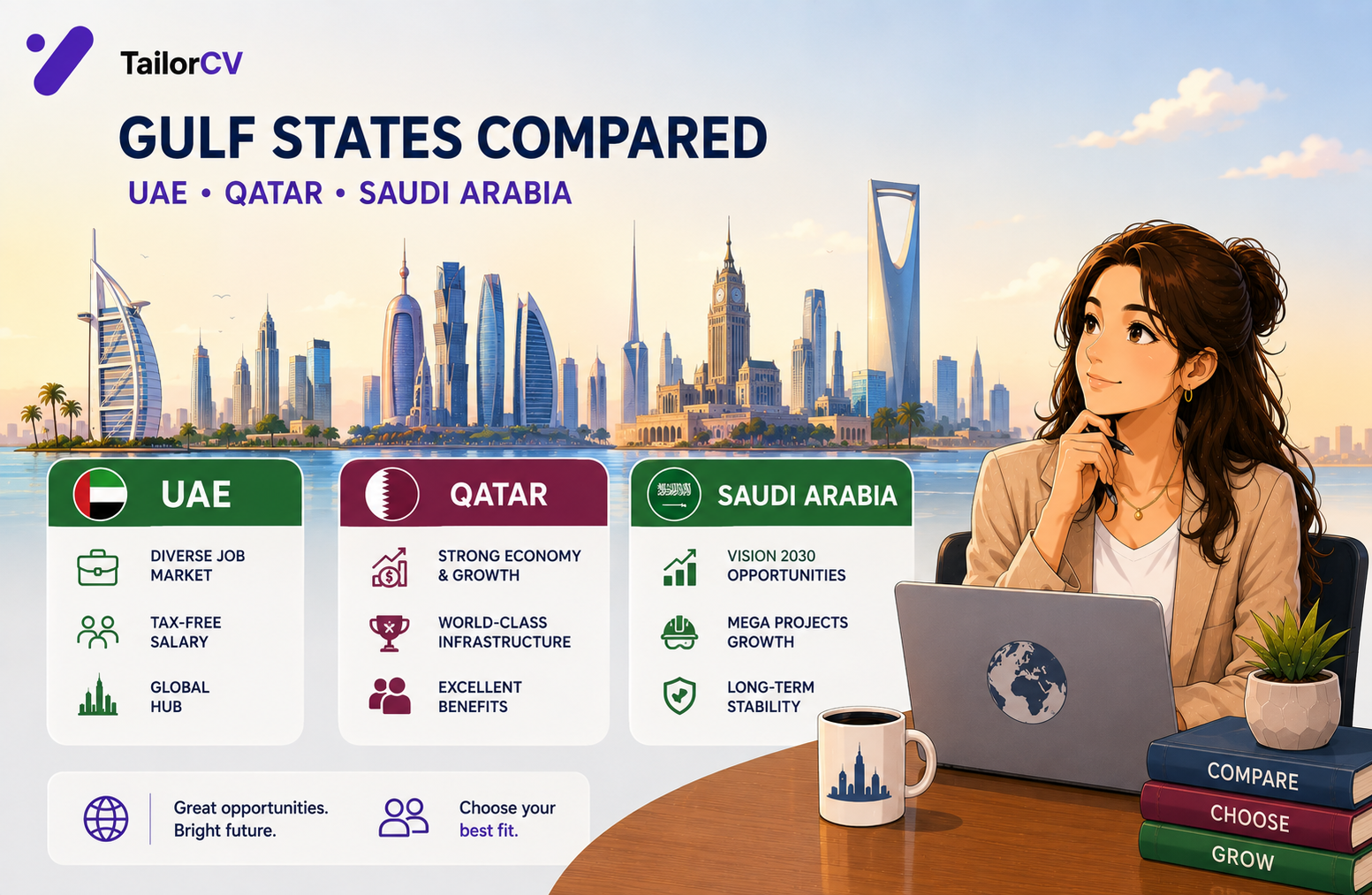
Comparing the Gulf systems
If you are weighing Saudi Arabia against its neighbours on immigration terms specifically.
On job mobility, all three major Gulf states have reformed. Qatar removed the NOC requirement outright; Saudi Arabia's Labour Reform Initiative eased transfers under conditions; the UAE operates its own framework.
On self-sponsorship, the UAE's Golden Visa and Saudi Arabia's Premium Residency both offer routes to residency without an employer. Qatar has a permanent residency scheme with narrower access.
On family sponsorship, all three set salary thresholds, and dependent costs differ — Saudi Arabia's per-dependent Iqama fees are a distinctive recurring cost.
On exit control, Qatar removed exit permits for most workers and Saudi Arabia eased them substantially.
On social environment, this is where the real difference sits rather than in the paperwork. The UAE is the most internationally liberal, Qatar in between, Saudi Arabia the most conservative and changing fastest.
The paperwork is broadly comparable now. Choose on sector fit and social environment rather than on immigration mechanics, because the mechanics have converged more than they used to differ.
Documents and preparation
The paperwork, and why it decides your timeline.
Degree certificates, attested by your home country's foreign ministry and the Saudi mission there.
Transcripts, similarly authenticated where required.
Professional licences and registrations, verified at source for regulated fields.
Criminal record certificate, attested.
Medical report, from an approved centre in your country before travel, and a further examination on arrival.
Passport validity with sufficient remaining time.
Certified translations into Arabic where documents are in other languages.
Multiple originals and certified copies. You will be asked repeatedly, and replacing documents from abroad while in the kingdom is slow.
And the practical instruction: begin attestation before you have an offer if you are seriously targeting the Gulf. It is the one part of the timeline entirely within your control and the one that most often delays a start.
Renewals and leaving
The end of the arrangement, planned rather than improvised.
Iqama renewal is your employer's responsibility annually. Confirm it is being done rather than assuming, because a lapsed Iqama creates immediate practical problems.
Final exit procedures were reformed and are more straightforward than they were, but they still require the employment relationship to be properly concluded.
Settle debts before departure. Bank loans, credit cards and finance agreements. Leaving the Gulf with outstanding obligations has consequences that follow you.
Close accounts in the right order — settle, transfer, then cancel residency, since banking generally requires valid status.
Final settlement includes gratuity, accrued leave and outstanding salary. Check the arithmetic.
Cancel utilities, phone and vehicle registration, and obtain clearance where issued.
And plan the currency transfer rather than moving a gratuity lump sum on whatever rate happens to apply the day you leave.
Mini checklist
- unchecked: Employer's sponsorship process confirmed
- unchecked: Degree attestation started early
- unchecked: Professional accreditation checked for regulated fields
- unchecked: Family sponsorship salary threshold confirmed
- unchecked: Dependent Iqama fees included in your calculation
- unchecked: Job mobility conditions understood
- unchecked: Premium Residency categories checked if you qualify
- unchecked: Contract registered on the government platform
- unchecked: Medical examination requirements understood
Scenarios
Scenario 1: You are a highly specialised professional
Check the Premium Residency talent categories. Self-sponsorship removes the dependency between your job and your residency, which changes your negotiating position substantially and is worth investigating early.
Scenario 2: You are moving with a family
Confirm the salary threshold for family sponsorship and budget the dependent Iqama fees explicitly. They are recurring, they are per dependent, and they surprise people.
Scenario 3: You want to change employer after a year
The reforms make this possible under defined conditions without your current employer's consent. Understand the notice and transfer mechanics before you resign so your Iqama does not lapse.
Tip: Start your degree attestation before you begin applying. It runs through your home country's authorities and the Saudi mission there, it takes weeks, and across the whole Gulf it is the single most common reason a start date slips.
Do's and Don'ts
Do
- Start attestation before applying
- Check Premium Residency if you are highly qualified
- Confirm family sponsorship thresholds and fees
- Ensure your contract is registered on the platform
- Understand the job transfer conditions
- Read anything online with an eye to its date
Don't
- Rely on pre-reform accounts of the system
- Leave attestation until after an offer
- Ignore dependent Iqama costs
- Assume your Iqama renews itself without employer action
- Resign before understanding the transfer mechanics
- Overlook professional accreditation timelines
Common Mistakes
- Using outdated information. The Labour Reform Initiative changed mobility and exit rules substantially.
- Late attestation. The most common cause of delayed starts across the Gulf.
- Forgetting dependent fees. Recurring, per dependent, and frequently unbudgeted.
- Missing Premium Residency. Self-sponsorship is available to qualifying talent and few people check.
- Unregistered contracts. A documented contract is what gives you standing in a dispute.
- Ignoring accreditation. Healthcare and engineering credentialing takes real time.
Related Guides
Keep building on this with the related guides in this series:
- Working in Saudi Arabia as an International Graduate
- Vision 2030 and the Sectors That Are Hiring
- Qatar Work Visas and Packages
- The UAE Golden Visa Explained
- Graduate Jobs in the UAE
You can also check your resume's ATS score for free, generate a tailored cover letter, or build a portfolio website in minutes.
Frequently Asked Questions
What is an Iqama?
The Saudi residence permit, sponsored by your employer and functioning as your identity document for banking, contracts, travel and essentially every transaction.
Can I change employer in Saudi Arabia?
Yes, under conditions introduced by the Labour Reform Initiative, without the previous requirement for employer consent in the form it took before. Understand the notice and transfer mechanics first.
What is Premium Residency?
A scheme allowing qualifying individuals — including specialised talent — to live and work without an employer sponsor, with family sponsorship and property rights attached. Unusual for the region.
Do I need my degree attested?
Yes, and it is mandatory for visa processing. It runs through your home country and the Saudi mission there and is the most common cause of a delayed start date.
Can I bring my family?
At defined salary levels and job categories, yes. Note that dependent Iqamas carry recurring fees per dependent, which should be in your package calculation.
Is information online about Saudi visas reliable?
Check the date. A great deal of it predates the Labour Reform Initiative and describes a considerably more restrictive system than the current one.
Do I need professional accreditation in Saudi Arabia?
For regulated fields, yes. Healthcare professionals register with the Saudi Commission for Health Specialties and engineers with the Saudi Council of Engineers, both with credential verification that takes real time.
What is the sequence for a Saudi work visa?
The employer obtains a block visa and a specific authorisation, you apply at the Saudi mission with attested documents, then enter, complete a medical, and receive your Iqama. Family visas follow after your Iqama is issued.
Can my family join me in Saudi Arabia?
At defined salary levels and in eligible job categories. Dependent Iqamas carry annual fees per person, and international school costs make the education allowance the largest variable in a family package.
How do Gulf immigration systems compare?
They have converged considerably. All three major states reformed job mobility, the UAE and Saudi Arabia both offer self-sponsored residency routes, and the meaningful differences now sit in sector fit and social environment rather than paperwork.
What is your resume scoring right now?
Scan it against a job description and get your ATS match score in about a minute.
Drop your resume here or choose a file
PDF only. Max 2 MB.
We never share your data or use it to train AI models.

Was this guide useful?
Be the first to rate it.