 SS
SS

Key Takeaways
- Your residence permit is sponsored by your employer, and the job and the residency remain a single decision even after the reforms.
- Changing employer no longer requires your current employer's consent, and exit permits were removed for most private-sector workers.
- Packages are basic salary plus allowances, and the split determines your end-of-service gratuity.
- A non-discriminatory minimum wage applies, with additional requirements where food and accommodation are not provided.
- Attestation of qualifications is the step most likely to delay your start date.
The visa and permit sequence
The order matters and it is employer-led.
The employer obtains approval to recruit you, and issues an employment contract.
A work visa is issued, allowing you to enter Qatar.
On arrival: a medical examination, fingerprinting and biometrics, and then the issue of your Qatar ID (QID) — the residence permit card that is your identity document for everything.
The employment contract is registered with the Ministry of Labour, and having a registered contract is what gives you access to the dispute mechanisms if you need them.
Your QID is tied to your employer as sponsor. Ending employment starts a defined period in which you must transfer sponsorship or leave.
Family sponsorship is available at defined salary levels, allowing you to sponsor a spouse and children — and the salary threshold for this is a genuine consideration when weighing an offer.
What the reforms changed, precisely
Because outdated accounts circulate widely.
No Objection Certificates were abolished for changing jobs. An employee may move to a new employer subject to the notice period in their contract, without needing permission from the current one.
Exit permits were removed for most private-sector workers, meaning you no longer require employer approval to leave the country.
A minimum wage was introduced, applying to all workers regardless of nationality, with additional allowances required where accommodation and food are not provided by the employer.
Labour dispute resolution committees and a workers' support fund were established.
What remains true: the residence permit is still employer-sponsored, so losing a job has immigration consequences and a period within which to resolve them. The system is meaningfully more flexible than it was and is not equivalent to European free movement.
Reading the package
The practical skill, and it is worth learning properly.
| Component | What it does |
|---|---|
| Basic salary | The core; gratuity is calculated on this alone |
| Housing allowance | Often large; sometimes replaced by provided accommodation |
| Transport allowance | Monthly amount or a vehicle |
| Education allowance | School fees for dependants at family status |
| Annual flights | Home-country travel for you and dependants |
| Medical insurance | Mandatory, employer-provided; check the tier |
| End-of-service gratuity | Accrues per year of service on basic salary |
The basic-to-allowance split is the thing to interrogate. Two offers with an identical total can differ substantially in gratuity over four or five years, because gratuity is calculated on basic salary only.
Ask for the breakdown in writing before accepting. It is an entirely normal request.
Check the family status threshold if you have dependants — the salary level required to sponsor them is a hard constraint, not a negotiation.
And confirm accommodation. Provided accommodation versus a housing allowance is a very different practical proposition, and the quality of provided housing varies enormously.
Leaving well
The exit is a financial and administrative event worth planning.
Serve your notice properly. Contractual notice periods matter and leaving without serving them can affect your final settlement and your ability to transfer sponsorship cleanly.
Final settlement includes your gratuity, accrued leave, and any outstanding salary. Check the calculation against your own arithmetic rather than accepting it.
Settle all debts before departure. Bank loans, credit cards and any finance agreements. Leaving the Gulf with unpaid obligations has consequences that follow you, and this is not a theoretical warning.
Close accounts in the right order. Settle debts, transfer funds, then cancel the residence permit — bank accounts generally require valid residency.
Cancel utilities, phone contracts and vehicle registration, and obtain clearance letters where they are issued.
Get your gratuity and final settlement in writing before you sign anything releasing the employer.
And plan the currency transfer. Moving a gratuity lump sum on a poor exchange rate day is an avoidable loss on money you worked years to accrue.
Transferring sponsorship to a new Qatari employer is now possible without your current employer's consent, but the mechanics still need coordinating so your residency does not lapse between roles.
Comparing Gulf offers against each other
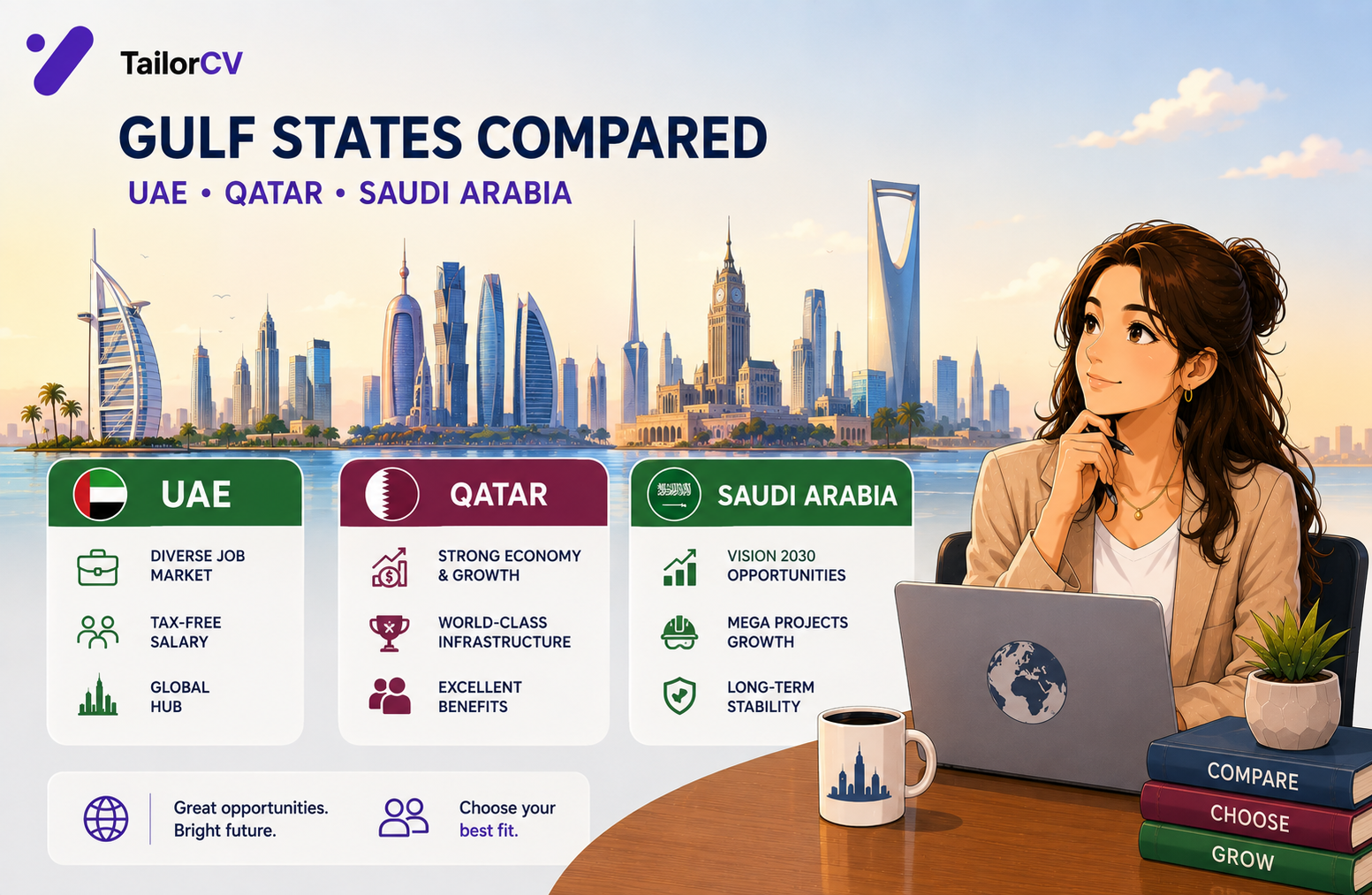
If you are weighing Qatar against the UAE or Saudi Arabia, the differences are specific.
On tax, all three have no personal income tax on employment income, though the wider tax environments differ.
On job mobility, Qatar's reforms removed the NOC requirement; the UAE has its own framework with different conditions; Saudi Arabia has been reforming similarly. All three are more flexible than a decade ago and none is equivalent to European free movement.
On residency, the UAE's Golden Visa offers long-term self-sponsored residency that Qatar does not currently match, which is a genuine differentiator for someone thinking beyond a few years.
On sector, Qatar concentrates in LNG, aviation and education; the UAE in trade, finance, logistics and technology; Saudi Arabia in energy and an enormous diversification programme.
On cost of living, all three are moderate for local goods and high for imported ones, with housing the main variable and Doha generally cheaper than Dubai.
On social environment, the UAE is the most internationally liberal, Qatar somewhat more conservative, and Saudi Arabia the most conservative though changing quickly.
The comparison worth making is not which country is best but which sector concentration matches your career and which social environment suits your life.
Questions to ask before signing
A checklist for the offer conversation, because most of these are asked too late.
"What is the basic salary, and what are the allowances?" The single most important question.
"Is accommodation provided or allowanced, and if provided, may I see it?" Quality varies enormously.
"Is this a family status or bachelor status package?" They are materially different.
"What is the education allowance per child, and is it capped?" For a family this is the largest variable.
"How many flights home per year, and for whom?"
"What tier is the medical insurance, and does it cover dependants?"
"What is the notice period, and what happens to my residence permit if I resign?"
"Is the contract registered with the Ministry of Labour?"
"What is the probation period and its terms?"
Get the answers in writing in the offer letter rather than in conversation. In a market where your residency depends on the employment relationship, documentation matters more, not less.
Saving and the financial plan
The reason most people go, and the part that needs deliberate handling.
Set the savings target before you arrive. A Gulf posting without a number attached tends to produce a higher standard of living rather than a higher balance.
Automate it. Decide what percentage leaves the account before you see it, in month one.
Understand your gratuity accrual so you know what is building alongside your savings.
There is no state pension. Nothing accrues for expatriates beyond gratuity, and the responsibility is entirely yours.
Decide where savings live. Home-country accounts, Qatari accounts or an international arrangement each carry different tax, access and currency implications.
The riyal is pegged to the US dollar, which means your savings move against your home currency in ways you do not control. If you intend to return to a country with a different currency, that exposure is real.
Be cautious with investment products sold locally. The Gulf has an active market in commission-heavy long-term savings plans with punitive exit charges, frequently sold socially. Independent scrutiny is warranted for anything you did not go looking for yourself.
Contract terms worth reading closely
The clauses that matter and that people skim.
Notice period, both ways, and what happens during it.
Probation terms, including whether either side can terminate with shorter notice.
Termination provisions, including what constitutes cause and what the consequences are for your residence permit.
Non-compete clauses, which are enforceable in Qatar within limits and can affect your ability to move within the local market.
Repatriation obligations — who pays for your flight home at the end, and under what circumstances that obligation lapses.
Annual leave entitlement and how it accrues.
Whether the contract is fixed-term or indefinite, and what happens at expiry.
Get any verbal assurance written into the contract. In a market where your residency depends on the employment relationship, a promise not in the document is not a promise.
Mini checklist
- unchecked: Written package breakdown requested
- unchecked: Basic-to-allowance ratio checked
- unchecked: Family sponsorship threshold confirmed if relevant
- unchecked: Education allowance negotiated if you have children
- unchecked: Accommodation arrangement clarified
- unchecked: Medical insurance tier confirmed
- unchecked: Notice period and termination terms read
- unchecked: Degree attestation started
- unchecked: Home-country tax position checked
- unchecked: Contract registration with the Ministry confirmed
Scenarios
Scenario 1: Two offers with the same total package
Compare the basic salaries. The higher basic accrues more gratuity over the years you stay, and that difference is real money that never appears in the headline figure.
Scenario 2: You have a family
Check the family sponsorship salary threshold first — it is a hard requirement — then negotiate the education allowance, which is the largest variable in a family package.
Scenario 3: You want to change jobs after a year
You can, subject to your notice period, without your current employer's consent. Plan the sponsorship transfer with the new employer so there is no gap in your residency.
Tip: Ask for the basic-versus-allowances split in writing before you accept. It determines your end-of-service gratuity, it is a completely normal question, and almost nobody asks — which means employers are rarely surprised to be asked.
Do's and Don'ts
Do
- Request the written breakdown
- Check the basic salary specifically
- Confirm the family sponsorship threshold
- Clarify accommodation versus allowance
- Read the notice and termination terms
- Start attestation early
Don't
- Compare packages on total alone
- Assume the old NOC rules still apply
- Ignore the family salary threshold
- Accept provided accommodation sight unseen
- Assume gratuity is calculated on the full package
- Leave attestation until after an offer
Common Mistakes
- Comparing totals. Gratuity depends on basic salary, not the package.
- Using outdated information. NOCs and exit permits were removed for most workers.
- Missing the family threshold. It is a hard requirement for sponsoring dependants.
- Not checking accommodation quality. Provided housing varies enormously.
- Late attestation. The most common cause of a delayed start.
- Forgetting home-country tax. No Qatari income tax does not mean no tax anywhere.
Related Guides
Keep building on this with the related guides in this series:
- Working in Qatar as an International Graduate
- The Qatari CV and Hiring Process
- Tax-Free Salaries in the UAE
- Graduate Jobs in the UAE
- Working in Saudi Arabia as a Graduate
You can also check your resume's ATS score for free, generate a tailored cover letter, or build a portfolio website in minutes.
Frequently Asked Questions
Can I change jobs in Qatar without permission?
Yes. The No Objection Certificate requirement was abolished, so you can move subject to your contractual notice period rather than your employer's consent.
Do I need an exit permit to leave Qatar?
Exit permits were removed for most private-sector workers, so you no longer need employer approval to travel or depart.
What is a QID?
The Qatar ID, your residence permit card and identity document for essentially every transaction in the country.
How is end-of-service gratuity calculated?
Per year of service on your basic salary only — which is why the split between basic and allowances in a package matters as much as the total.
Can I bring my family?
Yes, at defined salary levels. The family sponsorship threshold is a hard requirement rather than something negotiable, so check it before accepting an offer.
Is there really no income tax?
No personal income tax in Qatar. Your home country may still tax you depending on your nationality and residence rules, so check your own position.
What should I do before leaving Qatar?
Serve your notice, check the final settlement calculation yourself, settle every debt before departure, then transfer funds and cancel your residence permit in that order.
Can I transfer sponsorship to a new Qatari employer?
Yes, without your current employer's consent following the reforms — but coordinate the mechanics so your residency does not lapse between roles.
How does Qatar compare to the UAE and Saudi Arabia?
All three have no personal income tax and all have reformed job mobility. The UAE offers long-term Golden Visa residency Qatar does not match; sector concentrations and social environments differ meaningfully.
What should I ask before signing a Qatari contract?
The basic-versus-allowance split, whether accommodation is provided and viewable, family versus bachelor status, the education allowance and its cap, flights, insurance tier, notice terms and whether the contract is registered with the Ministry.
How should I handle savings on a Gulf salary?
Set a target before arriving and automate the transfer in month one. There is no state pension for expatriates beyond gratuity, and the riyal's dollar peg creates currency exposure against your home currency.
What is your resume scoring right now?
Scan it against a job description and get your ATS match score in about a minute.
Drop your resume here or choose a file
PDF only. Max 2 MB.
We never share your data or use it to train AI models.

Was this guide useful?
Be the first to rate it.