 TD
TD
Key Takeaways
- All three have no personal income tax and structure pay as basic salary plus allowances, with gratuity calculated on basic.
- Immigration rules have converged — all three reformed job mobility, and the mechanics matter less than they used to.
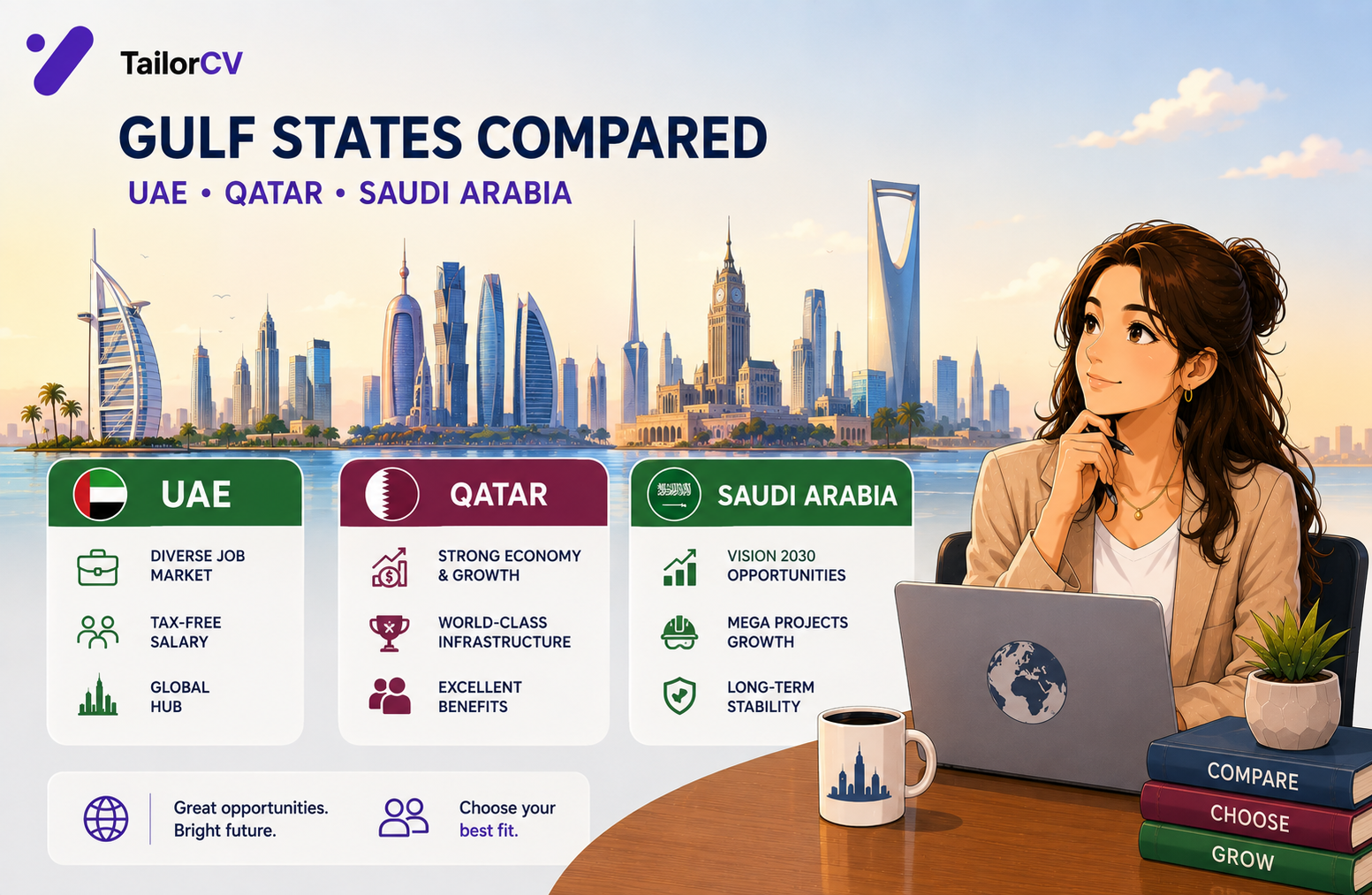
- Sector concentration is the real differentiator: the UAE in trade, finance, logistics and technology; Qatar in LNG, aviation and education; Saudi Arabia in energy and an enormous diversification programme.
- Long-term residency differs meaningfully. The UAE's Golden Visa and Saudi Arabia's Premium Residency allow self-sponsorship; Qatar's equivalent is narrower.
- Social environment is where the genuine difference lies, and it should weigh heavily in the decision.
Side by side
| UAE | Qatar | Saudi Arabia | |
|---|---|---|---|
| Economy size | Diversified, largest expatriate professional market | Small, gas-funded, concentrated | Largest Gulf economy |
| Key sectors | Trade, finance, logistics, tourism, technology, aviation | LNG, aviation, education, healthcare, sport | Energy, construction, giga-projects, healthcare, finance |
| Self-sponsored residency | Golden Visa, broad categories | Permanent residency, narrower | Premium Residency, including talent categories |
| Job mobility | Reformed framework | NOC requirement abolished | Reformed under the Labour Reform Initiative |
| Social environment | Most internationally liberal | Moderately conservative | Most conservative, changing fastest |
| Alcohol | Available | Available under licence | Prohibited |
| Cost of living | Highest, particularly Dubai | High | Moderate to high |
| International community | Very large and long established | Large | Growing rapidly |
Choosing by sector
The most reliable basis for the decision.
Finance, trade, logistics, tourism, media, technology, startups. The UAE, particularly Dubai and increasingly Abu Dhabi. The depth and variety are unmatched in the region.
LNG and gas engineering. Qatar, where the ongoing production expansion is among the largest energy projects anywhere.
Aviation. All three have major carriers, with Emirates, Qatar Airways and Saudia offering different propositions.
Construction, infrastructure and project management. Saudi Arabia by volume, given the giga-projects, with the UAE offering a longer-established market.
Healthcare. All three recruit internationally at scale; licensing requirements differ and all take time.
Education and research. Qatar's Education City is distinctive; Saudi Arabia's KAUST and university expansion is substantial; the UAE has branch campuses.
Mining. Saudi Arabia specifically, as a stated strategic priority with almost no international awareness.
Sport and events. Saudi Arabia and Qatar both, as deliberate national strategies.
The social question
The part that decides whether a posting works, and the part people research least.
The UAE is the most internationally liberal of the three, with Dubai in particular functioning as a genuinely cosmopolitan city. Alcohol is available, social norms are relaxed by regional standards, and the expatriate population is very large and long established.
Qatar sits in between. More conservative than the UAE, with alcohol available under licence, a large international community and a generally comfortable environment for expatriate professionals.
Saudi Arabia is the most conservative and is changing fastest. Entertainment, cinema, mixed public spaces and rules on women driving and guardianship have all changed substantially. Alcohol remains prohibited. Compound living is common for families.
For a single person, a couple and a family the calculation differs enormously, and it is worth talking to someone currently living there rather than reading about it.
And the honest advice: the paperwork has converged, the salaries are broadly comparable for equivalent roles, and the social environment is therefore where the real decision sits.
The financial comparison in detail
Where the money actually differs.
Headline packages are broadly comparable for equivalent roles, with variation driven by sector and employer more than by country.
Housing costs differ meaningfully. Dubai is the most expensive; Doha and Riyadh are lower, and provided accommodation is more common in Saudi Arabia.
Education allowances matter most for families, and international school costs are substantial in all three.
Gratuity is calculated on basic salary everywhere, which makes the package split the key variable in all three markets.
Saudi Arabia's dependent Iqama fees are a distinctive recurring cost that the other two do not impose in the same form.
No income tax in any of them, though your home country may still tax you.
And savings potential is highest where housing is provided and social spending opportunities are fewer, which frequently means Saudi Arabia — provided the environment suits you.
The practical instruction: get the written breakdown in every case and compare basic salary, housing arrangement, education allowance and dependent costs rather than headline totals.
Career trajectories across the region
How Gulf careers actually unfold.
Moving between the three is common and regional experience is valued everywhere. Many people spend time in two or all three across a career.
Each move is a fresh visa process, but the professional transition is straightforward because employers understand the region.
Experience compounds regionally. Someone with a decade across the Gulf has knowledge of local regulation, business practice and networks that an outside hire does not, and it is genuinely valued.
The UAE is frequently the entry point, given the depth of its market and the size of its international community.
Saudi Arabia is increasingly where the money is for specialists, given the scale of investment and the shortage of local expertise.
Qatar suits people who want a smaller, calmer environment with strong sector concentration.
And the exit matters. Gulf experience is well regarded in sectors where the region leads — energy, construction, aviation, project management — and less legible in fields where it does not. Consider how your experience will read elsewhere before committing many years to it.
Deciding practically
A framework.
Start with your sector. It narrows the choice more than anything else.
Then the social environment, honestly and specifically, ideally after talking to someone living there.
Then the family question, since education allowances, dependent costs and schooling differ meaningfully.
Then the package, comparing basic salary, housing arrangement and allowances rather than totals.
Then the time horizon. A defined three-year posting and an intended decade are different decisions with different requirements.
And plan the exit before you arrive. The Gulf rewards people who go with an objective and a horizon, and it is unkind to people who drift.
What each is genuinely best at
Stripping the comparison to its essentials.
The UAE is best for variety and optionality. The deepest market, the most sectors, the largest international community, the most liberal environment, and the Golden Visa offering long-term self-sponsored residency. If you are unsure what you want, this is the safest choice.
Qatar is best for concentrated sector strength. LNG at a scale nowhere else matches, aviation, and the education and research cluster. A smaller, calmer environment with a strong package structure.
Saudi Arabia is best for scale and savings. The largest economy, the largest investment programme, the greatest shortage of expertise, and frequently the strongest savings proposition — for those the environment suits.
And each is worst at the inverse. The UAE is the most expensive; Qatar is the narrowest; Saudi Arabia is the most socially restrictive.
The three-question test: what sector, what social environment, and what time horizon. Answer those honestly and the choice usually resolves itself without needing a spreadsheet.
Practical preparation for any of them
The steps that apply regardless of which you choose.
Start degree attestation now. It is required in all three, runs through your home country, takes weeks, and is the most common cause of delayed starts across the entire region.
Get professional credentials verified if you are in a regulated field, since healthcare and engineering registration is slow everywhere in the Gulf.
Prepare a Gulf-format CV with photo, nationality, visa status and notice period, quantified throughout.
Build a regional network on LinkedIn, which is where Gulf recruitment genuinely happens.
Register with several agencies, since they place a large share of roles.
Understand package structure before you see an offer, so you can read it properly when one arrives.
And plan your finances, including a savings target and a retirement plan, because no state pension accrues for expatriates anywhere in the region.
Mini checklist
- unchecked: Sector matched to the right country
- unchecked: Social environment researched properly, not abstractly
- unchecked: Family versus single circumstances weighed
- unchecked: Long-term residency options compared
- unchecked: Package breakdown requested in every case
- unchecked: Basic-to-allowance split checked for gratuity
- unchecked: Education allowance costed if you have children
- unchecked: Attestation started regardless of destination
- unchecked: Someone currently there spoken to
Scenarios
Scenario 1: You want variety and the largest professional market
The UAE. The deepest and most diversified market in the region, the largest international community, and the most liberal social environment.
Scenario 2: You are an energy or LNG engineer
Qatar for gas specifically, Saudi Arabia for oil, petrochemicals and the broader energy transition. Both pay well and both have employers accustomed to international hiring.
Scenario 3: You want maximum savings and can accept a conservative environment
Saudi Arabia frequently offers the strongest savings proposition, with high pay for scarce skills, provided housing and no income tax — provided the social environment genuinely suits you.
Tip: Choose on sector and social environment, not on immigration mechanics. The three systems have converged considerably, salaries are broadly comparable for equivalent roles, and the things that actually differ are what you would work on and how you would live.
Do's and Don'ts
Do
- Match your sector to the right country
- Research the social environment concretely
- Compare long-term residency options
- Request package breakdowns everywhere
- Consider family circumstances specifically
- Talk to someone currently living there
Don't
- Choose on immigration mechanics alone
- Assume the three are interchangeable
- Compare package totals without the basic split
- Underestimate the social environment's daily effect
- Rely on accounts more than a few years old
- Ignore the long-term residency differences
Common Mistakes
- Treating the three as one place. Sectors, social environments and long-term options genuinely differ.
- Choosing on paperwork. The systems have converged and it is no longer the differentiator.
- Comparing package totals. Gratuity depends on basic salary in all three.
- Underweighting the social question. It decides whether a posting is sustainable.
- Using old information. All three have changed substantially and quickly.
- Ignoring residency options. Self-sponsorship availability differs meaningfully.
Related Guides
Keep building on this with the related guides in this series:
- Graduate Jobs in the UAE
- Working in Qatar as an International Graduate
- Working in Saudi Arabia as an International Graduate
- The UAE Golden Visa Explained
- Tax-Free Salaries in the UAE
You can also check your resume's ATS score for free, generate a tailored cover letter, or build a portfolio website in minutes.
Frequently Asked Questions
Which Gulf country pays best?
Broadly comparable for equivalent roles, with variation by sector rather than by country. Saudi Arabia frequently offers the strongest savings proposition given provided housing and scarce-skill premiums.
Which has the easiest immigration?
They have converged considerably. All three reformed job mobility, and the UAE and Saudi Arabia both offer self-sponsored long-term residency options that Qatar matches more narrowly.
Which is best for families?
Depends heavily on the social environment you want and the education allowance in your package. The UAE has the largest established international schooling market; all three have substantial fees.
Which is most socially liberal?
The UAE, particularly Dubai. Qatar sits in between, and Saudi Arabia is the most conservative while changing fastest. Alcohol is available in the first two and prohibited in the third.
Can I move between them?
Professionally yes — Gulf careers frequently involve moves between the three, and regional experience is valued everywhere. Each move is a fresh visa process.
How should I actually decide?
On sector fit and social environment. The paperwork and the money have converged enough that what you would work on and how you would live are the real variables.
Which Gulf country leaves you with the most money?
Headline packages are comparable; the differences come from housing costs, whether accommodation is provided, education allowances and Saudi Arabia's dependent Iqama fees. Compare those rather than totals.
Is it common to move between Gulf countries?
Yes, and regional experience is valued everywhere. Each move is a fresh visa process but the professional transition is straightforward, and accumulated regional knowledge is genuinely valued.
How should I decide between the Gulf states?
Sector first since it narrows the choice most, then the social environment honestly, then family circumstances, then the package compared on basic salary and allowances rather than totals, then your time horizon.
What is each Gulf state genuinely best at?
The UAE for variety, optionality and the most liberal environment; Qatar for concentrated LNG, aviation and education strength in a calmer setting; Saudi Arabia for scale, expertise shortage and savings potential.
What preparation applies to all three?
Degree attestation started early, professional credential verification for regulated fields, a Gulf-format CV, a LinkedIn regional network, agency registrations, and a personal savings and retirement plan.
What is your resume scoring right now?
Scan it against a job description and get your ATS match score in about a minute.
Drop your resume here or choose a file
PDF only. Max 2 MB.
We never share your data or use it to train AI models.

Was this guide useful?
Be the first to rate it.