 SS
SS
Key Takeaways
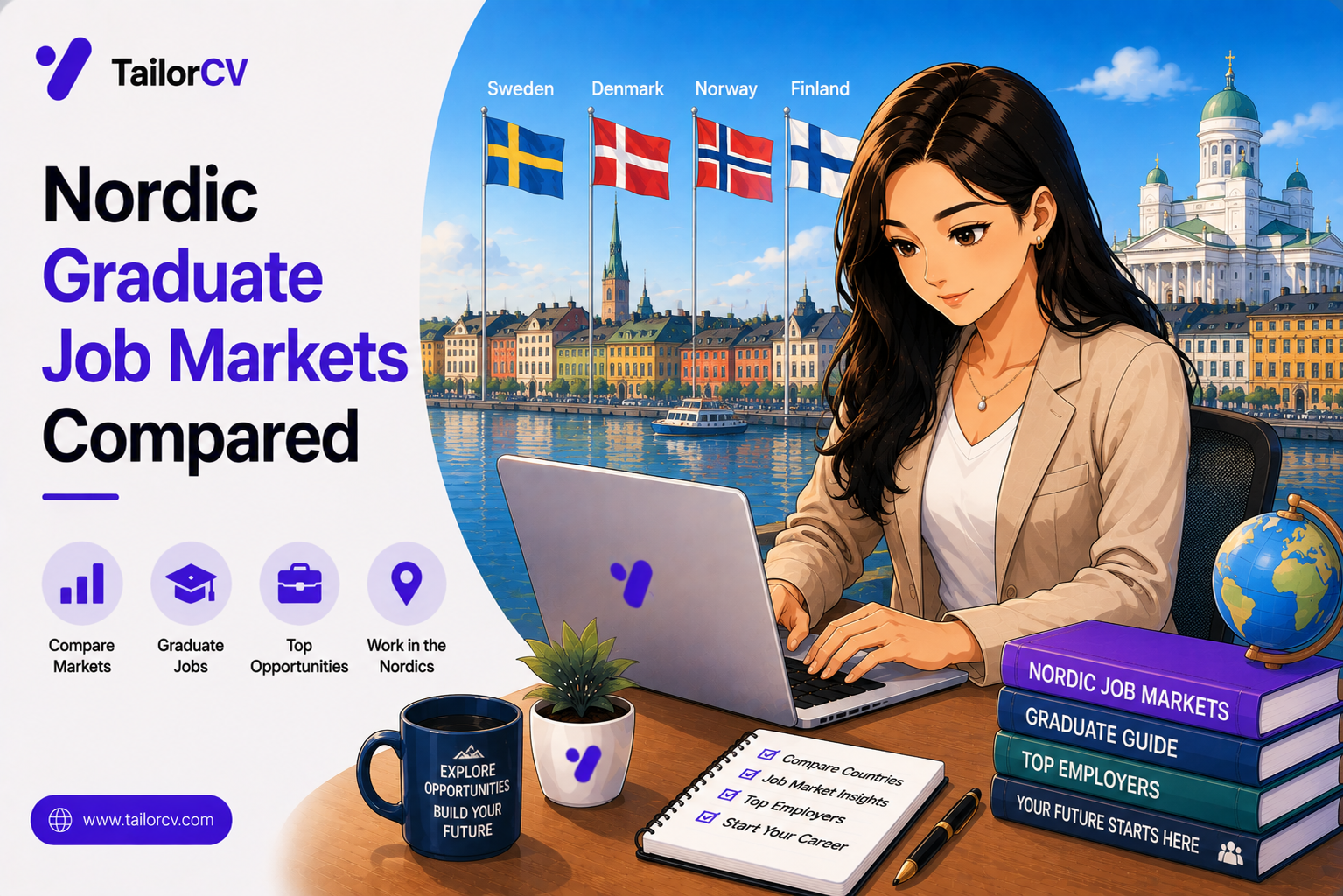
- The Nordics share a social model but differ sharply in industry mix, language accessibility, salary levels and permit routes.
- Sweden has the deepest technology and startup ecosystem; Norway pays the most and is dominated by energy and maritime; Denmark is pharmaceuticals, shipping and design with the most flexible labour market; Finland is engineering, gaming and telecommunications.
- English coverage is high everywhere in technology and low everywhere in the public sector, healthcare and SMEs.
- Norway is not in the EU — it is in the EEA, which matters for permits and for the details of professional recognition.
- All four have a post-study route for graduates of their own institutions, and all four have some form of shortage-occupation list.
The one-paragraph summary of each
Sweden is the largest market and the most internationally connected, with a technology sector out of all proportion to its size and the strongest startup ecosystem in the region. English works well in that sector and less well elsewhere.
Denmark has the most employer-friendly hiring rules under flexicurity, which cuts in a graduate's favour, plus world-leading pharmaceuticals, shipping and renewable energy. Copenhagen is expensive; Jutland is not.
Norway pays the highest salaries in the region by a clear margin and has the highest costs to match. Energy, maritime, seafood and public sector dominate. It sits outside the EU, inside the EEA.
Finland has the strongest engineering and telecommunications tradition, a globally significant gaming industry, and the most difficult language of the four — but also the most deliberate policy effort to attract international talent.
Iceland is tiny, expensive and specialised in tourism, fisheries, energy and a small but real technology scene. Worth knowing exists; rarely the plan.
Side by side
| Sweden | Denmark | Norway | Finland | |
|---|---|---|---|---|
| Dominant sectors | Tech, gaming, fintech, industrials | Pharma, shipping, wind, design | Energy, maritime, seafood, public | Engineering, telecoms, gaming, forestry |
| Salary level | High | High | Highest | High |
| Cost of living | High | High | Highest | Somewhat lower |
| English at work | Good in tech | Good in tech and corporates | Good in energy and tech | Good in tech and gaming |
| Language difficulty | Moderate | Moderate; pronunciation hard | Moderate | Hard |
| EU status | EU | EU | EEA, not EU | EU |
| Signature employers | Spotify, Klarna, Volvo, Ericsson | Novo Nordisk, Maersk, Ørsted, LEGO | Equinor, DNV, Telenor, Yara | Nokia, Supercell, KONE, Wärtsilä |
Choosing by what you actually do
Software engineering. Sweden first, for depth and volume. Finland second, particularly for gaming and embedded systems. Denmark third with a smaller but real scene.
Life sciences and pharmaceuticals. Denmark, unambiguously. Novo Nordisk, Lundbeck, LEO and Novozymes anchor a cluster with genuine international standing. Sweden's Uppsala is a real second option.
Energy. Norway for oil, gas and offshore, and increasingly for the energy transition. Denmark for wind, where Ørsted and Vestas lead globally.
Automotive and mechanical engineering. Sweden — Volvo, Scania, Gothenburg's supplier ecosystem.
Maritime and shipping. Norway and Denmark both, with Maersk in Copenhagen and Norway's maritime cluster around Oslo and the west coast.
Gaming. Finland (Supercell, Remedy, Rovio) and Sweden (King, Mojang, Paradox, Embracer) are both genuinely significant.
Telecommunications. Finland for Nokia, Sweden for Ericsson.
Design and consumer products. Denmark and Sweden, with LEGO, Bang & Olufsen, IKEA and H&M.
The language question, properly
This decides more than any other single factor.
Swedish, Danish and Norwegian are closely related and mutually intelligible to a substantial degree in writing. Learning one gives you meaningful access to the other two, which is a genuine argument for the Scandinavian three over Finland if you are undecided.
Danish pronunciation is notoriously difficult even for other Scandinavians, though the written language is close to Norwegian.
Finnish is unrelated to all of them. It belongs to a different language family entirely and is genuinely hard for speakers of Indo-European languages. Swedish is Finland's second official language and helps in parts of the country, but not everywhere.
All four countries offer subsidised or free language tuition to residents, and all four have high general English proficiency.
The uncomfortable truth is the same everywhere: you can work in English and you will struggle to build a social life in it. The people who stay are overwhelmingly the ones who learned the language.
Permits and post-study routes, side by side
The structures rhyme but the details differ, and the details are what stop applications.
Sweden. EU/EEA citizens work freely. Others need a work permit with a concrete offer meeting collective agreement terms, with a union consultation step. Graduates of Swedish institutions can get a permit to look for work.
Denmark. EU/EEA and Nordic citizens work freely. Others use the Positive List for shortage occupations, the Pay Limit Scheme for higher-paid roles, or the Establishment Card after a Danish degree.
Norway. EEA citizens have free movement under the EEA agreement. Others generally need a skilled worker permit requiring a relevant qualification and a concrete offer meeting Norwegian pay norms. Graduates of Norwegian institutions have a job-seeking route.
Finland. EU/EEA citizens work freely. Others use the specialist route, the residence permit for an employed person, or the Finnish post-study job-seeking permit, which is among the more generous in the region.
Common threads. All four require a real offer for the standard route, all four have a post-study option for their own graduates, all four set pay floors to prevent undercutting, and all four maintain some form of shortage list. Check each country's own immigration authority — Migrationsverket, SIRI, UDI and Migri respectively.
Tax, and the schemes for incoming workers
Nordic tax is high and there are specific reliefs that materially change the picture for a newcomer.
All four countries tax income progressively at high rates, funding healthcare, education and extensive social provision.
Sweden has an expert tax relief for qualifying foreign specialists, researchers and key personnel, reducing the taxable share of income for a limited period.
Denmark has the researcher taxation scheme, a lower flat rate for a limited period for qualifying researchers and highly paid incoming employees.
Finland has a flat-rate tax option for qualifying foreign key employees for a limited period.
Norway has a simplified flat-rate scheme available to many foreign workers in their early years.
Each has conditions — salary thresholds, prior residence tests, application deadlines that are frequently short and easy to miss.
Ask your employer's payroll about it before your first payslip. Several of these schemes require an application within a limited window after starting work, and missing that window means paying full rates for years on income you could have kept.
Cost of living, and what the salary is actually worth
Nominal comparison across the region is misleading in specific and predictable ways.
Norway is the most expensive by a clear margin — housing, food, alcohol and services all sit above the rest of the region. The salary premium is real but a large share of it is consumed locally.
Sweden and Denmark are broadly comparable, with Stockholm and Copenhagen the expensive points and the rest of each country considerably cheaper.
Finland is the most affordable of the four, particularly outside Helsinki, which makes its somewhat lower salaries go further than a raw comparison suggests.
Housing dominates everywhere. Stockholm's queue system, Copenhagen's prices and Oslo's scarcity are each their own problem, and each is solvable by living slightly further out in a region with excellent public transport.
Public services offset a lot. Healthcare, education and childcare are heavily subsidised or free across the region, and a family's real cost base is materially lower than the same family's would be in the UK or US.
Alcohol is state-controlled in Sweden, Norway and Finland, sold through state monopoly shops at high prices. It is a small thing that surprises people and shapes social habits.
The honest summary: all four give a comfortable standard of living on a graduate salary, none make you rich quickly, and the real differentiators are sector fit and whether you learn the language.
Integrating, and why people leave
The region's retention problem for internationals is well documented and worth naming.
Professional integration is easy; social integration is not. All four countries have workplaces that function in English, welcome international colleagues, and treat you decently. All four have social structures where friendships formed at school and university persist through adult life.
The winter is real. Northern latitudes mean genuinely short winter days, and the effect on mood is not a joke. People who plan for it — light therapy, winter sport, structured social commitments — cope far better than those who assume they will.
The language is the lever. Every long-term international says the same thing: the point at which the country stopped feeling foreign was the point at which they could follow a conversation in a group. Free tuition is available everywhere in the region.
Join organised activities. Nordic social life runs through associations, clubs and courses far more than through spontaneous socialising. This is the practical way in and it works.
Give it three years. The pattern is consistent across all four countries: year one is hard, year two is manageable, year three is home — and most of the people who leave do so in year two.
Mini checklist
- unchecked: Country chosen by sector, not by general impression
- unchecked: Language commitment decided honestly
- unchecked: Shortage-occupation list checked for your target country
- unchecked: EU versus EEA implications understood for Norway
- unchecked: Post-study route checked if you studied in the region
- unchecked: Salary compared against real local costs
- unchecked: Cross-border options considered — Öresund, and Norway-Sweden
- unchecked: Tax treatment researched, including any incoming-expert schemes
- unchecked: Free language tuition planned for
Scenarios
Scenario 1: You want the most technology jobs
Sweden. Stockholm has the deepest ecosystem, the most scale-ups, and the widest English-language coverage in the sector.
Scenario 2: You want the highest salary
Norway, though costs are correspondingly the highest and much of the premium sits in energy and maritime. Run the comparison net of real housing costs before deciding.
Scenario 3: You are in life sciences
Denmark. The Copenhagen pharmaceutical cluster is genuinely world-class, and it is the clearest sector-country match in the entire region.
Tip: Choose the country by your sector, then commit to the language. Every Nordic country will employ you in English and none of them will give you a social life in it — and the people who leave after two years are almost always the ones who never started learning.
Do's and Don'ts
Do
- Match the country to your sector
- Learn the language of wherever you land
- Check the shortage-occupation list first
- Compare salaries net of real housing costs
- Consider cross-border living in the Öresund region
- Look at Norway's EEA status specifically
Don't
- Treat the four countries as interchangeable
- Assume English alone is a long-term plan
- Ignore the smaller cities and industrial regions
- Compare gross salaries across borders
- Assume Norway follows EU rules automatically
- Underestimate Finnish
Common Mistakes
- Treating the Nordics as one place. Industry mix, salary and permits differ substantially.
- Assuming English is enough. It works professionally and fails socially, which is why people leave.
- Comparing gross salaries. Norway's premium partly disappears into Norway's costs.
- Ignoring Norway's EEA status. It is not an EU member and the rules differ in detail.
- Choosing by impression. Sector-country fit is far more predictive than general reputation.
- Overlooking cross-border options. Malmö to Copenhagen is a mainstream commute.
Related Guides
Keep building on this with the related guides in this series:
- Working in Sweden as an International Graduate
- Graduate Jobs in Denmark
- Graduate Jobs in Germany
- Finding a Job in the Netherlands as an International Graduate
- Europe versus North America for Graduate Jobs
You can also check your resume's ATS score for free, generate a tailored cover letter, or build a portfolio website in minutes.
Frequently Asked Questions
Which Nordic country is best for technology jobs?
Sweden, for depth and volume, with Finland strong in gaming and embedded systems and Denmark holding a smaller but genuine scene.
Which pays the most?
Norway, by a clear margin — with the highest living costs in the region to match. Compare net of real housing costs before treating it as settled.
Is Norway in the EU?
No. Norway is in the EEA and the Schengen area but not the EU, which affects permit routes and some professional recognition details.
How similar are the languages?
Swedish, Danish and Norwegian are closely related and largely mutually intelligible in writing. Finnish is unrelated and considerably harder.
Can I work in the Nordics in English only?
Professionally, in technology and international companies, yes. Socially, it is the main reason internationals leave after a couple of years.
Which country is easiest to get hired in?
Denmark's flexicurity model makes employers noticeably more willing to take a chance, and its Positive List route is straightforward for listed occupations.
Do the Nordic countries have tax schemes for incoming workers?
All four do — Sweden's expert tax relief, Denmark's researcher taxation scheme, Finland's flat-rate option for key employees, and Norway's simplified scheme. Several require an application within a short window after starting work.
Which immigration authority should I check?
Migrationsverket for Sweden, SIRI for Denmark, UDI for Norway and Migri for Finland. Each publishes its own rules and they differ in the details that matter.
Which Nordic country is cheapest to live in?
Finland, particularly outside Helsinki, which makes its somewhat lower salaries stretch further than a raw comparison suggests. Norway is the most expensive by a clear margin.
Do high salaries in Norway actually mean more money?
Partly. The premium is real but a large share is consumed by higher local costs, so compare net of real housing and living expenses.
What is your resume scoring right now?
Scan it against a job description and get your ATS match score in about a minute.
Drop your resume here or choose a file
PDF only. Max 2 MB.
We never share your data or use it to train AI models.

Was this guide useful?
Be the first to rate it.