 TD
TD
Key Takeaways
- A cybersecurity engineer resume in 2026 should highlight practical skills, tool experience, and the ability to address real security threats.
- The resume format should include a header, summary, technical skills, work experience, projects, certifications, and education, ideally within one to two pages.
- Use specific examples in the summary to showcase experience in areas like pentesting, SOC, or cloud security, along with measurable achievements.
- Important technical skills include tools for pentesting, web security vulnerabilities, cloud security practices, and incident response techniques.
- Incorporate relevant ATS keywords related to cybersecurity to enhance the chances of passing automated resume screenings.
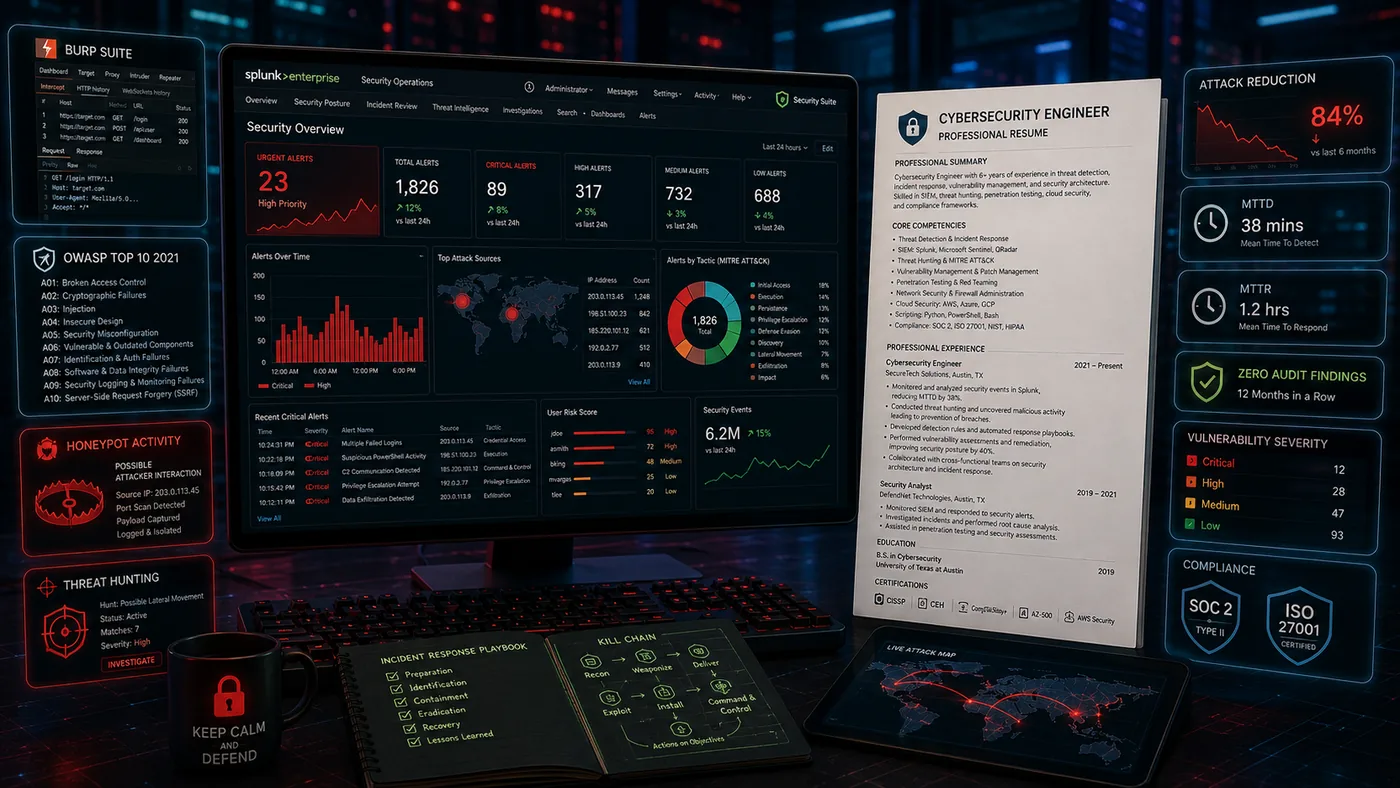
A cybersecurity engineer resume in 2026 needs to demonstrate technical security skills, hands-on tool experience, and the ability to detect, respond to, and prevent real threats. The cybersecurity talent shortage remains severe - but that means hiring is specific. Companies need people who can actually do the work, not people who have memorized compliance frameworks.
Your resume must show which tools you have used in anger, what vulnerabilities you found or fixed, what security incidents you responded to, and what improvements you delivered to an organization's security posture.
Before applying, compare your resume to the job description with the ATS score checker. Use ATS-friendly resume templates. For related infrastructure roles, read the DevOps engineer resume guide and the cloud engineer resume guide.
Best Cybersecurity Resume Format
- Header
- Summary
- Technical skills
- Work experience
- projects or CTF highlights
- certifications
- education
Your resume after optimization
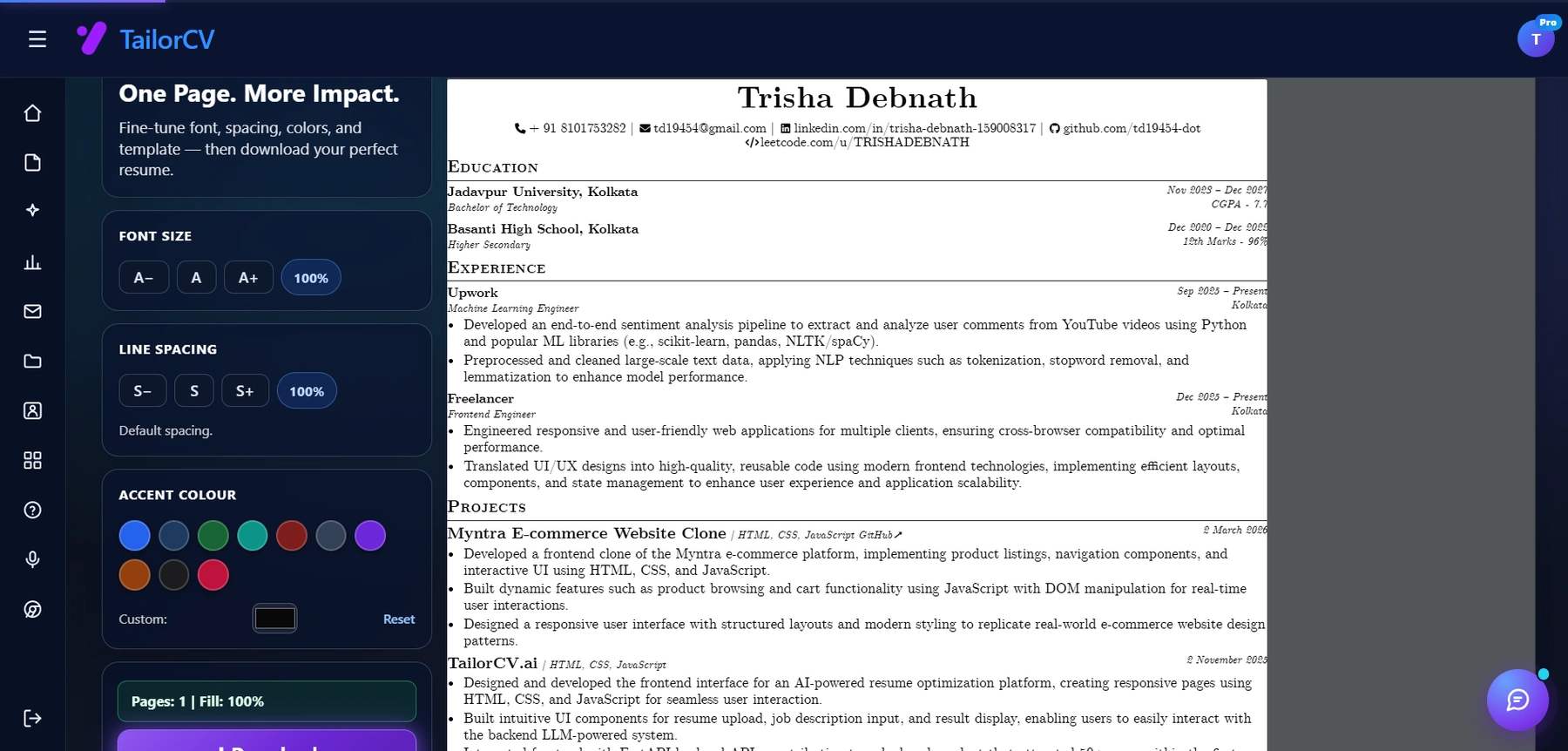
This is the resume after tailoring - the content is already matched, and these controls are how you fit it onto one page.
One to two pages. certifications are important in cybersecurity and should be visible, not buried.
Cybersecurity Engineer Resume Summary
Formula:
cybersecurity Engineer with X years of experience in [pentesting / SOC / AppSec / cloud security / GRC]. Skilled in [tools, frameworks]. Identified / Remediated / Reduced [vulnerability, incident, or risk metric].
Example for Experienced Security Engineer
cybersecurity Engineer with 5 years of experience in application security, cloud security, and penetration testing for fintech and SaaS environments. Conducted 40+ web application and API penetration tests, discovered 12 critical vulnerabilities including SSRF and IDOR issues in production systems. Reduced mean time to remediate critical findings from 28 days to 9 days through an improved vulnerability management workflow.
Example for Entry-Level / SOC Analyst
Junior cybersecurity Analyst with CompTIA Security+ and hands-on experience in SOC monitoring, SIEM analysis, and vulnerability scanning. Completed TryHackMe top 1% path and HackTheBox challenges covering Active Directory exploitation, web vulnerabilities, and privilege escalation. Seeking a SOC analyst or junior penetration testing role.
Cybersecurity Technical Skills
Pentesting Tools: Burp Suite, Metasploit, Nmap, Nessus, Nikto, SQLmap, Gobuster, Wireshark, BloodHound, Mimikatz Web Security: OWASP Top 10, XSS, SQL injection, CSRF, SSRF, IDOR, XXE, RCE, SAST/DAST Cloud Security: AWS IAM, S3 bucket policy, VPC security groups, GuardDuty, Security Hub, GCP Security Command Center SIEM and Detection: Splunk, Elastic (ELK), Microsoft Sentinel, QRadar, Chronicle Incident Response: Digital forensics, memory analysis, log analysis, chain of custody, IOC hunting, threat intelligence Compliance and GRC: SOC 2, ISO 27001, PCI DSS, GDPR, NIST CSF, CIS Controls Programming: Python, Bash, PowerShell, Go (for automation and tooling) Network Security: Firewalls (Palo Alto, Fortinet), IDS/IPS, WAF, VPN, DNS security, BGP security
Best ATS Keywords for Cybersecurity Resume
- Penetration testing
- Vulnerability assessment
- OWASP Top 10
- Burp Suite
- Metasploit / Nmap
- SIEM
- Incident response
- Threat hunting
- SOC
- AWS / Azure / GCP security
- IAM
- Security monitoring
- CISSP / CEH / OSCP
- Malware analysis
- Digital forensics
- Zero trust
- SOC 2 / ISO 27001
- Risk assessment
- Security hardening
- Red team / Blue team
How to Write Cybersecurity Resume Bullet Points
Formula:
Identified / Remediated / Reduced / Led + [vulnerability, threat, or security improvement] + [system or scope] + [risk reduced, time improved, or compliance achieved]
Weak Bullet Points
- Performed penetration testing on web applications
- Monitored SIEM alerts
- Worked on security compliance
- Fixed vulnerabilities
Strong Bullet Points
- Conducted a web application penetration test on a B2B SaaS platform, identifying 3 critical findings including a stored XSS in the admin panel and an IDOR allowing cross-tenant data access - both remediated within 7 days of disclosure.
- Built a Splunk detection rule for credential stuffing attacks by analyzing failed login patterns across 200K daily auth events, reducing successful account takeover attempts by 84%.
- Led AWS cloud security hardening across 4 production accounts, remediating 120 CIS Benchmark findings and achieving SOC 2 Type II cloud scope compliance with zero carryover findings.
- Responded to a ransomware incident affecting 3 Windows servers - isolated, contained, collected forensic artifacts, and restored operations from backup within 6 hours with zero data exfiltration confirmed.
- Reduced mean time to detect (MTTD) for high-severity alerts from 4.2 hours to 38 minutes by tuning 60+ Sentinel detection rules and creating automated triage playbooks.
Cybersecurity Resume Example
Security Engineer - Application Security Fintech Company | Jan 2023 - Present
- Owned the application security program for 4 customer-facing products processing $1.4B in annual transaction volume.
- Conducted 18 penetration tests and 6 red team exercises annually, discovering and tracking 95 findings from critical to informational severity.
- Integrated SAST (Semgrep) and DAST (OWASP ZAP) into CI/CD pipelines, blocking 340+ vulnerable code deployments automatically in 12 months.
- Led PCI DSS scope assessment and remediation for 3 payment-related systems, passing the annual QSA audit with zero findings for the first time in company history.
- Developed a security awareness training program completing 100% staff participation, reducing phishing simulation click rate from 22% to 6% in 6 months.
Certifications for Cybersecurity Resume
Highly valued certifications:
- OSCP (Offensive Security Certified Professional) - for pentesters
- CISSP (Certified Information Systems Security Professional)
- CEH (Certified Ethical Hacker)
- CompTIA Security+, CySA+, PenTest+
- AWS Security Specialty
- CISM, CISA - for GRC roles
- GPEN, GWAPT - GIAC certifications
List format: OSCP - Offensive Security | 2025 CompTIA Security+ | 2024
Common Cybersecurity Resume Mistakes
Mistake 1: Only listing compliance frameworks
"Knowledge of SOC 2, ISO 27001, GDPR, PCI DSS, NIST CSF" is a framework list. Show what you actually did to achieve, maintain, or audit compliance.
Mistake 2: No hands-on tool evidence
certifications plus no practical tool usage looks theoretical. Show real work with Burp Suite, Splunk, Metasploit, or equivalent tools.
Mistake 3: No incident or finding examples
The strongest cybersecurity resumes mention specific findings (vulnerability types), incidents responded to, or security improvements quantified.
Mistake 4: Weak certifications without practical proof
A CompTIA Security+ alone does not differentiate you in 2026. Add CTF platforms (TryHackMe, HackTheBox), GitHub security tools, or bug bounty history.
Related Guides
- QA Engineer Resume
- Business Analyst Resume
- Chemical Engineer Resume
- Civil Engineer Resume
- Cloud Engineer Resume
- Data Engineer Resume
- Electrical Engineer Resume
- Embedded Systems Engineer Resume
- Game Developer Resume
- Machine Learning Engineer Resume
- Mechanical Engineer Resume
- Site Reliability Engineer (SRE) Resume
- Software Engineer Resume for FAANG in 2026
- How to List Education on a Resume in 2026 - Complete Guide with Examples
- Paralegal Resume Guide 2026
Make This Practical
Once you draft this resume, test it against a real job post with the free ATS score checker. Then improve fit using Resume Matching With Job Description, polish the layout with ATS-friendly resume templates, and make the bullets stronger with How to Write Resume Bullet Points.
A complete application needs more than one document. Pair the resume with a targeted letter from the AI cover letter generator, practice role-specific questions with the AI mock interview tool, and publish proof of work with the portfolio website builder when your role benefits from projects or case studies.
Conclusion
A strong cybersecurity engineer resume in 2026 shows real hands-on tool experience, specific findings or incidents, and measurable security improvements. Do not just list certifications and frameworks - show what threats you found, what you fixed, and what improved.
Run your resume through the TailorCV ATS score checker to check keyword alignment. Then prepare for technical and behavioral interviews with the interview preparation guide.
Frequently Asked Questions
What should I include in my cybersecurity engineer resume summary?
Your resume summary should highlight your years of experience and specific areas of expertise, such as penetration testing, SOC, or cloud security. It's crucial to mention the tools and frameworks you are skilled in, as this will help your resume stand out. Use the Job Description Analysis Checklist Before You Apply to tailor your summary to match the job requirements.
How can I make my cybersecurity resume ATS-friendly?
To ensure your resume is ATS-friendly, use relevant keywords from the job description, maintain a clear format, and avoid complex layouts or graphics. Utilize ATS-friendly resume templates to help structure your resume properly. Additionally, you can check your resume's compatibility using the Free ATS score checker.
What types of projects should I include in my cybersecurity engineer resume?
Including projects that demonstrate your hands-on experience, such as Capture The Flag (CTF) competitions or real-world security assessments, can significantly enhance your resume. Highlight any specific vulnerabilities you addressed or improvements you implemented. Check out Cybersecurity Portfolio Projects That Help You Get Interviews for more ideas on impactful projects to showcase.
How important are certifications for a cybersecurity engineer resume?
Certifications are crucial in the cybersecurity field as they validate your skills and knowledge. Make sure to list relevant certifications prominently in your resume, as they can set you apart from other candidates. For guidance on how to effectively list certifications, refer to our how to list certifications on resume article.
What are the best practices for listing work experience in my cybersecurity resume?
When listing work experience, focus on quantifiable achievements and specific security incidents you managed. Use action verbs and bullet points to clearly convey your contributions to the organization's security posture. For a more comprehensive approach to work experience, consider reviewing our How to Update Your Resume guide to ensure your experiences are presented effectively.
What is your resume scoring right now?
Scan it against a job description and get your ATS match score in about a minute.
Drop your resume here or choose a file
PDF only. Max 2 MB.
We never share your data or use it to train AI models.

Templates that keep this structure intact
This template is ATS-tested — start from it and the formatting rules in this guide are already handled.
Was this guide useful?
Be the first to rate it.