TD
TD
Key Takeaways
- An embedded systems engineer resume in 2026 should highlight firmware development, hardware-software integration, and experience with resource-constrained devices.
- The recommended resume format includes a header with a GitHub link, a summary, technical skills, work experience, projects, and education.
- Technical skills for embedded engineers should cover programming languages, microcontrollers, RTOS, communication protocols, and debugging tools.
- Use strong bullet points to showcase achievements, focusing on the impact of your work on power, performance, memory, or reliability.
- Incorporate ATS-friendly keywords relevant to embedded systems to improve resume visibility in applicant tracking systems.
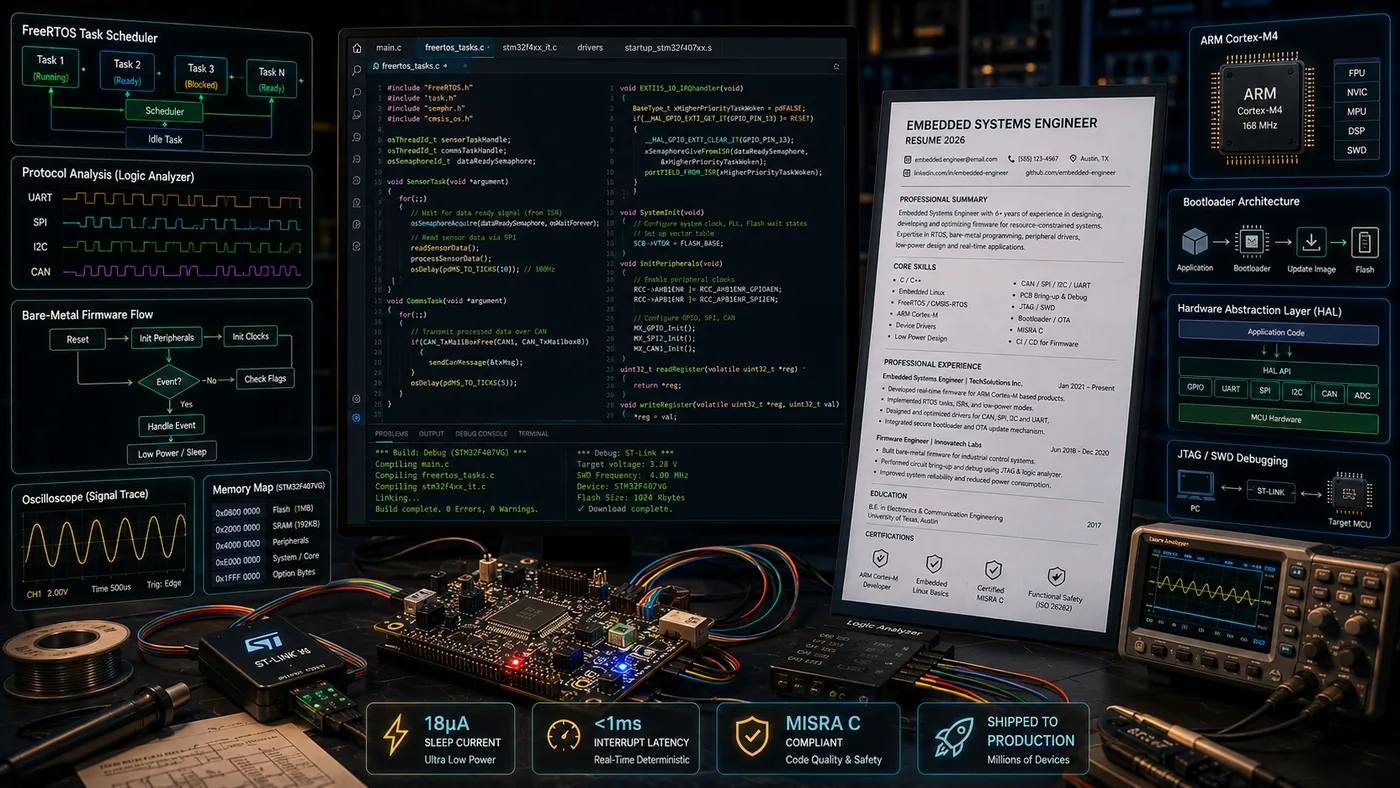
An embedded systems engineer resume in 2026 must demonstrate low-level firmware development, hardware-software integration, and the ability to build reliable systems on resource-constrained devices. Embedded engineering spans IoT, automotive, medical devices, consumer electronics, and industrial systems. Your resume should show your firmware skills, the hardware you worked with, and the systems you shipped.
Before applying, run your resume through the ATS score checker. Use ATS-friendly resume templates. For related hardware roles, read the electrical engineer resume guide.
Best Embedded Systems Engineer Resume Format
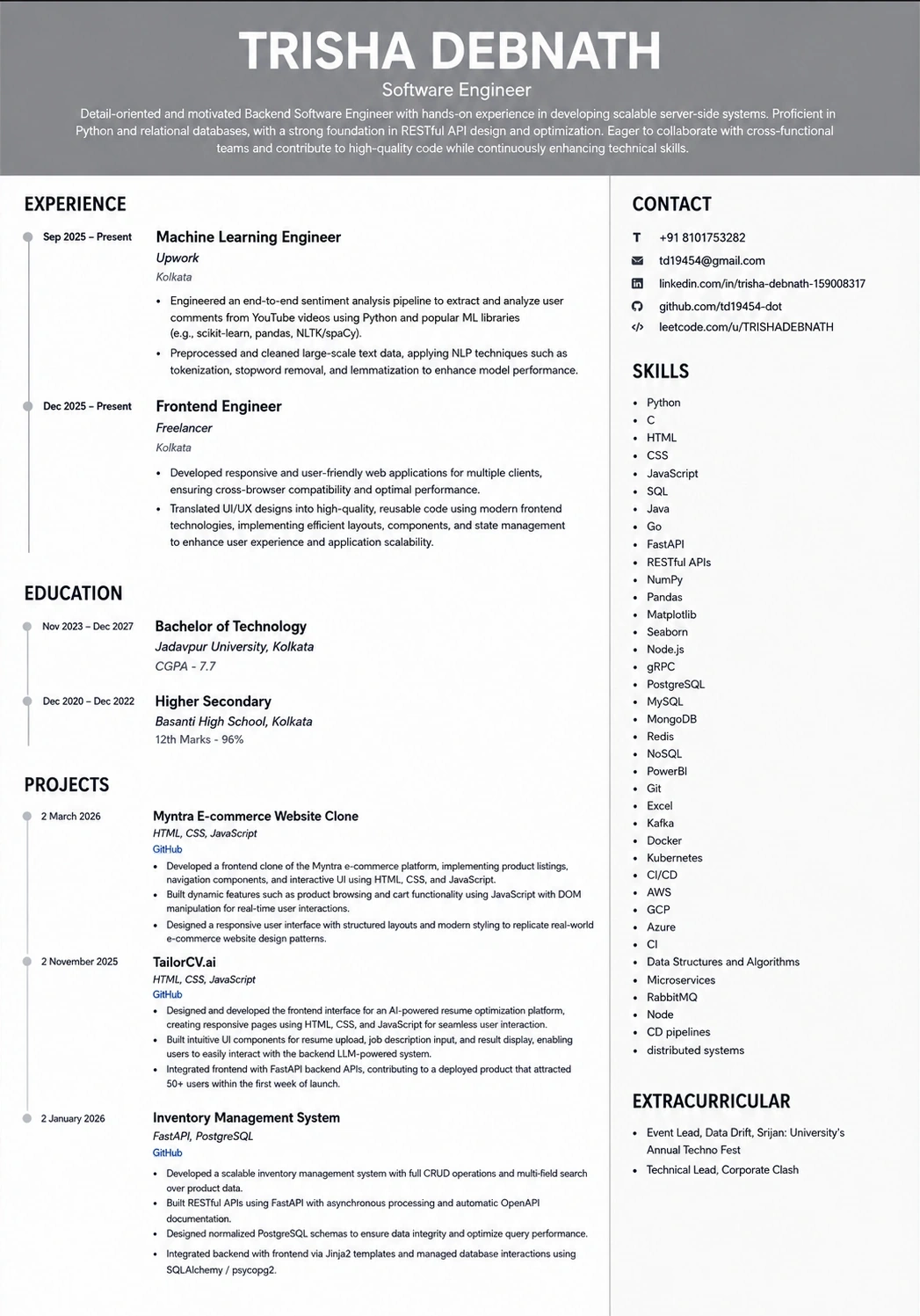
Your resume after optimization
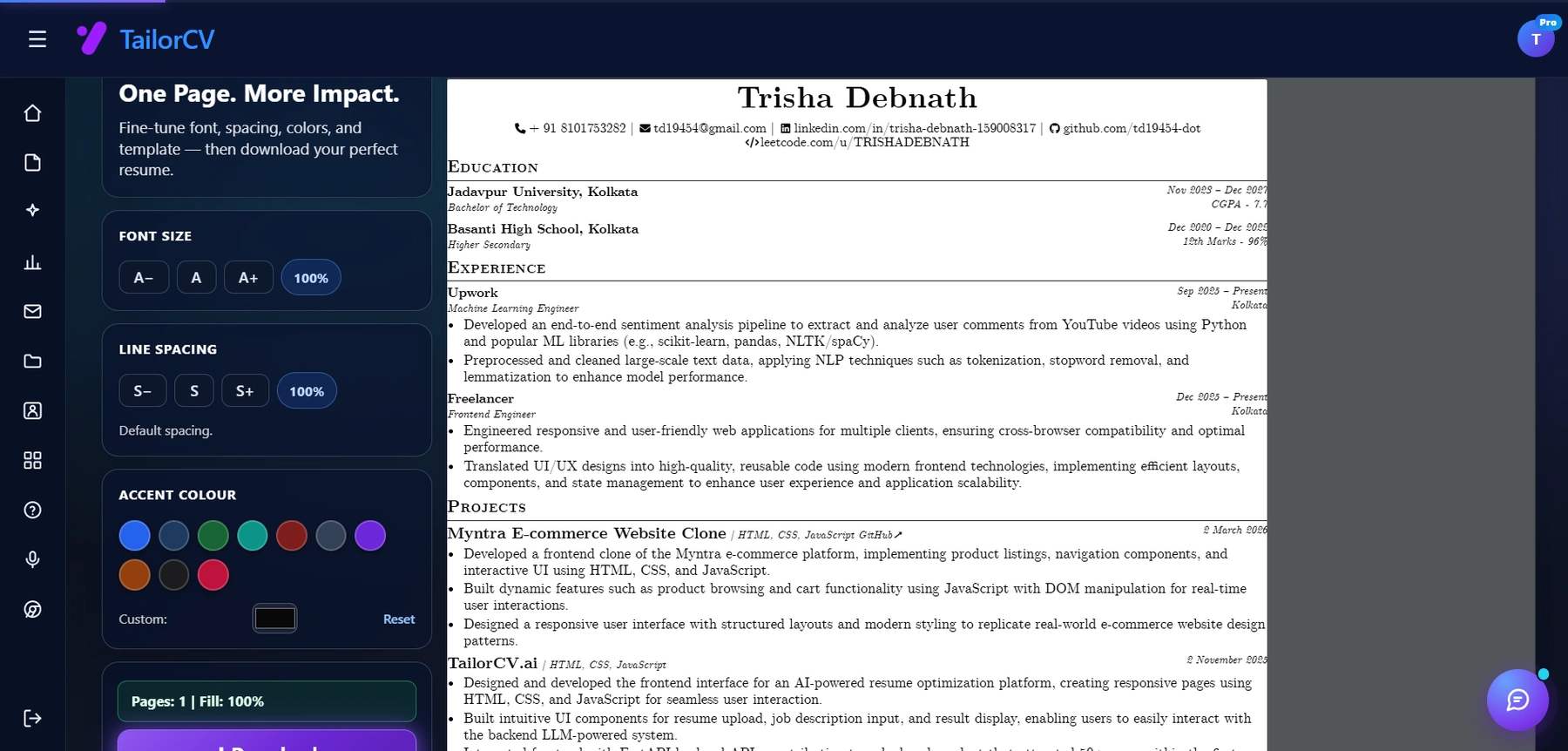
This is the resume after tailoring - the content is already matched, and these controls are how you fit it onto one page.
One page for engineers with under 8 years of experience.
Embedded Systems Engineer Resume Summary
Formula:
Embedded Systems Engineer with X years of experience developing firmware for [device type]. Skilled in [C/C++, RTOS, microcontrollers]. Shipped [products or systems] with [performance or reliability outcome].
Example for Experienced Embedded Engineer
Embedded Systems Engineer with 5 years of experience developing firmware for IoT and automotive devices. Proficient in embedded C/C++, FreeRTOS, and ARM Cortex-M microcontrollers. Shipped firmware for 4 production devices, reduced power consumption by 60% through low-power design, and integrated CAN, I2C, SPI, and BLE communication. Experienced in bare-metal and RTOS environments.
Example for Entry-Level Embedded Engineer
Embedded Systems Engineer with strong embedded C and microcontroller skills. Built 4 projects including an STM32-based sensor node and an ESP32 IoT device. Familiar with FreeRTOS, I2C/SPI/UART, and bare-metal programming. Seeking a junior embedded firmware role.
Embedded Systems Engineer Technical Skills
Languages: C, C++, Embedded C, Assembly, Python (tooling/scripting), Rust (emerging) Microcontrollers: ARM Cortex-M (STM32), ESP32, PIC, AVR, MSP430, Nordic nRF RTOS: FreeRTOS, Zephyr, ThreadX, bare-metal programming Communication: I2C, SPI, UART, CAN, USB, Ethernet, Modbus, BLE, Wi-Fi, LoRa, Zigbee Tools: GCC, GDB, JTAG/SWD debuggers, oscilloscopes, logic analyzers, IAR, Keil, PlatformIO Concepts: Interrupt handling, DMA, low-power design, memory management, device drivers, bootloaders, firmware OTA Hardware: Schematic reading, board bring-up, hardware debugging, datasheet interpretation Build/Version: CMake, Make, Git, CI for embedded, unit testing (Unity, CppUTest)
Best ATS Keywords for Embedded Systems Engineer Resume
- Embedded systems
- Firmware development
- Embedded C / C++
- RTOS / FreeRTOS / Zephyr
- Microcontroller (ARM Cortex-M / STM32 / ESP32)
- I2C / SPI / UART / CAN
- Bare-metal programming
- Device drivers
- Interrupt handling / DMA
- Low-power design
- BLE / Wi-Fi / IoT
- JTAG / debugging
- Bootloader / firmware OTA
- Hardware integration
- Real-time systems
- Memory optimization
- Board bring-up
- Schematic reading
- Unit testing
- Linux (embedded)
How to Write Embedded Resume Bullet Points
Formula:
Developed / Optimized / Integrated + [firmware or system component] + [hardware/protocol] + [power, performance, memory, or reliability result]
Strong Bullet Points
- Developed firmware in embedded C for an STM32-based industrial sensor, integrating I2C, SPI, and Modbus communication for a device deployed in 5,000+ units.
- Reduced power consumption by 60% (extending battery life from 3 days to 90 days) through deep sleep modes, peripheral clock gating, and optimized wake cycles.
- Built a FreeRTOS-based firmware architecture with task prioritization and inter-task communication for a multi-sensor IoT device, ensuring real-time responsiveness.
- Implemented a secure OTA firmware update system with rollback support, enabling field updates for deployed devices without physical access.
- Diagnosed and fixed a critical timing bug using a logic analyzer and oscilloscope, resolving intermittent data corruption affecting 8% of production units.
Embedded Systems Engineer Resume Example
Senior Embedded Systems Engineer IoT Device Company | Feb 2022 - Present
- Lead firmware development for a line of battery-powered IoT sensors deployed in 20,000+ units across industrial and agricultural applications.
- Architected FreeRTOS-based firmware on STM32L4 microcontrollers with BLE and LoRaWAN connectivity, achieving 12+ month battery life.
- Reduced firmware memory footprint by 35% through code optimization, enabling additional features on the existing hardware without a costly redesign.
- Built an OTA update system with cryptographic verification and A/B partition rollback, reducing field service visits by 70%.
- Collaborated with hardware engineers on board bring-up for 3 new device revisions, debugging hardware-firmware integration issues using JTAG and logic analyzers.
Embedded Project Ideas
- STM32 or ESP32 sensor node with wireless connectivity
- BLE peripheral device
- Motor control with PID
- Data logger with SD card
- IoT device with cloud connectivity (MQTT)
- Custom bootloader
Strong Project Example
BLE Environmental Sensor | STM32, Embedded C, FreeRTOS, BLE
- Developed firmware for an STM32-based environmental sensor measuring temperature, humidity, and air quality.
- Implemented FreeRTOS tasks for sensor sampling, BLE advertising, and data processing with proper synchronization.
- Achieved 6-month battery life on a coin cell through aggressive low-power design and duty cycling.
- Integrated I2C sensor drivers and a BLE GATT service for real-time data streaming to a mobile app.
Common Embedded Resume Mistakes
Mistake 1: No hardware specifics
List the microcontrollers, protocols, and hardware you worked with. These are key screening filters.
Mistake 2: No power/performance metrics
Embedded engineering is about constraints. Show power consumption, memory footprint, and timing improvements.
Mistake 3: No debugging tools
JTAG, oscilloscopes, logic analyzers - show your hardware debugging experience.
Mistake 4: Pure software framing
Embedded is hardware-software integration. Show that you understand and work with hardware, not just code.
Related Guides
- Electrical Engineer Resume
- Chemical Engineer Resume
- Civil Engineer Resume
- Cloud Engineer Resume
- Cybersecurity Engineer Resume
- Data Engineer Resume
- Game Developer Resume
- Machine Learning Engineer Resume
- Mechanical Engineer Resume
- QA Engineer Resume
- Site Reliability Engineer (SRE) Resume
- Accountant Resume
- Android Developer Resume 2026 - Complete Guide with Examples
- DevOps Engineer Resume 2026 - Complete Guide with Examples
- Software Engineer Resume for FAANG in 2026
- How to List Education on a Resume in 2026 - Complete Guide with Examples
- Veteran to Civilian Resume Guide 2026
Make This Practical
Once you draft this resume, test it against a real job post with the free ATS score checker. Then improve fit using Resume Matching With Job Description, polish the layout with ATS-friendly resume templates, and make the bullets stronger with How to Write Resume Bullet Points.
A complete application needs more than one document. Pair the resume with a targeted letter from the AI cover letter generator, practice role-specific questions with the AI mock interview tool, and publish proof of work with the portfolio website builder when your role benefits from projects or case studies.
Conclusion
A strong embedded systems engineer resume in 2026 shows firmware expertise, hardware integration, RTOS and protocol knowledge, and measurable constraints-driven outcomes (power, memory, timing). Every bullet should connect your firmware work to a system result.
Run your resume through the TailorCV ATS score checker. Then prepare for technical interviews with the technical interview guide.
Frequently Asked Questions
What should I include in my Embedded Systems Engineer resume summary?
Your resume summary should be a concise statement highlighting your experience and key skills. Use the formula provided in the post: "Embedded Systems Engineer with X years of experience developing firmware for [device type]. Skilled in [C/C++, RTOS, microcontrollers]. Shipped [products or systems] with [performance or reliability outcome]." This approach allows you to quickly convey your qualifications to potential employers.
How can I ensure my resume is ATS-friendly?
To make your resume ATS-friendly, use relevant keywords from the job description and stick to a clean format without complex designs. You can run your resume through the free ATS score checker to identify any issues and improve your chances of passing through automated screening systems.
What types of projects should I include in my resume?
Including relevant projects is crucial for demonstrating your hands-on experience. Focus on projects that showcase your skills in firmware development, hardware-software integration, and problem-solving. For ideas on impactful projects, refer to our guide on fresher resume projects that get interviews.
How can I tailor my resume for different embedded systems roles?
Tailoring your resume involves analyzing each job description and adjusting your skills and experiences to match the specific requirements. Use the job description analysis checklist to ensure your resume reflects the most relevant qualifications for each position you apply for.
What skills are essential for an Embedded Systems Engineer in 2026?
Key skills for an Embedded Systems Engineer include proficiency in embedded C/C++, experience with RTOS, and familiarity with various microcontrollers. Additionally, understanding low-level firmware development and hardware-software integration is vital. Highlight these skills prominently in your resume to attract attention from hiring managers. For more tips on crafting your resume, check out our article on resume for remote developer jobs.
What is your resume scoring right now?
Scan it against a job description and get your ATS match score in about a minute.
Drop your resume here or choose a file
PDF only. Max 2 MB.
We never share your data or use it to train AI models.

Templates that keep this structure intact
This template is ATS-tested — start from it and the formatting rules in this guide are already handled.
Was this guide useful?
Be the first to rate it.