 SS
SS
Key Takeaways
- An effective electrical engineer resume in 2026 must demonstrate technical expertise and successful project delivery across various domains like consumer electronics and automotive.
- Tailor your resume to the specific vocabulary and requirements of the target sector to enhance relevance and impact.
- Use a structured format that includes a header, summary, technical skills, work experience, projects, education, and certifications or publications, ideally within one to two pages.
- Incorporate strong bullet points that highlight specific achievements and outcomes, using action verbs and quantifiable results to convey impact.
- Include relevant ATS keywords related to PCB design, embedded systems, power electronics, and compliance standards to improve visibility in applicant tracking systems.
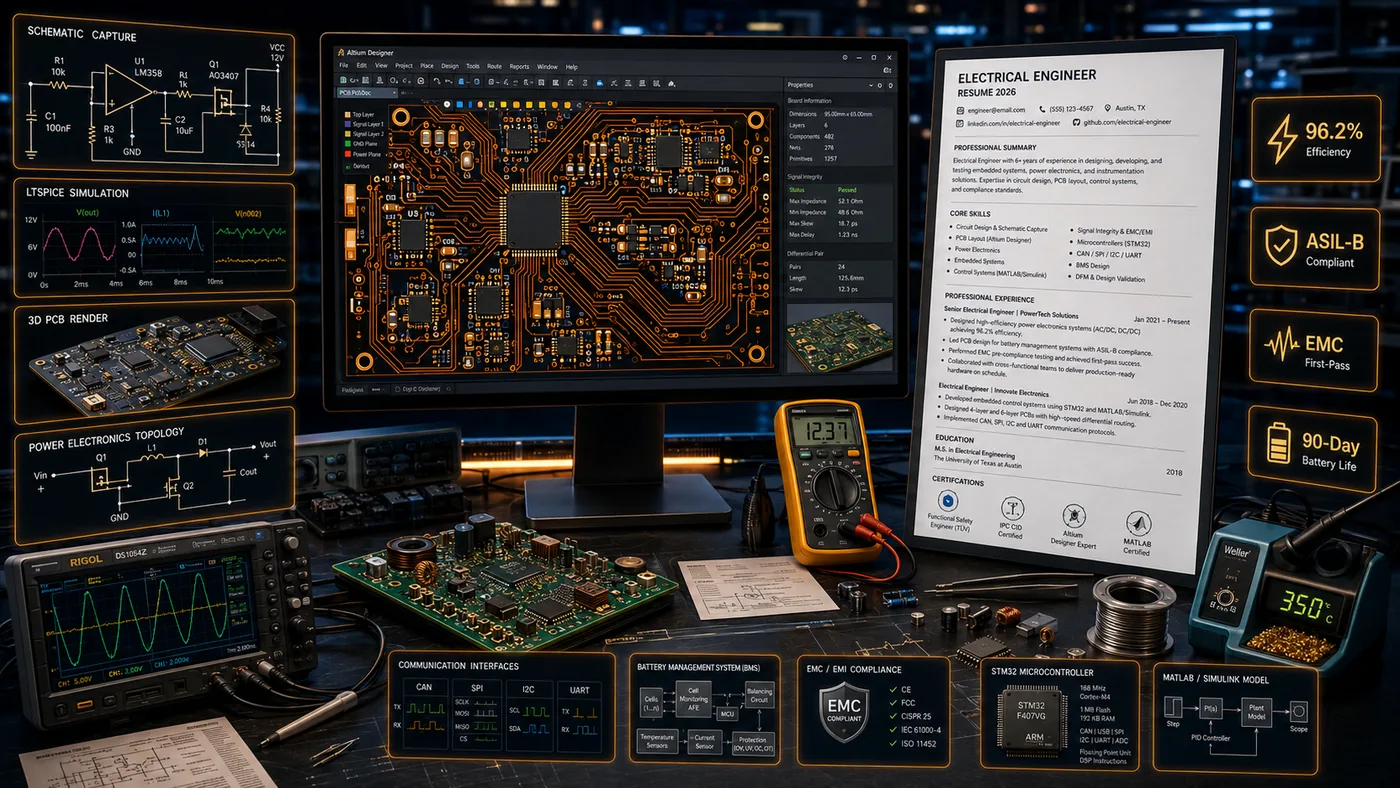
An electrical engineer resume in 2026 needs to show both technical depth and practical system delivery. Whether you are designing PCBs, working on power systems, developing embedded firmware, or commissioning industrial control systems, your resume must prove that your electrical designs reached production, performed to spec, and solved real engineering problems.
Electrical engineering roles span consumer electronics, automotive, industrial automation, energy, medical devices, and telecommunications. Each domain has specific vocabulary - tailor your resume to your target sector.
Before applying, run your resume through the ATS score checker. If you are targeting embedded-specific roles, read the embedded systems engineer resume guide. For broader engineering comparison, the mechanical engineer resume guide provides useful structural reference.
Best Electrical Engineer Resume Format
- Header
- Summary
- Technical skills
- Work experience
- projects
- education
- certifications or publications
Your resume after optimization
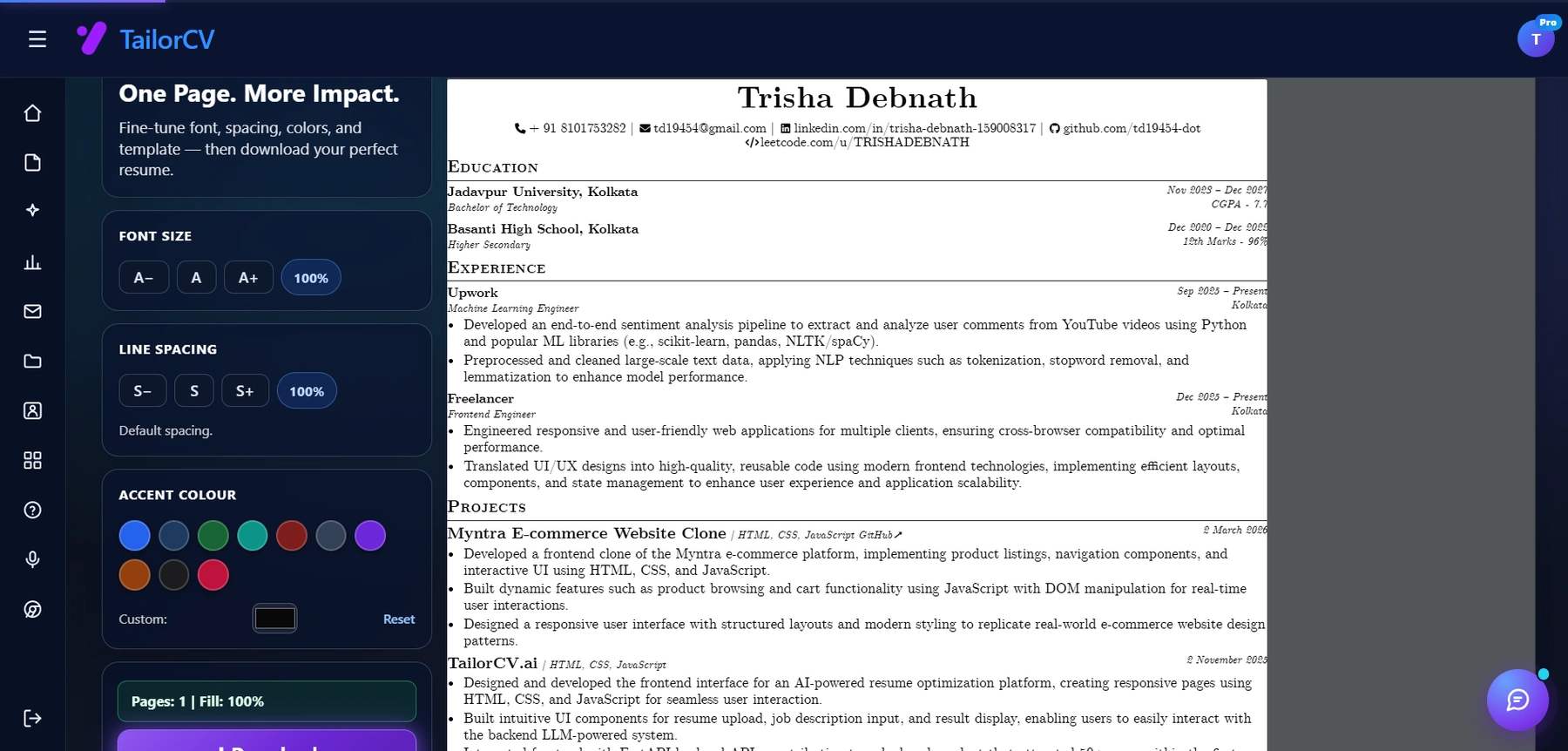
Font size, spacing, accent colour and template are all adjustable, with a live page counter.
One to two pages depending on project depth and experience level.
Electrical Engineer Resume Summary
Formula:
Electrical Engineer with X years of experience in [domain]. Skilled in [PCB design, power systems, embedded, signal processing]. Delivered [project or performance outcome].
Example for Experienced Electrical Engineer
Electrical Engineer with 5 years of experience in power electronics and embedded control systems for electric vehicle powertrains. Proficient in Altium Designer, MATLAB/Simulink, SPICE simulation, and C firmware for STM32 microcontrollers. Led hardware design of a 48V BMS system with CAN communication and cell balancing, delivered to production on schedule.
Example for Entry-Level Electrical Engineer
Electrical Engineering graduate with strong PCB design, embedded C programming, and simulation skills. Designed a 4-layer PCB for a wireless sensor node using KiCad, integrated STM32 microcontroller with BLE module, and validated through bench testing. Seeking an electronics or embedded hardware role.
Electrical Engineer Technical Skills
PCB Design: Altium Designer, KiCad, Eagle, OrCAD, Cadence Allegro Simulation: LTspice, MATLAB/Simulink, PSPICE, PSIM, Proteus Microcontrollers: STM32, ESP32, Arduino, PIC, AVR, TI C2000 Embedded Firmware: C, C++, FreeRTOS, bare-metal programming Communication Protocols: CAN, I2C, SPI, UART, RS-485, Modbus, Ethernet, BLE, Wi-Fi Power Electronics: DC-DC converters, inverters, motor drives, BMS, EMI/EMC design Test and Measurement: Oscilloscopes, logic analyzers, LCR meter, spectrum analyzer, power analyzer, HIL testing Standards and Compliance: IEC 61000 (EMC), IEC 60601 (medical), ISO 26262 (automotive), UL, CE marking Programming: C, Python, MATLAB, LabVIEW
Best ATS Keywords for Electrical Engineer Resume
- PCB design
- Altium Designer / KiCad
- Embedded systems
- Schematic capture
- MATLAB / Simulink
- Signal integrity
- Power electronics
- Motor control
- CAN / I2C / SPI / UART
- EMC / EMI testing
- Microcontroller programming
- Hardware design
- Circuit simulation
- FPGA design (if applicable)
- Battery management system (BMS)
- Prototype testing
- Design verification
- IEC standards
- Manufacturing support
- System integration
How to Write Electrical Engineer Resume Bullet Points
Formula:
Designed / Developed / Tested / Reduced + [circuit, system, or board] + [technology or standard] + [performance, reliability, cost, or time outcome]
Weak Bullet Points
- Designed PCBs using Altium
- Worked on embedded firmware
- Tested hardware designs
- Supported manufacturing
Strong Bullet Points
- Designed a 4-layer mixed-signal PCB for a motor control module using Altium Designer, passing EMC pre-compliance testing (CISPR 25) on the first prototype iteration.
- Developed a 48V-to-12V synchronous buck converter using TI C2000 DSP with 96.2% measured efficiency at full load, replacing a linear regulator solution and reducing thermal dissipation by 40%.
- Wrote embedded C firmware for an STM32-based BMS controller managing 16-cell Li-ion packs, including cell balancing, SoC estimation, and CAN communication with the vehicle ECU.
- Reduced prototype-to-production cycle time from 14 weeks to 9 weeks by establishing a structured design review process with milestone gates for schematic, layout, and pre-compliance checks.
- Diagnosed a recurring production-line EMC failure on a 3-phase inverter by conducting near-field scanning and identifying an unshielded trace coupling - fixing with layout change eliminated the issue across 400+ production units.
Electrical Engineer Resume Example
Hardware Engineer - Power Electronics EV Startup | May 2022 - Present
- Led PCB hardware design for a 3-phase 650V/200A SiC inverter for a Class 8 commercial vehicle powertrain from schematic capture through manufacturing release.
- Designed gate drive circuits, protection logic, and thermal management system for 6-pack SiC MOSFET module using Altium Designer and LTspice simulation.
- Coordinated ISO 26262 FMEA analysis for the inverter control electronics with the safety team, achieving ASIL B compliance without hardware redesign.
- Validated hardware against full design specification through HIL testing, achieving <2% deviation from simulated performance across all operating points.
- Supported CM supplier during first article build, resolving 4 manufacturing issues and achieving 98% first-pass yield on pilot run.
Electrical Engineering Project Ideas for Freshers
Strong project ideas:
- DC-DC power converter design and simulation
- Wireless sensor node with BLE or Wi-Fi
- Motor speed control with PID
- 4-layer PCB design for an embedded system
- Solar charge controller
- Smart home automation node
- Audio amplifier or filter design
Strong Project Example
Wireless Temperature Sensor Node | KiCad, ESP32, C++, FreeRTOS, MQTT
- Designed a 2-layer PCB with ESP32-S3 module, temperature/humidity sensor (SHT31), 3.3V LDO regulator, and USB-C programming interface.
- Wrote FreeRTOS-based C++ firmware with MQTT over Wi-Fi for real-time data publishing to a Home Assistant dashboard.
- Added deep sleep mode reducing idle current from 40mA to 18µA, extending 2000mAh battery life from 3 days to 90+ days.
- Validated firmware and hardware through bench testing with oscilloscope, logic analyzer, and power profiler.
Common Electrical Engineer Resume Mistakes
Mistake 1: Tools only, no system-level outcomes
"Used Altium Designer, LTspice, and MATLAB" is not impressive without showing what those tools produced and what worked.
Mistake 2: No test or validation evidence
All hardware must be tested. If you validated a design, ran EMC tests, or did thermal testing, include it.
Mistake 3: Ignoring manufacturing context
Hardware engineers who understand DFM, first-article inspection, and production yield issues are significantly more valuable. Add any manufacturing support experience you have.
Mistake 4: Not naming communication protocols
I2C, SPI, CAN, UART - many job descriptions search for specific protocols. List the ones you have used in real projects.
Related Guides
- Embedded Systems Engineer Resume
- Chemical Engineer Resume
- Civil Engineer Resume
- Data Engineer Resume
- Mechanical Engineer Resume
- Cloud Engineer Resume
- Cybersecurity Engineer Resume
- Game Developer Resume
- Graphic Designer Resume
- Machine Learning Engineer Resume
- QA Engineer Resume
- Site Reliability Engineer (SRE) Resume
- DevOps Engineer Resume 2026 - Complete Guide with Examples
- Veteran to Civilian Resume Guide 2026
Make This Practical
Once you draft this resume, test it against a real job post with the free ATS score checker. Then improve fit using Resume Matching With Job Description, polish the layout with ATS-friendly resume templates, and make the bullets stronger with How to Write Resume Bullet Points.
A complete application needs more than one document. Pair the resume with a targeted letter from the AI cover letter generator, practice role-specific questions with the AI mock interview tool, and publish proof of work with the portfolio website builder when your role benefits from projects or case studies.
Conclusion
A strong electrical engineer resume in 2026 shows design-to-production experience, validated system performance, and measurable engineering outcomes. Connect your circuit design, firmware, or power system work to real technical and business results.
Use the TailorCV ATS score checker to optimize your resume against the job description. For interview preparation, read the interview guide.
Frequently Asked Questions
What are the essential sections to include in an electrical engineer resume for 2026?
An effective electrical engineer resume should include a well-structured format with the following sections: Header, Summary, Technical Skills, Work Experience, Projects, Education, and Certifications or Publications. Each section should clearly showcase your relevant skills and accomplishments, emphasizing your technical depth and practical system delivery. For additional insights on structuring your resume, you can refer to the Mechanical Engineer Resume 2026 guide.
How important are ATS keywords in my electrical engineer resume?
In 2026, utilizing the right ATS keywords is crucial for ensuring your resume gets noticed by applicant tracking systems. Keywords related to your specific domain, such as PCB design or embedded systems, should be incorporated naturally throughout your resume. Before submitting your application, run your resume through our free ATS score checker to optimize it for potential employers.
What should I highlight in my work experience section?
In the work experience section, focus on quantifiable achievements that demonstrate your impact on previous projects. Use bullet points to describe your roles in various projects, highlighting your contributions to system-level outcomes and problem-solving capabilities. For example, you might mention how your embedded firmware development improved efficiency by a specific percentage. For more details on showcasing projects, check out our guide on projects in resume.
How can I tailor my resume for different engineering domains?
Tailoring your resume for different engineering domains involves adjusting the vocabulary and focus of your content to match the specific industry requirements. For instance, if you are applying for a role in power electronics, emphasize relevant skills and projects that align with that field. You can also explore examples from other engineering disciplines, such as the Chemical Engineer Resume 2026 for additional reference.
What is the best way to write a summary for my electrical engineer resume?
A compelling summary should succinctly present your experience, skills, and the value you bring to potential employers. Use the formula: "Electrical Engineer with X years of experience in [domain]. Skilled in [specific skills]. Delivered [notable project or outcome]." This approach immediately communicates your qualifications and sets the stage for the rest of your resume. For more examples, consider looking at executive LinkedIn summary examples for inspiration.
What is your resume scoring right now?
Scan it against a job description and get your ATS match score in about a minute.
Drop your resume here or choose a file
PDF only. Max 2 MB.
We never share your data or use it to train AI models.

Templates that keep this structure intact
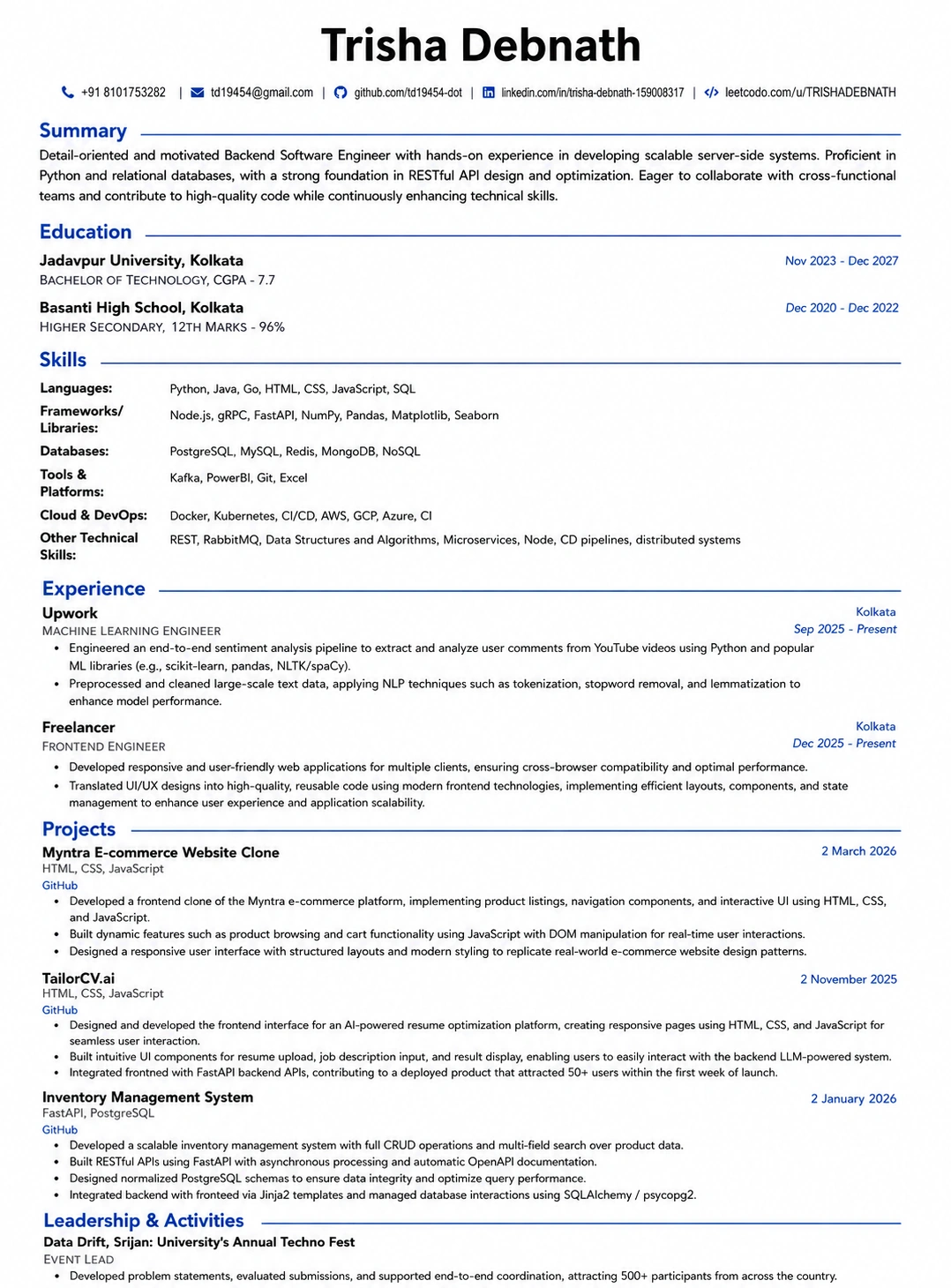
This template is ATS-tested — start from it and the formatting rules in this guide are already handled.
Was this guide useful?
Be the first to rate it.